Google Ads’ 2026 Terms Update: The Real Shift Isn’t AI—It’s Accountability Without Control
Google’s updated Ads terms formalize broader AI-driven automation—formatting, selecting, and generating targets, ads, and destinations—while keeping advertisers on the hook for outcomes. Here’s what changed, why it matters for SMEs and agencies, and how to build governance, measurement, and an approval-first execution workflow in a world where platforms act first and ask later.

Google is updating its Google Ads Terms of Service ahead of a July 2026 effective date. On the surface, it reads like a paperwork refresh to match how modern campaigns actually run: more automation, more AI, more “helpful” generation of targets, ads, and destinations. But the business reality underneath is sharper:
Google is formalizing a model where the platform can do more on your behalf—while you remain responsible for what happens.
That’s not inherently good or bad. Automation can absolutely improve performance and reduce busywork. But when the platform’s ability to act expands faster than your ability to govern, review, and measure, the risk shifts to the advertiser—especially for SMEs without dedicated compliance, analytics, and creative ops.
I’m Marius Dosinescu, and at AYSA we build systems for exactly this moment: monitor what’s changing, prepare recommended actions, ask for approval, and execute accepted website changes. Because in an AI-automated ad world, your competitive advantage isn’t “more toggles.” It’s faster, safer execution across your site, your tracking, and your messaging—where you still have durable control.
Concise summary
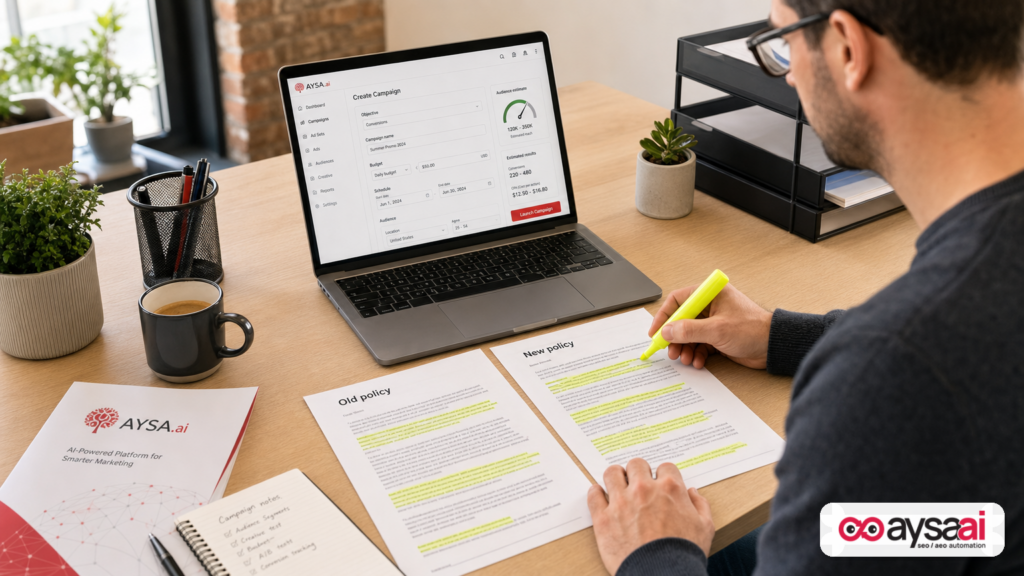
- What changed: Google’s updated Ads terms expand/clarify how advertiser inputs can be used across AI-powered and automated features, including conversational experiences, and how Google can access/crawl URLs/accounts you authorize for automated setup.
- What it signals: Automation is becoming contractual default language, not an optional add-on.
- Why it matters: The terms reinforce that advertisers remain responsible for reviewing and approving campaigns and assets—even if the platform generated them.
- What to do: Build governance around automation (guardrails, audit cadence, asset review), strengthen measurement, and invest in website-side execution that improves conversion quality (not just volume).
- Where AYSA fits: We help you monitor, prepare, approve, and execute SEO/AEO/GEO and website changes so you can respond faster and reduce risk—without letting automation rewrite your business.
Table of contents

- Context: ads are becoming systems, not campaigns
- What changed in Google Ads terms (and what it signals)
- Advertiser inputs: what counts as “inputs” now?
- Crawling URLs and automated setup: convenience with consequences
- The new risk model: “Google can generate—advertisers are responsible”
- The transparency gap: when optimization becomes un-auditable
- A concrete SME scenario: the local clinic that “saved time” and lost lead quality
- What agencies should rethink before July 2026
- Measurement and compliance: what to tighten first
- A practical action plan (30/60/90 days)
- Where AYSA fits: approval-first execution for the website and the measurement layer
- What to do next
- Sources and further reading
Context: ads are becoming systems, not campaigns

For most of Google Ads history, advertisers thought in a familiar mental model:
- You choose keywords and match types.
- You write ads.
- You pick landing pages.
- You set bids and budgets.
- Google auctions the impression and reports the outcome.
That model is collapsing into something else: the platform operates as a system optimizer. You provide constraints, signals, and business goals; Google’s automation decides how to assemble assets and route demand.
Search Engine Land has been covering this shift across PPC and AI: from the practical evolution of PPC skill sets (“system optimizer” vs. “Keyword manager”) to the platform’s growing reliance on exclusion lists and audience signals. Those related threads matter because the terms update isn’t a one-off document change—it’s an alignment of contracts with where the product is headed.
In other words: this is Google putting in writing what many advertisers already feel in the UI.
What changed in Google Ads terms (and what it signals)
Based on Search Engine Land’s reporting, Google’s updated terms (effective July 1, 2026) expand language around AI-driven automation and clarify that advertiser-provided inputs may be used across features to improve performance. The update also clarifies that information entered into conversational experiences and similar tools may be utilized by Google’s systems. Finally, it updates provisions related to URLs and accounts advertisers authorize Google to access and crawl for automated campaign setup.
The single most important “signal” to take from this update is the shift in default posture. Search Engine Land highlighted a notable change in how automated campaign management is framed—moving from “tools you can opt into/out of” toward language authorizing Google to use automated program features to format, select, or generate targets, ads, or destinations on the customer’s behalf—while keeping the customer responsible for what results.
That combination—broader authority + unchanged advertiser responsibility—is where operational risk lives.
Why a terms update is a product roadmap in disguise
Most SMEs ignore terms until something breaks. But platform terms often reveal what the platform expects to be normal:
- More machine-generated creative.
- More machine-chosen landing experiences.
- More machine-mediated targeting.
- More machine-led setup through crawls and imported business data.
If your team is still organized around “we tweak keywords weekly,” you’ll be outpaced by the platform’s own rate of change. Your job becomes governance, measurement, and high-quality inputs—because the platform is now a composer, not just a distributor.
Advertiser inputs: what counts as “inputs” now?
Historically, “inputs” sounded like obvious things: ad copy you wrote, keywords you chose, audiences you uploaded, landing pages you specified. The modern Google Ads reality is broader:
- Conversational prompts you type into campaign builders and AI assistants.
- Brand and product descriptions you provide for asset generation.
- Creative assets (images, video snippets, copy variants).
- URLs you submit or authorize for scan/crawl.
- Conversion definitions and the way you measure success (leads, purchases, calls).
- First-party data and matching signals (where applicable, such as Customer Match workflows discussed widely across PPC strategy coverage).
The terms update matters because it frames how these inputs may be used across AI-powered features “to improve performance.” That’s not a shocking claim—automation needs data. The practical question is: do your inputs accurately represent your business constraints and compliance needs?
Input hygiene becomes a performance lever
When a human writes every ad, you can catch nuance in the moment. When a system generates variations at scale, the risk shifts to input quality and review process.
For SMEs, “input hygiene” is often the highest ROI work because it’s boring and foundational:
- Do your landing pages clearly state eligibility, pricing ranges, and exclusions?
- Do your conversion actions reflect qualified leads, not just form fills?
- Are there pages on your site that should never be used as ad destinations?
- Do you have regulated-language constraints (health, finance, legal) that must be enforced?
If the platform can use your site content and your prompts as ingredients, then your site and your prompts become creative inputs—whether you intended that or not.
Crawling URLs and automated setup: convenience with consequences
Search Engine Land notes updated provisions covering URLs and accounts that advertisers authorize Google to access and crawl for automated campaign setup. In plain English: you may be granting the platform more permission to look at your web presence and use what it finds to speed up build and optimization.
For many businesses, that’s helpful. It reduces setup friction. But it also introduces two operational realities:
- Your website becomes the seed data. If your site is messy, outdated, or inconsistent, automation will inherit that mess—fast.
- Destination selection can drift. If the system can select destinations, you need to ensure the “destination set” is safe and conversion-optimized.
Where destination selection goes wrong (without any “bug”)
No conspiracy needed. A destination can be “valid” and still be wrong:
- An ecommerce Category page ranks well but is out of stock or seasonal.
- A blog post converts to newsletter signups but not purchases.
- A Location page is accurate but routes to the wrong clinic/office.
- A pricing page is top-of-funnel educational, but the campaign goal is booked demos.
With automation, the platform is incentivized to find something that moves the metric you defined. If your metric is weak (e.g., any lead), it will find the cheapest “lead” possible.
The new risk model: “Google can generate—advertisers are responsible”
Here’s the simplest way to interpret the shift described in Search Engine Land’s article: the platform gets more autonomy; you keep the liability.
Search Engine Land also reported criticism from Anthony Higman (AdSQUIRE), who argued this direction erodes advertiser relevance and control—two pillars that historically differentiated Google Ads for serious operators.
Whether you agree with Higman or not, the operational takeaway is the same: if your business cannot reliably review what the system is doing, you are accepting unmanaged risk.
What “you are responsible” means in practice
“Advertisers are responsible” sounds obvious, but translate it into work:
- You must be able to audit generated assets (copy, headlines, Sitelinks, images if applicable).
- You must be able to audit destinations (where traffic lands) and ensure they’re accurate and compliant.
- You must be able to audit targeting expansion and understand why lead quality shifted.
- You must be able to prove what happened if a stakeholder asks “why did we spend $X and get garbage?”
SMEs feel this pain first because they have less redundancy. One month of low-quality leads can blow up a quarter.
This isn’t only a legal story—it’s a performance story
Even if you never face a compliance event, “responsibility without control” creates everyday performance problems:
- Lead volume goes up; close rate goes down.
- CPA looks fine; revenue per lead collapses.
- Brand tone becomes inconsistent across generated assets.
- Support teams get flooded with irrelevant inquiries.
And because automation moves faster than humans, the “oops” can scale.
The transparency gap: when optimization becomes un-auditable
Google’s automation is often effective. The problem is that effectiveness is not the same as explainability.
When campaign decisions are increasingly made by systems—asset selection, destination routing, targeting expansion—advertisers run into a transparency gap:
- You may see outcomes without seeing the chain of decisions.
- You may see aggregated reporting that makes it hard to isolate what changed.
- You may be told to “provide better signals,” without clarity on which signal is failing.
This is why the broader industry conversation matters. Search Engine Land has published adjacent pieces that reflect the same pattern across search and AI: systems acting more agentically, selection sets expanding, and practitioners shifting from manual optimization to governance. (See related coverage like The new PPC skill set: From keyword manager to system optimizer and Google’s expanded candidate set and the selection crisis.)
Different topics, same business issue: selection is being delegated to AI systems, and humans are being pushed into oversight roles with imperfect visibility.
A concrete SME scenario: the local clinic that “saved time” and lost lead quality
Let’s make this real with a scenario I see constantly in small and mid-sized businesses.
The setup
A multi-location clinic runs Google Ads for:
- “Book an appointment”
- “Walk-in availability”
- “Insurance accepted”
They’re short-staffed, so they embrace automation. They use conversational setup tools, let Google generate assets, and allow broad matching/expansion because it “finds more patients.” Their primary conversion is a form submit.
What goes wrong (quietly)
- The system starts routing more traffic to an informational page about a service that the clinic offers only at one location.
- Generated headlines emphasize “same-day” more aggressively than the clinic can reliably fulfill.
- Conversion volume increases, but many leads are out-of-area, uninsured, or looking for a different specialty.
On paper: success. In the clinic: chaos. Staff wastes hours triaging. Patient experience suffers. Real booked appointments don’t rise.
Why the terms update matters here
This is exactly the “responsibility without control” problem. If automation is authorized to format/select/generate assets and destinations, the platform can create a mismatch between what you sell and what the system optimizes—unless you’ve engineered:
- Better conversion definitions (qualified appointment, not any form).
- Destination guardrails (approved landing pages only).
- Clear eligibility language on-site (so crawls and users see constraints).
- A review cadence that catches drift early.
For most SMEs, the fix is not “turn all automation off.” The fix is tighten the system inputs and governance so automation works for you, not around you.
What agencies should rethink before July 2026
Agencies and consultants sit in the blast radius of these changes because clients don’t care what the terms say—they care who is accountable when lead quality collapses or brand compliance gets messy.
Your deliverable can’t just be “campaign management” anymore
If the platform is generating and selecting more elements, then “we manage keywords and bids” becomes less defensible as a premium service.
Your value shifts toward:
- System design: defining goals, constraints, conversion quality, offline feedback loops.
- Governance: review processes, approvals, documentation of changes.
- Creative operations: brand-safe messaging frameworks that scale into generated variants.
- Measurement engineering: instrumenting what actually matters (revenue, qualified leads, margin).
Search Engine Land’s broader PPC coverage points in this direction: the role is becoming a “system optimizer.” If you’re an agency and you don’t productize governance, you’ll be stuck explaining decisions you didn’t explicitly make.
Update how you talk about responsibility (without giving legal advice)
I’m not offering legal counsel here, but operationally, agencies should prepare for clients asking:
- “Did you approve that ad copy?”
- “Why did traffic start landing on that page?”
- “Who decided to expand targeting?”
Your internal documentation and client reporting must be able to answer those questions quickly, with evidence.
Measurement and compliance: what to tighten first
If you do only one thing in response to this shift, do this: strengthen your measurement so optimization aligns with business value.
1) Redefine conversions around quality
If your primary conversion is “form submit,” automation will find the cheapest form submits. That’s not Google being evil—that’s math.
Examples of higher-quality conversion definitions:
- Lead forms that include qualifying questions (service type, budget, location) and are scored downstream.
- Appointment booked (not request submitted).
- Demo scheduled with minimum company size.
- Purchase completed (with revenue value), not add-to-cart.
2) Create destination controls on your own website
Even if the platform can choose destinations, you can reduce risk by improving the site:
- Make “money pages” unmistakable, fast, and clear.
- Use Internal linking to channel users to the right next step.
- Add strong on-page clarity to reduce misfit leads (eligibility, service area, pricing ranges, exclusions).
This is where SEO and paid search stop being separate silos. Your site is now the substrate for both organic discovery and paid automation.
3) Operationalize review: assets, destinations, and claims
The terms update reinforces advertiser responsibility. That means you need an asset review routine:
- Weekly spot checks of generated headlines/descriptions.
- Monthly audits of top landing pages by spend and by conversion rate.
- Quarterly brand and compliance review (especially in regulated verticals).
If you can’t do that manually, you need monitoring systems that surface changes and anomalies.
A practical action plan (30/60/90 days)
Here’s a plan built for SMEs and lean agencies—practical, not theoretical.
Next 30 days: stabilize inputs and accountability
- Inventory your inputs: list what you’ve provided to Google Ads (URLs, feeds, prompts used in conversational tools, brand text, conversion actions).
- Audit destinations: identify which pages should be eligible to receive paid traffic and which should not.
- Review conversion definitions: ensure you’re not optimizing for a proxy metric that creates junk volume.
- Create an “automation review checklist”: a simple recurring routine for asset/destination/targeting drift.
Next 60 days: tighten measurement and feedback loops
- Improve lead quality signals: add qualifying fields and route leads into a scoring or tagging process.
- Connect offline outcomes: if possible, align conversions to revenue, booked appointments, or qualified stages.
- Align messaging to reality: update site content so it matches what you can deliver (availability, pricing, geo constraints).
Next 90 days: build durable governance and faster execution
- Document constraints: brand language do’s/don’ts, regulated claims, exclusions, service areas.
- Create a change log: track meaningful changes across ads and the website so performance shifts can be explained.
- Invest in approved execution: a workflow that proposes improvements, gets human approval, and then implements changes safely and quickly.
Where AYSA fits: approval-first execution for the website and the measurement layer
When platforms automate advertising, your edge increasingly comes from what you control:
- Your website structure, content, and conversion paths
- Your technical foundations (speed, indexability, schema where appropriate)
- Your measurement definitions and clarity of business outcomes
- Your governance: what gets approved, when, and by whom
AYSA is built to operate in that reality. We’re not trying to replace your judgment with another black box. We’re trying to operationalize execution so improvements don’t sit in a Google Doc for three months.
1) Monitor what matters
Start with monitoring and visibility: AYSA Monitoring
When your ad platform is shifting under you, you need fast detection of changes and issues on the site side—because that’s what your ads and users touch.
2) Prepare for the “AI discovery” layer too
Paid search and organic discovery are converging into blended “answer” experiences. Even though this article is about Ads terms, businesses can’t ignore AI discovery and search visibility. AYSA helps teams understand and improve visibility in AI-driven contexts here: AI Search Visibility
3) Use AI SEO tools as execution support, not as uncontrolled generation
Tools matter, but governance matters more. See our toolset approach: AI SEO Tools
4) Approval-first execution
The core difference in AYSA’s philosophy is the approval step. Platforms are moving toward “generate first.” We move toward:
- Monitor
- Prepare recommendations
- Ask for approval
- Execute accepted changes
This matters because the 2026 terms dynamic is ultimately about accountability. If you’re accountable, you need a system that respects business review and still moves quickly.
5) Fit for SMEs and agencies
If you want to evaluate what an execution system costs versus the cost of slow cycles and lead-quality waste, start here: AYSA Pricing
6) Ongoing learning
We publish operational playbooks and updates here: AYSA Blog
What to do next
- Read the reporting and note the shift: automation authority is expanding; advertiser responsibility remains. Start with Search Engine Land’s coverage: Google Ads updates terms of service ahead of July 2026 rollout.
- Audit your “eligible destinations” list and remove pages that should never be landing pages for paid traffic.
- Upgrade conversion definitions so the system optimizes for business value, not cheap volume.
- Implement a weekly governance cadence: generated assets, destination drift, targeting expansion, and lead quality checks.
- Move faster on-site with approvals: set up monitoring and an approval-first execution workflow so fixes ship quickly and safely.
Sources and further reading
- Search Engine Land: Google Ads updates terms of service ahead of July 2026 rollout
- Search Engine Land: The new PPC skill set: From keyword manager to system optimizer
- Search Engine Land: Google’s expanded candidate set and the selection crisis
- Search Engine Land: Your #1 competitive advantage in Google Ads: Customer Match
- Search Engine Land: How Google Display exclusions guide AI-driven optimization
- Search Engine Land: AI in the wild: Confident, wrong, and weirdly expensive
- Search Engine Land: What to do now that AI Overviews turned search into reading sessions
Note: This editorial is based on the research context provided by Search Engine Land’s reporting. For precise legal language and applicability to your account and region, consult the official Google Ads Terms of Service in your Google Ads account and/or your counsel.
Continue the AI search topic inside AYSA.
Use these pages to connect the article with AI SEO tools, AI visibility monitoring, AI Overviews and approved website execution.
Turn this topic into a website action plan.
Use these AYSA hubs to move from reading to technical fixes, AI visibility monitoring, research, glossary context and approval-first SEO execution.