Healthcare Ads in Google AI Mode: What This Test Reveals About the Next Era of Search (and What to Do Now)
Google is testing healthcare ads inside AI Mode—one of the most regulated ad categories, placed inside one of the newest AI search experiences. That combination is a signal: AI-generated search is getting monetized, fast. Here’s what changed, why it matters for trust and demand capture, and how SMEs and agencies should prepare across SEO, AEO/GEO, and paid media—with an execution plan you can actually run.

Google is testing healthcare ads inside AI Mode. That sounds like a niche PPC update—until you realize what it implies: AI Search is no longer just an “Answer engine.” It’s becoming a monetized decision engine, where the model’s narrative and paid placements can shape what people believe, who they trust, and where they book.
Because healthcare is one of the most regulated ad categories, this test is also a stress test for the future of advertising in AI-generated search. If Google can make ads work here—while maintaining user trust and compliance—expect expansion to other categories and broader rollout across AI search surfaces.
Below is my take on what changed, why it matters, and what businesses should do next—especially SMEs that can’t afford to “wait and see” while their pipeline shifts. I’ll also outline how AYSA.ai fits as an execution system: we monitor, prepare changes, ask for approval, and implement accepted updates so you can keep up with AI-driven search without living in spreadsheets.
Concise summary
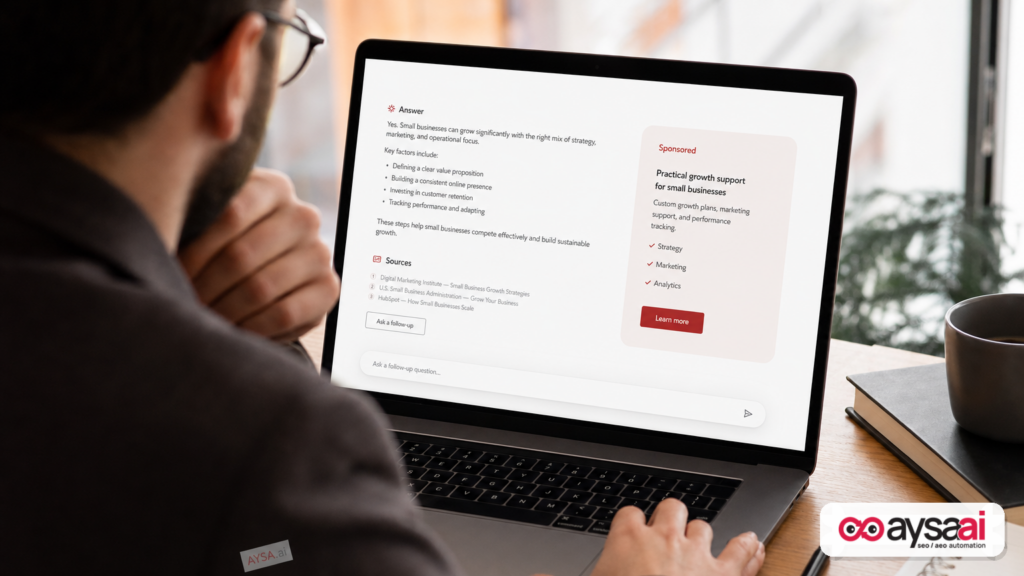
- What changed: Google confirmed a small U.S.-only test of healthcare ads in AI Mode for English queries, with eligibility spanning multiple campaign types (including Performance Max and broad match).
- Why it matters: Ads inside an AI response are not “just another placement.” They’re part of a narrative users may treat as a recommendation—raising trust, compliance, and measurement stakes.
- What to do: Treat AI surfaces as a new funnel: adjust creative, tighten landing page trust signals, measure outcomes differently, and upgrade your content to win citations and inclusion in AI answers.
- AYSA angle: The winners won’t be the loudest brands; they’ll be the teams that can execute consistently—monitor shifts, ship site improvements, and iterate fast with approvals and governance.
Table of contents
- What changed: Google is testing healthcare ads inside AI Mode
- Why healthcare is the most important test category Google could pick
- AI Mode vs. AI Overviews: why this ad test is different
- How ads fit inside an AI answer without breaking trust
- What this means for healthcare marketers (and other regulated industries)
- Organic implications: citations, “reading sessions,” and the new SERP reality
- Measurement will get harder before it gets easier
- Creative restrictions: why the fine print matters
- A concrete SME scenario: local clinic demand capture in the AI era
- Agency reset: from keyword manager to system optimizer
- An execution plan for SMEs and agencies (30/60/90 days)
- Where AYSA.ai fits: monitoring + approved execution for AI search
- What to do next (action list)
- Sources and further reading
What changed: Google is testing healthcare ads inside AI Mode

Google confirmed it’s running a limited test of healthcare ads in AI Mode—currently in the U.S. for English-language queries. The confirmation was reported by Search Engine Land based on statements from Google Ads Liaison Ginny Marvin.
The specifics matter because they indicate how Google may operationalize ads within AI search experiences:
- It’s vertical-specific: healthcare only (so far).
- It’s format-limited: early-stage restrictions on eligible creatives (more on that below).
- It’s campaign-type inclusive: multiple campaign types can be eligible, including Performance Max and broad match (which suggests the ad serving logic is tapping into existing systems rather than building an entirely new “AI Mode-only” campaign type).
In plain English: Google is figuring out how to inject ads into AI-generated answers in a category where it can’t afford to get things wrong. That should make every advertiser—and every business that relies on Google for demand—pay attention.
Why healthcare is the most important test category Google could pick
If you want a preview of where AI search advertising is headed, don’t look at easy categories first. Look at the categories where Google has to balance three forces that constantly fight each other:
- Monetization: ads fund the product.
- User trust: users need to believe the answer isn’t just pay-to-play.
- Regulatory and policy compliance: healthcare claims, targeting, and disclosures carry real-world risk.
Healthcare is a pressure cooker. If the AI model summarizes something incorrectly—or if an ad appears to be “endorsed” by the model—users could interpret it as medical guidance. That’s not the same as choosing between running shoes.
So why would Google start here? My take: because healthcare forces the company to design the ad experience with stricter guardrails. If the guardrails work in healthcare, they’ll be easier to adapt elsewhere. If they don’t, the entire AI monetization roadmap gets messy.
And there’s a second reason: healthcare advertisers tend to have strong incentives to pay for leads, which makes the category attractive—if Google can maintain trust while doing it.
AI Mode vs. AI Overviews: why this ad test is different
Search Engine Land notes that the same campaign types can also serve in AI Overviews. That matters because AI Mode and AI Overviews represent two different user mindsets.
- AI Overviews often appear as a summary layer on top of traditional results.
- AI Mode is closer to a full “conversation-like” search experience, where the user may stay inside the AI interface longer, ask follow-ups, and rely on the synthesized answer as the primary interface.
When ads show in a traditional SERP, users understand the contract: results + ads, side by side. In AI Mode, the contract changes: the user is reading a narrative. An ad inserted into a narrative can feel more like a recommendation—even if it’s labeled. That’s why this test is more significant than “ads appear in another Google surface.” It’s ads inserted into how users form decisions.
If you’ve felt Organic traffic “disappearing” in the last year, this is part of the same story: AI experiences turn search into fewer Clicks and more on-SERP (or on-interface) consumption. Search Engine Land has separately covered how AI Overviews can turn search into “reading sessions,” which aligns with what many SMEs are experiencing: Impressions may remain, but clicks and pipeline quality shift.
How ads fit inside an AI answer without breaking trust
This is the central design problem: ads must be visible enough to monetize but separated enough to preserve trust.
For businesses, here’s the practical implication: you can no longer treat ads as “Above The Fold placement.” You need to treat them as in-narrative persuasion units that will be compared—implicitly or explicitly—against the AI’s explanation and its citations.
That forces new questions:
- Does the ad match the intent the AI is describing, or does it feel like an interruption?
- Does the landing page confirm the AI’s framing (pricing, availability, eligibility, location), or contradict it?
- If the AI answer includes safety considerations, alternatives, or “what to ask your doctor,” does the ad feel responsible—or opportunistic?
In healthcare especially, “trust gaps” aren’t just conversion killers; they become compliance risks and brand risks. The AI interface amplifies that risk because users can attribute more authority to the interface than to the ad label.
What this means for healthcare marketers (and other regulated industries)
Even if you’re not in healthcare, this test sets a pattern likely to repeat in other sensitive categories (financial services, legal, insurance, certain supplements, etc.).
1) AI surfaces will be a new premium inventory class
As AI Mode usage grows, the first brands to learn the new creative + landing page + measurement playbook will gain an advantage that looks like “better CTR,” but is actually deeper: they’ll become the default option inside the decision narrative.
2) Compliance and creative will merge
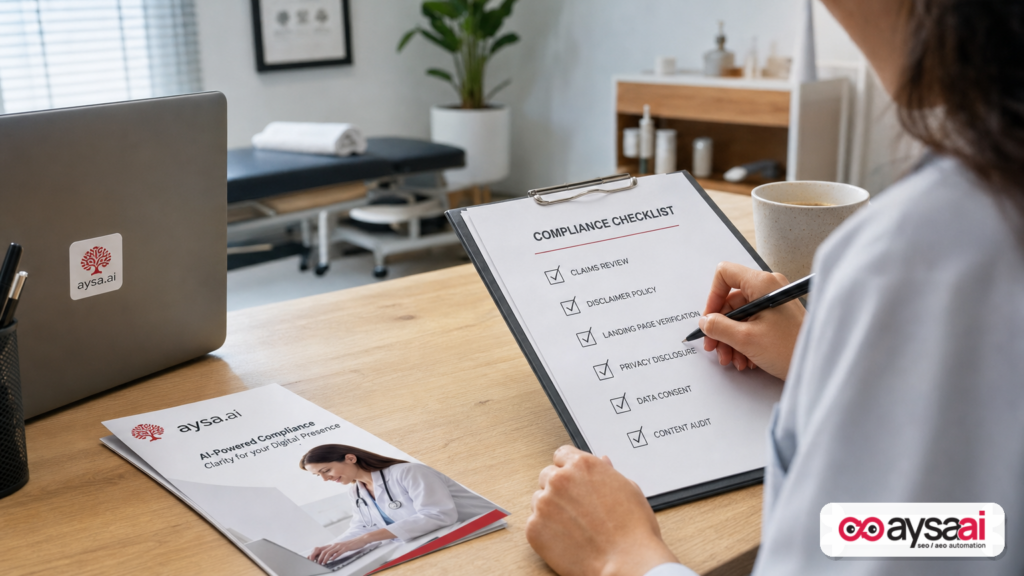
In regulated categories, you can’t separate “marketing copy” from “policy-safe copy.” When Search Engine Land reports that early creative restrictions exclude pinned assets and text disclaimers, that’s not a random limitation—it signals that Google is simplifying ad rendering inside AI Mode.
The short-term outcome is annoying (less control). The long-term outcome is strategic: teams that rely on heavy pinning or disclaimer patterns may need a new creative architecture that is both compliant and flexible.
3) Organic and paid will share the same battlefield
Historically, you could run a paid strategy and an SEO strategy with only light coordination. AI Mode compresses that separation. If the AI answer cites sources that contradict your landing page claims or your pricing, the ad will underperform.
In other words: paid can’t outrun bad or thin content anymore. And “thin” now includes missing trust signals and missing clarity, not just word count.
Organic implications: citations, “reading sessions,” and the new SERP reality
AI Mode and AI Overviews are pushing Google toward an interface where users consume more information without clicking. That’s why this ad test has an SEO implication: your goal is no longer only ranking #1. Your goal is:
- being cited or referenced in AI answers,
- being selected as a recommended option,
- earning the click when a click happens, and
- capturing demand via paid placements when the user is ready to act.
This is where AEO/GEO (Answer Engine Optimization / Generative Engine Optimization) becomes operational, not theoretical. You have to build pages the model can confidently summarize and cite—while keeping them conversion-ready.
If you’re an SME, that might sound abstract. Here’s the simplest mental model I use:
- Classic SEO: “How do I rank my page?”
- AI search optimization: “How do I become the source the AI trusts—and the business the user chooses?”
AYSA’s focus areas—monitoring visibility shifts and shipping improvements—are built for this reality. Strategy without execution doesn’t survive AI-driven change.
Measurement will get harder before it gets easier
AI Mode ads create measurement challenges, even if Google eventually provides reporting:
- Attribution blur: users may read the AI response, then come back later via direct, branded search, maps, or another device.
- New assisted conversions: the ad might influence selection without getting clicked (or without being the final touch).
- Query visibility gaps: as AI summarizes intent, the exact “keyword” becomes less meaningful than the topic + context the model inferred.
This is why relying on old KPIs alone (CPC, CTR, last-click ROAS) becomes risky. You still need them—but you’ll also need:
- lead quality feedback loops (did this turn into an appointment?),
- conversion rate by landing page trust factors (not just by keyword), and
- brand lift proxies you can actually observe (branded search demand, returning users, call volume patterns).
Search Engine Land also recently covered Google Ads launching a built-in lead management dashboard. If Google is improving lead workflows while expanding ads into AI experiences, that’s consistent: monetize more surfaces and reduce friction for advertisers to prove value. (We’re not assuming details beyond that coverage; the direction is what matters.)
Creative restrictions: why the fine print matters
According to Search Engine Land’s reporting, the initial test limits ads that use pinned assets or text disclaimers. That’s a big deal in healthcare, where advertisers often depend on structured messaging and compliance text.
Here’s why I think Google is doing this:
- AI Mode is dynamic: the interface may reflow content based on device, follow-up prompts, and summary length.
- Pinned assets reduce flexibility: forcing exact combinations can break layout or degrade experience.
- Disclaimers may require specialized rendering: and Google may be staging that complexity for later.
What you should do now, even before you have access:
- Audit your RSAs and asset groups for how dependent they are on pinning.
- Build alternative compliant copy blocks that can rotate without losing meaning.
- Make landing pages do more compliance heavy lifting (clear eligibility, clear limitations, clear next steps) so the ad can be simpler.
A concrete SME scenario: local clinic demand capture in the AI era
Let’s make this real.
Scenario: You run a small dermatology clinic in a metro area. Historically, you’ve relied on:
- local SEO (“dermatologist near me”),
- Google Ads for high-intent services (“acne treatment appointment”),
- and a handful of strong service pages.
Now imagine a patient searches in AI Mode: “What’s the best treatment for adult acne and how much does it cost in [city]?”
In the classic world, the user sees ads + organic listings, clicks around, and you fight for a click. In the AI Mode world, the user may get:
- a summarized explanation of treatment types,
- guidance like “talk to a board-certified dermatologist,”
- maybe a short list of local options or sources to compare,
- and now—potentially—a sponsored placement from a clinic or a telehealth provider.
Here’s what determines whether you win that patient:
1) Your ad and landing page match the AI narrative
If the AI explains that pricing varies by severity and that an in-person consult is needed, your landing page must confirm that reality. If your page looks like a generic sales page with unclear pricing, trust drops.
2) Your organic content is citeable
AI systems pull from sources that are clear, structured, and trustworthy. A page that cleanly answers “treatment options,” “what to expect,” “risks,” “pricing ranges,” and “who it’s for” is more likely to be referenced than a page that just repeats “best acne treatment in [city].”
3) Your local proof is unmissable
Even if AI Mode isn’t strictly “Maps,” users still want local confidence: credentials, location details, appointment availability, and real-world service clarity.
This is execution-heavy work: content updates, schema/structured data where appropriate, trust assets, internal linking, and conversion flow improvements. That’s exactly why automation without governance fails—and why an approved execution model matters.
Agency reset: from keyword manager to system optimizer
If you run an agency or manage paid media, AI Mode ads will accelerate a shift that’s already underway: the job is less about hand-tuning keyword lists and more about building a system that can respond to:
- new placements,
- new matching behavior,
- new creative constraints,
- and messy attribution.
Search Engine Land’s broader coverage has been pointing in this direction—PPC practitioners evolving into system optimizers. Whether you agree with the label or not, the operational truth is unavoidable: AI-driven surfaces reduce the number of levers you can micromanage and increase the importance of foundations—conversion tracking, landing page quality, brand trust, and fast iteration.
Agencies that win will be the ones that can:
- coordinate paid + organic messaging,
- create compliant creative systems that can flex,
- and ship site changes quickly (not “next quarter”).
An execution plan for SMEs and agencies (30/60/90 days)
You don’t need to predict exactly how AI Mode ads will look to prepare. You need a plan that makes you resilient to the direction: more AI answers, more monetization inside those answers, and more competition for trust.
Days 0–30: stabilize trust + measurement
- Confirm tracking basics: clean conversion actions, call tracking if relevant, and lead-quality feedback (even a simple weekly review).
- Landing page trust audit: credentials, policies, clear next steps, transparent limitations. Especially in healthcare, remove ambiguity that triggers skepticism.
- Inventory your “AI-ready” content: which pages clearly answer questions users ask? Which pages are just marketing copy?
- Start monitoring AI visibility: not just rankings. You need to know if you’re appearing in AI experiences and where you’re missing.
AYSA can help here by monitoring and surfacing changes in AI search visibility and website performance patterns, so you see shifts early rather than after the quarter ends. Start with: AYSA Monitoring and our AI search visibility overview: AI Search Visibility.
Days 31–60: build “citeable” pages and reduce creative dependency
- Upgrade 5–10 key pages into clear, structured answers: who it’s for, how it works, risks, expected timeline, and what to ask.
- Align paid and organic claims: if the ad says “same-week appointments,” the page must support it. If pricing varies, say so clearly.
- Prepare creative variants: less pinning, more modular compliance-safe copy blocks.
For teams that want an execution system instead of a backlog, this is where AYSA’s “prepare → approve → ship” loop becomes valuable. See our tools direction here: AYSA AI SEO Tools.
Days 61–90: operationalize iteration and governance
- Set an AI/ads review cadence: bi-weekly is realistic for SMEs; weekly for agencies.
- Build a change pipeline: monitor signals → propose site updates → approve → publish → measure.
- Expand topic coverage: fill gaps where competitors are becoming the “default cited source.”
- Test new paid assumptions: treat AI surfaces as different inventory; don’t assume your classic RSA approach performs the same.
If you’re trying to price and resource this realistically, start here: AYSA Pricing.
Where AYSA.ai fits: monitoring + approved execution for AI search
Most businesses don’t fail because they lack ideas. They fail because they can’t execute those ideas fast enough—especially when the platform shifts every few weeks.
AI Mode ads are exactly that kind of shift. You’ll need to coordinate:
- paid messaging,
- landing page clarity and compliance,
- content that earns citations,
- and technical hygiene that prevents trust and performance issues.
AYSA is built to be an execution system for that reality:
- Monitor: track visibility and performance signals across the site and AI search presence.
- Prepare: identify and draft the website changes that would improve outcomes (content upgrades, internal links, on-page clarity, technical fixes).
- Ask for approval: you stay in control—especially important in regulated industries.
- Execute accepted changes: ship improvements consistently, not “when we get to it.”
If you want to see the broader thinking and updates, we keep practical guidance in our AYSA blog.
What to do next (action list)
- Audit your landing pages for trust: credentials, clear limitations, transparent process, and easy next steps.
- Reduce reliance on pinned assets: build compliant message modules that still work when rotated.
- Pick 5 high-intent questions your customers ask and create/upgrade pages to answer them clearly (not just rank for them).
- Align paid + organic: ensure your ad promise matches what the AI will likely summarize from your site.
- Start monitoring AI visibility changes: treat it like a new channel, not an SEO footnote.
- Set a 90-day iteration cadence: your competitive advantage will come from speed + consistency, not one-time optimization.
Sources and further reading
- Search Engine Land: Google begins testing healthcare ads in AI Mode
- Search Engine Land: Google Ads launches built-in lead management dashboard
- Search Engine Land: What to do now that AI Overviews turned search into reading sessions
- Search Engine Land: The new PPC skill set: From keyword manager to system optimizer
- Search Engine Land: How Google Display exclusions guide AI-driven optimization
AYSA internal reading:
Continue the AI search topic inside AYSA.
Use these pages to connect the article with AI SEO tools, AI visibility monitoring, AI Overviews and approved website execution.
Turn this topic into a website action plan.
Use these AYSA hubs to move from reading to technical fixes, AI visibility monitoring, research, glossary context and approval-first SEO execution.