Microsoft Web IQ And The Next Era Of AI Search: How Bing Grounding APIs Change SEO, Citations, And Execution
Microsoft’s Web IQ aims to become a “search engine for AI systems,” returning passages and structured evidence objects from Bing’s index for faster, cheaper grounding. Here’s what that likely changes for citations, SEO strategy, and how SMEs and agencies should adapt—plus how AYSA turns monitoring into approved execution.

AI Search is changing the contract between websites and discovery. For two decades, SEO mostly meant: publish a page, get it crawled, earn authority, rank the page, win the click.
Now, more and more “search” is happening inside AI assistants and agentic workflows that don’t always want a page. They want evidence: the best passage, the right fact, the verifiable snippet that can be used while the model reasons through a task.
Microsoft’s announcement of Web IQ—a set of grounding APIs that connect AI agents directly to Bing’s index—signals that this shift is becoming infrastructure, not a side feature. Microsoft describes Web IQ as “a search engine for AI systems,” designed to return passages and structured evidence objects rather than full pages, with the explicit goal of fewer tokens, faster calls, and lower cost for AI developers.
This editorial explains what changed, why it matters for businesses (not just SEOs), what could go wrong, and what to do next. I’ll also give you the AYSA.ai perspective: in a world of rapid AI-driven changes, the winners won’t just “know” what to do—they’ll have a system to monitor, prepare, ask for approval, and execute site improvements consistently.
Concise summary
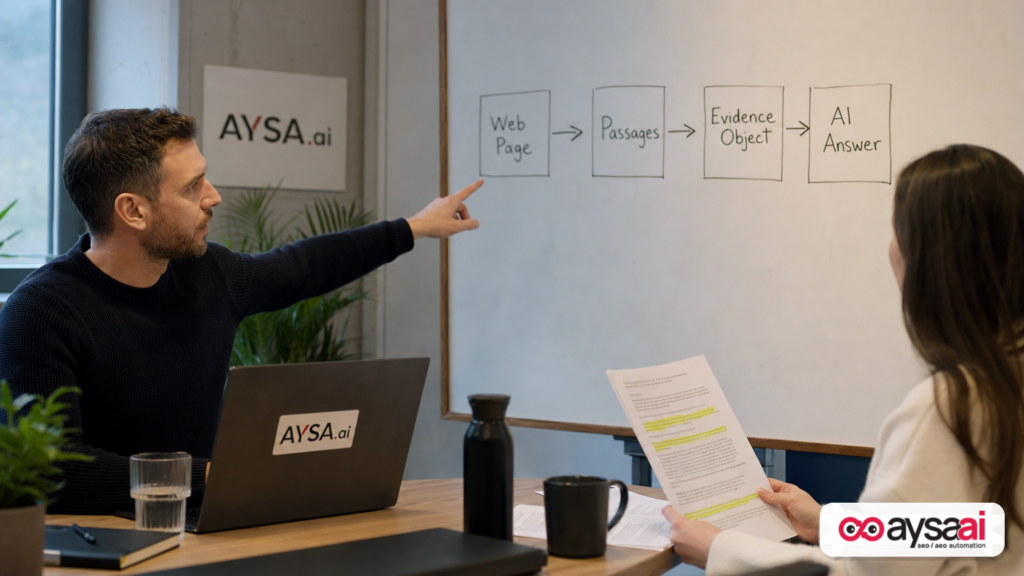
- Web IQ is Microsoft’s push to make Bing’s index usable by AI agents through grounding APIs that return passages and structured evidence objects (not full pages).
- This accelerates the shift from “ranking pages” to “winning citations,” where the best extractable passage can matter more than the best overall page.
- For SMEs and agencies, the practical work is less about chasing hype and more about making your site easy to ground: clear facts, strong entity signals, consistent location/service details, and content designed for retrieval.
- Execution speed becomes a moat—but so do controls. Agentic SEO without approvals is how brands end up with broken templates, conflicting claims, and compliance headaches.
Key takeaways (what to do if you only have 5 minutes)
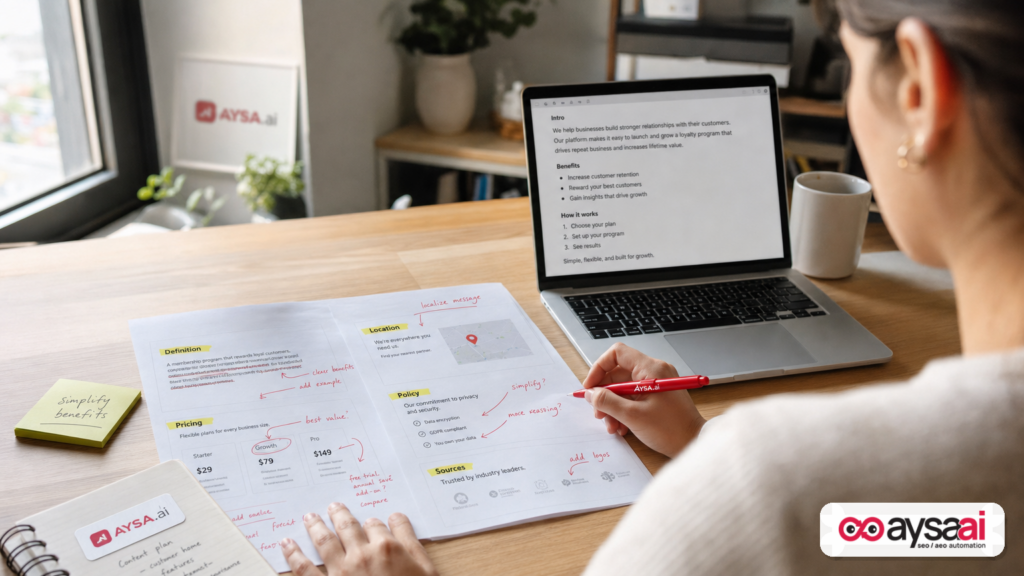
- Audit your “citable passages.” Identify pages where one paragraph should be cited (pricing, hours, return policy, service eligibility, location coverage). Rewrite those sections for clarity and verification.
- Strengthen your entity footprint. Make your business name, locations, services, and policies unambiguous across the site—especially on location pages.
- Reduce contradiction. AI systems punish inconsistency. Align headers, footers, service menus, FAQ answers, and location details so the “truth” is stable.
- Build a Monitoring + execution loop. AI search changes quickly. Set a cadence to monitor visibility and ship improvements weekly—using an approval gate.
- Prepare for passage-level competition. You may “rank” and still not be cited. Optimize for extractability and evidence, not just traditional SEO metrics.
Table of contents

- What changed: grounding becomes a first-class interface
- What Microsoft Web IQ is (and what we can responsibly infer)
- From pages to passages: why “structured evidence objects” matter
- The new KPI: citable passages (and why your best page might still lose)
- Publisher controls, robots rules, and the trust problem
- The technical shift: retrieval optimized for reasoning, not benchmarks
- What this changes for SMEs, ecommerce, local businesses, SaaS, and publishers
- A concrete SME scenario: a multi-location clinic competing for AI answers
- What can go wrong: the failure modes businesses will hit first
- What agencies should rethink: deliverables, reporting, and content ops
- Action plan: how to become the easiest site to ground and cite
- Where AYSA fits: monitoring, preparation, approval, and execution
- What to do next (checklist)
- Sources and further reading
What changed: grounding becomes a first-class interface
When a major search engine treats “grounding” as a dedicated API product for AI agents, that’s a strategic message: AI systems are no longer just layers on top of search; they are becoming customers of search infrastructure.
In plain business terms, this is like going from “people browse your catalog” to “automated purchasing systems query your catalog.” The interface changes. The winner changes. The metrics change.
Historically:
- Search engines retrieved pages.
- Users clicked pages and decided what to trust.
- Publishers and businesses optimized for rankings and CTR.
In the emerging model:
- AI agents retrieve evidence, often many times per task, under time constraints.
- The agent assembles an answer, a plan, a comparison, a purchase decision, or a workflow outcome.
- Your website competes to be the best source passage—sometimes without getting a click.
That doesn’t mean websites “stop mattering.” It means websites need to become better inputs for AI Retrieval and grounding. If you’re a business owner, the practical question becomes: Is my site the easiest place for an AI system to extract the right truth?
What Microsoft Web IQ is (and what we can responsibly infer)
According to Search Engine Journal’s coverage of Microsoft’s announcement, Web IQ is a set of grounding APIs that connects AI agents to Bing’s index and returns passages and structured evidence objects rather than full web pages. Microsoft frames it as “a search engine for AI systems,” emphasizing speed, token efficiency, and the realities of multi-step agent workflows under tight latency budgets.
Here’s the source report: Search Engine Journal — Microsoft Web IQ Gives AI Agents Bing Grounding APIs.
Important constraints:
- Pricing, documentation, and general availability timing were not confirmed in the source coverage, so any business planning should treat this as “directionally important,” not something you can fully budget for today.
- We also can’t responsibly claim which Microsoft products will use it until Microsoft publishes that directly. The SEJ report notes Microsoft hasn’t clarified whether existing Copilot/Bing Chat grounding already uses Web IQ or if it’s separate.
What we can infer safely, as a strategic implication: Microsoft is incentivizing a world where AI developers—and eventually enterprise platforms—use Bing as a Retrieval Layer for agentic tasks. That expands “search visibility” beyond the classic search results page.
From pages to passages: why “structured evidence objects” matter
If you’ve done SEO for a while, you know the pain: you publish a great page, but the snippet the engine shows users might come from a weird paragraph or an outdated sentence.
Passage-level retrieval takes that to the next level. In a grounding workflow, the model is not looking at your “page experience” first. It’s looking for the most relevant extract—then using it as evidence inside a reasoning chain.
That has major implications:
1) You’re competing at the paragraph level
Your competitor can beat you with a single better paragraph—even if your overall site is stronger.
Example: A local HVAC company has an “Air Conditioner Repair” page with long marketing copy. Another competitor has a simple section titled “Emergency AC repair: response times and coverage area” with clear service boundaries. In an AI answer to “Can someone come today in Westfield?”, the clearer, bounded passage is more likely to be selected.
2) Token economics becomes SEO economics
Microsoft’s positioning (as described by SEJ) emphasizes fewer tokens for better answers and lower cost per call. That’s not a marketing detail—it’s a new selection pressure. If two sources are comparable, the system is biased toward the one that is easier to process and less ambiguous.
In practice, that rewards:
- Direct language
- Explicit constraints (“Available in these zip codes…”, “Not available for…”, “Updated on…”)
- Structured sections (definitions, steps, eligibility, pricing ranges with caveats)
- Consistency across the site
3) “Evidence objects” imply machine-usable packaging
We don’t have Microsoft’s full documentation in the supplied research context, so we can’t describe the exact schema. But the concept of a “structured evidence object” strongly implies more than just raw text: metadata that helps an agent cite, attribute, verify freshness, and reason about context.
For business websites, this reinforces a long-standing truth: structure wins. Not because “Google likes schema” (that’s the old framing), but because AI systems need reliable anchors: what the statement refers to, where it applies, when it was last updated, and how confident the system should be.
The new KPI: “citable passages” (and why your best page might still lose)
Most businesses still optimize like it’s 2018: build a pillar page, add a few FAQs, get some links, improve Core Web Vitals, call it a day.
That work still matters. But Web IQ’s passage-returning approach (as described by SEJ) highlights the KPI shift: from “rank this page” to “be the best evidence.”
I want you to internalize a simple rule:
A page can be great for humans and still be bad for AI grounding.
Why? Because grounding is extraction under constraints. If the key facts are buried, hedged, inconsistent, or wrapped in marketing language, the agent won’t risk citing it—or it will cite it inaccurately, which is worse.
What a citable passage looks like
Not “short.” Not “keyword-rich.” Citable means:
- Specific: names the product/service, location applicability, and boundaries.
- Verifiable: points to a stable policy page, a pricing page, an official schedule, or an “updated” timestamp.
- Non-contradictory: doesn’t conflict with other site sections (FAQs, footers, location pages).
- Extractable: can stand alone without needing the whole page to interpret it.
What to audit first
If you’re an SME, start with the pages that are most likely to be used as “evidence”:
- Pricing and plans
- Shipping/returns (ecommerce)
- Hours, services, and insurance/payment policies (clinics)
- Service area boundaries (local services)
- Eligibility, onboarding steps, and security/compliance (SaaS)
- Booking policies and amenity lists (hotels)
Publisher controls, robots rules, and the trust problem
One of the most sensitive issues in AI search is: “Are AI systems respecting publisher preferences?” In the SEJ report, Microsoft states Web IQ follows the same robots exclusion rules and publisher preferences that Bing already honors, and that Microsoft is working with standards bodies like the IETF on standards for how AI systems access web content.
We should treat that as a direction, not a solved problem. Even with robots rules, there’s still the practical trust challenge:
- Publishers want attribution and traffic.
- Businesses want accurate representation.
- AI systems want fast, cheap evidence to answer everything.
For SMEs, this matters because your “publisher controls” are often accidental: a plugin, a staging site indexed, duplicate location pages, or a misconfigured robots.txt can change what evidence the agent sees.
If AI search becomes more passage-based, you should assume that one stray paragraph (old pricing, outdated hours, discontinued services) can show up in answers and cost you revenue.
That’s why monitoring becomes an operational requirement—not an occasional report.
The technical shift: retrieval optimized for reasoning, not benchmarks
The SEJ coverage notes that Web IQ uses Microsoft’s open-sourced embedding model to find relevant content and additional models to rank and select passages, and that these models are trained for how they’ll be used in AI reasoning, not for standalone benchmark scores. It also mentions Microsoft extending DiskANN for fast large-scale search.
You don’t need to know embeddings or ANN indexes to act on this. But you do need to understand the implication:
Your content is increasingly being evaluated by systems trained to support reasoning workflows.
That suggests AI retrieval may reward:
- Clear definitions and disambiguation (“X means…”)
- Step-by-step processes (“To do Y, follow…”)
- Constraints and exceptions (“Does not apply when…”)
- Freshness cues (“Updated June 2026” with meaningful updates)
- Stable, canonical URLs for core policies and facts
Classic SEO can accidentally work against this when it leads to:
- Thin pages created for every keyword variation
- Over-optimized copy that obscures the point
- Template sprawl where each page contradicts the next
What this changes for SMEs, ecommerce, local businesses, SaaS, and publishers
Let’s translate all of this into business reality.
For SMEs: the playing field can get more fair—and more volatile
If AI systems choose passages, smaller sites can win with clarity even without massive authority—especially in niche categories. That’s the upside.
The downside: volatility. If you change a template, you might accidentally remove the “best” citable paragraph. Or you might introduce inconsistent details that cause the AI system to prefer a competitor’s cleaner statement.
SMEs need two things:
- A small set of “truth pages” (pricing, locations, policies, service definitions)
- A monitoring cadence that catches drift fast
For ecommerce: policies and product facts become citation battlegrounds
In ecommerce, the most common AI-search prompts are not “buy this exact SKU.” They’re comparative and conditional:
- “What’s the best gift under $50 that ships by Friday?”
- “Which blender is easiest to clean?”
- “Is this brand’s return policy strict?”
If agents can pull passages from Bing’s index through grounding APIs, your return policy paragraph and shipping cutoff times are not just customer support content—they are competitive assets.
Make them:
- Specific (timeframes, exclusions)
- Consistent (product pages should not contradict policy pages)
- Easy to cite (short subsections with descriptive headings)
For local businesses: entity and location precision becomes the difference
Local intent is where AI answers can be most “confident” and most damaging if wrong.
Common local AI prompts:
- “Does this clinic accept my insurance?”
- “Is there a florist that can deliver to my zip code today?”
- “Which hotel has EV charging and allows pets?”
In passage-based retrieval, the system will prefer the business that states the answer clearly, with boundaries and freshness cues. If your location page is vague (“We serve the greater area”), you’re forcing the agent to guess.
For SaaS: documentation-like clarity wins top-of-funnel trust
SaaS buyers increasingly use AI to pre-qualify vendors: security posture, integrations, pricing model, contract terms. If your site hides the answer behind sales gates, AI systems will source it elsewhere.
That doesn’t mean you must publish everything. It means you should publish enough verifiable truth that the AI can’t misrepresent you.
For publishers: attribution and “passage extraction” economics collide
Publishers are right to worry about AI systems that summarize without sending traffic. Web IQ’s passage return approach reinforces the extraction model.
But publishers also have an opportunity: if AI systems use passages, then “being the canonical passage” for a topic becomes a moat—especially if you pair it with strong brand signals and unique reporting.
Businesses that operate as publishers (brands with content teams) should think similarly: if you can own the “definition paragraph” or the “how it works” paragraph for your niche, you earn citations, trust, and downstream demand.
A concrete SME scenario: a multi-location clinic competing for AI answers
Let’s make this real with a scenario I see constantly.
Business: A multi-location dental clinic group with 8 locations across two metro areas.
Goal: Get cited in AI answers for prompts like:
- “Does [Clinic] offer emergency dental appointments near me?”
- “What is the cost of a dental crown in [City]?”
- “Which dentists accept Delta Dental in [Neighborhood]?”
Current reality:
- Each location page is templated but inconsistently edited by local managers.
- Insurance info is on a separate PDF that’s outdated.
- Emergency appointment policy is described differently on three pages.
- The “pricing” page uses vague ranges with no explanation.
In a passage-based grounding world, the AI agent is likely to:
- Find conflicting passages and reduce confidence.
- Prefer a competitor with a clean “Insurance Accepted” list and an updated timestamp.
- Give an answer that’s partially wrong (“They don’t accept X”) because the cleanest passage says “select plans” without details.
What we’d do (in an execution-first model):
- Create a single canonical Insurance page with clear disclaimers and an update cadence, then link it from all locations.
- Standardize an Emergency Appointments section on every location page (same heading, same structure, location-specific phone number and hours).
- Add a “Pricing transparency” passage that explains ranges, what changes cost, and when a quote is provided.
- Remove contradictory fragments from old blog posts and outdated PDFs, or set canonical/noindex where appropriate.
- Monitor AI visibility and citations weekly and ship iterative copy improvements monthly (or faster) as prompts evolve.
None of this is “AI magic.” It’s operational excellence in how truth is published on your site.
What can go wrong: the failure modes businesses will hit first
AI search doesn’t just create new opportunities. It creates new ways to lose—quietly.
1) Contradictions across your site become deal-breakers
If location A says “Open Saturdays” and location B says “Closed weekends,” that’s fine. But if your header says “Open 7 days” and your FAQ says “Weekdays only,” the agent has a problem.
Agents prefer sources that reduce reasoning complexity. Contradiction increases it.
2) Stale passages get cited long after you changed the business
In traditional search, you might notice stale content because users complain or because rankings drop. In AI answers, you may not see the error until it costs you: refunds, angry calls, compliance issues.
That’s why “updated on” timestamps only matter if the content is truly maintained.
3) Template changes can wipe out your best evidence
Teams redesign pages all the time. If the redesign removes a clear “Service Area” section and replaces it with a hero banner and vague bullets, you’ve reduced your citable surface area.
4) Over-automation creates brand and legal risk
Agentic SEO is exciting: let a tool generate new pages, rewrite content, and push changes. But without a controlled approval step, it’s how you end up with:
- Claims you can’t substantiate
- Medical/legal overreach
- Pricing inaccuracies
- Conflicts with contracts or policies
This is where I’m unapologetically opinionated: AI execution must be approved execution. Speed matters, but governance matters more.
What agencies should rethink: deliverables, reporting, and content ops
If you run an agency, Web IQ is another signal that the market is moving from “SEO deliverables” to “AI visibility outcomes.”
Here’s what I expect to break first:
Traditional ranking reports won’t satisfy clients
Clients will ask: “Are we showing up in AI answers? Are we cited? Are we recommended?”
Agencies need a reporting layer that covers AI visibility, not just SERP positions.
At AYSA, we frame this as AI search visibility—measuring and improving how your brand appears in AI-driven discovery, not just classic search results.
Content deliverables must become “retrieval-ready”
A 2,000-word blog post is not a deliverable if it can’t produce citable passages. Agencies should add:
- Passage maps (“these are the 5 paragraphs we expect to be cited”)
- Entity and location consistency checks
- Policy and pricing truth audits
The agency moat becomes operational execution
Strategy is commoditizing. Execution is not. The winners will run a weekly cycle: monitor → prioritize → prepare changes → approve → implement → measure.
This is where AI SEO tools are only useful if they connect to a controlled execution system.
Action plan: how to become the easiest site to ground and cite
This is the practical section. If you do nothing else, do this.
Step 1: Identify your “truth inventory”
Create a list of pages that define your business reality. Usually 10–30 URLs for an SME:
- Pricing / plans
- Returns / shipping / warranty
- Contact and location pages
- Service definitions
- Eligibility criteria
- Compliance statements (where relevant)
These pages should be stable, maintained, and internally consistent.
Step 2: Rewrite for extractability (not fluff)
For each truth page, add or improve “citable blocks”:
- One-paragraph definition (what the service/product is)
- Constraints (where it applies, what’s excluded)
- Process (steps, timelines)
- Proof cues (updated date, links to official policy sections)
Don’t overdo it. The goal is to remove ambiguity.
Step 3: Reduce duplication and contradictions
Businesses often have:
- Old PDFs that conflict with new pages
- Blog posts that mention old pricing
- Location pages edited independently
Pick one canonical source of truth for each fact. Then align everything else to it.
Step 4: Strengthen entity signals and internal linking
Even without going deep into schema talk, make sure your site clearly communicates:
- Who you are (brand name, legal name if relevant)
- Where you operate (locations, service areas)
- What you offer (service taxonomy)
- How to verify key claims (policies, credentials, references)
Link location pages to service pages and policy pages in a predictable pattern.
Step 5: Create a monitoring cadence
AI search is not “set it and forget it.” Establish a cadence:
- Weekly: check for inconsistencies, broken pages, location drift, policy changes
- Monthly: refresh truth pages and expand missing citable passages
- Quarterly: re-evaluate the core prompts your customers ask AI assistants
At AYSA, this starts with monitoring so teams can catch issues before they become revenue problems.
Where AYSA fits: monitoring, preparation, approval, and execution (in that order)
Here’s my perspective as Marius Dosinescu building AYSA.ai: the AI era doesn’t eliminate SEO work—it multiplies the number of changes a business should make, while also multiplying the risk of making the wrong ones.
So the differentiator is not “having ideas.” It’s having a controlled system for shipping improvements.
AYSA is built around a simple operational loop:
- Monitor: Track what matters for visibility and accuracy, including AI search visibility signals (where available) and website consistency.
- Prepare: Generate recommended changes—content edits, technical fixes, internal linking improvements—aligned to your goals.
- Ask for approval: You control what goes live. That’s non-negotiable for brand, legal, and operational safety.
- Execute accepted website changes: After approval, implement changes reliably and document what changed.
If you want the broader framing on why this matters, start here: AI Search Visibility. If you want to see the tooling angle, see AYSA AI SEO Tools. For ongoing education and execution ideas, visit the AYSA blog.
And because pricing and tooling choices matter for SMEs, we keep our plan details accessible: AYSA pricing.
What to do next (a practical checklist)
Use this as your immediate next sprint—whether you’re a founder, a marketer, or an agency.
- Pick 10 “truth queries” customers ask AI tools (pricing, availability, eligibility, returns, service area).
- Map each query to a single best URL on your site (or create that URL if it doesn’t exist).
- Rewrite the key passage on each page to be extractable, specific, and non-contradictory.
- Standardize headings for those passages across locations (e.g., “Insurance Accepted,” “Service Area,” “Emergency Appointments”).
- Remove conflicts: update old posts, retire outdated PDFs, consolidate duplicate pages.
- Add freshness discipline: only show “updated” if you actually review monthly/quarterly.
- Set monitoring so you detect drift and errors quickly.
- Adopt approved execution so AI-assisted optimization doesn’t become AI-assisted brand damage.
Sources and further reading
- Search Engine Journal — Microsoft Web IQ Gives AI Agents Bing Grounding APIs (primary research input for this editorial)
- Search Engine Journal — Latest News (ongoing coverage context)
- Search Engine Journal — SEO (broader SEO context)
- AYSA.ai — AI Search Visibility
- AYSA.ai — AI SEO Tools
- AYSA.ai — Monitoring
- AYSA.ai — Pricing
- AYSA.ai — Blog
Note on sources: The supplied research context references Microsoft working with standards bodies and mentions specific technical components (embeddings, DiskANN) and performance measurements. I’ve limited claims to what was described in the provided source coverage and framed broader implications as analysis, not verified fact, because the official Microsoft documentation and pricing/GA details were not included in the provided materials.
Continue the AI search topic inside AYSA.
Use these pages to connect the article with AI SEO tools, AI visibility monitoring, AI Overviews and approved website execution.
Turn this topic into a website action plan.
Use these AYSA hubs to move from reading to technical fixes, AI visibility monitoring, research, glossary context and approval-first SEO execution.