
Google’s New AI Ad Disclosures: What “How This Ad Was Made” Means for Trust, Performance, and Your Marketing Operations
Google is rolling out AI-made ad disclosures across Search, YouTube, and Discover. Here’s what changed, why it matters for SMBs and agencies, and how to operationalize AI transparency without slowing down creative or performance.

Google is rolling out a new layer of ad transparency: users will be able to see whether an ad’s creative was created or edited with AI. This “How this ad was made” detail will appear in My Ad Center across Google Search, YouTube, and Discover, worldwide.
That sounds like a small UI tweak. It isn’t.
When provenance becomes visible, your creative workflow becomes part of your brand—and part of your risk surface. The teams that win won’t be the ones who avoid AI. They’ll be the ones who can use AI at scale while keeping messaging, landing pages, compliance, and measurement tightly aligned.
My take: disclosures won’t kill performance by themselves. The real impact is operational. The bar for “grown-up marketing” is rising: documentation, review steps, and consistency across paid and owned channels. If you’re a founder, a marketing lead, or an agency operator, this is your cue to modernize the system behind the ads—not just the ads.
Concise summary
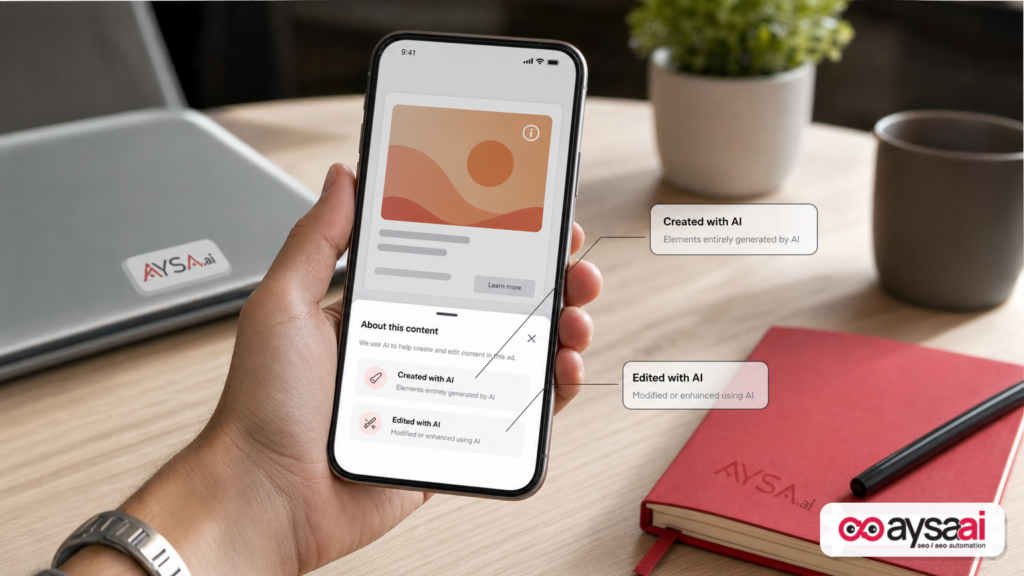
- What changed: Google is expanding AI ad disclosures via a new “How this ad was made” section in My Ad Center across Search, YouTube, and Discover.
- What users will see: an indication that the ad creative was created or modified with AI (depending on how it was produced).
- Why it matters: AI use is becoming a visible attribute of your marketing—affecting trust, compliance, workflow governance, and potentially performance in sensitive categories.
- What to do: set an AI disclosure policy, inventory creative workflows, tighten landing-page alignment, create a QA process, and measure impact by segment.
- Where AYSA fits: disclosures increase the need for consistent, provable messaging between ads and your website. AYSA monitors, prepares site improvements, asks for approval, and executes accepted changes—reducing mismatches that drive wasted spend and trust erosion.
Table of contents

- What changed: “How this ad was made” expands across Google’s biggest surfaces
- Why Google is doing this now (and why you should care even if you’re not a power advertiser)
- What users will actually experience (and how it could shape behavior)
- How the disclosures work: first-party AI vs third-party AI
- Important: disclosures don’t replace ad policies (and they don’t protect you)
- What can go wrong: the real risks hiding behind a “simple” disclosure
- Implications by business type: ecommerce, local services, SaaS, and agencies
- How to measure the impact without guessing
- A concrete SME scenario: the local clinic that scales ads with AI—without losing trust
- An operator’s action plan: how to prepare your ads, teams, and processes in 30 days
- Where AYSA.ai fits: approved execution for trust, consistency, and AI-era visibility
- What to do next
- Sources and further reading
What changed: “How this ad was made” expands across Google’s biggest surfaces

Google announced it is adding AI disclosures to ads across Search, YouTube, and Discover via a new section called “How this ad was made” inside My Ad Center. Users can access it from an ad’s three-dot menu or information icon, and it will indicate whether the ad creative was created or modified with AI. The rollout is global.
This update expands Google’s broader ad transparency approach. Instead of treating generative AI as a behind-the-scenes production method, Google is turning it into a user-visible attribute of the ad.
Primary implications:
- Provenance becomes part of perception. Users can understand not only who paid for the ad, but how it was produced.
- Workflow choices become governance choices. If your team uses AI tools—Google’s or third-party—there is now a disclosure layer to manage.
- Search, video, and feed ads are covered. This isn’t limited to one ad format; it spans the main surfaces many SMBs rely on for demand capture and retargeting.
Reference announcement (as covered by Search Engine Land): Google expands AI ad disclosures across Search, YouTube, Discover.
Why Google is doing this now (and why you should care even if you’re not a power advertiser)
Disclosures are a product response to three converging realities:
1) AI is making ad creative cheap, fast, and plentiful
Generative AI lowered the cost of producing variations—headlines, descriptions, images, even video concepts. That’s a performance opportunity, but it also increases the volume of low-effort or misleading creative. When production becomes trivial, the platform must raise the trust bar elsewhere.
2) Users are more skeptical—and regulators are paying attention
Even without citing specific jurisdictional rules (they vary and change), the trend is clear: synthetic or AI-altered content is increasingly treated as something consumers should be informed about, especially when persuasion is involved. Google’s approach lets it support “transparency by design” while keeping its ad products scalable globally.
3) Google is standardizing transparency across surfaces
Search ads are not the only place where persuasion happens. YouTube and Discover blend paid, organic, and recommendations in ways that can feel more editorial to users. Disclosing AI involvement is one way to reduce perceived manipulation—especially as creative becomes more personalized and automatically assembled.
If you run a small business, you might think this is “enterprise compliance theater.” It isn’t. Any change that touches user trust at the moment of impression can affect the metrics you care about: click-through rate, Conversion rate, and customer quality.
What users will actually experience (and how it could shape behavior)
Google is not saying every ad will carry a giant “AI” badge in the headline. The disclosure appears in My Ad Center when users open the transparency details. In some cases—depending on local requirements—an AI label may also appear directly on the ad.
Practically, that means:
- Most users won’t see it on every impression. They’ll see it when they’re curious, cautious, or suspicious—often the exact users you least want to lose.
- The disclosure is context-sensitive. The user who’s casually shopping for socks behaves differently from the user considering a medical procedure, a financial product, or an expensive service contract.
- It becomes ammunition for comparison. If one brand is consistently “AI-made” and another looks “human-crafted,” users may form narratives—fair or not—about authenticity, care, or quality.
To be clear: none of that is guaranteed to happen at scale. But once the platform exposes a new attribute, you should assume it will matter for at least some segments, especially in higher-stakes decisions.
How the disclosures work: first-party AI vs third-party AI
Google’s announcement includes a crucial operational detail:
- When advertisers use Google’s generative AI ad tools, Google will automatically add the disclosure in My Ad Center.
- When advertisers use third-party AI tools, advertisers will control whether to disclose AI use (and depending on local requirements, labels may appear directly on the ad automatically or after the advertiser uses that control).
This creates two governance regimes inside one account:
Regime A: Google-native AI usage (automatic disclosure)
If you use Google’s own AI features to generate or transform assets, you should assume disclosure is not optional. That’s actually good news operationally: fewer hidden decisions, more consistency, and less risk of “forgetting” to disclose in some campaigns.
Regime B: Third-party AI usage (advertiser-controlled disclosure)
This is where things get messy. Many teams write copy in ChatGPT, Claude, or other tools, generate images elsewhere, then upload assets to Google Ads. Under the described approach, you may have control over whether the AI use is disclosed.
Control sounds empowering—but it also increases your burden:
- You must define what “AI use” means in your organization.
- You must decide what you’ll disclose (and where) across markets.
- You must ensure consistency across agencies, contractors, and internal teams.
If you don’t already have a written policy, now is the time.
Important: disclosures don’t replace ad policies (and they don’t protect you)
One dangerous misconception is: “If it’s labeled as AI, then it’s fine.”
Google explicitly stated that existing rules still apply—ads must not be misleading or deceptive, whether AI was used or not. The disclosure adds transparency; it does not change fundamental requirements like clearly identifying who the advertiser is and what is being promoted.
Also, the disclosure doesn’t “blame the tool.” If an AI-written headline makes a claim your landing page doesn’t support, that’s still your responsibility.
The operational takeaway: treat AI like a production accelerator, not a compliance shield.
What can go wrong: the real risks hiding behind a “simple” disclosure
When I talk to founders and marketing operators, I often hear: “We’ll just tick whatever box Google wants.” But the risk isn’t the box. It’s the downstream consequences of inconsistent systems.
Risk 1: Disclosure inconsistency across campaigns and markets
If one set of campaigns is automatically disclosed (Google AI tools) and another set is not (third-party tools), you can end up with:
- Different disclosure states for similar products
- Different user experiences across geographies
- Confusing internal reporting (“Did we change creative quality or just disclosure status?”)
Risk 2: “AI-made” becomes a proxy for “low quality”
This is perception, not truth. AI can produce excellent creative when directed well and reviewed. But users may associate AI with spammy ads, scams, or overly polished persuasion. If your category already struggles with trust, you must over-invest in credibility signals elsewhere (site, reviews, policies, identity).
Risk 3: Message drift between ad and landing page
AI makes it easy to produce a headline that sounds great but is slightly too broad (“Best price guaranteed,” “Same-day service,” “Doctor-approved,” “Clinically proven”). If your landing page doesn’t substantiate it, you risk:
- Lower conversion due to mismatch
- Higher refunds/chargebacks due to expectation gaps
- Policy issues if claims cross into restricted territory
Risk 4: Agency-client misalignment (who owns disclosure decisions?)
Agencies often generate creative variations quickly to hit performance goals. Clients often want brand safety, legal review, and consistency. Disclosures add a new wedge issue: who decides when the label is applied, and based on what criteria?
If you don’t define this contractually and operationally, you’ll get friction right when you need speed.
Risk 5: Attribution confusion in measurement
If disclosure status changes at the same time as creative refreshes, budgets shift, or targeting expands, you can’t isolate cause and effect. You need a measurement plan that isolates variables, at least at a practical SMB level.
Implications by business type: ecommerce, local services, SaaS, and agencies
The disclosure itself is one feature. The business implications differ depending on how much trust, regulation, and brand differentiation matter in your purchase decision.
Ecommerce brands: the trust stack matters more than the label
For ecommerce, I expect many brands will see minimal impact from the disclosure itself—especially in commodity categories. Where it could matter:
- Higher AOV products where reassurance is required (warranties, returns, authenticity)
- Health-adjacent products where claims are sensitive
- Brands competing on craftsmanship, heritage, or “human-made” positioning
Action: tighten product page clarity and policies. The ad is the promise; the product page is the proof.
Local services: identity and credibility become the differentiator
Local services win on trust: who is showing up at my home, what credentials do they have, can I verify them? If AI makes ads more generic, your best defense is being undeniably real:
- Clear “About” information
- Service area specifics
- Licensing/insurance where relevant
- Photos that reflect reality
Action: align ads with your most trustworthy on-site pages, not just your highest-converting ones.
SaaS and B2B: disclosures shift the review burden to proof points
B2B buyers already assume marketing is optimized. An AI label won’t shock them. But it can increase scrutiny of claims. If your ad promises “cut costs,” “automate,” or “reduce churn,” make sure your landing page shows:
- Clear feature scope
- Implementation expectations
- Security/compliance pages if relevant
- Case study framing without exaggerated outcomes
Action: create a proof-first landing page template for paid campaigns.
Agencies: you’re now selling governance, not just performance
As AI-generated assets become ubiquitous, the agency differentiator shifts:
- Performance is necessary, but not sufficient.
- Process becomes your moat: how you manage disclosure decisions, approvals, QA, and documentation.
Action: productize an “AI creative governance” layer. Make it part of onboarding and reporting.
How to measure the impact without guessing
Most SMBs don’t have the luxury of running perfect experiments. But you can still measure intelligently.
1) Segment by where the disclosure appears
Because the disclosure is in My Ad Center (and potentially on-ad labels in some locales), you want to separate performance by:
- Surface: Search vs YouTube vs Discover
- Market/GEO where requirements differ
- Campaign type and funnel stage
2) Track trust and friction signals, not only CTR
If the disclosure changes user perception, it may not show up as a CTR drop. It can show up as:
- Higher Bounce Rate / lower engagement on landing pages
- More “contact us” questions that indicate skepticism
- Lower lead quality (more price shoppers, fewer qualified buyers)
Even if you don’t have sophisticated Attribution, you can monitor these patterns in your analytics stack.
3) Separate creative change from disclosure change
If you’re updating ads anyway, do not change everything at once. A practical approach:
- Keep one control campaign stable for 2–4 weeks.
- Roll out AI-assisted creative in one segment at a time.
- Document which assets were created/edited with AI.
4) Audit landing pages as part of your measurement
If AI helps you create bolder headlines, you need landing pages that carry that promise. This is where paid search and “AI Search visibility” converge: the same pages that convert paid traffic also influence how you show up in AI-driven discovery and recommendation environments.
If you care about that broader visibility, see: AYSA AI Search Visibility.
A concrete SME scenario: the local clinic that scales ads with AI—without losing trust
Consider a realistic example: a multi-location dental clinic running Google Search ads and YouTube remarketing to keep chairs filled.
The clinic starts using AI to speed up ad testing:
- AI drafts 15 headline variations for “same-week appointments.”
- AI suggests new descriptions for “transparent pricing.”
- AI helps generate variant image concepts for YouTube companion creatives.
Performance improves because they test faster. Then disclosures roll out. Now a portion of users can see that the ad was created or edited with AI.
What could happen?
- Most users don’t care.
- A subset of anxious patients—already worried about cost and pain—click the info panel, see the AI note, and become more skeptical.
How does the clinic protect performance?
- They tighten claims. “Same-week appointments” becomes “Appointments available this week in select locations.”
- They add proof on landing pages. Clear location availability, what “transparent pricing” means, and what’s included.
- They strengthen identity signals. Dentist credentials, licenses, real team photos, and clear contact information.
- They standardize approval. AI can draft, but a human must approve final claims and required disclaimers.
That’s the real pattern: AI increases speed. Disclosures increase the need for disciplined truth alignment.
An operator’s action plan: how to prepare your ads, teams, and processes in 30 days
If you’re an SMB or agency, you don’t need a “Center of Excellence” to handle this. You need a simple operating system.
Week 1: Inventory and policy
- Inventory your creative workflow: where copy and images are produced, who edits them, and which tools are used.
- Define “AI use” internally: drafting, rewriting, image generation, background replacement, voiceover, etc.
- Write a one-page disclosure policy: when you disclose, when you must disclose due to local requirements, and who decides.
Week 2: Governance and QA
- Add an “AI involvement” line to creative briefs so you can track what was AI-created or AI-edited.
- Create a QA checklist focused on claims, substantiation, sensitive categories, and landing page alignment.
- Clarify roles: who drafts, who reviews for brand, who reviews for compliance, who approves launch.
Week 3: Landing-page alignment (this is where most teams are weak)
- Map top ad claims to page elements: if the ad says “free returns,” the page must say it clearly and consistently.
- Strengthen trust modules: About, policies, contact, FAQs, credentials, reviews—whatever is appropriate for your industry.
- Fix mismatch quickly: don’t let landing pages lag behind ad iterations.
This is exactly the kind of work that benefits from a system that monitors changes and executes approved improvements. AYSA is built for that loop: monitor → propose → approve → execute.
Explore: AYSA Monitoring and AYSA AI SEO tools.
Week 4: Measurement and iteration
- Set a baseline: capture current performance by surface and campaign.
- Roll out changes gradually: avoid simultaneous targeting, creative, and landing page overhauls.
- Review outcomes weekly: focus on conversion quality and post-click behavior, not only CTR.
Where AYSA.ai fits: approved execution for trust, consistency, and AI-era visibility
At AYSA, we think the biggest marketing failure of the AI era isn’t “using AI.” It’s shipping inconsistency at scale:
- Ads promise one thing.
- Landing pages say something slightly different.
- Policies are outdated.
- Trust signals are missing or buried.
When users can see how an ad was made, they may scrutinize the outcome more. That’s why the website side matters. Your site is where trust is either confirmed or lost.
AYSA fits here as an execution system that:
- Monitors your site and visibility signals over time (so you catch drift early): AYSA Monitoring
- Prepares recommended updates (content, technical, structure, on-page clarity) that strengthen alignment between ads and pages.
- Asks for approval before making changes—so you keep control and governance.
- Executes accepted changes quickly—reducing the lag between what you’re advertising and what your website proves.
This matters for more than paid campaigns. The same clarity and trust signals help in AI-driven discovery (AEO/GEO) where systems summarize and recommend brands based on on-site evidence.
To see how we approach visibility in AI environments: AI Search Visibility.
If you want to evaluate AYSA operationally—what it costs versus the time you spend coordinating fixes—start here: AYSA Pricing.
And if you want more practical playbooks like this one: AYSA Blog.
What to do next
- Write your AI creative disclosure policy (one page) and assign an owner.
- Inventory your ad creation workflow (Google AI tools vs third-party AI tools vs human-only).
- Build a claims-to-proof map: for your top 20 ad claims, identify where the landing page proves each one.
- Strengthen identity and trust pages (About, Contact, policies, credentials) to reduce skepticism when users seek transparency.
- Create a QA checklist for AI-assisted creative: claims, substantiation, sensitive topics, brand tone, and landing page match.
- Set up measurement by segment (Search vs YouTube vs Discover; by geo; by funnel stage).
- Operationalize execution so landing pages keep up with ad iteration—this is where most wasted spend happens.
Sources and further reading
- Search Engine Land: Google expands AI ad disclosures across Search, YouTube, Discover (primary research input for this editorial)
- Search Engine Land: Ask YouTube AI search experience expands to U.S. desktop users (context on AI-driven discovery surfaces)
- Search Engine Land: Gemini Intelligence signals a new era for search and commerce (context on AI shaping search and commerce)
- Search Engine Land: Winning the AI decision layer: From AI discovery to agentic commerce (context on recommendation layers and decision-making)
- Search Engine Land: ChatGPT Ads new overview tab, suggested ad drafts, new ad formats and more (competitive context: AI-assisted ad creation across ecosystems)
- Search Engine Land: Google Search Console gains reporting on social and video platforms (analytics context for multi-surface visibility)
Note on official policy links: The supplied research context references Google’s ongoing ad policy enforcement and prior safeguards (e.g., imperceptible signals like SynthID and political ad synthetic-content requirements). The underlying official documentation is not included in the provided source bundle, so this editorial avoids quoting or deep-linking to policy language we cannot verify here. If you need a jurisdiction-specific compliance checklist, consult your legal counsel and the latest official Google Ads policy documentation in your account.
Continue the AI search topic inside AYSA.
Use these pages to connect the article with AI SEO tools, AI visibility monitoring, AI Overviews and approved website execution.
Turn this topic into a website action plan.
Use these AYSA hubs to move from reading to technical fixes, AI visibility monitoring, research, glossary context and approval-first SEO execution.

