
Ask YouTube Is Expanding: What Conversational Video Search Means for SEO, Discovery, and Revenue (and What to Do About It)
YouTube’s “Ask YouTube” conversational search is now reaching signed-in U.S. desktop users. That changes how videos get discovered, how demand gets captured, and how businesses should structure content. Here’s the practical playbook for SMEs and agencies—and how AYSA helps you monitor, prepare, approve, and execute improvements across your site and content ecosystem.
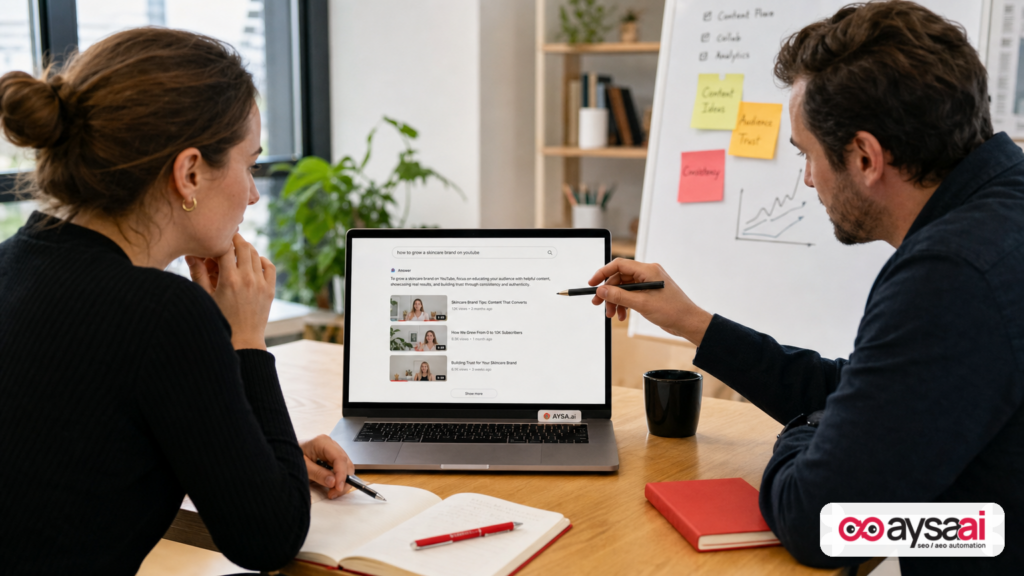
Ask YouTube is a small product update with a big strategic consequence: YouTube is training everyday users to search with full questions and expect an AI-generated answer that bundles video segments, full videos, Shorts, and follow-up prompts. That’s not just “another feature.” It’s a shift in discovery mechanics—especially for small and mid-sized businesses that rely on YouTube to create demand, earn trust, and turn attention into leads.
This editorial breaks down what changed, why it matters to businesses (not just creators), what can go wrong, and what to do next. I’ll also explain where AYSA fits as an execution system: we monitor, measure AI search visibility, prepare recommended improvements, request approval, and then execute accepted changes—so “strategy” doesn’t die in a Google Doc.
Concise summary
YouTube’s Conversational search experience, Ask YouTube, is expanding to signed-in U.S. desktop users (13+). Users can ask natural-language questions and receive AI responses that blend text with videos, Shorts, and prompts for follow-up questions. Standard YouTube Search still exists and can be toggled back.
For businesses, the practical implication is simple: you’re no longer optimizing only for “keywords” and thumbnails—you’re optimizing for answerable segments that an AI layer can confidently select, quote, and recommend. Structure and clarity (titles, chapters, and tight segments) become as important as production value.
Key takeaways
- Ask YouTube expands the “answer layer” into YouTube search. That changes how users browse and how creators get surfaced.
- Discovery becomes more segment-based. Chapters and clear topic transitions help systems match your exact moment to a question.
- Intent is expressed in full questions, not fragments. Your content strategy needs to map to real-world questions and follow-ups.
- Measurement won’t be perfect at first. You’ll likely need proxies and disciplined experimentation.
- Execution matters. The businesses that win will treat this as an operational capability, not a one-off optimization sprint.
Table of contents
- What changed: Ask YouTube goes from experiment to default behavior
- What Ask YouTube is (and what it isn’t)
- Why it matters: discovery is shifting from “search results” to “answer interfaces”
- The real change is behavioral: how people will search when answers are cheap
- The new optimization target: segments, chapters, and “answerable moments”
- Creator economics for businesses: views count, but trust counts more
- What can go wrong (and why most teams will feel “stuck”)
- How to measure impact without making things up
- An SME scenario: how one local business wins (or loses) in Ask YouTube
- What agencies should rethink: deliverables, not decks
- Where AYSA fits: monitoring + approved execution for AI-era search
- What to do next (practical action list)
- Sources and further reading
What changed: Ask YouTube goes from experiment to default behavior
According to Search Engine Land, YouTube expanded Ask YouTube beyond a Premium-only test and into a broader U.S. desktop audience. Specifically:
- It’s available to signed-in U.S. desktop viewers using English-language searches.
- Users must be 13+ (and signed in). Signed-out viewers and supervised accounts are excluded.
- The experience supports natural-language questions, AI-generated responses, surfaced videos/Shorts, and follow-up prompts.
- Standard YouTube Search isn’t removed; users can switch back.
If you run marketing for a business, you should read that list again and notice what’s missing: there’s no mention of creators getting a separate “Ask YouTube SEO console,” no guarantee of stable placement, and no promise of transparent reporting. That’s typical of new discovery layers. The opportunity arrives first; measurement and controls arrive later.
But the expansion is still an important inflection point: it’s no longer a gated, niche experiment. It’s the beginning of a behavioral shift, because the interface is training people to ask questions in the way they already ask ChatGPT, Gemini, or other AI assistants.
What Ask YouTube is (and what it isn’t)
Ask YouTube is best understood as a conversational search mode inside YouTube. The user asks a question. The system returns a blended result:
- A text response (an AI-generated synthesis).
- Video clips/segments (where a specific moment may answer the question).
- Long-form videos (deeper exploration).
- Shorts (quick hits or highlights).
- Follow-up prompts that encourage refinement.
What it isn’t (at least right now, based on the available information):
- Not a replacement for standard YouTube Search. Users can return to the traditional results view.
- Not “just another ranking factor.” This is a different product surface with different incentives: summarized answers and segment selection, not only a list of results.
- Not only for entertainment queries. The design makes it easier to ask practical questions: “How do I…?”, “What is…?”, “Which one should I buy…?”, “What’s the difference between…?”—exactly the question formats that precede purchases.
YouTube also said that views generated from Ask YouTube placements count toward total views and eligibility metrics in the YouTube Partner Program, per the Search Engine Land report. That matters because it tells us YouTube intends this to be a “real” discovery channel, not a sandbox.
Why it matters: discovery is shifting from “search results” to “answer interfaces”
The SEO industry spent two decades optimizing for ranked lists: 10 blue links, then richer SERPs, then blended results. AI systems are pushing a bigger change: answers become the interface.
On YouTube, that means users might get:
- A short synthesized answer, which reduces the need to open multiple videos.
- A curated set of clips, which changes watch behavior (and what “top of funnel” looks like).
- Follow-up prompts, which can steer the next query.
In plain business terms: you’re competing not only for Clicks or watches—you’re competing to be the source the AI layer trusts enough to recommend. That has two major consequences:
1) The “best video” isn’t always the “most entertaining video”
Entertainment still wins on watch time and subscriptions. But for Q&A discovery, the winners are often the videos (and specific moments) that are:
- Unambiguous
- Well-structured
- Directly responsive to the question
- Easy to segment
That’s good news for SMEs. You don’t need Hollywood polish to answer a question clearly. You need clarity, structure, and relevance.
2) You can “rank” without being opened first
If the user reads a text answer and sees a set of clips, your brand might be visible even before a click—or never get a click if the answer suffices. That’s not hypothetical; it’s the same pattern we’ve seen across AI answers in other environments: visibility and influence may rise while direct traffic becomes harder to attribute.
This is why we emphasize AI search visibility as a discipline. In AI-mediated discovery, being “mentioned” and being “chosen” can matter as much as being clicked.
The real change is behavioral: how people will search when answers are cheap
The most important thing happening here isn’t the UI. It’s the training effect.
When a search bar rewards full questions with coherent answers, users start asking better questions. Better questions are longer, more specific, and closer to purchase intent. Think about the difference between:
- “standing desk” (Keyword)
- “What standing desk is best for a small apartment and back pain?” (question)
- “Is bamboo durable?” (follow-up)
- “What’s the difference between dual-motor vs single-motor?” (follow-up)
That sequence is the customer journey—compressed into a few conversational turns. And YouTube is uniquely positioned to satisfy it, because video is often the fastest trust-builder for complex decisions: demonstrations, comparisons, walkthroughs, before/after proof, and “here’s what I would do if I were you.”
So here’s my point of view: Ask YouTube is an AEO moment for video. We’re moving from “optimize a video to rank” to “build an answer system with video as the proof layer.”
The new optimization target: segments, chapters, and “answerable moments”
YouTube, per the Search Engine Land write-up, encouraged creators to publish unique, high-quality content with clear chapters and descriptive titles, because those signals help match video segments to questions.
Let’s translate that into a practical framework you can operationalize.
Define “answerable moments”
An answerable moment is a segment—often 20 seconds to 2 minutes—where you:
- Restate the question in plain language
- Give a Direct answer early
- Provide one example or demonstration
- Clarify the edge cases (“Unless…”, “If you have…”, “Avoid if…”)
In a conversational search environment, these moments can be extracted, previewed, and recommended as the most relevant part. Your job is to make them easy to find.
Chapters are product strategy, not formatting
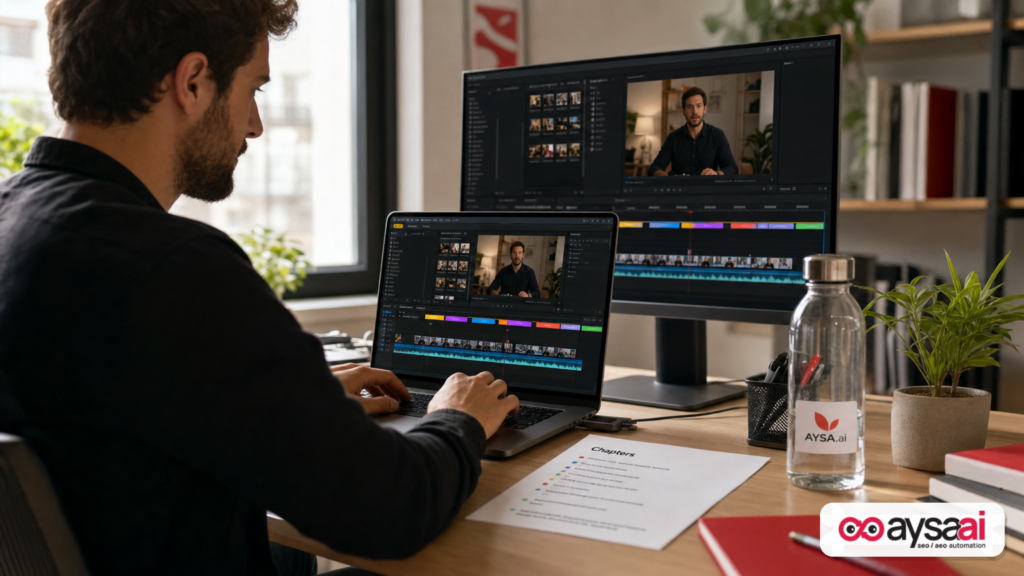
Many teams treat chapters like an afterthought: “We should add timestamps.” In an AI-assisted discovery world, chapters are:
- Indexable structure
- Implicit topic segmentation
- Navigation for humans and systems
If you’re an SME, you can win by being disciplined. A consistent chapter format across videos can become your competitive advantage because it makes your content library easier to parse.
Title for questions, not just keywords
Descriptive titles don’t have to be clickbait. A strong Ask YouTube-era title often includes:
- The question
- The audience/context
- The outcome/constraint
Example patterns:
- “How to Choose X (If You’re Y)”
- “X vs Y: Which Is Better for Z?”
- “What Happens If You Don’t Do X?”
- “X Explained in 5 Minutes (With Examples)”
Make follow-up questions predictable
Ask YouTube includes follow-up prompts. That means your content should anticipate the second and third question.
Operationally, when you plan a video, build a “follow-up map”:
- Main question: “How do I do X?”
- Follow-up 1: “What tools do I need?”
- Follow-up 2: “How much does it cost?”
- Follow-up 3: “How long does it take?”
- Follow-up 4: “What can go wrong?”
This isn’t just good pedagogy—it’s good distribution. If the system learns that your channel reliably answers the next question, you’re training it to keep recommending you.
Creator economics for businesses: views count, but trust counts more
YouTube says views from videos featured in Ask YouTube count toward view totals and YouTube Partner Program eligibility (again, per the Search Engine Land report). Businesses should care, but not for the obvious reason.
The obvious reason: more views is good.
The real reason: views are the cheap metric. Trust is the expensive one.
When an AI layer intermediates discovery, you risk getting:
- More Impressions, fewer clicks
- More previews, shorter watch segments
- More “awareness,” less attributable conversion
That doesn’t mean the channel is worse. It means your conversion system has to be stronger:
- Give the user a next step that doesn’t feel like an ad (checklist, calculator, guide, consultation, product finder).
- Use consistent naming and positioning so the brand sticks even when the user only watches a clip.
- Make it easy to continue on your site, where you control the journey.
This is where your website and your YouTube strategy converge. The better your on-site content hubs, Internal linking, and conversion paths, the more value you can capture from AI-mediated discovery—even if direct attribution gets fuzzier.
AYSA’s role is to connect those dots operationally: use monitoring to detect opportunities, use AI SEO tools to prepare improvements, then execute approved changes that strengthen the “landing” experience.
What can go wrong (and why most teams will feel “stuck”)
When a new search surface arrives, most teams fail in predictable ways. Here are the big ones I’m watching with Ask YouTube.
Failure mode 1: Treating it like a creator-only feature
If you’re a business, you might assume this is “for influencers,” not you. That’s a mistake. The queries that matter most to SMEs—“best,” “vs,” “how to,” “cost,” “near me,” “what happens if,” “is it worth it”—are exactly the queries that a conversational layer makes more common.
Failure mode 2: Publishing without structure
Some videos are great but messy: rambling intros, unclear topic shifts, missing chapters, ambiguous titles. Humans can tolerate that if they already trust you. AI retrieval systems generally prefer clarity.
Failure mode 3: Over-optimizing and losing credibility
When teams hear “AI,” they sometimes produce content that sounds engineered rather than useful: keyword-stuffed titles, generic scripts, and repetitive filler. The long-term winners will be the teams that keep content uniquely helpful and credible, then add structure that makes it retrievable.
Failure mode 4: Measuring the wrong thing
If you only track subscriber growth or raw view totals, you may miss the real KPI: whether Ask YouTube visibility increases qualified demand. That requires tying video topics to business outcomes (leads, bookings, product page sessions, demo requests), even if attribution is imperfect.
Failure mode 5: Strategy without execution
This is the classic: a consultant creates a plan, the team agrees, and nothing changes for 90 days because nobody owns implementation.
That’s precisely why AYSA is built around approved execution: we don’t just recommend; we prepare the work, ask for approval, and execute what you accept—so improvements actually ship.
How to measure impact without making things up
YouTube’s expansion announcement doesn’t include a detailed measurement framework, and we shouldn’t pretend it does. So how do you approach this responsibly?
Use a “proxy stack”
Until there’s explicit Ask YouTube reporting, measure with proxies you can verify:
- Topic-level view trends: Do clusters of Q&A videos rise together after you add chapters and sharpen titles?
- Audience retention around chapters: Do you see cleaner retention curves at the start of each “answerable moment”?
- On-site behavior: Do sessions to relevant landing pages increase after publishing or updating video content?
- Brand search lift: Do you see more branded queries in your normal search reporting over time?
- Lead quality notes: Are sales calls mentioning “I saw your video about…” more frequently?
Run controlled updates on existing winners
One of the best ways to avoid attribution myths is to update existing videos that already get steady demand:
- Add chapters
- Tighten the first 30–60 seconds to restate and answer the question
- Improve titles to match natural-language questions
- Refresh descriptions to clearly describe who it’s for and what it covers
If a stable video improves materially after structured changes, you’re seeing signal—not luck.
Track AI-era visibility across surfaces
Ask YouTube is one AI layer. Your customers also ask questions in other AI answer interfaces. That’s why we recommend monitoring overall AI visibility across your category and key topics. AYSA provides an AI search visibility approach that’s meant to be practical: detect where you’re missing, then prioritize execution.
An SME scenario: how one local business wins (or loses) in Ask YouTube
Let’s make this real with a scenario I see constantly.
The business
A local clinic (could be dental, dermatology, physical therapy—any service where trust and education matter). They rely on:
- Word of mouth
- Google visibility
- Occasional paid campaigns
- Some social content
They also have a YouTube channel with a handful of educational videos, but it’s inconsistent.
The Ask YouTube moment
A user goes to YouTube and asks: “Does whitening damage enamel?” Follow-up: “How long does it last?” Follow-up: “What should I avoid after whitening?”
If the clinic’s video is titled “Teeth Whitening Q&A,” with no chapters, a long intro, and vague descriptions, it may never be selected as the best segment to answer a specific question.
But if the clinic has one video titled “Does Teeth Whitening Damage Enamel? What Dentists Want You to Know,” with chapters like:
- 00:00 Short answer
- 00:40 What enamel is (quickly)
- 01:20 When whitening can cause sensitivity
- 02:10 How to reduce risk
- 03:05 How long results last
- 03:50 What to avoid for 24–48 hours
…then the system has a much easier job matching the right moment to the user’s question.
How the clinic captures business value (not just views)
The clinic then needs a next step that respects the user:
- A page on the site that answers the same questions in text (for skimmers)
- A simple “Is whitening right for me?” checklist
- A booking flow that’s frictionless
This is where execution matters. It’s not enough to “make videos.” You need the connected system: video → landing page → conversion.
AYSA helps by monitoring what topics matter, preparing on-site improvements, and executing approved changes quickly—so you don’t spend a quarter debating what to do.
What agencies should rethink: deliverables, not decks
If you run an agency, Ask YouTube expansion is a warning: your clients will increasingly judge you on outcomes in AI-mediated discovery, not on classic rank trackers alone.
Here are the shifts I’d recommend:
Shift 1: From “keyword research” to “question research”
Clients still need keyword coverage, but the content plan should be framed as:
- Core questions
- Follow-up questions
- Objections and misconceptions
- Comparisons and alternatives
Shift 2: From “content calendars” to “content systems”
A calendar says what you’ll publish. A system defines:
- How every piece is structured
- How it links to on-site assets
- How it’s measured
- How it’s refreshed
Shift 3: From “recommendations” to “execution velocity”
The best strategy in the world is worthless if it takes 12 weeks to ship basic improvements. This is why I believe agency stacks will increasingly include tools and partners that can prepare and execute changes efficiently, with approvals and guardrails.
If you’re an agency, you can use AYSA to operationalize execution: monitor, prepare, approve, execute. Learn more about AYSA’s tooling at aysa.ai/ai-seo-tools and see how we approach continuous monitoring.
Where AYSA fits: monitoring + approved execution for AI-era search
Ask YouTube highlights a broader pattern: AI layers are popping up everywhere customers ask questions. The winning teams won’t be the ones who “figure it out once.” They’ll be the ones who build a repeatable capability.
Here’s how AYSA fits into that capability.
1) Monitor the topics and surfaces that matter
You can’t manage what you don’t track. AYSA’s monitoring helps you keep an eye on visibility shifts and opportunities—so you’re not surprised when traffic patterns change.
2) Translate insights into concrete, prioritized work
In AI-era search, “content ideas” are cheap. What’s scarce is the ability to turn ideas into:
- Updated landing pages
- Better internal linking
- Clearer on-page explanations
- Better structured hubs that match user questions
AYSA prepares recommended changes so your team sees exactly what would change and why.
3) Keep humans in control with approvals
Most businesses can’t allow a tool to freely rewrite their site. That’s reasonable. AYSA’s model asks for approval before changes go live, which is the only sustainable path for brands that care about accuracy and compliance.
4) Execute accepted changes—fast
The execution step is where most programs fail. AYSA exists to make sure accepted improvements actually ship. That’s especially important as AI search surfaces evolve quickly. A six-month implementation cycle is a competitive disadvantage.
If you want to evaluate whether this is worth it for your business, start at aysa.ai/pricing and browse the latest thinking on the AYSA blog.
What to do next (practical action list)
Here’s a practical list you can run in the next 30 days without waiting for perfect data.
1) Pick 10 “money questions” customers ask before buying
- Cost and pricing
- Best option for a specific use case
- Comparison vs alternatives
- Risks and downsides
- Timeline and what to expect
2) Audit your existing YouTube videos for structure
- Do titles clearly match a question?
- Do you answer early?
- Do you have chapters that reflect real sub-questions?
- Can someone jump to “the moment” that answers the query?
3) Update 3 existing videos before producing new ones
Start with videos that already have consistent views. Add chapters, tighten intros, and align titles to natural-language questions.
4) Create one “hub page” per major topic on your website
This is how you convert YouTube discovery into business outcomes. A hub page should:
- Answer the core question in text
- Embed the relevant video(s)
- Link to next-step pages (service, product, booking)
- Include FAQs that match follow-up questions
5) Set up measurement proxies
- Track topic-cluster performance (not just single videos)
- Watch retention around key chapters
- Monitor related on-site sessions and conversions
- Keep a simple “lead source notes” field for sales/support
6) Build a refresh rhythm
Conversational search rewards freshness differently: not just “new,” but “newly relevant.” Commit to a monthly refresh of:
- Top-performing Q&A videos (chapters, titles)
- Associated hub pages (FAQs, internal links)
- CTAs and next steps
7) Use AYSA to operationalize the site-side execution
If your bottleneck is implementation, start with:
- AI search visibility to see where you’re missing in AI answers
- Monitoring to spot shifts early
- AI SEO tools to prepare changes
Sources and further reading
- Search Engine Land: Ask YouTube AI search experience expands to U.S. desktop users
- Search Engine Land: Google Search Console gains reporting on social and video platforms (context on multi-surface reporting trends)
- Search Engine Land: ChatGPT commands 92% of AI referral traffic. Here’s what 6.77 million sessions reveal. (broader AI discovery context)
- Search Engine Land: Gemini Intelligence signals a new era for search and commerce (macro trend: AI decision layers)
- Search Engine Land: Winning the AI decision layer: From AI discovery to agentic commerce (strategic framing for AI-mediated discovery)
- AYSA.ai: AI Search Visibility
- AYSA.ai: Monitoring
- AYSA.ai: AI SEO Tools
- AYSA.ai: Pricing
- AYSA.ai: Blog
Continue the AI search topic inside AYSA.
Use these pages to connect the article with AI SEO tools, AI visibility monitoring, AI Overviews and approved website execution.
Turn this topic into a website action plan.
Use these AYSA hubs to move from reading to technical fixes, AI visibility monitoring, research, glossary context and approval-first SEO execution.

