ChatGPT Ads Manager updates: What the new overview tab, suggested drafts, and new formats mean for paid search (and your AI visibility strategy)
OpenAI is iterating fast on ChatGPT Ads: a new overview tab, suggested ad drafts built from website metadata, refreshed ad cards, and expanded targeting in Japan and South Korea. Here’s what changed, why it matters for SMEs and agencies, and how to build an execution-first plan that connects paid testing with AI search visibility.

ChatGPT Ads is moving from “interesting new placement” to “operational ad platform” in real time. OpenAI is rolling out a new overview tab, suggested ad drafts based on your website metadata, refreshed ad card formats, and broader market availability (including Japan and South Korea). Those sound like UI tweaks—until you realize what they signal: ads inside AI interfaces will reward the same businesses that win in AI discovery.
If you’re a founder, marketer, or agency operator, you should read these changes as a warning and an opportunity. A warning because AI-driven ad experiences compress the time between what your site says and what a user sees. And an opportunity because early movers can build a repeatable loop: test messaging in paid, improve the site, strengthen AI visibility, and compound results across channels.
Concise summary
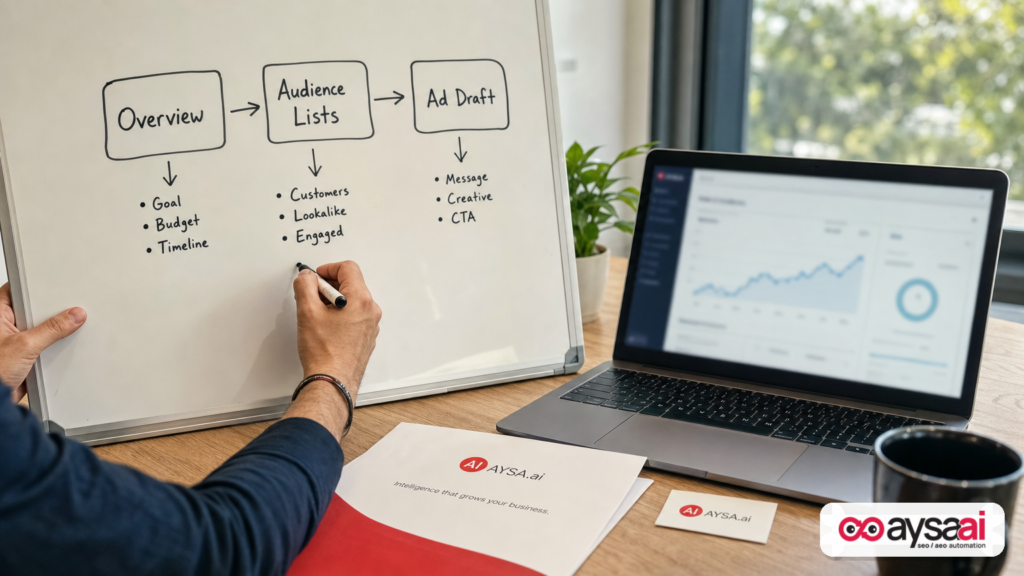
- What changed: ChatGPT Ads Manager added an account overview tab, expanded custom audiences and bid multipliers, introduced suggested ad drafts prefilled from website metadata, refreshed the static ad card format, and expanded ads availability to Japan and South Korea.
- Why it matters: Suggested drafts tie ad creation to your site’s metadata quality. Better structured content and assets don’t just help SEO—they can speed paid iteration and reduce creative bottlenecks.
- What to do: Tighten metadata and image standards, set up audience suppression, build a testing matrix, and instrument measurement that connects ad learnings to on-site execution.
- Where AYSA fits: AYSA monitors your AI Search visibility and site health, prepares the improvements that affect both discovery and conversion, asks for approval, and executes accepted website changes—so “learning” becomes “shipping.”
Table of contents

- What changed in ChatGPT Ads (and what didn’t)
- Why these updates matter now: the AI interface is becoming the decision layer
- The Overview tab: why “account health” is the new minimum
- Suggested ad drafts from metadata: why this is bigger than it sounds
- Custom audiences and bid multipliers: where ChatGPT Ads starts to look like “real PPC”
- Refreshed ad card formats: small UI change, big creative implications
- Japan and South Korea expansion: what global targeting changes for SMEs
- What can go wrong: brand risk, thin metadata, and measurement blind spots
- A practical SME scenario: using ChatGPT Ads to find your next best category page
- What agencies should rethink: process, reporting, and content-ad alignment
- The AYSA perspective: approved execution wins in AI + ads
- What to do next (action list)
- Sources and further reading
What changed in ChatGPT Ads (and what didn’t)

Search Engine Land reported that OpenAI sent advertisers an email detailing several updates across ChatGPT Ads Manager and the on-surface ad experience, including:
- Custom audiences: upload user lists (with a stated minimum size) to include or suppress audiences, plus bid multipliers at the ad group level.
- Overview tab: consolidated monitoring for account health, recommended tasks, and key performance metrics with more flexible trend views.
- Suggested ad drafts: a workflow to prefill an ad draft using existing website metadata (image, title, description). Notably, the report emphasized this does not generate new copy or imagery with AI; it’s prefill from your existing assets.
- New/updated ad card format: a refreshed static card designed to be more compact and readable with larger visuals.
- Geographic expansion: ChatGPT Ads live in Japan and South Korea.
Source: Search Engine Land.
What didn’t change is equally important: we’re still early in the lifecycle of ads inside AI chat interfaces. That means shifting policies, evolving placements, and incomplete norms for Attribution and reporting. Businesses that treat this like “set and forget PPC” will be disappointed. Businesses that treat it like a structured learning program will build an advantage.
Why these updates matter now: the AI interface is becoming the decision layer
Traditional paid search rewarded a specific skill set: Keyword Intent mapping, ad copy testing, landing page relevance, and Conversion rate optimization. AI chat experiences change the texture of demand capture:
- Discovery is conversational. Users often ask for comparisons, “best for me” guidance, or bundled recommendations rather than searching a short head term.
- The interface mediates choices. Even when a user Clicks out, the AI interface pre-frames what’s “important” (features, pricing expectations, trust cues).
- Your site is not just a destination; it’s an input. The suggested ad drafts feature makes this explicit: your metadata can become ad creative scaffolding.
In that world, paid search isn’t isolated. It’s entangled with:
- AEO (Answer Engine Optimization): whether your business is described accurately when users ask questions.
- GEO (Generative Engine Optimization): whether AI systems reliably surface your products/services, and whether your information is complete and consistent.
- Execution velocity: how quickly you can update pages, fix missing metadata, and ship improvements informed by ad learnings.
This is where many SMEs lose. Not because they lack ideas, but because they lack throughput. They run tests, gather insights, then stall on implementation. The organizations that win will shorten that loop.
The Overview tab: why “account health” is the new minimum
An overview tab sounds basic—Google Ads has long conditioned marketers to expect consolidated dashboards. But when a platform highlights “account health” and “recommended tasks,” it’s telling you how it expects advertisers to operate: continuously, with hygiene and iteration.
For SMEs, the risk is that “dashboard comfort” becomes a substitute for performance work. An overview page can make you feel in control while you’re missing the fundamentals:
- Are you segmenting by intent or just bundling everything?
- Are you aligning ad promises with landing pages?
- Are you measuring what happens after the click (qualified leads, margin, retention)?
For agencies, the overview tab is a warning shot: clients will have simpler ways to interpret performance at a glance. If you’re not adding strategic insight—creative hypotheses, audience strategy, landing page improvements—your reporting becomes redundant.
Practical move: treat the overview as your daily “triage screen,” not your decision engine. Your decisions should come from structured experiments and post-click outcomes.
Suggested ad drafts built from your site metadata: why this is bigger than it sounds
Search Engine Land’s report included a detail many people will gloss over: suggested ad drafts use existing website metadata to prefill an ad draft with image, title, and description—and it explicitly does not generate new creative with AI.
That constraint is precisely why it matters.
1) Metadata is no longer just “SEO stuff”—it becomes ad inputs
For years, SMEs treated metadata as an afterthought:
- Default titles like “Home” or “Product Page”
- Auto-generated descriptions that repeat navigation
- Missing or low-quality social sharing images
- Inconsistent brand naming
When a platform can prefill an ad from that data, weak metadata stops being a theoretical SEO issue and becomes an immediate paid performance drag. Your ad drafts will be bland, off-brand, or incomplete—and your team will spend time cleaning up avoidable mess.
2) Ads and AI visibility share a root problem: clarity
AI systems and ad platforms both need the same core inputs:
- Clear categorization: what is this page about?
- Accurate claims: what do you actually offer?
- Strong assets: images that represent the product/service truthfully.
- Consistency: do your pages agree with each other, and with the business’s real-world policies?
If you want to show up in AI answers and run ads efficiently, you need to be legible. Not clever. Not “brand poetic.” Legible.
3) The bottleneck moves from “writing ads” to “fixing the website”
Suggested drafts reduce friction in one place—ad assembly—but they increase the pressure on another place: your website’s underlying content system. If your product pages are inconsistent, if your service pages are thin, if your images are mismatched, the drafts will reflect that.
This is where execution systems win. At AYSA, we care less about producing a PDF of recommendations and more about a pipeline that actually lands the improvements on your site:
- Monitor issues and opportunities
- Prepare specific fixes (metadata, page structure, internal links, content gaps)
- Ask for approval
- Execute accepted changes
If you want the suggested-draft feature to work for you, your website needs to be ad-draft-ready—meaning structured, consistent, and up to date.
Related AYSA resources: AI Search Visibility and Monitoring.
Custom audiences and bid multipliers: where ChatGPT Ads starts to look like “real PPC”
Custom audiences and bid multipliers move ChatGPT Ads from “contextual placement” toward the mechanics performance marketers rely on to control efficiency.
Based on the report, advertisers can upload sufficiently large user lists to:
- Include audiences (e.g., known prospects, high-LTV users, newsletter subscribers)
- Suppress audiences (e.g., customers who already purchased, support-ticket users, job applicants)
- Apply bid multipliers at the ad group level
Suppression is often the fastest ROI lever
Most SMEs think of audiences as a way to “target better.” In practice, suppression is frequently where the money is. If you’re paying to send existing customers to acquisition landing pages—or paying to show promos to people who can’t buy—you’re leaking budget.
SME example: A local clinic running appointment ads might want to suppress recent patients who already booked follow-ups, and instead prioritize lapsed visitors or people who downloaded pre-visit forms but didn’t schedule.
Bid multipliers force a testing discipline
Bid multipliers make you articulate a hypothesis: “This audience is worth more.” That pushes better measurement conversations:
- What’s a qualified lead?
- What’s the conversion window?
- What’s the real margin by product/service?
- What is the value of a repeat purchase?
Even if attribution inside AI experiences evolves, the discipline of valuation is non-negotiable.
For additional context from Search Engine Land’s coverage of the audience lists rollout, see: ChatGPT Ads rolling out audience lists.
Refreshed ad card formats: small UI change, big creative implications
OpenAI is rolling out a refreshed static ad card format across web and mobile that’s more compact and easier to read, with larger visual elements (per the Search Engine Land report).
Whenever a platform shifts layout, three things change for advertisers:
- What gets noticed: a larger image can dominate recall, meaning your visual standards matter more.
- What gets truncated: compact formats often shorten visible text, so your first words carry more weight.
- How “ad-like” it feels: certain cards can feel more native or more interruptive, changing user trust and click behavior.
Creative standards to audit before you scale spend
- Image consistency: Do images accurately represent the offer, or are they generic lifestyle fillers?
- Mobile legibility: If the card is compact, does your imagery still communicate without tiny details?
- Brand cues: Can users recognize you quickly without feeling tricked?
- Landing page continuity: Does the landing page hero area match the ad’s promise and imagery?
This is not “design nitpicking.” It’s conversion rate.
Japan and South Korea expansion: what global targeting changes for SMEs
OpenAI said ChatGPT Ads are live in Japan and South Korea, allowing campaigns to target users in those markets (per Search Engine Land’s report).
If you do business internationally—or you’re an ecommerce brand with cross-border demand—this matters immediately. But it also increases complexity.
International ads expose international site weaknesses
When you target new markets, your website needs to answer basic questions in-market:
- Do you ship there? How long? What does it cost?
- Are prices in local currency?
- Are returns and warranties clear?
- Is customer support available in-language?
If those answers are missing, you can buy attention but you can’t buy trust.
Translation isn’t localization
Many SMEs make the mistake of translating copy without localizing the offer structure. Even without introducing new claims, you should ensure:
- Local measurement units
- Local payment preferences (where relevant)
- Local compliance language (as applicable)
- Local social proof (where you truly have it)
If you can’t do that yet, keep experiments small and treat them as research—then invest in the site improvements that unlock scale.
What can go wrong: brand risk, thin metadata, and measurement blind spots
New ad platforms create new failure modes. Here are the big ones I’d watch.
Risk #1: Your site metadata is messy, so your ad drafts are messy
Suggested drafts are only as good as their inputs. Common SME issues:
- Duplicate titles across many pages
- Missing descriptions or boilerplate templates
- Low-quality default images (or no images)
- Mismatched page intent (a category page that reads like a blog post)
Mitigation: standardize templates for key page types (home, categories/services, product detail, location pages), then enforce them.
Risk #2: “Native” placements can amplify brand safety mistakes
Ads inside conversational interfaces may feel more like recommendations to users. That increases the consequences of:
- Overpromising (“best,” “#1,” “guaranteed”) without substantiation
- Unclear eligibility (who the offer is for)
- Ambiguous pricing
Mitigation: align ad claims with on-page proof. If you can’t prove it on the landing page, don’t put it in the ad.
Risk #3: Measurement lags reality, so teams optimize the wrong thing
With emerging placements, teams may default to what’s easy to see (clicks) instead of what matters (profit, qualified leads, retention). You need a measurement plan that answers:
- What is a qualified lead? How is it marked in CRM?
- What is the payback window?
- Which products/services are margin winners?
- What happens to users who arrive from AI interfaces—do they browse differently, bounce faster, convert later?
Mitigation: build a simple “decision dashboard” outside the ad platform, even if it starts as a spreadsheet: spend → leads → qualified leads → sales → gross margin.
Risk #4: You learn fast, but your site can’t ship fast
This is the silent killer. You run tests, you find the winning message, and then your website stays unchanged for six weeks because:
- no one owns the CMS
- dev is backlogged
- legal review is slow
- there’s no approval workflow
In AI-driven markets, speed compounds. This is exactly why we built AYSA as an execution system, not a reporting tool.
A practical SME scenario: the ecommerce brand that uses ChatGPT Ads to find its next best category page
Let’s make this concrete without pretending we have perfect data about performance inside ChatGPT Ads (we don’t, and you shouldn’t trust anyone who claims universal benchmarks today).
Scenario: A 12-person ecommerce brand sells premium home office furniture. They already run Google Ads and email marketing. Organic traffic is volatile, and they’re trying to build visibility in AI answers when people ask, “What’s the best ergonomic chair for a tall person?” or “Best chair under $500 that doesn’t look like gaming.”
Step 1: Use ChatGPT Ads for message discovery, not just cheap clicks
They launch small-budget campaigns with 3–5 distinct value propositions:
- “Tall-friendly fit” (dimensions and adjustability)
- “Workday comfort” (materials, warranty)
- “Design-forward office” (aesthetic appeal)
- “Fast shipping + easy returns” (risk reversal)
They do not assume the “best” message is the one with the highest CTR. They care about qualified add-to-carts and lower return rates.
Step 2: Fix metadata so suggested ad drafts are actually usable
If suggested drafts pull from site metadata, the brand standardizes:
- Category page titles that reflect real queries (“Ergonomic Chairs for Tall People” rather than “Shop Chairs”)
- Descriptions that state differentiators and constraints (price bands, shipping regions)
- Consistent, high-quality category imagery that matches inventory
Step 3: Use winning ads to decide what to build on the site
They discover that “tall-friendly fit” drives the most qualified traffic, but their website doesn’t have a true “tall people” category page—just a filter buried in navigation.
So they build:
- a dedicated category/collection page
- a short fit guide with measurable specs
- FAQ blocks that answer common questions (seat height, headrest range, return policy)
- internal links from relevant blog posts and product pages
This is how paid becomes a product strategy input for the website—and how website improvements can improve AI visibility over time.
Where AYSA fits: AYSA can monitor AI visibility for those queries, prepare the content and internal linking plan, request approval, and execute the accepted changes on the site. See: AYSA AI SEO Tools and Monitoring.
What agencies should rethink: process, reporting, and content-ad alignment
If you’re an agency, ChatGPT Ads updates should trigger a process audit.
Stop selling setup; sell iteration
New platforms create a temptation to sell “we’ll set up ChatGPT Ads for you.” Setup is table stakes. The value is in:
- creative testing systems
- audience strategy (especially suppression)
- landing page alignment
- measurement and CRM integration
Connect paid learnings to owned-asset execution
The suggested draft workflow makes it obvious: the website is upstream of ads. Agencies that can’t influence the site will hit a ceiling.
This is why an execution partner (or an execution platform) becomes strategic. At AYSA, we designed the workflow to reduce the “agency recommendation backlog” problem: the system monitors, prepares, asks for approval, and executes accepted changes. That means an agency can focus on strategy and creative, while execution happens reliably.
Learn more: AYSA Pricing and the AYSA blog.
Report on decisions, not dashboards
When clients have their own overview tabs, the agency report should answer:
- What did we test?
- What did we learn?
- What did we change on the website because of it?
- What will we test next?
This is how you remain indispensable.
The AYSA perspective: approved execution wins in AI + ads
I’ll be direct: most businesses don’t have an “ideas” problem. They have an execution problem.
ChatGPT Ads’ suggested drafts feature is a perfect example. It can speed ad creation. But it will also expose whether your site is structured well enough to feed that system. If you’re missing clean metadata, strong images, and clear product/service descriptions, you’ll spend your time patching drafts rather than compounding performance.
AYSA is built for this moment:
- Monitor: track your AI search visibility and site signals that affect discovery and conversion. Start here: AI Search Visibility.
- Prepare: generate a concrete set of improvements (not generic advice) across technical, content, and internal linking—based on what’s actually missing.
- Approve: you stay in control; changes are proposed and require human approval.
- Execute: accepted changes get implemented so insights become outcomes.
The businesses that win in AI-driven advertising won’t be the ones with the flashiest “AI-generated” ad copy. They’ll be the ones with the cleanest foundation and the fastest approval-to-implementation cycle.
What to do next (action list)
Use this as a practical checklist—whether you’re an SME running ads yourself or an agency managing multiple accounts.
1) Standardize website metadata for your money pages
- Audit titles/descriptions on top landing pages (services, categories, top products).
- Ensure each page has a unique, descriptive title that matches intent.
- Ensure descriptions clearly state offer, constraints, and differentiators.
- Set image standards (dimensions, quality, brand consistency) for pages likely to be used in ad drafts.
2) Build audience lists with suppression first
- Create a suppression list for recent buyers / existing customers where appropriate.
- Create a “high intent” list (email subscribers, product configurator users, repeat visitors) where compliant and available.
- Apply conservative bid multipliers until you validate incremental lift.
3) Create a simple creative testing matrix
- Test 3–5 value propositions, not 30 micro-variations.
- Map each proposition to a landing page that proves the claim.
- Track post-click quality (qualified leads, add-to-cart rate, call quality).
4) Fix measurement before scaling spend
- Define “qualified” in CRM or analytics.
- Track gross margin where possible, not just revenue.
- Segment new vs returning customers.
5) Build an execution pipeline (or borrow one)
- Assign ownership for site changes (content + technical).
- Create an approval workflow so changes don’t stall.
- If you need an execution system, evaluate AYSA’s approval-based model: Monitoring and Pricing.
Sources and further reading
- Search Engine Land: ChatGPT Ads new overview tab, suggested ad drafts, new ad formats and more
- Search Engine Land: ChatGPT Ads rolling out audience lists
- Search Engine Land: ChatGPT commands 92% of AI referral traffic (session data analysis) (useful context for thinking about AI-driven referral behavior, not as a universal performance benchmark)
- Search Engine Land: Google expands AI ad disclosures across Search, YouTube, Discover (broader context on ads + AI transparency expectations)
- Search Engine Land: Gemini Intelligence signals a new era for search and commerce (context on search/commerce evolution)
- Search Engine Land: Winning the AI decision layer: From AI discovery to agentic commerce (strategic framing)
Related AYSA resources:
Note: This editorial is based on the cited Search Engine Land reporting and analysis of what these platform mechanics imply for advertisers. Where the underlying platform documentation is not included in the provided research context, I’ve avoided making claims about specific policies, attribution models, or performance benchmarks.
Continue the AI search topic inside AYSA.
Use these pages to connect the article with AI SEO tools, AI visibility monitoring, AI Overviews and approved website execution.
Turn this topic into a website action plan.
Use these AYSA hubs to move from reading to technical fixes, AI visibility monitoring, research, glossary context and approval-first SEO execution.