LLMs.txt vs WebMCP: The Two Bets Every Website Is Making In The Agentic Web (And What SMEs Should Do Next)
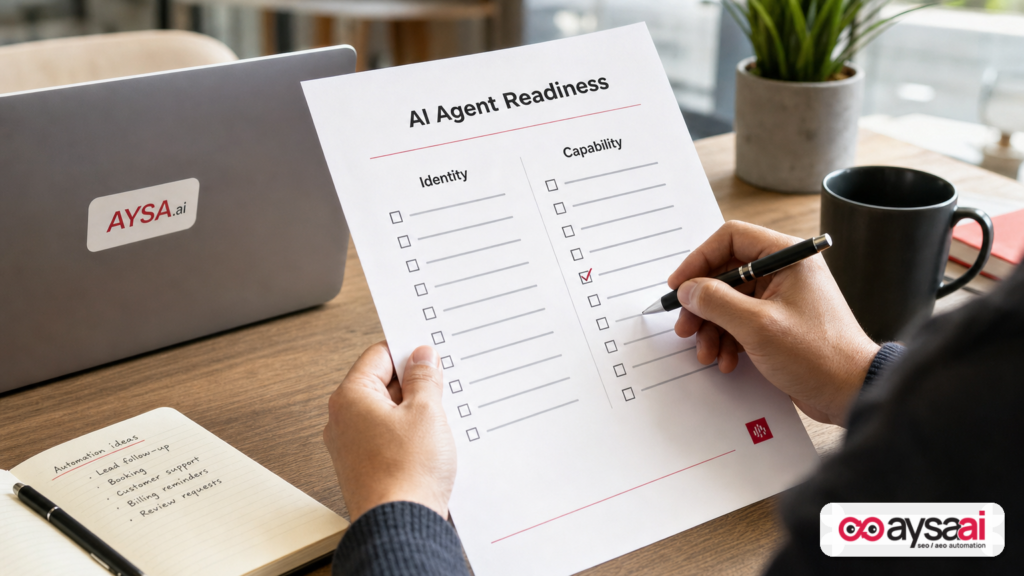
AI agents don’t just read your site—they try to complete tasks. LLMs.txt is an identity brochure. WebMCP is a capability layer that lets agents take real actions. Here’s how to choose, what can go wrong, and how to operationalize both with approved execution.

AI Search visibility used to be about one thing: getting crawled, indexed, and ranked.
Now it’s about two things at once:
- Whether an AI system understands who you are (identity), and
- Whether an AI agent can actually complete a task on your site (capability).
This is a bigger shift than most businesses realize. When agents start doing the work—shopping, booking, comparing, submitting, returning—your website stops being “just content” and becomes a set of machine-invocable actions.
That’s why I’m paying close attention to a split that Search Engine Journal highlighted: LLMs.txt (identity) vs WebMCP (capability). The original research framing is worth reading here: The Agentic Web Is Splitting Into Two Bets: Identity And Capability (Search Engine Journal).
In this AYSA.ai editorial, I’ll go beyond the headline and turn it into a practical playbook for SMEs and agencies: what changed, why it matters, what can go wrong, and what to do next—especially if you don’t have a giant engineering team.
Table of contents
- The Concise Summary (Read This If You’re Busy)
- Key Takeaways
- What Changed: The Protocol Layer Is Splitting
- Two Questions AI Agents Ask: Identity vs Capability
- The Identity Bet (LLMs.txt): “Who Are You?”
- The Capability Bet (WebMCP): “What Can Your Site Do For An Agent?”
- Why Identity And Capability Aren’t Interchangeable
- What Can Go Wrong (And Usually Does)
- A Concrete SME Scenario: “The Local Clinic With A Busy Front Desk”
- What Agencies Need To Rethink In 2026
- What To Monitor: Signals That Your Bet Is Working
- The 30-Day Action Plan (SME-Friendly)
- Where AYSA Fits: Monitoring + Approved Execution
- What To Do Next
- Sources And Further Reading
The Concise Summary (Read This If You’re Busy)
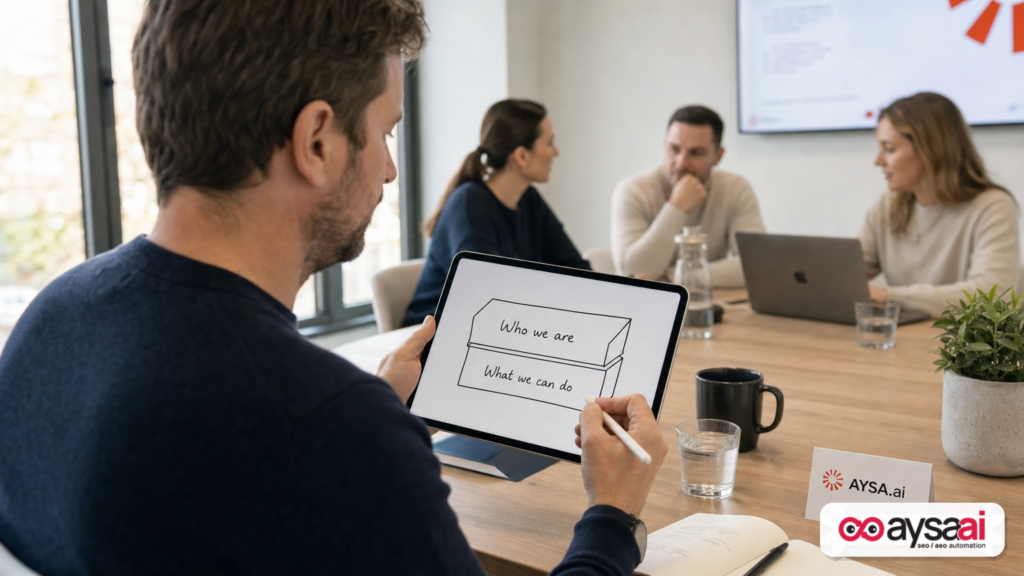
LLMs.txt is a simple text file you publish to describe your site and your most important pages. It’s about identity: helping AI systems understand what you are.
WebMCP (Web Model Context Protocol) is positioned as a browser-level way for websites to expose callable tools to AI agents. It’s about capability: helping AI agents do things on your site.
These are not substitutes. A “perfect identity” doesn’t mean an agent can book, buy, return, or schedule. And exposing actions without a trustworthy identity layer can still lead to wrong answers, wrong citations, and user distrust.
If you’re an SME, your best move is usually:
- Audit what you’re already publishing (many sites now have an llms.txt by default),
- Make your identity consistent everywhere (site, schema, listings, about pages, policies),
- Improve task completion (clean paths for booking, inventory, pricing, returns, contact),
- Operationalize it with Monitoring and Approved Execution so your site doesn’t drift.
That last part—execution—matters more than the file format. That’s the gap AYSA.ai is built to close.
Key Takeaways

- Identity is “Who are you?” Capability is “What can a machine do here?” Treat them as different workstreams.
- Defaults are not strategy. If your CMS/plugin generated an llms.txt, it may be inaccurate or incomplete—and you might not even know it exists.
- Capability maps closer to revenue. If your business depends on bookings, quotes, inventory, or transactions, you’ll get more leverage from making actions clean and machine-friendly than from publishing another index file.
- Don’t wait for one “standard” to win. You can make your site more agent-friendly today with technical hygiene, Structured data, and simpler task flows.
- Monitoring + execution is the moat. AI search changes quickly; the winners will be the businesses that detect shifts early and ship updates safely.
What Changed: The Protocol Layer Is Splitting
For years, “SEO” was a set of tactics aimed at a fairly stable workflow:
- Search engine crawls your site,
- Search engine indexes your pages,
- Ranking algorithms decide where you appear,
- Humans click and navigate.
AI-driven discovery breaks the simplicity of that model.
In AI results, the system might cite you without sending a click. Or it might send an agent that tries to complete a task. Or it might do both depending on the query type. This is why the web is now developing a new “protocol layer” geared toward machine consumption and machine action.
Search Engine Journal’s analysis captures the key idea: the agentic web is effectively splitting into two bets—identity (LLMs.txt) and capability (WebMCP). See: Search Engine Journal.
My take: this isn’t just a technical debate. It’s a budget debate.
If you’re a business owner, you don’t have infinite time to “make your site AI-ready.” You need to know where the return is: what improves trust, citations, and conversions. Identity and capability deliver value differently—and at different times in the customer journey.
Two Questions AI Agents Ask: Identity vs Capability
When a machine lands on your digital property, it needs two categories of context:
1) Identity: “What is this place?”
This is entity-level clarity:
- What business is this?
- What do you sell or provide?
- Where do you operate?
- What are the canonical pages and policies?
- What topics are you authoritative in?
Historically, we solved this via consistent on-site content, Internal linking, and structured data (schema). LLMs.txt is an attempt to provide a simple, curated map of that identity in one place.
2) Capability: “What can I do here?”
This is task-level clarity:
- Can I check inventory in a specific location?
- Can I compare prices, shipping speed, and returns?
- Can I schedule an appointment?
- Can I generate a quote with specific parameters?
- Can I initiate a return or claim?
Historically, we forced machines to “read” a user interface and guess which buttons to click—fragile, error-prone, and expensive.
WebMCP is positioned as a more direct approach: a site declares the actions an agent can call (think: tools/functions), rather than forcing the agent to reverse-engineer the interface.
The Identity Bet (LLMs.txt): “Who Are You?”
LLMs.txt is typically described as a plain-text (often markdown-style) file placed at the root of a domain (example format: HTTPS://example.com/llms.txt).
The appeal is obvious:
- It’s easy to publish.
- It’s easy to read.
- It can cut through page clutter and point machines to your most important resources.
But here’s the operational truth for SMEs: easy-to-publish does not mean safe-to-publish.
The default-generation risk
As the SEJ piece notes, llms.txt is being generated by default in parts of the ecosystem (notably WordPress plugins). That means a lot of businesses may have an “AI identity brochure” live on their domain that they never reviewed.
And if that file is wrong, outdated, or incomplete, it’s not a harmless artifact. It’s a canonical-sounding statement about your business that can conflict with:
- your real site navigation,
- your current services/pricing/policies,
- your location coverage,
- your newest product categories,
- or the pages you actually want cited.
To be clear: I’m not anti-llms.txt. I’m anti “ship it and forget it.”
What llms.txt can realistically help with (today)
Even if adoption by major AI systems remains uncertain (and SEJ reports skepticism from Google’s John Mueller in the context of llms.txt usage), llms.txt can still be useful internally:
- As a forced prioritization exercise: what are your top pages and why?
- As an index QA tool: do you know what you want machines to treat as canonical?
- As an alignment artifact: marketing, SEO, and product teams can agree on “the map.”
But if you publish it publicly, treat it like any other public-facing claim: it needs ownership, review, and change control.
Identity work that often matters more than llms.txt
If you’re an SME trying to show up in AI answers, the biggest identity improvements are usually boring—but powerful:
- Clear “About” and “Contact” pages with consistent entity details
- Location/service area clarity (especially for local and multi-location)
- Well-structured category/service pages (not just blog content)
- Policy pages that match reality (shipping, returns, cancellations)
- Schema that matches on-page content (no “SEO schema theater”)
This is the foundation for AEO/GEO: answer engine optimization and Generative Engine Optimization. If you want an overview of how AYSA frames this work, start here: AI search visibility at AYSA.ai.
The Capability Bet (WebMCP): “What Can Your Site Do For An Agent?”
WebMCP (Web Model Context Protocol) is described in the SEJ analysis as a browser standard that lets websites expose tools to agents via a browser API (SEJ mentions navigator.modelContext).
In plain business terms, it’s an attempt to shift from:
- “Read our UI and guess”
to:
- “Here are the actions we support—call them like functions”
This matters because UI-driven automation is fragile. Buttons move. Labels change. A/B tests reshuffle flows. Popups block clicks. Consent screens interrupt sessions. A human adapts. A machine fails silently—or worse, completes the wrong task.
Capability tends to map closer to revenue
For many SMEs, the highest-value “agent outcomes” are not informational. They’re transactional:
- Ecommerce: find product → validate stock → price/shipping → purchase
- Local services: find service → check availability → book → pay/deposit
- Clinics: find provider → insurance/cost rules → schedule
- Hotels: date search → room selection → booking
- SaaS: plan comparison → trial signup → onboarding steps
If you only invest in identity, you may be cited more often—but still lose the transaction to a competitor whose site is easier for agents (and humans) to complete the task on.
You don’t need WebMCP adoption to start capability work
This is the trap: businesses hear “new protocol” and assume they must wait. Don’t.
Capability can be improved immediately through fundamentals that make both humans and machines more successful:
- Server-rendered critical pages (so important content and actions are accessible)
- Fast, stable flows (Core Web Vitals still matter when agents and humans bounce)
- Simple internal search with clean URLs for filtered results (when appropriate)
- Predictable forms with clear labels and error handling
- Structured data that accurately describes products, services, locations, and policies
WebMCP (if and when it becomes widely supported) would amplify the benefits. But the baseline work is the same work good businesses should be doing anyway.
Why Identity And Capability Aren’t Interchangeable
Here’s the mistake I see coming for 2026: teams will treat llms.txt as a “checkbox” that equals agent readiness.
It doesn’t.
Identity answers: “What are you?”
Capability answers: “What can be done here reliably?”
A great identity layer with weak capability produces frustrating outcomes:
- The AI cites you…
- The user (or agent) arrives…
- Then the flow breaks (inventory unclear, booking confusing, pricing hidden, policy ambiguous).
A strong capability layer with weak identity creates a different failure:
- The agent can do tasks…
- But the system doesn’t trust you enough to recommend or cite you often.
So the right question isn’t “Which one wins?” It’s “Which one is my bottleneck right now?”
What Can Go Wrong (And Usually Does)
Let’s get brutally practical. SMEs don’t lose because they picked the wrong “standard.” They lose because they ship changes without governance—and their digital identity drifts while their website experience degrades.
1) Drift: the silent killer of machine trust
Drift happens when your “machine-readable truth” and your “human-visible truth” diverge:
- Old service pages remain indexed after you stop offering the service
- Pricing tables change but schema doesn’t
- Location pages list hours that don’t match reality
- Return policies differ across pages and PDFs
- LLMs.txt points to outdated URLs
Agents (and models) don’t handle ambiguity like humans do. They choose a version and proceed. That’s how you get wrong answers, wrong citations, and support tickets.
2) “AI optimization theater” that creates fragility
When teams chase AI visibility with shallow tricks, they often introduce technical debt:
- Duplicate “AI summary” pages that cannibalize the real page
- Schema that claims features the page doesn’t support
- Hidden content blocks designed for bots
- Overly complex JS rendering that breaks extraction
The short-term win can become a long-term trust problem.
3) Measurement gaps: “We think it worked” isn’t a strategy
In classic SEO, ranking and traffic were your north stars.
In AI search, you need additional indicators:
- Are you being cited?
- Are citations consistent across prompts and platforms?
- Do citations lead to qualified visits or conversions?
- Are AI systems describing your business accurately?
This is why we built AYSA with monitoring at the center: AYSA Monitoring is designed to detect visibility and narrative changes early—then turn them into an execution plan you can approve.
A Concrete SME Scenario: “The Local Clinic With A Busy Front Desk”
Let’s make this real.
Imagine a local clinic with two locations. The owner wants “more visibility in AI results.” The marketing manager hears about llms.txt and asks the dev to add it.
They do. It lists:
- Home page
- Services page
- Two provider bios
- Contact page
Good identity hygiene. But what happens when an AI agent tries to help a patient?
- “Book an appointment with Dr. Patel next week after 5pm”
- “Does this clinic accept my insurance?”
- “What’s the cancellation policy?”
If the website:
- hides scheduling behind multiple popups,
- requires an account to see availability,
- has unclear provider hours,
- or has policy info spread across PDFs,
the agent fails. The patient calls. The front desk stays overwhelmed. The “AI visibility” investment doesn’t reduce friction or increase booked appointments.
Now flip it: the clinic prioritizes capability. They implement:
- Clean provider pages with structured availability info (even if it’s “call to confirm,” be explicit)
- Clear insurance and billing FAQ with updated timestamps
- A single canonical cancellation policy page
- Simple, accessible booking flow with minimal steps
Even without a new protocol, agents and humans complete tasks more reliably.
This is the strategic point: for many SMEs, capability work pays twice—it improves AI agent success and improves human conversion.
What Agencies Need To Rethink In 2026
If you run an agency, the agentic shift changes what clients will pay for.
Move from “rankings” to “outcomes”
AI search pushes SEO toward business outcomes:
- qualified leads
- booked appointments
- sales
- reduced support volume
- better self-serve experiences
That means you need the ability to ship improvements across content, technical SEO, and UX—without waiting three weeks for a dev sprint.
Execution becomes part of the product
Many agencies are great at audits and roadmaps. But in 2026, roadmaps without implementation are increasingly a liability.
This is where “approved execution” changes the game. With AYSA, the model is simple:
- Monitor what AI and search are saying/doing,
- Prepare a prioritized set of fixes,
- Ask for approval,
- Execute changes safely after approval.
Learn more about our approach here: AYSA AI SEO tools.
Teach clients the difference between identity and capability
Clients will hear buzzwords. Your job is to translate them into budgets and outcomes:
- Identity improvements are about trust, clarity, and citations.
- Capability improvements are about completion, conversion, and operational efficiency.
If you can’t explain that difference, you’ll be outsold by someone who can—regardless of who is “right” about protocols.
What To Monitor: Signals That Your Bet Is Working
SMEs often ask me: “How do we know this is working if traffic doesn’t spike?” That’s the right question.
Monitoring in the agentic era needs multiple layers:
1) Narrative monitoring (what AI says about you)
- Are AI systems describing your services accurately?
- Do they mention the right locations, hours, and policies?
- Are they confusing you with another brand?
If the narrative is wrong, capability won’t save you—because you’ll be recommended for the wrong thing.
2) Citation monitoring (where you get referenced)
- Which pages get cited?
- Are citations stable across query variants?
- Do citations prefer your competitors’ “explainers” over your actual service pages?
This is where “content SEO” and “technical SEO” converge in AI search.
3) Task monitoring (can users and agents complete the journey?)
- Drop-off points in booking/checkout flows
- Form errors and validation friction
- Internal search success rate (if applicable)
- Support tickets that indicate website confusion (“Where do I…?”)
AYSA is built around monitoring-first operations so you don’t rely on gut feel: Monitoring → recommendations → approval → execution.
The 30-Day Action Plan (SME-Friendly)
If you’re running a business and want to act now—without getting trapped in protocol debates—use this 30-day plan.
Days 1–3: Audit what exists (especially “defaults”)
- Open
/llms.txton your domain. If it exists, read it. - Check if it lists pages you no longer want to promote or that no longer exist.
- Verify it doesn’t contradict your navigation, services, policies, or locations.
If you don’t understand what you’re reading, that’s the point: machine-facing artifacts still represent your business publicly.
Days 4–10: Fix identity drift in your highest-value areas
Pick the pages that matter for revenue and trust:
- Top service pages
- Top category/product pages
- Location pages
- Shipping/returns/cancellation policies
- Contact and About pages
Make them unambiguous. Reduce “marketing fluff.” Add specifics the AI can safely repeat (and you can stand behind).
Days 11–20: Simplify one key task end-to-end
Choose the one task that drives your business:
- Ecommerce: “Find and buy the right product”
- Local services: “Get a quote and book”
- Clinic: “Find provider and schedule”
- Hotel: “Check availability and book”
Then remove friction:
- Reduce steps
- Make requirements clear (what info is needed)
- Ensure pages are crawlable and render reliably
- Use consistent terminology across pages
Days 21–30: Operationalize monitoring and safe execution
This is where most SMEs fail: they do a burst of optimization, then stop. Meanwhile, the business changes weekly—products, services, promos, policies, hours, staffing. If your website doesn’t keep up, AI answers drift.
Set up:
- A recurring review of AI visibility and brand narrative
- A monthly technical check for broken pages and slowdowns
- A lightweight approval process for website edits (so changes ship)
AYSA is designed to do this as a system, not as a one-off project. See: AI Search Visibility and Pricing.
Where AYSA Fits: Monitoring + Approved Execution
Here’s my perspective as Marius Dosinescu: the winners in AI search won’t be the businesses that “picked the right spec first.” They’ll be the businesses that can:
- detect changes quickly,
- turn them into clear, prioritized actions,
- ship improvements safely,
- and keep everything in sync over time.
That’s why AYSA is built as an execution engine, not a reporting tool.
AYSA’s role in the identity vs capability split:
- Identity support: monitor how AI describes your business, identify inconsistencies, propose content and structured-data improvements, and execute approved updates.
- Capability support: identify high-friction tasks on your site, propose technical/content changes that reduce friction for users and agents, and execute them safely.
Start with: AI SEO Tools or browse more editorials at AYSA Blog.
What To Do Next
If you want a simple checklist you can do this week:
- Check if you already have an llms.txt and verify it’s accurate.
- Pick one money page (service/category/product/location) and make it the best, clearest answer on the web for its job.
- Pick one task flow (book, buy, quote, return) and remove friction.
- Set up monitoring so you catch narrative drift and visibility changes early.
- Adopt approved execution so fixes ship consistently instead of living in a doc.
If you’re ready to operationalize that, AYSA is built for it: Monitoring + AI Search Visibility.
Sources And Further Reading
- Search Engine Journal: The Agentic Web Is Splitting Into Two Bets: Identity And Capability
- Search Engine Journal: SEO coverage
- Search Engine Journal: SEO News
- AYSA.ai: AI Search Visibility
- AYSA.ai: AI SEO Tools
- AYSA.ai: Monitoring
- AYSA.ai: Pricing
- AYSA.ai: Blog
Note: The SEJ source references additional claims and standards activity (including browser origin trials and community group work). In this editorial, I’ve treated those as context and focused recommendations on steps SMEs can take today regardless of which standards ultimately become universal.
Continue the AI search topic inside AYSA.
Use these pages to connect the article with AI SEO tools, AI visibility monitoring, AI Overviews and approved website execution.
Turn this topic into a website action plan.
Use these AYSA hubs to move from reading to technical fixes, AI visibility monitoring, research, glossary context and approval-first SEO execution.