
Winning the AI Decision Layer: How SMEs Get Recommended (and Transacted With) by AI Agents
AI assistants are moving from “finding answers” to “making choices” — including which businesses get recommended and which get paid. Here’s a practical playbook to become machine-readable, trusted, and ready for agentic commerce, with an execution path that SMEs can actually run.

By Marius Dosinescu (AYSA.ai)
Search is changing in a way most small and mid-sized businesses (SMEs) haven’t fully priced in yet: AI systems are no longer just surfacing information. Increasingly, they’re deciding what to recommend and, in emerging workflows, completing tasks like booking, purchasing, or filling out forms on a customer’s behalf.
That means the next competitive moat isn’t “ranking #1.” It’s becoming the brand the AI chooses to trust, cite, recommend, and eventually transact with—before a human ever lands on your site.
This editorial is inspired by (and builds on) the concept of the “AI decision layer” introduced in Search Engine Land’s piece on winning the AI decision layer, but it’s written as a practical, standalone resource for business owners, operators, and lean marketing teams. We’ll translate the ideas into an execution playbook you can run—without needing to become an AI researcher or an enterprise SEO department.
Concise summary

AI assistants are moving from “answer engines” to “decision engines.” For businesses, this creates a new funnel:
- AI discovery: Can the system access and parse your information?
- AI understanding: Does it correctly model your brand, offerings, and entity relationships?
- AI Retrieval: Can it extract and cite the exact passages it needs?
- AI trust: Are your claims grounded and corroborated across the web?
- AI preference: Do you “win the shortlist” algorithmically and still appeal to humans?
- Agentic transactions: Can an agent complete the task (buy, book, quote, schedule) reliably?
To win, you need technical accessibility, semantic clarity, Retrieval-ready content, authority signals, consistent business data, and transaction-ready endpoints. Then you need a system to monitor, approve, and execute changes continuously—because this is not a one-time optimization.
Key takeaways (for busy operators)
- Clicks aren’t the only “conversion” anymore. AI can influence decisions without sending a visit. Track visibility and influence, not just sessions.
- AI doesn’t “rank pages” the same way. It retrieves chunks, compares attributes, checks consistency, and weighs trust signals.
- Structure beats volume. You don’t need 3,000-word posts on everything—you need crisp, extractable answers with corroboration.
- Consistency is now computational. Conflicting prices, hours, policies, or locations reduce AI confidence.
- Agentic commerce is coming in layers. Start with accessibility and understanding; transaction readiness is the end state, not step one.
- Execution is the bottleneck. Most teams can identify problems; few can ship fixes reliably. That’s where systems matter.
Table of contents

- The AI decision layer (what changed, in plain English)
- Why this shift is happening now
- How AI assistants “decide” (a practical mental model)
- Step 1 — Get found: Make your site and data accessible to AI crawlers and agents
- Step 2 — Be understood: Build semantic clarity and an entity footprint
- Step 3 — Be retrieved: Structure content so AI can extract and cite it
- Step 4 — Be trusted: Build authority and grounding signals across the web
- Step 5 — Be chosen: Win machine preference and human preference
- Step 6 — Enable agentic transactions: Prepare your business for AI-driven checkout and bookings
- What to measure: New KPIs for the AI decision layer
- A concrete SME scenario: Local clinic vs. AI shortlists
- What agencies should rethink (and what SMEs should demand)
- Where AYSA.ai fits: Monitoring + approved execution in an AI-first world
- What to do next (action list)
- Sources and further reading
The AI decision layer (what changed, in plain English)
In classic search, Google primarily returned a list of documents. Your job was to make one of your documents the best match. You could measure success by ranking, clicks, sessions, and Conversion rate.
In AI-mediated search and assistants, a model often produces a composed answer. It may cite sources, summarize comparisons, and propose next steps. In emerging “agentic” workflows, the assistant can also complete tasks (purchase, book, contact) without the customer navigating your site the way they used to.
So a new competitive layer appears between your business and the customer: the AI decision layer. It’s the set of checks the system performs—explicitly or implicitly—before it includes you in the recommendation set or selects you for action.
If you’re not represented clearly and consistently in this layer, you can lose before the customer ever considers you. That’s the hard truth. And it’s why “SEO” is expanding into something more like decision architecture: shaping how machines interpret, validate, and act on your business information.
Why this shift is happening now
This isn’t a single product update. It’s the convergence of three forces:
1) Assistants are becoming default interfaces
More users now start with a conversational interface for “what should I buy,” “who should I hire,” “what’s the best option,” and “what’s the policy.” Even when they still end up in Google, the journey is increasingly guided by AI-generated summaries and comparisons.
Search Engine Land’s editorial context also points to the market reality that AI referrals and AI-influenced commerce are rising fast (see the referenced discussion and citations in the original article). The exact numbers vary by source and time window, but the directional change is clear: AI is inserting itself into the funnel.
2) AI systems can “read” more than just text
The moment assistants can interpret:
- raw HTML,
- semantic structure (headings, lists, schema),
- and even interface cues (via accessibility trees and vision-based navigation),
…your website becomes more than a marketing brochure. It becomes an environment an agent can operate inside—if you make it legible.
3) Commerce is being protocol-ized
We’re seeing early signs of standardization for how assistants and agents interact with websites and services. Search Engine Land’s source article references concepts like Model Context Protocol (MCP) and agentic commerce protocols. Even if the specific implementations evolve, the direction matters: assistants need reliable, standardized ways to retrieve data and execute actions.
In other words, we’re moving from “search engines Indexing pages” to “agents calling capabilities.” And that changes what it means to be optimized.
How AI assistants “decide” (a practical mental model)
Let’s strip away the hype and use a working model you can apply.
When an AI assistant is asked something like “best florist for same-day delivery near me” or “which accounting software fits a 10-person agency,” it typically does some combination of:
- Retrieve information from sources it trusts (your site, third-party sites, databases, maps, review platforms, knowledge graphs).
- Extract attributes (price, availability, location, policies, features, shipping times, warranties, appointment slots).
- Validate consistency (do multiple sources agree on the basics?).
- Score relevance (does this match the user’s constraints?) and confidence (how sure is the system?).
- Compose a shortlist or a recommendation.
- Route to an action (call, book, buy, request a quote) if the workflow supports it.
In classic SEO, you often won by creating the “best page.” In AI decisioning, you win by being the best-understood and best-validated option for the task.
That’s why the playbook is sequential: access → understanding → retrieval → trust → preference → transactions.
Step 1 — Get found: Make your site and data accessible to AI crawlers and agents
If AI systems can’t access your content, everything else is moot. This is the new “Indexability,” but broader: it includes crawl permissions, rendering reliability, and efficiency.
What businesses should do
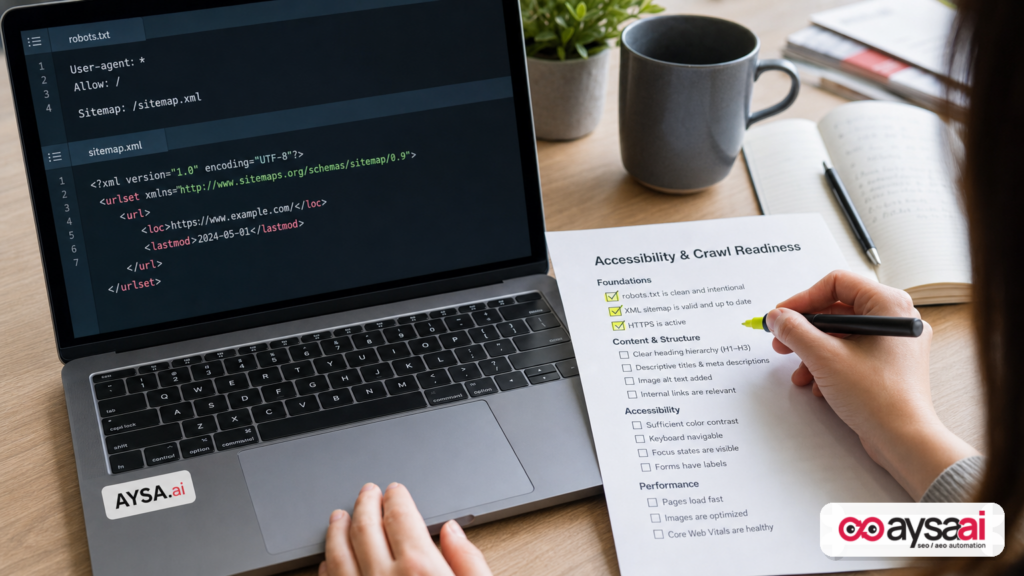
- Confirm you’re not unintentionally blocking crawlers. Many sites restrict bots aggressively, then wonder why they don’t show up in AI answers. Review Robots.txt, WAF rules, and bot management settings.
- Ensure core technical hygiene. Clean sitemaps, sane canonicals, minimal crawl errors, fast and stable pages. Core Web Vitals still matter because performance affects accessibility and user experience. (For background, see Google’s documentation on Core Web Vitals.)
- Prioritize server-rendered, machine-legible output. If critical content only appears after heavy client-side rendering, you’re increasing the chance an agent misses it or misreads it.
- Reduce “token waste.” AI systems have limits. Bloated templates, excessive navigation, and repetitive boilerplate can crowd out the substance. A clean DOM and well-structured content isn’t just good UX—it’s good machine comprehension.
AI-ready assets (useful, but don’t treat as magic)
The source article mentions practices like providing llms.txt or Markdown alternatives to reduce token overhead. These can help certain crawlers and workflows, but they’re not a substitute for robust technical SEO. Treat them as an enhancement layer, not the foundation.
Where AYSA helps
Most SMEs don’t lose visibility because they “don’t know” what to do. They lose because the fixes are scattered across dev, CMS, analytics, and content. AYSA is built to make this operational:
- Continuous monitoring via AYSA Monitoring.
- AI-search focused visibility tracking at AI Search Visibility.
- Actionable, approval-based change preparation from the tools at AYSA AI SEO Tools.
We monitor issues, prepare fixes, ask for approval, then execute what you accept—so you don’t sit on a backlog for months.
Step 2 — Be understood: Build semantic clarity and an entity footprint
Humans can “get it” from vibes. Machines need structure.
In AI-mediated discovery, the system needs to confidently answer:
- Who are you (as an entity)?
- What do you offer (products, services, locations, categories)?
- Where do you operate (service areas, shipping regions, hours)?
- What makes you distinct (certifications, specialization, policies)?
Use structured data to reduce ambiguity
Structured data doesn’t guarantee rankings, but it does reduce misunderstanding. It’s a way to say, “Here are the facts, in a format machines can process.” Schema.org is the most common vocabulary for this. If you’re new to it, start here: Schema.org.
For SMEs, the high-impact areas often include:
- Organization / LocalBusiness: name, logo, address, phone, sameAs links, service area.
- Product (for ecommerce): identifiers, pricing, availability, shipping details where appropriate.
- FAQPage (where it’s legitimate): policies, returns, scheduling, licensing, insurance acceptance, turnaround times.
- Service (for service businesses): what’s included, who it’s for, constraints, pricing model.
Build a consistent “entity graph” across the web
AI systems triangulate. Your site is one input. Third-party citations, directories, industry associations, and consistent profiles are others. The goal isn’t to be everywhere; the goal is to be consistent where it matters.
Operational advice for SMEs
- Maintain one canonical source of truth for business facts (hours, address, phone, brand name, returns policy, shipping policy).
- When you update a fact (like hours), update it everywhere—don’t let the web fragment.
- Use the same naming conventions for products and services across pages and listings.
Where AYSA helps
Semantic clarity isn’t a one-off schema project. New services launch, products change, hours change, policies change. AYSA’s workflow is designed to keep your site aligned over time: monitor changes, prepare structured updates, request approval, and implement safely.
Step 3 — Be retrieved: Structure content so AI can extract and cite it
Traditional SEO often rewarded long, comprehensive pages. AI retrieval rewards extractable clarity.
AI systems frequently “quote” or paraphrase small sections. They need:
- clear headings,
- self-contained sections,
- definitions, steps, constraints, and numbers near the top of each section,
- and minimal ambiguity.
How to write for retrieval (without writing like a robot)
Use this structure on key pages (service pages, category pages, shipping/returns pages, pricing pages):
- Lead with the answer. The first sentence should state what you do and for whom.
- List constraints and qualifiers early. “Same-day delivery available for orders placed before 1pm.” “Appointments available Mon–Sat.” “Serves Austin + 25 miles.”
- Use scannable formatting. H2/H3 sections, bullets, short paragraphs.
- Separate policies into explicit sections. Don’t bury returns, cancellations, refunds in a footer blob.
- Connect topic clusters. Link from service pages to FAQs, case studies, and relevant guides. Not for PageRank theater—for comprehension.
What to avoid
- “Marketing fog.” If your page says “best-in-class solutions” without concrete details, AI can’t compare you.
- Copycat content. AI can synthesize generic information. You need original experience, real constraints, and specific offers.
Where AYSA helps
Content restructuring is where projects stall—because it’s not just writing, it’s publishing changes correctly (headings, internal links, schema, metadata, templates). AYSA is built to execute approved changes at scale with guardrails.
If you want to see the execution-oriented toolset, start here: AI SEO Tools and our product updates and frameworks at AYSA Blog.
Step 4 — Be trusted: Build authority and grounding signals across the web
Being retrievable doesn’t mean being recommended.
In AI systems, trust is often treated like a confidence score. If information is inconsistent or unsupported, the model may hedge, exclude you, or prefer a competitor that’s easier to validate.
Trust is not only “E-E-A-T,” but it rhymes with it
Google popularized the concept of E‑E‑A‑T (Experience, Expertise, Authoritativeness, Trustworthiness) in its quality guidelines. Even beyond Google, it captures a useful principle: prove you’re real, qualified, and consistent. If you want the primary reference, see Google’s Search Quality Rater Guidelines (the official PDF location changes over time; if you can’t find the latest, search for “Google Search Quality Rater Guidelines” from Google’s domains).
In practice, for SMEs, “trust” often comes down to:
- Corroboration: other reputable sources confirm your claims.
- Consistency: your basic facts match across platforms.
- Transparency: clear policies, contact info, and ownership signals.
- Recency: outdated pages and stale info reduce confidence.
Grounding signals you can actually improve
- Reviews and sentiment: you don’t control them, but you can improve operations and respond consistently.
- Business listings accuracy: name/address/phone/hours. One mismatch seems small—until an AI system treats it as uncertainty.
- Pricing and availability consistency: if your product page says “in stock,” but a third-party feed says “out of stock,” agents may avoid acting.
- Editorial mentions: local press, niche publications, associations. Not spammy link building—credible references.
Where AYSA helps
Authority building is partly PR and operations. But a lot of “trust leakage” is simply site maintenance: outdated policies, conflicting hours, missing author information, inconsistent service descriptions. AYSA monitoring catches drift, and our approval-based execution helps you keep trust signals aligned without turning every fix into a dev ticket.
Step 5 — Be chosen: Win machine preference and human preference
Here’s the uncomfortable part: even if you’re accessible, understood, retrievable, and credible, you can still lose because the assistant needs to pick. That selection is shaped by two forces:
- Machine preference: what the system can validate, compare, and complete confidently.
- Human preference: what the user ultimately wants, emotionally and contextually.
Machine preference: make your “attributes” legible
Assistants compare attributes like:
- price and fees,
- availability,
- delivery times / appointment times,
- coverage area,
- policies (returns, cancellations),
- requirements (insurance, licensing, deposits),
- support response times.
If these attributes are hidden, vague, or contradictory, you’re hard to recommend. If they’re clear and consistent, you become an easy “yes.”
Human preference: don’t let “machine clarity” sterilize your brand
Some purchases are delegated quickly (printer ink, basic supplies). Others are identity-laden (a wedding photographer, a clinic, a premium hotel). Winning brands do both:
- Machine-readable facts for comparison.
- Human resonance for final choice: proof, stories, photos, case studies, before/after (where appropriate), craftsmanship, values.
Practical technique: “query fan-out” testing
The source article references testing across multiple prompts and questions. That’s essential. Users don’t ask one query; they ask ten variations. Your job is to understand where AI includes you, how it describes you, and where competitors win.
In AYSA terms: monitor visibility in AI surfaces, identify gaps, prepare site changes, approve, execute, then re-test. It’s an ongoing loop.
Learn more about the monitoring/visibility layer here: AI Search Visibility.
Step 6 — Enable agentic transactions: Prepare your business for AI-driven checkout and bookings
Recommendation used to be the finish line. In agentic commerce, recommendation is only the midpoint. The assistant may complete the transaction—meaning your site becomes a source of truth and capability provider, not just a destination.
This is the part that gets people excited—and where hype can get ahead of reality. You don’t need to bet your business on a specific protocol name. But you do need to prepare for a world where agents want:
- structured product/service catalogs,
- real-time availability,
- clear pricing rules,
- shipping/returns/cancellation policies,
- and secure ways to perform actions (book, buy, quote, reserve).
Make your business “transaction-readable”
Start with fundamentals that help any agentic system, regardless of who builds it:
- Clean product/service data: SKUs or identifiers, variant rules, bundles, service packages.
- Accurate availability: inventory, appointment slots, lead times.
- Policy clarity: returns, cancellations, warranty, deposits—written in plain English and not contradictory across pages.
- APIs or structured endpoints where feasible: even simple feeds help when kept current.
- Form reliability: if an agent submits a form and it fails silently, you’ll lose out.
Don’t skip security and risk management
Agentic transactions raise new risks:
- Fraud and abuse: automated ordering patterns.
- Inventory mismatches: agents acting on stale data.
- Policy disputes: unclear cancellation terms become expensive.
- Brand liability: if an assistant misstates your offer, your site must correct and ground it.
The business response isn’t fear—it’s readiness: clean data, consistent policies, and robust monitoring.
Where AYSA helps
Agentic readiness is a moving target. Your catalog changes weekly. Your hours change seasonally. Your FAQs drift. AYSA’s model—monitor continuously, prepare changes, request approval, execute—fits this reality better than quarterly “SEO audits” that turn stale before the invoice is paid.
If you want to evaluate whether this fits your business, see plans at AYSA Pricing.
What to measure: New KPIs for the AI decision layer
Most businesses still manage search like it’s 2016: rankings, sessions, and click-through rate. Those metrics still matter, but they no longer describe the full picture.
In the AI decision layer, you need two KPI stacks:
1) Visibility and influence KPIs
- AI presence rate: how often your brand appears in AI answers for target intents.
- AI share of voice: how you compare to key competitors across a query set.
- Citation frequency: how often your site is cited as a source (when citations are provided).
- Recommendation rate: how often AI recommends you vs. mentions you.
- Attribute accuracy: how often AI states your hours, pricing rules, service area, etc. correctly.
2) Commerce and outcomes KPIs
- AI-influenced leads: calls, forms, bookings where the journey involved AI discovery (where measurable).
- Agent-friendly conversion rate: how reliably forms, scheduling, and checkout work in automated or assistant-led paths.
- Autonomous transaction volume: emerging metric; track when available via platform reporting.
One important nuance from the Search Engine Land framing: traffic can decline even as revenue improves. If an assistant answers basic questions and only sends high-intent users (or completes actions elsewhere), your sessions might drop while your qualified leads rise. That’s not failure—it’s a funnel shift.
What SMEs should monitor weekly
- Top AI-driven intents in your category (“best,” “near me,” “cost,” “shipping time,” “return policy,” “appointment availability”).
- Whether AI describes your business facts correctly.
- Whether competitors are being cited for “your” expertise topics.
- Whether policy pages are outdated or inconsistent.
This is exactly the kind of ongoing operational monitoring we built AYSA around: AYSA Monitoring.
A concrete SME scenario: Local clinic vs. AI shortlists
Let’s make this real with a scenario that’s common, high-stakes, and not purely ecommerce.
The business
A 3-location physical therapy clinic in a metro area. They’ve historically relied on:
- Google Business Profile visibility (maps),
- local SEO pages (“physical therapy in [neighborhood]”),
- and word-of-mouth.
The new customer journey
A user asks an assistant: “Find a physical therapist near me that takes my insurance and has appointments this week.”
The assistant now needs structured clarity on:
- locations and hours,
- specialties (sports rehab, post-surgery, chronic pain),
- insurance accepted,
- appointment availability (or at least scheduling workflow),
- reviews and credibility,
- and whether the clinic is accepting new patients.
Where clinics lose (even with “good SEO”)
- Inconsistent location data: one directory has an old suite number; another has outdated hours.
- Vague services: the service page says “we offer personalized care” but never lists conditions treated.
- Policies buried: cancellation fees, insurance requirements, and referral needs are unclear.
- Scheduling friction: a form that errors out, or a booking tool that blocks bots entirely.
What winning looks like
- Each location has a clean, server-rendered page with explicit services, insurance notes, and “what to bring.”
- Schema clarifies entity, locations, and services.
- FAQs answer common constraints (“Do I need a referral?” “Do you accept X insurance?” “What’s the first visit like?”).
- Off-site listings match exactly.
- Scheduling is reliable and clearly explained, even if the agent can’t fully automate it yet.
This isn’t about “gaming AI.” It’s about being the easiest safe choice for a system that’s trying to reduce user effort and risk.
What agencies should rethink (and what SMEs should demand)
If you run an agency—or hire one—here are the shifts I believe are non-negotiable in the AI decision layer era.
1) From deliverables to systems
Monthly reports and one-time audits don’t win when the environment changes continuously. SMEs should demand:
- monitoring,
- prioritized backlog,
- fast execution,
- re-testing loops.
2) From “content calendar” to “retrieval architecture”
Publishing more content isn’t a strategy. Structuring the right content so it can be extracted, cited, and trusted is the strategy.
3) From “link building” to “corroboration building”
The old mindset was “get links.” The new mindset is “get trusted references that corroborate your expertise and facts.” Sometimes that includes links. Sometimes it’s citations, listings, partnerships, and authoritative mentions.
4) From “SEO-only” to “operations + marketing alignment”
AI exposes operational truth. If your delivery times slip, your reviews reflect it. If your inventory data is wrong, agents will avoid acting. This forces alignment between operations and marketing in a way classic SEO often didn’t.
5) From recommendations to execution
Most teams drown in “opportunities” they never implement. That’s why we emphasize approved execution at AYSA: ideas are cheap; shipped improvements win.
Where AYSA.ai fits: Monitoring + approved execution in an AI-first world
AYSA is built for the part most businesses struggle with: turning AI-era visibility strategy into ongoing, safe, measurable execution.
Here’s how I think about our role in the AI decision layer:
1) Monitor what AI and search surfaces are doing to your brand
- Track AI search visibility signals.
- Detect technical issues that block access or degrade comprehension.
- Watch for content drift: outdated pricing, outdated hours, broken pages, inconsistent policy references.
Start here: AI Search Visibility and Monitoring.
2) Prepare changes that improve machine readability and trust
This includes structured data, on-page restructuring, internal linking, metadata improvements, and content clarity enhancements—especially on pages that represent your business “facts” (pricing, policies, products, services, locations).
3) Ask for approval before making edits
SMEs need speed, but they also need control. Our workflow keeps humans in the loop with clear approvals.
4) Execute accepted website changes (reliably)
This is the “last mile” most tools don’t do. Execution is where ROI lives.
If you want to explore this operational model, review the product ecosystem at AI SEO Tools, pricing at AYSA Pricing, and our ongoing editorial frameworks at AYSA Blog.
What to do next (action list)
If you want a practical starting plan for the next 30 days, here’s the order I recommend for most SMEs:
- Pick 10–20 “money intents.” Not keywords—intents: “same-day delivery,” “book this week,” “price,” “near me,” “returns,” “insurance accepted,” “warranty.”
- Run an AI visibility baseline. Document: Are you mentioned? Recommended? Cited? Are your facts correct?
- Fix access blockers. Robots, rendering, broken pages, slow templates, messy canonicals.
- Make your core pages retrieval-ready. Add headings, front-load answers, separate policies, use lists.
- Implement/repair structured data. Focus on Organization/LocalBusiness + Product/Service + FAQ where appropriate.
- Audit off-site consistency. Top directories, maps, key profiles—align name/address/phone/hours and core descriptions.
- Update credibility signals. Real author attribution where relevant, case studies, certifications, photos of real work, clear contact info.
- Harden transactional workflows. Test forms, booking, checkout. Remove friction and failure points.
- Set new KPIs. Track AI presence, accuracy, citations, and AI-influenced conversions alongside traffic.
- Make it continuous. Put monitoring and execution on a weekly cadence, not quarterly.
If you want the systemized version of this process—monitor, prepare, approve, execute—AYSA is built for that: monitoring + AI search visibility + AI SEO tools.
Sources and further reading
- Search Engine Land — Winning the AI decision layer: From AI discovery to agentic commerce
- Schema.org — Structured data vocabulary
- web.dev — Core Web Vitals
- Search Engine Land — Google’s Universal Commerce Protocol: The SEO implications
- Search Engine Land — Gemini Intelligence signals a new era for search and commerce
- Search Engine Land — ChatGPT commands 92% of AI referral traffic (analysis referenced in source context)
Note: Several protocol and platform concepts in this space are evolving quickly. Where official primary documentation isn’t included in the supplied research context, I’ve avoided making hard claims about specifications and timelines. The strategic direction—AI-mediated discovery and agent-assisted transactions—is the durable takeaway.
Continue the AI search topic inside AYSA.
Use these pages to connect the article with AI SEO tools, AI visibility monitoring, AI Overviews and approved website execution.
Turn this topic into a website action plan.
Use these AYSA hubs to move from reading to technical fixes, AI visibility monitoring, research, glossary context and approval-first SEO execution.

