Google Is Becoming Its Own Top Citation In AI Mode: What That Means For Local & Ecommerce (And How To Respond)
New AI Mode citation data suggests Google is increasingly citing Google-hosted cards (Business Profiles and Product Knowledge Panels) instead of independent websites. Here’s what changed, why it matters for SMEs, and a practical, execution-first playbook to win visibility anyway.

Google’s AI Mode is increasingly citing Google-hosted surfaces—especially Business Profile cards for Local intent and Product Knowledge Panels for product intent—rather than citing independent websites directly.
That shift matters because it changes what “winning” looks like in search. You’re not just competing for a blue-link ranking anymore. You’re competing to be the best, cleanest, most trusted data source inside Google’s own cards—and to be the brand that AI systems repeatedly select when they assemble an answer.
This editorial breaks down what changed, why it’s happening, the risks (and the opportunities) for SMEs, and a practical playbook to respond. I’ll also explain where AYSA fits: as an AI Search visibility + Approved Execution system that monitors what’s happening, prepares the changes, asks you for approval, and then executes what you accept.
Concise Summary
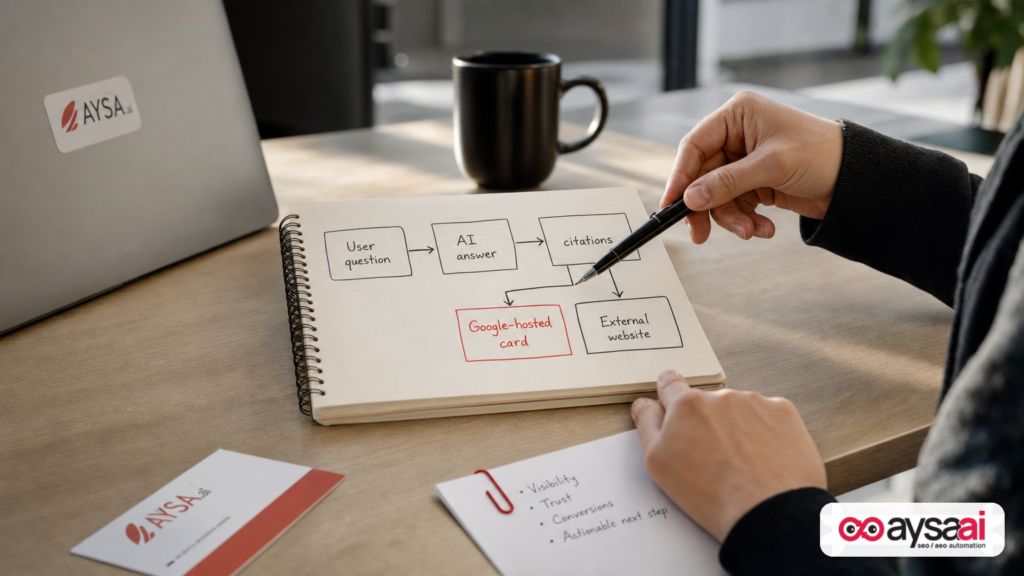
- What changed: Third-party analysis reported by Search Engine Journal suggests google.com has become one of the most-cited domains inside Google’s AI Mode, driven largely by citations to Google-hosted Business Profile and Product Knowledge Panel card URLs. (Source)
- Why it’s happening: Cards and panels are efficient for AI: they’re structured, standardized, and often “good enough” to answer local and product questions without sending users elsewhere.
- Why you should care: If AI Mode cites a Google-hosted card containing your business or product details, your website may get fewer visits—but you can still gain calls, directions, bookings, and purchases if the card data is complete and compelling.
- What to do: Treat Business Profiles and product data as first-class marketing assets. Build measurement around citations/coverage, and run an execution rhythm that improves the data inputs AI Mode relies on.
Table Of Contents
- What Changed: Google Is Getting Cited More In Google’s Own AI Mode
- Context: From 10 Blue Links To AI Answers (And Why Citations Matter)
- The Two Surfaces That Are Winning Citations: Business Profiles & Product Knowledge Panels
- Local Search: Why Hospitality, Home Services, Restaurants, Real Estate, And Healthcare Feel This First
- Ecommerce & Product Queries: Comparisons, Compatibility, And Specs Are The New Battleground
- Is This “Self-Citation”? Yes—But It’s More Complicated Than It Sounds
- What Can Go Wrong: Data Quality, Brand Control, And The Invisible Leak In Your Funnel
- The New SERP Is A Citation Graph, Not A List Of Links: KPIs That Actually Help
- An Execution-First Playbook (Local, Ecommerce, And Hybrid Businesses)
- A Concrete SME Scenario: The Clinic That Lost Traffic But Gained Appointments
- What Agencies Should Rethink: Deliverables, Reporting, And The New Moat
- Where AYSA Fits: Monitor → Prepare → Approve → Execute
- What To Do Next (Action List)
- Sources And Further Reading
What Changed: Google Is Getting Cited More In Google’s Own AI Mode
Search Engine Journal reported on analysis from Profound (an AI visibility platform) indicating that google.com rose to become the No. 2 cited domain in Google’s AI Mode during a measured period in 2026, with much of the increase attributed to citations that resolve to Google-hosted Business Profile cards and Product Knowledge Panel cards. (SEJ coverage)
Two critical nuances from the coverage:
- These citations are often recorded at the domain level as “google.com” even when the card contains information about your business or product.
- The growth appears concentrated in local-intent and product-intent queries—exactly where Google already has strong, Structured data surfaces.
In plain English: Google’s AI answers are increasingly “citing” Google as the source—not because Google wrote the information, but because Google is hosting the card that packages it.
Context: From 10 Blue Links To AI Answers (And Why Citations Matter)
For 20+ years, most search strategy has been built around a simple deal:
- Google indexes the web.
- Google ranks pages.
- Publishers and brands earn Clicks by being the best page.
AI Mode (and other AI answer experiences) complicate this deal. Instead of a list of links, users get a synthesized answer. Links are still present—but increasingly they behave like supporting citations, not the main event.
This is not just a user-interface change. It’s an incentive change:
- Traditional SEO: You’re optimizing for ranking and click-through.
- AI search optimization (AEO/GEO): You’re optimizing for inclusion—being selected as a source, being accurately represented, and being preferred when the system composes an answer.
Google is uniquely positioned here because it owns the “container” where so many facts live: business listings, product panels, maps, knowledge panels, reviews, photos, attributes, availability signals, and more. If an AI system needs structured information quickly, these are efficient sources.
And that leads to the core strategic reality:
In AI-first search, the company that controls the data surface controls the citation gravity.
The Two Surfaces That Are Winning Citations: Business Profiles & Product Knowledge Panels
SEJ’s summary of the Profound dataset points to two Google-hosted “card types” driving citation share:
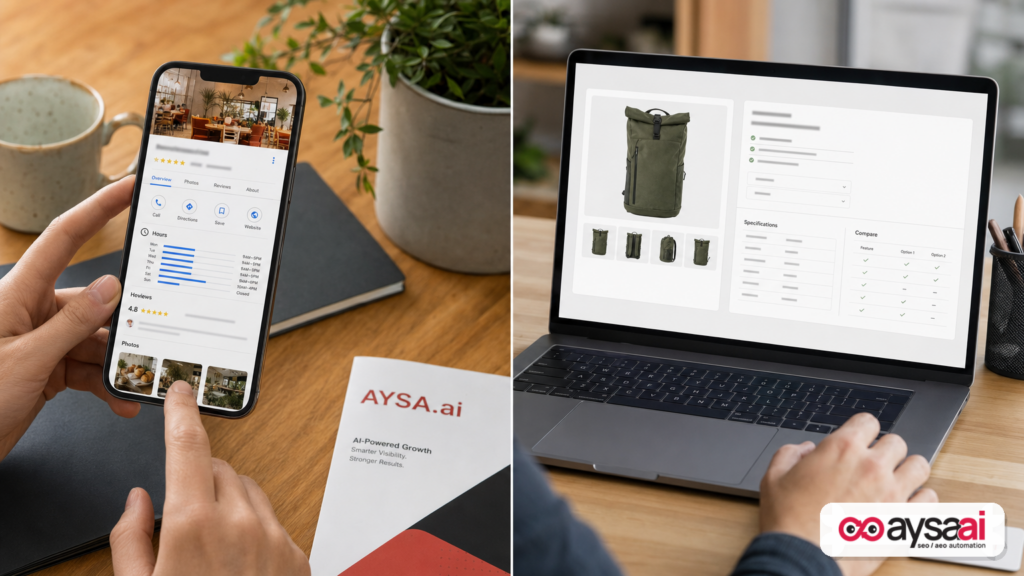
- Business Profile cards (for local queries)
- Product Knowledge Panels (for product queries, especially comparisons/specs/compatibility)
Let’s translate what those surfaces actually do.
1) Business Profiles: The “Local Answer Card”
For a local intent query (think: “emergency plumber near me,” “best hotel in Austin,” “pediatric dentist open Saturday”), users don’t want a long article. They want:
- Is it open?
- How do I call?
- Can I book?
- Is it close?
- Is it trusted?
Business Profiles are engineered to answer those questions quickly. They include the exact “decision” elements AI systems love: hours, address, phone, categories, attributes, reviews, photos, services, and sometimes booking actions.
Google documents the basics of managing your listing via Google Business Profile resources (primary, official). If you’re rusty on the fundamentals, start there. (Google Business Profile)
2) Product Knowledge Panels: The “Product Truth Layer”
For product queries, especially mid-funnel and bottom-funnel ones, users often ask questions like:
- “Is this compatible with…?”
- “What are the specs?”
- “Which is better: X or Y?”
- “Does it come in size…?”
Those questions are frequently answerable with structured attributes: size, weight, material, compatibility lists, model numbers, GTINs, etc. When Google has enough product data, it can present a product panel that reduces the need to click out.
If you sell products online, you should be thinking in terms of product data quality and feed/structured data hygiene. Google’s official documentation around Merchant Center and product data is the canonical reference, and it’s where most ecommerce teams realize they have gaps. (Google Merchant Center Help)
Key point: In AI Mode, the citation can go to Google-hosted panels that summarize your product—rather than to your product detail page (PDP). That doesn’t mean you can’t win. It means the playing field has more surfaces than your website.
Local Search: Why Hospitality, Home Services, Restaurants, Real Estate, And Healthcare Feel This First
SEJ’s reporting notes that the rise in citations to Business Profile cards is especially visible in local-intent sectors like:
- Hospitality & travel
- Home services
- Restaurants & dining
- Real estate
- Healthcare
That checks out logically—even without needing extra numbers—because these verticals share three traits:
- High urgency: “I need this now” queries reward fast answers.
- High trust requirements: Reviews, proximity, and verification matter.
- High conversion on the SERP: Calls, directions, bookings can happen without a website visit.
What this means for a local business owner
If you run a local business, your Business Profile is no longer a directory listing. It’s effectively:
- a mini landing page,
- a trust layer,
- a conversion interface, and
- now, a frequently cited source in AI answers.
In practice, that changes priorities. For many SMEs, it is easier (and faster) to improve Business Profile completeness than to overhaul an entire site—especially if the site is on a legacy CMS, has slow developer cycles, or is managed by an agency retainer with long lead times.
But it also introduces risk: a wrong hour, wrong category, missing attribute, or outdated photo set can harm conversions at the exact moment a customer is ready to buy.
Ecommerce & Product Queries: Comparisons, Compatibility, And Specs Are The New Battleground
Product search has been drifting toward “answers” for years. AI accelerates that trend.
When someone asks a comparison question, they are often looking for decision support, not a brand story. A product panel (or a well-structured product dataset) can satisfy that need quickly.
Why product panels win in AI answers
- Normalization: Panels turn messy product pages into consistent fields.
- Confidence: Structured attributes are easier for systems to reconcile.
- Speed: The AI model can reference a compact representation rather than crawling multiple long pages.
Implication for ecommerce teams
You should assume that a growing share of product discovery will happen in environments where:
- your brand is visible, but
- your website is not the primary interface.
That doesn’t eliminate the website. It makes the website one part of a broader “product truth system,” where your feeds, structured data, and consistency across surfaces influence whether you’re cited and how you’re represented.
If you don’t have clean product identifiers and structured data, you’re effectively asking AI Mode to “guess” from messy signals. And guessing is where brands lose margin, lose differentiation, and get misrepresented.
Is This “Self-Citation”? Yes—But It’s More Complicated Than It Sounds
Many SEOs hear “Google is cited more in AI Mode” and jump to one conclusion: self-preference. That concern isn’t irrational. The incentives are obvious: keeping users on Google surfaces is valuable.
But it’s also important to be precise about what is being cited.
In the scenario described by SEJ, the AI answer is often citing a Google-hosted card that might include:
- your business name, address, phone, hours, reviews, photos (local), or
- your product attributes, pricing context, and comparisons (product).
So the citation is “google.com,” but the content is partially sourced from:
- your Business Profile inputs,
- your product feeds,
- your website structured data (in some cases),
- and other third-party sources (reviews, aggregators, etc.).
Editorial point of view: If you’re a small business, arguing about whether this is “fair” doesn’t protect your revenue. The winning move is to treat these cards as a controllable distribution layer and invest in the inputs you can directly improve.
What Can Go Wrong: Data Quality, Brand Control, And The Invisible Leak In Your Funnel
When Google-hosted cards become the cited source, three risks emerge for SMEs and brands.
Risk 1: The “Wrong Answer” risk increases
If your Business Profile says you’re open when you’re closed, or your attributes are incorrect, AI systems can amplify that error at scale.
This isn’t theoretical; it’s a natural outcome of a system that summarizes instead of sending users to verify details on your site. The responsibility shifts toward maintaining accurate structured data everywhere it appears.
Risk 2: You lose narrative control
Cards are great at facts, weaker at nuance. If your differentiation is “we’re the best because of our process,” but the AI answer focuses on “4.3 stars, open until 6,” you may feel commoditized.
This doesn’t mean you abandon brand storytelling. It means you must pick where to tell it:
- Use cards for conversion-critical facts.
- Use your website and owned channels for differentiation and retention.
Risk 3: Attribution becomes harder
When outcomes happen inside Google surfaces (calls, directions, bookings), traditional analytics that rely on website sessions can undercount performance.
If you only measure success by organic sessions, you may mistakenly cut budgets that are actually driving revenue. This is one reason AI-era KPIs must include visibility and presence metrics, not only clicks.
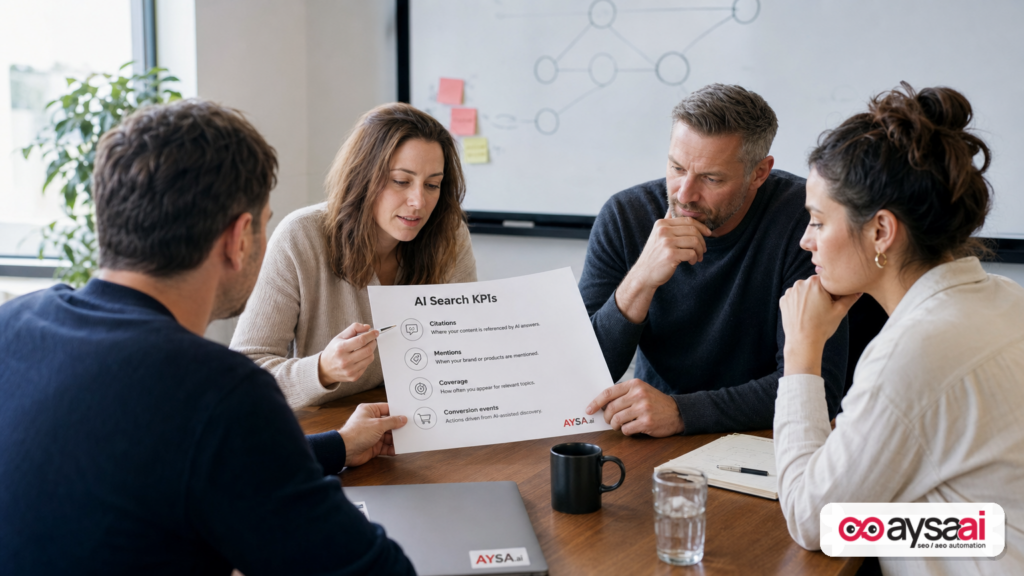
The New SERP Is A Citation Graph, Not A List Of Links: KPIs That Actually Help
In an AI answer world, ranking reports alone will mislead you. You need to complement them with KPIs that reflect how AI systems “see” and “source” your brand.
Based on the SEJ reporting (and what we see broadly as AI answers become mainstream), here are practical KPIs for SMEs that don’t require a data science team:
1) Coverage: Are you present in the surfaces AI uses?
- Do you have a verified, complete Business Profile?
- Do you appear for the right categories and service attributes?
- Do your products have consistent identifiers and attributes across feeds and pages?
2) Accuracy: Are the facts correct everywhere?
- Hours, holiday hours, phone, address, service areas
- Pricing signals (where applicable), availability indicators
- Product specs, variants, compatibility info
3) Preference: Are you the “default choice” inside the card?
- Reviews volume and recency
- Photo quality and freshness
- Complete service/product detail vs competitors
4) Conversion events that don’t require a site click
Depending on your model, track the outcomes that can happen directly from Google surfaces:
- Calls
- Direction requests
- Bookings (where integrated)
- Orders (where shopping flows apply)
Important constraint: The SEJ coverage emphasizes that citation share indicates what AI Mode links to, not necessarily where traffic goes. That’s exactly why KPIs should separate “presence” from “clicks.” (SEJ)
An Execution-First Playbook (Local, Ecommerce, And Hybrid Businesses)
The businesses that win in AI search won’t be the ones with the best opinions. They’ll be the ones with the best execution system.
Here’s the playbook I recommend for SMEs and growth teams.
Principle: Optimize what AI cites, not just what ranks
Traditional SEO asks: “How do I rank my page?”
AI-era optimization asks: “What will the system cite, and what will it trust as the ‘truth’?”
That includes your website, but also includes:
- Business Profile data
- Product feeds and product structured data
- Consistency across authoritative sources
Local businesses: the 12-point Business Profile checklist
Start with the basics, then move to differentiation. (If you can’t do all 12, do the first 6 this month.)
- Ownership & verification: Confirm you control the profile.
- Primary category: Choose the closest category to your revenue driver.
- Secondary categories: Add only those you truly offer.
- Hours + holiday hours: Keep them current.
- Phone + website URL: Ensure consistency with your site and other listings.
- Address/service areas: Set correctly (especially for service-area businesses).
- Services/products: Populate service lists where relevant.
- Attributes: Accessibility, payment types, appointment requirements—whatever applies.
- Photos: Fresh, real, high-quality; update monthly if possible.
- Reviews: Build a review request process; respond consistently.
- Q&A: Seed common questions with accurate answers (where possible).
- Tracking/measurement: Align internal reporting to calls, bookings, direction requests.
Reference for official guidance and capabilities: Google Business Profile.
Ecommerce brands: the product-data “clean room” approach
For ecommerce, your first job is to make sure your products can be unambiguously understood by machines.
Priorities (in a practical order):
- Identifiers: Ensure GTIN/MPN/brand consistency where applicable.
- Variant clarity: Size/color/material variations must be explicit and consistent.
- Specs completeness: Fill out the fields customers compare (dimensions, compatibility, power, etc.).
- Image quality: Clean, accurate images that match variants.
- Feed hygiene: Fix disapprovals, mismatches, and gaps in Merchant Center inputs.
- On-site structured data: Ensure your site communicates the same truth as your feed.
For official references, start with Merchant Center documentation: Google Merchant Center Help.
Hybrid businesses (local + ecommerce): don’t split your truth
If you have physical locations and ecommerce, the biggest trap is inconsistency. AI systems penalize ambiguity. Your goal is a single “truth layer” that stays aligned across:
- Business Profiles (per location)
- Inventory/availability signals
- Product catalog truth (identifiers/specs)
- Website pages
A Concrete SME Scenario: The Clinic That Lost Traffic But Gained Appointments
Here’s a realistic scenario that illustrates why the “citation shift” can feel scary—and still be profitable if you operate correctly.
The business
A multi-location dental clinic in a mid-sized U.S. metro area.
The trigger
Over a quarter, organic website sessions decline. Leadership panics and assumes SEO is failing.
What’s actually happening
- More patients are searching with local-intent questions (hours, insurance accepted, emergency availability).
- AI answers and local cards satisfy those questions directly.
- Patients call from the listing or book via a profile-integrated action, resulting in fewer website visits.
The fix (execution, not theory)
- Each location profile is audited: categories, hours, holiday hours, services, attributes.
- Reviews are operationalized: a consistent post-visit request flow.
- Photos are refreshed to reflect the actual experience (operatories, staff, parking, signage).
- Call tracking and booking attribution are aligned so leadership can see outcomes beyond website sessions.
Outcome: Website traffic is no longer the primary success metric; booked appointments and calls are. The business stops making decisions based on a shrinking metric and starts optimizing for where customers convert.
That is the mental model shift AI Mode forces: optimize for the customer’s decision moment, even if it happens off-site.
What Agencies Should Rethink: Deliverables, Reporting, And The New Moat
If you’re an agency, the trend described by SEJ is a wake-up call.
1) Your deliverables can’t be “content + rank tracker” anymore
Content still matters, but AI answers increasingly draw from structured sources and entity data. Agencies need to deliver:
- Business Profile operations
- Product feed and structured data quality
- Entity consistency across key sources
- Measurement that reflects citations and conversion events
2) Your reporting must separate visibility from traffic
If a client’s website traffic is down but calls are up, you need a story that is credible and data-driven, not hand-wavy.
In practice, that means building a reporting layer that includes:
- AI/search surface coverage
- Listing health and completeness
- Product data health
- Conversions from Google surfaces
3) Your moat becomes execution speed + governance
In AI search, the window between “we found an issue” and “we fixed it” matters. But so does avoiding reckless changes.
The agency that wins will be the one that can:
- monitor continuously,
- prepare changes in a clean workflow,
- get approval,
- execute quickly,
- and document outcomes.
That’s exactly where tooling and process become strategic, not optional.
Where AYSA Fits: Monitor → Prepare → Approve → Execute
At AYSA, our view is simple: AI search changes the interface, but it doesn’t change the truth of growth.
Growth still comes from consistent execution.
AYSA is built to operationalize AEO/GEO/SEO in a way SMEs can actually run:
- Monitor what’s happening across your site and your AI search visibility footprint. (AYSA Monitoring)
- Prepare recommended changes (technical, content, structured data, on-page improvements) mapped to outcomes.
- Ask for approval so your brand stays in control—no surprise deployments.
- Execute accepted changes to keep momentum without blowing up workflows.
If you’re trying to adapt to AI Mode’s citation patterns, AYSA’s core value is that we connect “what changed” to “what we will do about it,” then ship improvements reliably.
Start here depending on your goal:
- Understand the toolset: AYSA AI SEO Tools
- Focus specifically on AI-era visibility: AI Search Visibility
- See plans for SMEs and teams: Pricing
- Browse more operational editorials: AYSA Blog
One more important
Continue the AI search topic inside AYSA.
Use these pages to connect the article with AI SEO tools, AI visibility monitoring, AI Overviews and approved website execution.
Turn this topic into a website action plan.
Use these AYSA hubs to move from reading to technical fixes, AI visibility monitoring, research, glossary context and approval-first SEO execution.