
Google AI Overviews Adds Top Stories: What It Changes for Visibility—and How SMEs Should Respond
Google is now showing Top Stories inside AI Overviews for some U.S. mobile queries. That’s a meaningful shift: it blends real-time news signals with AI summaries, changes how users scan results, and creates new “visibility surfaces” that aren’t measured like traditional rankings. Here’s what changed, why it matters, and a practical plan SMEs and agencies can execute—without guessing.

Google just added another layer to the search experience: Top Stories can now appear inside AI Overviews for some queries. It’s live in the United States on mobile and expected to expand over time, per reporting by Search Engine Land.
On the surface, this looks like a UX tweak. In practice, it’s a signal that Google is blending real-time content (news) directly into an AI-generated answer layer. That changes how attention flows, how brands earn trust, and how you should plan content—especially if you’re an SME that can’t afford to chase every SERP experiment.
Concise summary (for busy operators)
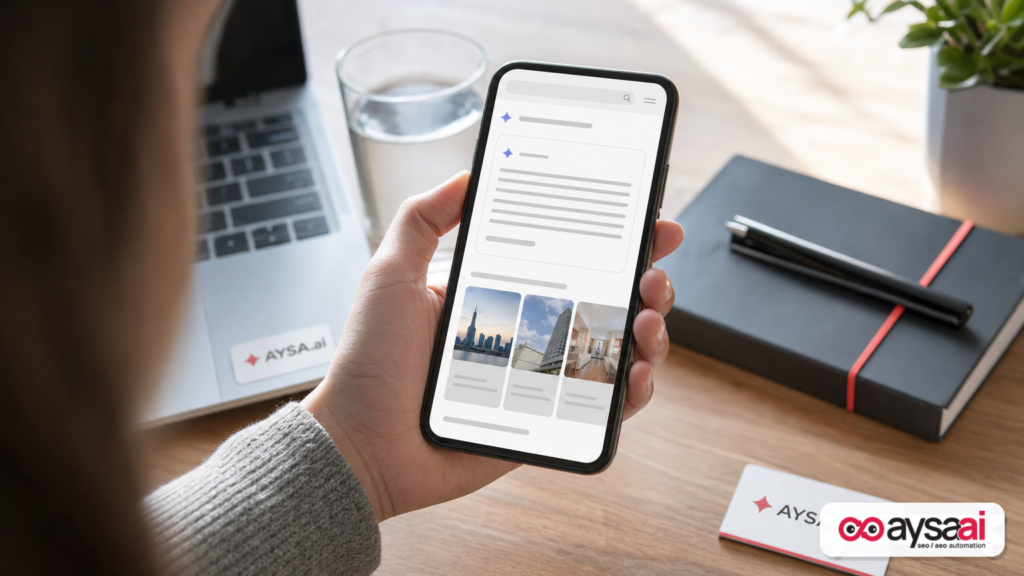
- What changed: Some AI Overviews now include a Top Stories/news carousel for developing topics on U.S. mobile.
- Why it matters: Visibility is splintering into multiple “surfaces” (AI summaries, citations, news cards, classic results). If you only track rankings, you’ll miss what’s happening.
- Who benefits: Publishers and brands with fast, credible updates; businesses with clear entity signals and “answer-ready” pages; teams that operationalize refreshes.
- What to do: Build an execution loop: monitor AI visibility, improve topical coverage, add Structured data where appropriate, refresh key pages, and measure beyond Clicks.
- Where AYSA fits: AYSA helps you monitor changes, prepares recommended fixes, asks for approval, and executes accepted changes—so you can respond quickly without losing control.
Table of contents
- What changed: Top Stories inside AI Overviews
- Context: AI Overviews are evolving into a multi-format SERP
- Why this matters: visibility is fragmenting into new “surfaces”
- Who wins and who loses as AI + news blend
- How this likely changes user behavior (without guessing metrics)
- Measurement: what to track when rankings aren’t the whole story
- Content strategy shifts: from “evergreen only” to “evergreen + timely updates”
- Technical foundations that make you eligible (and trustworthy)
- What can go wrong: common failure modes
- A practical SME scenario: clinic or ecommerce brand
- What agencies should rethink (and how to explain it to clients)
- The AYSA perspective: approved execution for AI-era SEO/AEO
- The execution plan: a 30-day playbook
- What to do next
- Sources and further reading
What changed: Top Stories inside AI Overviews (and why it’s different from the blue links era)
According to Search Engine Land, Google is now showing news updates and Top Stories within the AI Overviews section for some queries. A Google spokesperson confirmed the rollout is fully live in the U.S. for mobile users and will expand in the future.
Google had previously signaled this direction in a May announcement described in the same report: for developing topics, users may see a prominent carousel highlighting “Preferred Sources” and timely articles. Now we’re seeing that concept materialize: a search answer that doesn’t just summarize—it also tries to keep itself current by surfacing fresh reporting.
This is important because it changes what “winning” looks like. In classic SEO, if you ranked high, you captured attention. In the AI Overviews era, the top of the page can be a blended experience:
- An AI-generated summary
- Citations and links
- Now: a Top Stories/news carousel for certain queries
- And then: traditional organic results below
If your reporting still assumes a single linear stack of results, you’ll make the wrong decisions.
Context: AI Overviews are evolving into a multi-format SERP, not a single feature
AI Overviews are not a “card” you either appear in or you don’t. They’re becoming a container that can include multiple modules depending on query intent, freshness, location, and topic sensitivity.
Over the past year, Google has also been developing and expanding AI-first experiences like AI Mode. Search Engine Land has covered related shifts in how AI Search features impact the open web, including reporting on Google’s claims about AI search sending clicks to websites (source). Whether you take those claims at face value or not, the direction is clear: the SERP is being re-architected around AI assistance.
Top Stories inside AI Overviews is another piece of that redesign. It suggests Google is trying to address two core problems AI answers have:
- Freshness: summaries can get stale quickly during developing events.
- Credibility and sourcing: users and publishers want clearer paths to primary reporting.
Embedding Top Stories is a structural attempt to solve both: it increases visible sourcing and gives users a fast route to recency.
Why this matters: visibility is fragmenting into new “surfaces”
SMEs and agencies typically talk about “traffic from Google” as if it’s one pipe. That mental model is now outdated.
In AI-shaped SERPs, you have multiple visibility surfaces:
- Classic blue-link organic results (still valuable, still competitive)
- AI Overviews citations (visibility + trust + some clicks)
- Top Stories/news modules (time-sensitive attention)
- Other SERP Features (local packs, shopping, videos, “perspectives,” etc.)
Top Stories inside AI Overviews increases the competition at the very top of mobile search. If you’re a business whose category intersects with news—even lightly—your organic clicks may be influenced by whether Google interprets the query as “developing.”
This also creates a strategic opportunity: if you can become a “preferred” or routinely cited source for timely updates, you may gain exposure that a slow-moving evergreen strategy can’t win.
Who wins and who loses as AI + news blend
Likely winners
- Publishers with strong topical authority and fast editorial cycles (especially if their pages are accessible, indexable, and easy to cite).
- Brands that publish credible, timestamped updates during moments of heightened demand: recalls, policy changes, product launches, seasonal shifts, local events.
- Organizations with clear entity signals—consistent “who we are” markers (authors, organization pages, citations across the web), making them safer to reference.
- Teams that measure and adapt quickly, because SERP composition can change week to week.
Likely losers
- Sites that rely on one or two head terms and don’t build breadth/depth across a topic.
- Content strategies that never refresh. If the SERP is blending in freshness, static content risks getting bypassed even if it’s “correct.”
- Brands that treat SEO as reporting instead of execution—watching graphs go down without the operational muscle to fix what’s fixable.
How this likely changes user behavior (without guessing metrics)
We don’t need to invent click-through rates to understand what a Top Stories carousel inside AI Overviews implies. On mobile, the top screen is everything. If the top screen becomes:
- a direct answer (AI Overview),
- plus a set of “fresh” story cards (Top Stories),
- plus citations,
…then users have more reasons to stay in that top layer and fewer reasons to scroll.
But there’s a second effect that’s more nuanced: intent can split. Two people searching the same phrase may want different things:
- User A wants a quick explanation (the AI summary satisfies that).
- User B wants the latest developments (Top Stories satisfies that).
- User C wants to buy something or book something (classic results, shopping, local).
Your job is to make sure your brand can be discovered by the user type that matters to your business—and that your pages are structured to be eligible for the surface that user chooses.
Measurement: what to track when rankings aren’t the whole story
The biggest failure I see in modern SEO programs is measurement lag: teams look at monthly organic sessions and try to explain everything after the fact. With AI Overviews and now embedded Top Stories, you need tighter instrumentation and a clearer separation between:
- Visibility (are you being surfaced/cited at all?)
- Engagement (when you are surfaced, do you earn the click?)
- Conversion outcomes (do those clicks behave differently?)
Practically, that means:
- Use Google Search Console to monitor query and page trends (impressions and clicks), especially on mobile. (If you’re not using GSC, fix that before you debate AI Overviews.)
- In analytics (often GA4), separate organic landing pages into buckets: evergreen informational, product/service pages, support content, and “timely update” content.
- Track AI visibility as a distinct KPI. That includes whether your brand is mentioned, cited, or recommended across AI experiences. AYSA supports this type of tracking via AI search visibility monitoring.
If your board deck still says “rankings up/down,” you’re not measuring the system Google is actually shipping.
Content strategy shifts: from “evergreen only” to “evergreen + timely updates”
For years, many SMEs were told to focus on evergreen content. That advice wasn’t wrong—it was incomplete. Evergreen content builds authority and compounds over time. But AI Overviews with Top Stories introduces a stronger freshness affordance at the top of search.
A durable strategy now looks like a two-layer content system:
Layer 1: Evergreen foundations
- Category explainers (“What is X?”)
- Buying guides (“How to choose X”)
- Service pages with clear outcomes and constraints
- FAQ hubs that match real customer questions
Layer 2: Timely updates (news-like cadence)
- Policy/regulation changes affecting customers
- Seasonal or local changes (weather-driven, event-driven)
- Product availability, shipping disruptions, recalls
- Industry shifts (pricing changes, new standards, safety updates)
Not every business needs to “do news.” But most businesses do face moments when customers suddenly have urgent questions. The brands that publish clear, responsible updates during those moments tend to earn disproportionate trust and attention.
And here’s the key: timely does not mean shallow. A “quick update” that lacks context will not build authority. The best approach is to publish updates that link back to deeper evergreen explainers, and to keep those evergreen pages refreshed as reality changes.
Technical foundations that make you eligible (and trustworthy)
AI Overviews and news modules are not purely “content quality” games. They’re also technical eligibility games. If Google can’t crawl, parse, and understand your pages cleanly, you’ll lose before your content is even evaluated.
Core foundations to review:
1) Indexation hygiene
- Ensure important pages are indexable (no accidental noindex, canonical errors, or parameter traps).
- Make sure you’re not diluting signals across duplicated templates or thin location pages.
2) Structured data where it actually applies
Structured data doesn’t guarantee visibility, but it reduces ambiguity. Use it correctly—only when it matches the page. Common relevant types include Organization, LocalBusiness, Product, FAQPage (where appropriate), and Article (for editorial content). If you’re unsure, treat this as a compliance exercise rather than a growth hack.
3) Clear “who” signals
- Author and editor transparency for content that reads like advice or guidance
- About pages and policies that clearly state responsibility, especially in sensitive niches
4) Internal linking that reflects topical structure
If you want to be cited, your site needs to look like a coherent knowledge base, not a collection of blog posts.
5) Page experience basics
Mobile-first performance, readability, and intrusive interstitial avoidance still matter because the environment is mobile and fast. Even if AI summaries reduce clicks, when you do get the click, you need to convert it.
AYSA’s value here is operational: we help you continuously detect and fix the issues that prevent your content from being eligible—see AYSA AI SEO tools and monitoring.
What can go wrong: common failure modes
When Google adds a new surface, the internet responds predictably: people rush to “optimize for it” with shortcuts. That’s how you end up with fragile strategies.
Here are the failure modes I’d actively avoid:
Chasing “news” when you’re not credible in news
If you’re a local service business, you don’t need to publish daily takes on national headlines. But you do need timely updates in your lane (local conditions, pricing changes, safety procedures, appointment availability, supply constraints).
Publishing fast updates without ownership and approvals
Speed matters, but so does accuracy—especially for healthcare, finance, legal-adjacent, and regulated industries. This is where an approved execution model is critical: changes should be proposed, reviewed, and then executed in a controlled way.
Measuring the wrong thing and “canceling SEO”
If you only measure sessions, you’ll miss the role of AI visibility in demand capture and brand preference. Some queries may yield fewer clicks but higher conversion intent when they do click.
Over-optimizing pages to look like they were written for machines
AI-friendly content is not robotic content. It’s clear, structured, and complete. Humans still decide whether to trust you.
A practical SME scenario: how a local clinic or ecommerce brand wins (or loses) from this change
Let’s make this real.
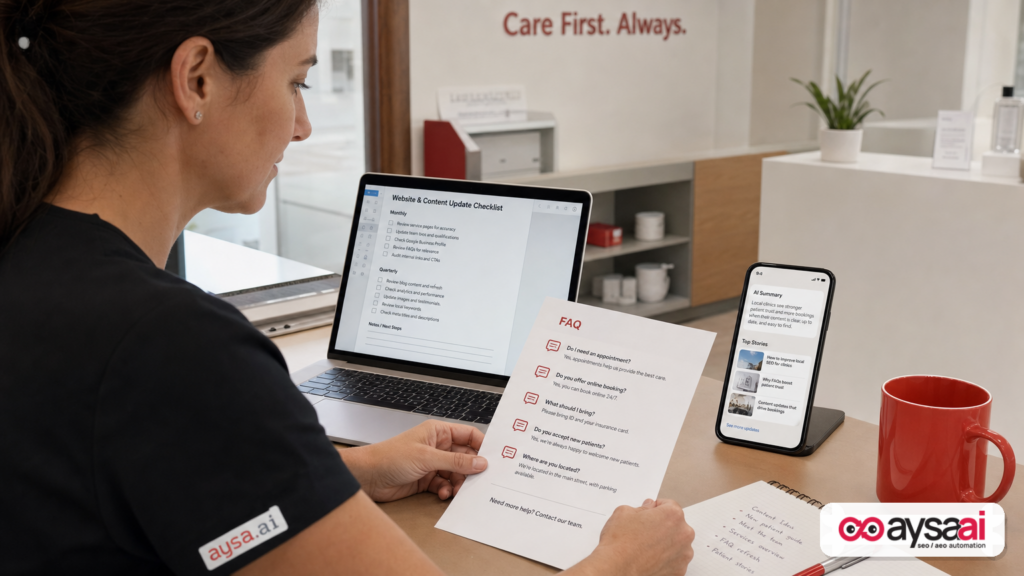
Scenario A: A local clinic (primary care, dermatology, dental—pick your flavor). A new local outbreak, guideline update, or seasonal health issue emerges. People search on mobile: “symptoms of X,” “is X going around,” “how long does X last,” “should I see a doctor,” “near me.”
With Top Stories inside AI Overviews, Google may surface:
- An AI summary describing symptoms and guidance
- A Top Stories carousel with local/national reporting
- Then local pack / organic pages
What the clinic should do (operationally):
- Maintain an evergreen “Condition hub” with clear triage guidance, reviewed periodically.
- Publish timely updates when guidance changes (hours, testing availability, appointment protocols).
- Ensure pages clearly communicate who wrote/reviewed medical content and when it was updated.
- Use internal links from updates back to the evergreen hub, and from the hub out to local booking pages.
Scenario B: An ecommerce brand selling, say, air purifiers, allergy products, or travel gear. A sudden event spikes demand: wildfire smoke, a travel advisory, an airline policy shift, a new compliance standard.
What the brand should do:
- Create a “What’s happening + what to buy” explainer that is helpful, not exploitative.
- Update product category pages with clear fit guidance (who it’s for, key specs, shipping realities).
- Publish a timely update page that can be cited (and that points to products and FAQs).
In both cases, the winners are not the brands with the most blog posts. They’re the brands that can respond quickly with accurate, structured, customer-first information—and keep that information maintained.
What agencies should rethink (and how to explain it to clients)
Agencies are going to feel this rollout in client conversations as soon as a client sees a SERP screenshot and asks, “Why aren’t we in that AI box?”
Here’s the reframing I recommend:
1) Stop selling “rankings.” Sell coverage and outcomes.
The deliverable is not position 2 vs 4. The deliverable is presence across relevant surfaces: AI citations, traditional organic, local, and yes—timely modules when appropriate.
2) Build a refresh operation, not a publishing calendar
Many content calendars are “write new posts forever.” In an AI + freshness blended world, you need a system to:
- detect decaying pages
- refresh what matters
- retire what confuses Google and users
(Search Engine Land has also covered topics adjacent to content decay and maintenance—use that as a research lead, not a script.)
3) Make approvals a feature, not a bottleneck
Clients don’t want surprises on their website. They want speed and control. That’s why AYSA’s “prepare → approve → execute” model matters: it’s how you scale action without risking brand damage.
The AYSA perspective: approved execution for AI-era SEO/AEO
This rollout is a reminder that you can’t spreadsheet your way to visibility anymore. You need a living system that can react to changes in:
- SERP layout
- query intent
- competitor content velocity
- freshness expectations
AYSA is built for that operational reality.
Here’s how we think about it:
- Monitor what matters: not just rankings, but AI visibility and website health. Start here: AYSA Monitoring
- Prepare recommended actions: technical fixes, content improvements, internal linking, structured data checks, and topical coverage expansion.
- Ask for approval before changes go live—because SMEs and agencies need governance.
- Execute accepted website changes—so strategy turns into outcomes.
If you want the toolkit view, see: AI SEO tools. If you want the visibility view, see: AI search visibility. And if you want to understand how this fits your budget, see: pricing.
The execution plan: a 30-day playbook to adapt without chasing every SERP ripple
If you’re an SME, you don’t need a 40-slide AI search strategy. You need a month of focused execution that establishes the foundations and gives you a repeatable loop.
Week 1: Baseline your reality
- Export top queries and pages from Google Search Console (mobile focus).
- Identify which queries are “developing topic” prone (seasonal spikes, local events, fast-moving categories).
- Set up AI visibility monitoring for brand/category prompts (AYSA can help here: AI search visibility).
Week 2: Fix eligibility blockers
- Resolve indexation and canonical issues on key pages.
- Clean up thin/duplicated pages that muddy topical focus.
- Verify structured data is accurate where used.
Week 3: Upgrade your “answer-ready” content
- Rewrite introductions to be direct and decision-supportive (what it is, who it’s for, what to do next).
- Add concise FAQs that match real customer questions.
- Improve internal links: from timely updates → evergreen hubs → money pages (service/product/booking).
Week 4: Build a timely update loop
- Create an “Update protocol” page template: what changed, who it affects, what customers should do, last updated date, sources (when applicable).
- Assign ownership: who publishes, who approves, who reviews monthly.
- Set monitoring alerts for sudden impression spikes/drops, indicating SERP layout or intent shifts.
At the end of 30 days, you should have two things you didn’t have before: (1) cleaner eligibility and (2) a repeatable process for freshness without chaos.
What to do next (action list)
- Confirm whether your queries trigger AI Overviews on mobile and note any “developing topic” patterns.
- Decide your stance on timely updates: what topics are worth responding to, and what topics you will ignore.
- Audit your top 20 pages for “answer readiness”: clarity, structure, internal links, and update cadence.
- Set up monitoring that includes AI visibility, not just rankings and sessions (AYSA: AI search visibility).
- Operationalize approvals so you can move fast without breaking trust.
- If you need execution capacity, not another dashboard, consider an approved-execution system (AYSA: monitoring, tools, pricing).
Sources and further reading
- Search Engine Land: Top Stories roll out in Google AI Overviews
- Search Engine Land: Google says AI Search features send billions of clicks to websites each week
- Search Engine Land: Google AI Mode ads reach nearly 30% of queries: Study
- Search Engine Land: Why the SEO vs. PPC debate is finally over
- Search Engine Land: How to report SEO results executives actually care about
- Search Engine Land: Visual semantics: The missing piece of topical authority
If you want more practical operational guidance from our team, browse the AYSA blog: AYSA Blog.
Continue the AI search topic inside AYSA.
Use these pages to connect the article with AI SEO tools, AI visibility monitoring, AI Overviews and approved website execution.
Turn this topic into a website action plan.
Use these AYSA hubs to move from reading to technical fixes, AI visibility monitoring, research, glossary context and approval-first SEO execution.

