Google’s May Core Update: Intent-Match Wins, “Wrong-Market” Loses — The New Operating System for SEO in 2026
Aleyda Solis’ read of SISTRIX data points to a practical rule of the May core update: Google rewarded pages that match the query’s intent, result type, and market—while demoting pages that are adjacent, duplicated, or mislocalized. Here’s how SMEs and agencies should adapt, what to monitor, and how AYSA turns that strategy into approved execution.

Google’s May 2026 core update is a reminder that modern SEO is less about “being the most authoritative page on the internet” and more about being the right destination for a specific query in a specific market.
That idea isn’t new, but the May update appears to have sharpened it. In analysis shared by Aleyda Solis using SISTRIX visibility data for the US and UK, winners tended to be pages that match the query’s intent, the expected result type, and the user’s market. Losers often weren’t “bad”—they were simply a step removed from the best destination (or the wrong market version of the destination). Search Engine Journal’s coverage summarizes those visibility patterns and the implications for site owners.
This editorial is my operational take as Marius Dosinescu, building AYSA.ai: what likely changed, why it matters for SMEs and agencies, what to monitor, and how to turn the strategy into approved, scalable execution—without panic, guesswork, or endless SEO tickets.
Concise summary

- Intent-match is the new baseline: pages aligned to the query’s intent and expected destination type tended to gain; “almost right” pages tended to lose.
- Market fit matters more than many teams expect: Solis’ US vs UK view suggests local domains can be favored in local markets, while “global default” domains can slip in those same markets.
- Stop diagnosing by category alone: “forums lost” or “aggregators lost” isn’t a complete story; Google appears to be sorting by intent and destination type per query.
- Execution is the bottleneck: after core updates, most businesses know what to fix (localization, page type, Internal linking, SERP alignment)—they just can’t ship it consistently. That’s where AYSA’s monitor → propose → approve → execute workflow fits.
Key takeaways (what to do differently starting today)
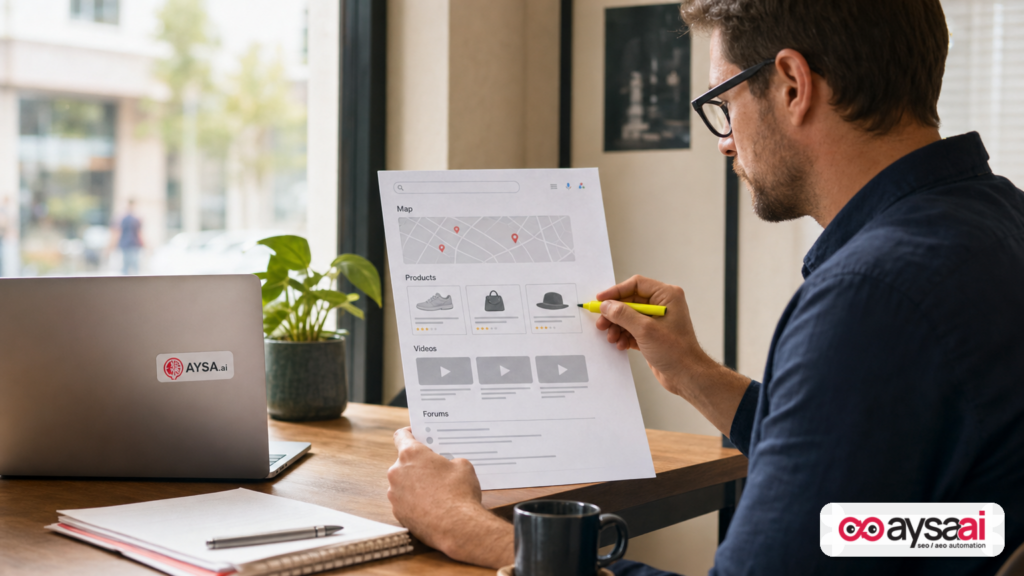
- Audit by query cluster, not by page: for each money Keyword group, identify the current SERP’s dominant result types and rebuild your content architecture to match.
- Decide your “destination role”: are you the original source, a local provider, a marketplace, a tool, a community, or an explainer? Trying to be all five usually fails after core updates.
- Localize beyond language: country-specific domains/subfolders need real market signals (offers, logistics, customer support, pricing/currency, local trust) or they’ll be treated as thin replicas.
- Measure intent drift: rankings alone can mislead. Watch Clicks, query mix, and landing page mix in Search Console after the rollout settles.
- Operate with controlled automation: use systems that monitor changes and generate safe, reviewable fixes. AYSA is built for that: it monitors, prepares changes, asks for approval, and executes accepted website updates at scale.
Table of contents

- The pattern behind the May core update: “destination fit” beats generic authority
- What changed in plain English (and why most businesses misdiagnose it)
- Authority didn’t disappear—it just stopped being a universal shortcut
- The international twist: local domains and “wrong-market” relevance
- Why “forums lost” and “aggregators lost” are incomplete explanations
- How to read result types: the fastest way to stop fighting the SERP
- The SME scenario: a multi-location service business that lost rankings without doing anything “wrong”
- A 30-day action plan: stabilize, realign, then scale
- What to monitor after a core update (without drowning in tools)
- What agencies should rethink: deliver “intent alignment,” not just deliverables
- Where AYSA.ai fits: approved execution for SEO/AEO/GEO
- What to do next (checklist)
- Sources and further reading
The pattern behind the May core update: “destination fit” beats generic authority
Here’s the operational thesis that matters most for business owners:
Google increasingly chooses winners by asking, “What is the best destination type for this query—right now, for this user, in this market?”
In the SEJ coverage of Solis’ analysis, the key observation wasn’t that one category won and another lost. It was that fit mattered:
- Fit to intent: informational vs transactional vs navigational vs local service vs tool usage
- Fit to result type: official sources, local providers, product/category pages, marketplaces, videos, social platforms, tools/calculators, etc.
- Fit to market: the correct country/locale domain and supporting localization signals
This matters because many SEO strategies still assume a simpler equation:
More authority + more content = more rankings.
That equation still works sometimes. But it fails badly when Google decides the SERP should be dominated by a different destination type. You can be authoritative and still be the wrong shape for the query.
The practical takeaway is uncomfortable: you can do “good SEO,” publish quality content, earn links, and still lose visibility if your page is not the best destination type for the query anymore.
What changed in plain English (and why most businesses misdiagnose it)
Most businesses diagnose core update impact in one of three ways:
- “Google is penalizing us.”
- “Our content quality dropped.”
- “Competitors built more links.”
Sometimes those are true. But intent-focused updates often behave differently. The change can be more like this:
Google re-labeled the query. Not officially, not publicly—but functionally. It may start treating a keyword as more local, more transactional, more comparison-oriented, more tool-oriented, or more “go to the original source.”
When that happens, your page can go from “best answer” to “wrong asset.”
Examples non-SEO teams immediately understand:
- “Best running shoes” becomes more transactional (product grids and shopping-heavy results). A long blog listicle might slip.
- “How to pronounce X” becomes more tool-oriented. A dictionary definition page might lose to a pronunciation tool—or vice versa depending on what Google wants as the destination.
- “Emergency plumber near me” becomes more Local pack + local landing pages. A national blog post on plumbing tips is irrelevant, no matter how good.
- “NIH guidelines on …” becomes more “original source.” A third-party summary site can lose even if it’s well written.
In Solis’ read (as covered by SEJ), this “destination reset” idea shows up in domains rising because they are original sources for certain query types, while third parties dipped—even when both were in the same broad category (education, health, etc.).
Authority didn’t disappear—it just stopped being a universal shortcut
A common overreaction to core updates is to assume authority is everything. The May update is a useful counterweight: authority still matters, but it’s not a universal permission slip.
SEJ’s summary of Solis’ analysis notes that some high-authority domains dropped while others rose, and that “authority alone didn’t explain the winners.” That is the part many teams need to internalize.
Here’s how I explain it in business terms:
- Authority is a multiplier. If you’re already the right destination type, authority helps you win more often and more broadly.
- Authority is not a disguise. If you’re the wrong destination type, authority can keep you afloat for a while—but core updates increasingly remove that protection.
So if your post-update plan is “get more backlinks,” you might be solving the wrong problem. You can’t out-link a SERP that has changed its mind about what it wants.
The international twist: local domains and “wrong-market” relevance
One of the most useful signals from the SEJ write-up is the UK vs US difference Solis observed in SISTRIX visibility: UK results tilted toward local sites.
That’s not shocking to anyone who has operated internationally. But it’s still something many global companies get wrong because they assume Google will “figure it out.”
The pattern described in the SEJ summary is essentially this:
- Local versions (like a country-specific domain) gained visibility in that country.
- Global .com versions sometimes lost visibility in that same country.
Even more important is the operational warning Solis raised (again, via the SEJ coverage): international sites should check for wrong-market ranking and weak country-specific signals.
For SMEs and mid-market brands expanding internationally, “wrong-market” is the silent revenue leak. It creates:
- Pricing/currency mismatch
- Shipping and returns confusion
- Regulatory or availability issues
- Customer support friction
- Lower conversion rates that feed back into perceived relevance
Editorial POV: International SEO is no longer a side quest. It’s now part of core relevance. If Google thinks users in the UK are better served by UK-targeted destinations, a generic global page is a weaker answer even if it has stronger links.
Localization is not just an SEO problem—it’s a product/ops problem
Many teams treat localization as “translate the page and add hreflang.” That’s table stakes, but it’s not the finish line. Market fit requires signals that show the user is in the right place:
- Local inventory/availability (where applicable)
- Local pricing, taxes, shipping, delivery times
- Local contact options
- Local policies and trust elements
- Local testimonials/case studies (where appropriate)
If your “UK version” is a thin clone of your .com with a flag icon, don’t be surprised when a core update exposes that weakness.
Why “forums lost” and “aggregators lost” are incomplete explanations
After every core update, the internet looks for a simple villain and a simple winner. This time it’s tempting to say:
- “Forums are done.”
- “Aggregators got crushed.”
But SEJ’s summary of the SISTRIX read explicitly warns against blanket category conclusions: it wasn’t a blanket category story.
Yes, Solis observed a pullback in forums/Q&A in the dataset, but she also noted that larger social/video platforms were mixed, and that some large marketplaces gained—so “aggregators lost” doesn’t hold as a universal rule.
That’s the right way to think about this. A category label is too broad. The real questions are:
- For this query, does Google want firsthand discussion (forum), or a definitive answer (official), or a product grid (marketplace), or a local provider?
- Is the forum result the best destination, or is it redundant noise?
- Is the aggregator adding unique value, or is it an echo of better primary sources?
Core updates are increasingly about separating “destination” from “commentary.” Both can rank, but not for the same query shapes.
How to read result types: the fastest way to stop fighting the SERP
If you only take one tactical practice from this editorial, take this:
Before you change your content, change your diagnosis method.
Don’t start with your page. Start with the SERP.
Step 1: Snapshot the SERP for your most important queries
Pick 20–50 queries that drive revenue or leads. For each, record what Google is rewarding today:
- Are the top results mostly official sources?
- Mostly product/category pages?
- Mostly local landing pages?
- Mostly tools (calculators, converters, pronunciation, templates)?
- Mostly video/social?
- Mostly comparison/review lists?
You’re looking for the dominant “shape” of the SERP.
Step 2: Assign your role for each query cluster
Be brutally honest:
- If Google wants an official source and you’re a third-party summary, your job is to target different intent (or bring genuinely unique value).
- If Google wants a local provider and you’re a national generic page, build location-specific destinations or stop chasing the query.
- If Google wants a marketplace grid and you have a blog post, create a category/collection experience that converts.
Step 3: Build the right asset—not the “best version” of the wrong asset
This is where SEO teams waste months. They keep improving the wrong page type because it’s what they already have. They rewrite, expand, and optimize a blog post… when the SERP wants a product finder.
Core updates punish that kind of stubbornness. Your job is to build the destination Google is trying to rank.
The SME scenario: a multi-location service business that lost rankings without doing anything “wrong”
Let’s make this real with a scenario I see constantly.
Business: A multi-location home services company (think HVAC, plumbing, or pest control) operating across several cities and expanding into a neighboring country market.
Pre-update behavior:
- They rank with a strong “Services” page and a handful of blog posts.
- They have location pages, but they’re thin and similar.
- The .com site sometimes ranks in the other country because it has more links and history.
Post-update symptoms:
- Traffic drops for “service + city” queries.
- Rankings become volatile, with local competitors and directories rotating in.
- The wrong-market domain begins showing up more often, hurting leads because phone numbers, hours, or service areas don’t match.
The common misdiagnosis: “We need more blogs and more backlinks.”
The more likely diagnosis (aligned to the May update pattern): Google is reasserting that these queries should go to local destinations that fit the market and intent. Thin location pages and generic national pages don’t match the destination type Google wants to rank.
The fix: Not “more content.” Better destinations:
- Upgrade location pages to be truly local (service area, proof, constraints, FAQs, policies, contact options).
- Make sure the right country/locale pages rank for the right users (stronger market signals, internal linking, consistent localization).
- Remove cannibalization where the national page competes with local pages for the same cluster.
- Align titles, headings, and content blocks to the query intent (emergency vs scheduled, residential vs commercial).
This is the kind of “boring” work that wins after core updates. It’s not glamorous. It’s operational excellence.
A 30-day action plan: stabilize, realign, then scale
Google core updates create urgency, but the right response is phased. You need to avoid thrash while still acting decisively.
Days 1–7: Confirm impact and isolate intent shifts
- Wait for the dust to settle: SEJ notes Google’s own guidance is to wait at least a week after completion before drawing conclusions from Search Console. Treat early movement as signal, not truth.
- Segment by query intent: brand vs non-brand; local vs non-local; informational vs transactional.
- Identify “SERP shape changes”: queries where the top 10 result types look different than before (more local, more official, more shopping, more tools, etc.).
Days 8–15: Build or upgrade the correct destination pages
- Create missing page types: category pages, comparison pages, local landing pages, tool pages—whatever the SERP is now rewarding.
- Reduce “echo pages”: if you are summarizing a source that Google now prefers directly, add unique value or reposition the content to a different intent.
- Fix internal linking to match intent: make sure the pages you want ranking are the ones receiving contextual links from relevant hubs.
Days 16–30: Strengthen market fit and measure conversion impact
- International/local signals: ensure the right country/locale site is clearly the best destination for users in that market.
- Conversion alignment: if Google is pushing transactional results, make sure the destination converts (speed, UX, trust elements, clear offers).
- Measure “query mix”: watch which queries you’re gaining/losing; sometimes the fix is to stop targeting a query shape you can’t win as.
What to monitor after a core update (without drowning in tools)
Tools vary. Datasets disagree. SEJ’s coverage correctly emphasizes that Solis’ read is one tool (SISTRIX), two markets (US/UK), and the tail end of rollout—useful, but not a final verdict.
So what should an SME do?
Focus on a tight set of monitoring outputs
- Search Console clicks by query cluster: are transactional queries down while informational is flat?
- Search Console landing page mix: did Google shift traffic from one page type to another?
- Top losing pages: are they the wrong destination type (blog posts losing to category pages, or global pages losing to local)?
- Country segmentation: for international sites, compare performance by country and verify the right domain/subfolder is winning.
- Lead/revenue quality: don’t “win traffic” that doesn’t convert. Intent-match is also conversion-match.
Then create a weekly cadence: identify the top 10 query clusters with the biggest business impact, and ship improvements to the destination pages that are supposed to own them.
What agencies should rethink: deliver “intent alignment,” not just deliverables
Agencies often sell SEO as a package: content, links, technical fixes, reporting. Core updates like May 2026 punish that packaging because outcomes depend on which destination type the SERP is rewarding.
If you’re an agency, the new value proposition is:
- SERP intent interpretation (what Google is trying to rank and why)
- Information architecture decisions (which page types should exist)
- Localization strategy (market-specific destinations and signals)
- Fast, controlled execution (shipping changes without breaking the site)
And the uncomfortable truth is: many agencies can diagnose intent shifts—but can’t execute at the speed required because implementation depends on clients, dev backlogs, CMS limitations, or internal politics.
This is exactly where systems thinking wins. Monitoring + recommendations are not enough. You need a workflow that turns recommendations into approved changes, reliably.
Where AYSA.ai fits: approved execution for SEO/AEO/GEO
At AYSA, we built around the reality that SEO is now a continuous operations function. Core updates, AI-driven SERP changes, localization, and intent shifts require ongoing monitoring and fast iteration—but with guardrails.
AYSA is designed as an execution system for SEO/AEO/GEO:
- Monitor: detect visibility and page-level changes over time and surface what matters. See AYSA Monitoring.
- Prepare: generate specific, page-level actions tied to intent alignment (content adjustments, internal links, localization consistency, structural improvements).
- Ask for approval: you control what gets shipped—no black box pushing changes live without review.
- Execute accepted changes: once approved, changes can be implemented consistently, helping teams move faster than manual ticket queues.
In the context of the May core update pattern, that means AYSA can help you operationalize the right work:
- Identify pages that lost because they’re the wrong destination type for the SERP
- Recommend destination rebuilds (e.g., convert a blog intent into a category/collection destination)
- Strengthen localization signals for the correct market versions
- Maintain internal linking structures that reinforce the destination pages you need to win
If you’re evaluating whether this model fits your team, start here: AI Search Visibility and AI SEO Tools. For implementation planning, see Pricing. For more editorial thinking like this, browse the AYSA blog.
What to do next (checklist)
- Pick your top 20 revenue-driving query clusters (not 200 keywords).
- For each cluster, write down the SERP’s dominant destination type (official source, local provider, marketplace, tool, video/social, etc.).
- Grade your current page: is it the right destination type, or a workaround?
- Fix wrong-market issues: ensure the right country/locale version is the best destination for that market.
- Ship 5–10 high-impact destination improvements in the next 30 days (not endless rewrites).
- Monitor query mix and landing page mix weekly to confirm you’re aligning with intent—not just chasing rank positions.
- If execution is your bottleneck, adopt approved automation so the work actually ships. Start with AYSA Monitoring.
Sources and further reading
- Search Engine Journal: Google’s May Core Update Favored Pages That Match Intent
- Search Engine Journal: Google Algorithm Updates (history hub)
- Search Engine Journal: International Search category
- Search Engine Journal: Local SEO category
- Search Engine Journal: On-Page SEO category
Note: The SEJ story summarizes Aleyda Solis’ analysis and references SISTRIX visibility data. This editorial does not claim access to additional datasets beyond the supplied source context; treat conclusions as strategy guidance rather than definitive measurement for every niche and region.
Continue the AI search topic inside AYSA.
Use these pages to connect the article with AI SEO tools, AI visibility monitoring, AI Overviews and approved website execution.
Turn this topic into a website action plan.
Use these AYSA hubs to move from reading to technical fixes, AI visibility monitoring, research, glossary context and approval-first SEO execution.