
Google’s New Merchant Center AI Visibility Insights: The Practical Playbook for Ecommerce Brands (and the New “Share of Voice” Reality)
Google is rolling out AI shopping visibility insights inside Merchant Center—share of voice, funnel stage performance, conversational query terms, and missing attribute diagnostics. This editorial breaks down what changed, why it matters as shopping becomes conversational, and exactly how SMEs and agencies should adapt their feeds, content, and measurement with an execution-first workflow—where AYSA monitors, prepares fixes, asks for approval, and implements what you accept.

By Marius Dosinescu / AYSA.ai
Google is rolling out new AI shopping visibility insights inside Merchant Center—reporting designed to show retailers how products perform across Google’s AI-powered shopping experiences. If you sell online, this is a signal worth taking seriously: Google is telling you, explicitly, that the future of ecommerce visibility won’t be measured only by blue-link rankings and Shopping Clicks. It will increasingly be measured by whether your products get recommended inside conversational and AI-assisted shopping experiences.
This isn’t a “nice-to-have” report. It’s Google building a measurement layer for AI commerce—starting with Share of Voice benchmarking, funnel-stage performance, conversational product terms, and missing attribute diagnostics. Those categories are not accidental. They’re a roadmap for what Google’s AI systems need to confidently surface products, and for how Google wants advertisers and merchants to optimize.
Below is the practical playbook: what changed, why it matters, where teams get it wrong, and what to do next—especially if you’re an SME that can’t afford a data engineering project just to keep up with search.
Concise summary
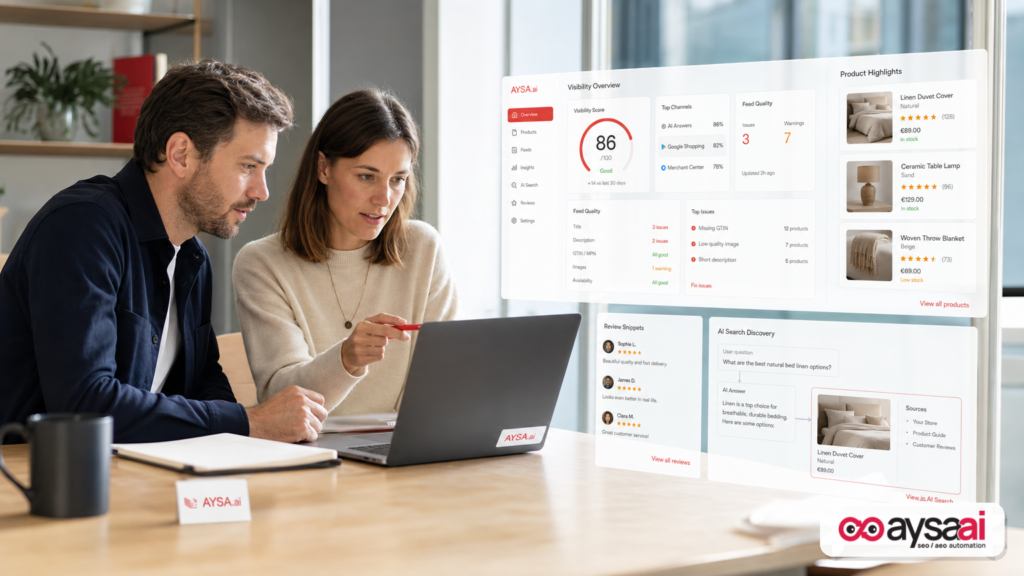
- What changed: Google is adding AI performance insights to Merchant Center so retailers can see how products appear across AI-powered shopping surfaces, including “share of voice,” funnel-stage performance, Conversational search terms, and missing attributes.
- Why it matters: AI shopping experiences compress the journey. Many shoppers will get a shortlist of product options without browsing ten category pages. Your feed quality and product data completeness increasingly determine whether you’re on that shortlist.
- What to do: Treat product attributes like Technical SEO. Expand coverage, normalize naming, add missing specs, align on-site content with feed data, and measure visibility like “recommendation share,” not just clicks.
- Where AYSA fits: AYSA monitors AI visibility and Ecommerce SEO issues, prepares specific site changes, asks for your approval, and executes accepted fixes—so improvements actually ship instead of living in a doc.
Key takeaways (the business version)

- Merchant Center is evolving from a “feed upload tool” into an AI commerce optimization hub.
- Share of voice in AI shopping is the new competitive KPI. You don’t need to “rank #1”; you need to be “included.”
- Attribute gaps are revenue gaps. Missing color, material, compatibility, sizing, or style data can reduce how confidently AI can match you to conversational queries.
- Conversational term insights imply a shift from short keywords (“running shoes”) to intent-rich prompts (“best running shoes for flat feet under $120”).
- The winners will be teams that can execute quickly: monitor → diagnose → approve → implement → iterate.
Table of contents
- What Google just added to Merchant Center (in plain English)
- Why Google is doing this now
- The shift: from “ranking pages” to “being recommended as a product option”
- Share of voice in AI shopping: what it is (and what it isn’t)
- The funnel is back—inside AI
- Product term insights: conversational shopping is a different keyword universe
- Attribute completeness is the new technical SEO for ecommerce
- What can go wrong (and why “more AI” can hide problems)
- A concrete SME scenario: a niche ecommerce brand fighting invisible competitors
- What agencies should rethink: deliverables vs. outcomes
- How to measure success when clicks are not the only win
- A 90-day execution plan (SME-friendly)
- Where AYSA.ai fits: approved execution for AI-era ecommerce SEO
- What to do next
- Sources and further reading
What Google just added to Merchant Center (in plain English)
According to Search Engine Land, Google is rolling out new AI performance insights inside Merchant Center to help retailers understand how products appear across Google’s AI-powered shopping experiences.
The reporting is described as covering four main areas:
- Share of voice insights: benchmarking brand visibility against similar retailers.
- Shopping funnel performance: performance across discovery, evaluation, and purchase stages.
- Product term insights: popular conversational shopping queries tied to your products.
- Product attribute insights: missing or incomplete structured attributes (e.g., color, material, style) across your feed.
Also important: the rollout begins in several countries (U.S., Canada, Australia, India, New Zealand) over the coming months, which suggests Google is testing and iterating before expanding.
To me, the most telling piece is this: Google isn’t just reporting on performance. It’s reporting on inputs (missing attributes) and AI matching behavior (conversational terms, funnel stages). That’s a different mindset than traditional ecommerce analytics.
Why Google is doing this now
Google doesn’t add reporting categories unless it expects the surface area to matter. As AI Overviews, AI Mode, and Gemini-style experiences change how people search and shop, Google needs merchants to do two things:
- Provide better product data so AI can generate accurate comparisons, recommendations, and summaries.
- Spend (and keep spending) by giving advertisers feedback loops that justify budget and optimization work.
You can see this broader direction in the way Search Engine Land has been covering the “AI Search” transition, including changes around AI Overviews and AI Mode (e.g., preferred sources, citation-style labeling). Those topics are discussed in related coverage like:
- Google AI Overviews & AI Mode gain preferred sources, plus new perspectives carousel and highly cited labels
- The SEO-GEO gap: How AI search traffic differs from organic traffic
- Google’s latest AI ad push shows ads are becoming conversations, not clicks
You don’t need to agree with every framing to see the trajectory: search is blending into assisted decision-making. And ecommerce is the most direct monetization path for that assistance.
The shift: from “ranking pages” to “being recommended as a product option”
For 20 years, ecommerce SEO was mostly: build category pages, optimize product pages, earn links, improve site speed, and rank for “best X” or “buy Y.” You were optimizing for a results page with ten blue links and a shopping carousel.
AI-assisted shopping changes the geometry:
- The user’s “SERP browsing” time shrinks.
- The assistant summarizes options, compares, and narrows choices.
- Visibility becomes inclusion in the AI’s shortlist, not just position in a list.
This makes your product data—what you submit through Merchant Center and what you publish on your site—closer to an “API for recommendation.” If the AI can’t confidently understand what your product is, who it’s for, what makes it different, and what constraints apply (size, compatibility, ingredients, material, shipping), it will hesitate to recommend it.
That’s why Merchant Center reporting is now about share of voice, conversational queries, and attribute completeness. Google is telling you what its AI needs to do the job.
Share of voice in AI shopping: what it is (and what it isn’t)
“Share of voice” is a loaded phrase in marketing. In PPC, it can imply impression share. In brand marketing, it can mean media presence. In SEO, it often means a visibility index based on rankings.
In AI shopping, share of voice is likely to mean something closer to:
- How often your products/brand appear within AI-powered shopping experiences compared with peers.
- How often you’re included in recommendation sets for relevant intents.
- How your inclusion varies by stage of the journey and query type.
What it is not (and this is where teams will trip):
- It’s not a guarantee of traffic.
- It’s not a direct proxy for revenue.
- It’s not “SEO rankings but with AI branding.”
But it is a competitive signal: if you’re being recommended less than similar retailers, you likely have a data or positioning problem. And if you’re being recommended more, you can defend and expand that edge.
My point of view: share of voice will become the executive-friendly metric for AI visibility, because it answers the question founders actually ask—“are we showing up?”—even when clicks and sessions get noisier.
The funnel is back—inside AI
For years, marketers argued about whether the funnel is dead. In practice, the funnel never died—it just became harder to measure because journeys fragmented across devices and platforms.
AI brings the funnel back in a new place: inside the assistant’s workflow.
Google’s framing—discovery, evaluation, purchase—matters because it suggests AI shopping surfaces may behave differently at each stage:
- Discovery: broad prompts (“best gifts for new homeowners”) that require interpretation and categorization.
- Evaluation: comparison prompts (“ceramic vs stainless travel mug for coffee”) that require attributes and evidence.
- Purchase: narrowing prompts (“dishwasher-safe 16oz mug under $30 delivered by Friday”) that require precise constraints and fulfillment signals.
If Merchant Center starts showing you stage-based performance, you can stop guessing where you’re weak. Many brands are strong at purchase-stage queries (because Shopping ads and product titles cover them) but weak in evaluation-stage prompts (because product pages lack detail, reviews, FAQs, and attribute coverage).
That’s a strategy unlock: invest in what the AI needs at the stage where you’re invisible.
Product term insights: conversational shopping is a different keyword universe
“Product term insights showing popular conversational shopping queries” is the sleeper feature here.
Why? Because conversational queries have different properties than traditional keywords:
- They are longer and often include constraints (budget, delivery date, health concerns, compatibility).
- They encode preferences (“minimalist,” “eco-friendly,” “for sensitive skin”).
- They assume context (“I have a small kitchen,” “I’m training for a half marathon”).
In the classic SEO playbook, you’d mine keywords from tools, build pages, and measure clicks. In AI shopping, you need to:
- Map conversational terms to attributes (material, size, fit, finish).
- Map them to content modules (FAQs, comparisons, “how to choose,” use cases).
- Map them to structured data consistency across feed and site.
This is where AEO and GEO thinking becomes practical, not theoretical: you’re optimizing to be the best answer and the best option, not only the best “page.”
If you want to go deeper on the changing nature of AI traffic vs organic traffic, Search Engine Land’s discussion of the “SEO-GEO gap” is a useful conceptual lead, even if each business will experience it differently: The SEO-GEO gap: How AI search traffic differs from organic traffic.
Attribute completeness is the new technical SEO for ecommerce
In traditional technical SEO, you’d fix crawlability, canonicalization, faceted navigation, Core Web Vitals, and schema. Those still matter. But ecommerce brands entering AI shopping now have a new “technical baseline”:
Can an AI system confidently represent your product?
Google specifically mentions identifying incomplete structured product attributes like color, material, or style. That’s just the start. In many verticals, the “decision attributes” include:
- Apparel: fit, fabric composition, inseam, rise, stretch, care instructions, model sizing context.
- Home goods: dimensions, weight, finish, installation requirements, room suitability, warranty.
- Beauty: skin type, ingredient highlights, fragrance-free, allergen info (be careful with claims), usage instructions.
- Electronics: compatibility, ports, standards, generation/version, included accessories.
- Food/supplements: ingredients, allergens, nutrition facts, certifications (only if verifiable), serving size.
Here’s the hard truth: many product pages are written to “sell,” not to “specify.” AI shopping needs both. A persuasive description without specifics is marketing. A spec sheet without context is a commodity. You need structured completeness and human clarity.
What attribute work looks like in practice
- Coverage audit: Which attributes are blank across your catalog? Which are inconsistent (e.g., “navy” vs “midnight blue”)?
- Normalization: Standardize values so AI can compare (materials, sizes, styles).
- Enrichment: Add missing details from suppliers, internal QA, or measured data.
- Alignment: Ensure the feed matches the on-site page (titles, variants, availability signals).
- Governance: Put rules in place so new SKUs don’t regress.
This is not glamorous work. It’s the kind of work that quietly wins markets because competitors don’t do it.
What can go wrong (and why “more AI” can hide problems)
AI shopping visibility creates new failure modes. A few I expect to become common:
1) You’ll optimize the wrong thing because you’re chasing the wrong KPI
If you only track sessions and last-click revenue, you might miss that your presence in AI recommendations is rising or falling. Conversely, you might see “share of voice” rise but revenue not follow because your pricing or fulfillment is uncompetitive.
2) Your catalog will be “partially invisible”
Brands often have a few hero products with great data and content—and thousands of long-tail SKUs with thin specs. AI systems will disproportionately favor the SKUs they can confidently describe and compare.
3) Variants will become a mess
Color/size/material variants are where attribute completeness breaks down. If your feed treats variants inconsistently (or your site does), AI experiences may show the wrong version, omit you, or surface you for the wrong intent.
4) Over-automation can introduce silent errors
Using LLMs to auto-fill attributes without validation is risky. You can’t “guess” material or dimensions. Incorrect specs will create returns, negative reviews, and potential policy problems. AI can help structure and draft, but it cannot replace verification.
5) Teams will treat Merchant Center as “ads-only”
Merchant Center has historically lived with paid media teams. But AI shopping spans organic-like experiences too. If your SEO/content team and your feed/ads team aren’t collaborating, you’ll have conflicting narratives: your site says one thing, your feed says another.
A concrete SME scenario: a niche ecommerce brand fighting invisible competitors
Let’s make this real.
Scenario: You run a $3–$10M/year ecommerce brand selling premium ceramic drinkware. You’re not Amazon. You compete with marketplace sellers and a couple of large DTC brands. You’ve historically relied on a mix of Google Shopping, some SEO to category pages (“ceramic travel mug”), and repeat customers.
Then behavior shifts. Customers start asking assistants questions like:
- “What’s the best ceramic-lined travel mug that doesn’t retain odors?”
- “Find a dishwasher-safe 16oz mug under $35 that ships fast.”
- “Compare ceramic-lined vs stainless for taste.”
Your product pages are beautiful—but your specs are incomplete. Your feed has titles, prices, and images, but “material” is inconsistent (“ceramic,” “ceramic-lined,” blank). Dimensions are missing on half the SKUs. Care instructions are on a PDF, not on the product pages. Your “odor-free” claim is in marketing copy but not backed by clear explanations or guidance.
In a conversational shopping experience, the AI needs constraints and comparables. It’s going to favor brands that have:
- clear material definitions
- consistent capacity sizing
- care instructions
- fast shipping signals
- Q&A style content (“will it fit in cup holders?”)
Google’s new Merchant Center AI insights would likely flag you on missing attributes and show which conversational terms you’re not showing up for. The fix is not “write more blog posts.” The fix is feed enrichment + on-page alignment + content modules that translate specs into decision guidance.
What agencies should rethink: deliverables vs. outcomes
If you’re an agency, this update is a warning shot. Clients are going to ask:
- “Are we visible in AI shopping?”
- “Why did our organic traffic flatten?”
- “Why are competitors showing up in AI answers?”
And you can’t answer that with a list of deliverables like “10 optimized titles” or “schema added.” You need an outcome model:
- Visibility outcomes: share of voice trends, inclusion trends, category coverage.
- Data quality outcomes: attribute completeness, variant accuracy, policy compliance.
- Experience outcomes: content that resolves evaluation questions, not just “targets keywords.”
Also: this update blurs lines between paid and organic. Merchant Center is often staffed by PPC teams, but the optimization work touches the site, the catalog, and content. Agencies that keep siloed departments will move slower than agencies that run integrated “commerce visibility” pods.
Search Engine Land’s related coverage on ads becoming “conversations” is a useful clue for agencies building new service lines: Google’s latest AI ad push shows ads are becoming conversations, not clicks.
How to measure success when clicks are not the only win
We’re entering an era where some visibility happens without a click. That doesn’t mean measurement is impossible. It means measurement needs layers.
Layer 1: Classic ecommerce metrics (still required)
- Revenue, margin, ROAS/MER
- Conversion rate
- AOV
- Returns (watch for spec errors)
Layer 2: Visibility metrics (what the new Merchant Center insights point to)
- Share of voice in AI surfaces (benchmarking over time)
- Funnel-stage presence (discovery vs evaluation vs purchase)
- Conversational query coverage (themes, not just keywords)
Layer 3: Input quality metrics (the work you control)
- Attribute completeness rate by category
- Variant integrity (do variants inherit correct specs?)
- Feed-to-page consistency (titles, pricing, availability signals)
- Content module coverage (FAQs, comparison tables, “how to choose” blocks)
In other words: don’t only ask “did traffic go up?” Ask “did we become easier to recommend?”
A 90-day execution plan (SME-friendly)
Most SMEs don’t need a transformation project. They need a clear plan and the ability to execute. Here’s a realistic 90-day approach.
Days 1–15: Baseline and triage
- Inventory your catalog: top sellers, high-margin items, seasonal items.
- Audit feed completeness: identify missing attributes that are decision-critical in your niche.
- Audit on-page alignment: do product pages contain the same specifics as the feed?
- Identify “evaluation gaps”: what questions do shoppers ask before buying?
Days 16–45: Fix what blocks recommendation
- Enrich attributes for top SKUs: prioritize 20% of SKUs that drive 80% of revenue (or profit).
- Normalize attribute values: build controlled vocabularies (colors, materials, styles).
- Add missing specs on-site: don’t hide them in PDFs; make them crawlable and consistent.
- Build “decision support” modules: FAQs and comparison sections that address conversational prompts.
Days 46–75: Expand coverage and build governance
- Roll enrichment rules to the rest of the catalog where feasible.
- Set QA checks: new SKUs can’t go live with missing critical attributes.
- Align teams: PPC/merchant feed owners + SEO/content owners share one source of truth.
Days 76–90: Measure, iterate, and defend
- Track share-of-voice and funnel shifts: look for trend changes after fixes.
- Watch for unintended consequences: returns, customer confusion, variant mismatches.
- Iterate content around the conversational terms you see: add clarifications, not fluff.
The goal in 90 days is not perfection. It’s to establish a system where AI visibility improves because your inputs improve continuously.
Where AYSA.ai fits: approved execution for AI-era ecommerce SEO
Most ecommerce teams don’t fail because they lack ideas. They fail because work doesn’t ship. Someone identifies missing attributes. Someone writes a ticket. It sits. Or a contractor fixes five pages. Then the catalog changes and everything regresses.
AYSA is built for the execution gap.
Here’s how to think about AYSA in this AI shopping visibility era:
- Monitor: Track your AI search visibility and the signals that matter as search shifts. Start here: AI Search Visibility and AYSA Monitoring.
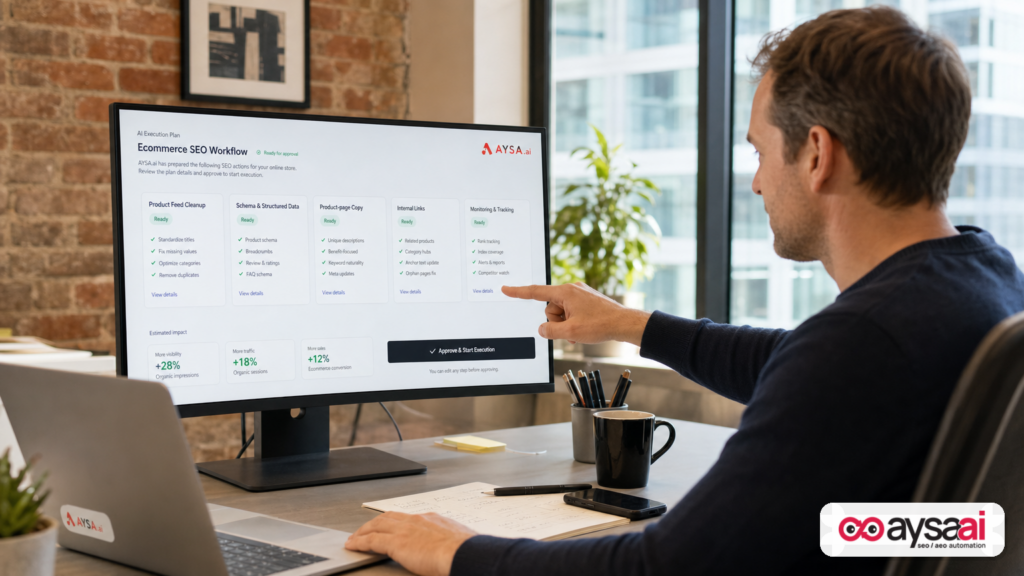
- Prepare fixes: AYSA identifies issues and prepares concrete website changes (for example, updating product page sections, adding missing specs, improving internal linking, clarifying FAQs).
- Ask for approval: You stay in control. AYSA proposes changes and waits for your acceptance.
- Execute accepted changes: Once approved, AYSA implements—so the optimization becomes real, not theoretical.
If you want to see the tool ecosystem around AI SEO, start at: AI SEO Tools.
If you’re deciding whether this kind of execution system fits your budget, see: AYSA Pricing.
And for more editorials like this (AI search, ecommerce SEO, execution strategy), browse: AYSA Blog.
My perspective as a builder: AI visibility will reward disciplined operational teams more than “clever hacks.” The companies that win will be the ones that treat product data, content clarity, and technical hygiene as a continuous system—with tight feedback loops and fast execution.
What to do next
- Open Merchant Center and list your top 50 SKUs. Are critical attributes complete for all variants?
- Write down 20 “conversational shopping” questions customers ask. Do your product pages answer them clearly and consistently?
- Pick one category and build an attribute standard. Define allowed values for color/material/style; normalize your feed and on-site copy.
- Add an evaluation-stage content module. Examples: “How to choose,” “Compatibility,” “Materials explained,” “Sizing help,” “Care and cleaning.”
- Establish a QA gate for new products. No launch without the attributes that influence recommendation.
- Implement an execution loop. Monitor → prepare changes → approve → execute → measure. If your team can’t sustain this, use an execution system like AYSA.
Sources and further reading
- Search Engine Land: Google adds AI shopping visibility insights to Merchant Center
- Search Engine Land: Google AI Overviews & AI Mode gain preferred sources, plus new perspectives carousel and highly cited labels
- Search Engine Land: The SEO-GEO gap: How AI search traffic differs from organic traffic
- Search Engine Land: Google’s latest AI ad push shows ads are becoming conversations, not clicks
- Search Engine Land: How to get your Google Ads seen in AI Overviews
Note: The source coverage summarizes Google’s rollout and feature categories. For official definitions, reporting methodology, and UI specifics, consult Google’s own Merchant Center documentation and announcements directly inside your account. If/when Google publishes a public help-center page for these AI insights, that should become your primary reference for how metrics are calculated.
Continue the AI search topic inside AYSA.
Use these pages to connect the article with AI SEO tools, AI visibility monitoring, AI Overviews and approved website execution.
Turn this topic into a website action plan.
Use these AYSA hubs to move from reading to technical fixes, AI visibility monitoring, research, glossary context and approval-first SEO execution.

