
Google Merchant Center drops “Next”: What the rename really signals for ecommerce SEO, feeds, and AI-driven discovery
Google removed the “Next” branding and reverted Merchant Center Next back to “Google Merchant Center.” The change is cosmetic, but the signal is strategic: consolidation is complete, and the execution bar for product data, feed hygiene, and AI-era visibility is rising.

Google quietly did something that looks trivial: it dropped the word “Next” from Google Merchant Center Next. Going forward, the platform is simply Google Merchant Center.
On paper, this is a cosmetic rename. Google explicitly said there’s nothing you need to do and the name change doesn’t affect accounts.
Operationally, though, these moments matter—especially for small and mid-sized ecommerce businesses. When Google removes the “new version” label, it’s a signal that the transition period is over. The consolidated platform becomes the default. And once defaults harden, the competitive advantage shifts away from “Did we set it up?” toward “Do we run it well every week?”
I’m Marius Dosinescu. At AYSA.ai, we focus on the execution gap in modern SEO/AEO/GEO: we monitor visibility, prepare changes, ask for approval, and then execute accepted website improvements. This rename is a great prompt to treat Merchant Center as what it really is: a product data operations system that touches SEO, paid, analytics, and ultimately revenue.
Concise summary

- What changed: Google removed the “Next” branding. Merchant Center Next is now referred to as Google Merchant Center.
- What didn’t change: Google says no action is required and your account is unaffected.
- Why it matters: The rename signals consolidation is complete. That typically raises the bar for operational consistency—product data quality, site/feed alignment, governance, and Monitoring.
- What to do: Update internal docs, clarify ownership, run a product data QA pass, and build a monitoring-to-execution cadence so small problems don’t become silent revenue leaks.
Key takeaways (for busy operators)

- Don’t overreact to the rename—but do use it as a trigger to tighten your commerce data hygiene.
- Merchant Center is not “just ads.” It’s a data-quality layer that influences eligibility and visibility across Google commerce surfaces.
- The most expensive failures are usually quiet: drift between your site and your product data (price, availability, shipping, identifiers, landing page behavior).
- In 2026, Ecommerce SEO is increasingly about execution systems, not one-time audits.
- AYSA fits where most teams struggle: turning monitoring into approved, shipped improvements—without losing control.
Table of contents
- What changed: Merchant Center Next is now just Merchant Center
- Why a “simple rename” still matters
- Context: the pattern behind Google “Next” products
- Merchant Center is a data-quality system, not just an ads tool
- Who should own Merchant Center (and why most org charts get it wrong)
- Feed hygiene and site alignment: the unglamorous work that wins
- Common failure modes that hurt ecommerce visibility
- Why this matters more in the AI era (AEO/GEO meets ecommerce)
- Concrete SME scenario: the pricing mismatch spiral
- What to monitor weekly (not quarterly)
- What agencies should rethink: reporting isn’t execution
- Where AYSA fits: monitoring + approved execution
- What to do next (action list)
- Sources and further reading
What changed: Merchant Center Next is now just Merchant Center
As reported by Search Engine Land, Google has removed “Next” from the name Google Merchant Center Next. Google said you’ll see the branding removed across help documentation, email communication, and the interface, and that no action is required.
This is the cleanest kind of product update: nothing breaks, no one has to migrate, and everyone keeps working.
But here’s the business reality: even a rename can create operational friction. Teams rely on language. Agencies rely on documentation. Training relies on screenshots and recorded walk-throughs. When the interface and documentation language changes, small misunderstandings create delays—and in ecommerce, delays are expensive.
So yes: ignore the rename from a technical standpoint. But don’t ignore it as an opportunity to do the boring, high-leverage work that keeps your commerce visibility stable.
Why a “simple rename” still matters
When Google drops “Next” from a product name, it’s typically an indicator that:
- The legacy experience is effectively dead. Even if it still exists somewhere, it’s no longer the mental model Google wants the market to use.
- The new defaults are now “the defaults.” That means documentation, support, training, and future features will assume this version.
- The evaluation standard can tighten over time. Consolidated platforms make it easier to enforce consistency, reduce edge-case exceptions, and standardize expectations.
Translated into ecommerce operator language: “We’re done with the transition era. Now it’s on you to run the machine well.”
If you’re a founder or GM, this is the moment to ask a simple question: Do we operate product data like a system, or like a setup task we completed once?
Context: the pattern behind Google “Next” products
Search Engine Land notes that Merchant Center Next was introduced as a newer version of Merchant Center and rolled out over time. Over the years, merchants moved over, and now Google is removing the “Next” branding because the transition is basically complete.
This is a familiar lifecycle in large platforms:
- Introduce a new version with better onboarding and a refreshed interface.
- Run both in parallel while migration happens.
- Shift more users onto the new experience as the default.
- Remove “new” language when the old experience is no longer relevant to most users.
What changes for you after consolidation? The competitive advantage moves from “we have access” to “we have operational excellence.” In other words: in 2023–2025, being early to a platform upgrade might have been a differentiator. In 2026, the differentiator is whether you’re disciplined and fast enough to keep product data accurate and your website aligned.
Merchant Center is a data-quality system, not just an ads tool
One reason this rename matters is that it can mislead teams into thinking Merchant Center is purely a naming/UX layer for advertisers. In reality, Merchant Center is closer to:
- a product data management layer,
- a compliance and policy gate, and
- a visibility eligibility system
…that sits between your store catalog and the various surfaces where products might appear.
This is an important reframing for SMEs:
- If you treat Merchant Center as a “paid channel tool,” you’ll tend to optimize for ad performance while missing the deeper work of data governance and consistency.
- If you treat it as a “technical tool,” you’ll likely push everything into a dev backlog and move too slowly for ecommerce reality.
- If you treat it as a “set-and-forget setup,” you’ll eventually get hit by drift—often at the worst possible time (a promotion, a seasonal peak, a launch).
My view: Merchant Center is commerce infrastructure. Like checkout. Like inventory management. Like returns. You don’t “set up returns” once and never look again. You run it.
Who should own Merchant Center (and why most org charts get it wrong)
In most SMEs, Merchant Center ownership lands in one of four places:
- Paid media (because Shopping ads are visible and urgent)
- SEO / marketing (because it influences organic merchandising and Structured data strategy)
- Engineering / IT (because feeds, API connections, and automation feel technical)
- “Whoever set it up” (the most dangerous model, because it’s essentially no ownership)
Here’s the uncomfortable truth: any single-owner model is fragile. Merchant Center sits at the intersection of:
- Merchandising (what you sell, pricing, bundles, margins)
- Operations (inventory truth, shipping rules, tax settings)
- Marketing (visibility, demand capture, promotion messaging)
- Web execution (landing pages, templates, canonicals, structured signals)
The practical governance model I recommend for SMEs and mid-market brands is:
1) One accountable owner, two empowered collaborators
- Accountable owner: Ecommerce manager, growth lead, or marketing ops leader who can make tradeoffs.
- Collaborator #1: Paid media lead (or agency) who sees performance signals quickly.
- Collaborator #2: SEO/website owner who can address site alignment and content clarity.
2) A defined response time for different issue types
- Immediate: large-scale disapprovals, widespread price mismatches, checkout/shipping changes.
- This week: missing attributes on best-sellers, repeated URL errors, category mapping drift.
- Next sprint: taxonomy cleanups, template improvements, long-term content improvements.
3) A “monitor → decide → execute” system that actually ships changes
This is where most teams break. They can monitor. They can decide. They can’t execute consistently—because execution is stuck behind tickets, approvals, or unclear responsibilities.
AYSA’s model is built around this exact bottleneck: monitoring and recommendations are only useful if they can become approved, executed website changes in a controlled way.
Feed hygiene and site alignment: the unglamorous work that wins
Ecommerce performance is often discussed like it’s mostly strategy: new channels, new creatives, new landing pages, new offers.
But the operators who win year after year typically have something less exciting and more profitable: tight data hygiene.
Feed hygiene and site alignment means your catalog reality matches your customer reality. The same product should “behave” consistently across:
- your storefront product page,
- your category pages,
- your structured content signals,
- your shopping experience, and
- your analytics interpretation.
In practice, this breaks down into a handful of operational disciplines.
Discipline #1: Price integrity
Price integrity is not just “the price is correct.” It’s:
- Promotions turn on/off without creating mismatches.
- Bundle pricing and variant pricing are consistent.
- Currency and rounding behave predictably across templates and exports.
Why it matters: price is a trust signal. Inconsistent price presentation can create user distrust, support overhead, and channel eligibility headaches.
Discipline #2: Availability integrity
Availability is easy to get “mostly right,” and hard to keep consistently correct at scale. Availability integrity means:
- Out-of-stock items aren’t presented as purchasable.
- Preorder and backorder states are handled clearly.
- Warehouse splits and regional restrictions are represented accurately.
Why it matters: availability drift is a classic cause of wasted spend and frustrated customers.
Discipline #3: Shipping reality
Shipping is one of the most common “silent divergence” areas because it lives across multiple systems: carrier rates, rules engines, checkout logic, promotions, and policies. Shipping reality means:
- Shipping costs and delivery promises match what customers see at checkout.
- Free shipping thresholds are consistent.
- Regional exclusions (e.g., Alaska/Hawaii) are clearly reflected.
Discipline #4: Landing page behavior
Landing page behavior is where ecommerce SEO and Merchant Center operations collide. You can have perfect product data and still lose visibility if:
- your URLs redirect unpredictably,
- pages return 404s after a seasonal change,
- canonicals point somewhere unexpected,
- variants resolve to the wrong parent, or
- tracking parameters break rendering or create Duplicate content confusion.
This is also where execution speed matters. A URL pattern change from a theme update can create widespread issues. The faster you detect and correct, the less revenue you leak.
Discipline #5: Identifier discipline and catalog clarity
Catalog clarity includes stable naming, consistent variant logic, and clean category mapping. If your product titles fluctuate wildly between systems, or variants get reorganized weekly, you create a moving target for every channel.
Even if you’re not thinking about “SEO,” this is business hygiene: the more stable and consistent your catalog representation, the easier it is for systems (and people) to understand and recommend your products.
Common failure modes that hurt ecommerce visibility
Most ecommerce teams don’t “break Merchant Center.” They break their visibility through normal business activity: new promotions, new SKUs, new theme changes, new apps, new shipping rules.
Here are the failure modes I see most often in the market, framed in plain business terms—no jargon required.
Failure mode 1: “We changed the site, but forgot the data pipeline”
A typical example: marketing launches a promotion with dynamic pricing. The storefront updates instantly. The export job updates later. For a period of time, the catalog sends one truth while the site shows another. No one notices until performance drops or warnings pile up.
Fix: make “site changes” trigger a checklist review of product data alignment. This is a process problem, not a platform problem.
Failure mode 2: “It’s someone else’s job”
Paid assumes SEO handles product pages. SEO assumes paid handles Merchant Center. Dev assumes marketing handles titles and categories. Result: issues live in the gaps between teams.
Fix: assign one accountable owner and define response times and escalation rules.
Failure mode 3: “We monitor, but we don’t execute”
This is the most common and most costly. Teams can spot issues but can’t implement fixes fast enough. The issue survives multiple meetings, gets deprioritized, and becomes background noise. Meanwhile, your best sellers lose exposure during your most important sales window.
Fix: treat execution as a product. Measure “time-to-fix.” Reduce dependencies. Use a system that can prepare changes, request approval, and execute safely—especially for repeatable website improvements.
Failure mode 4: “We optimize campaigns to compensate for broken inputs”
This is a classic paid search trap: when performance drops, teams tweak bids, budgets, and targeting instead of verifying whether the underlying product data and landing page experience are still aligned.
Fix: make input integrity a default check before major budget changes. It’s like checking tire pressure before rebuilding the engine.
Failure mode 5: “Our reporting is too slow to catch drift”
If your visibility and performance reporting cadence is monthly, you’re running ecommerce with a blindfold. Promotions, inventory, and competitor moves happen weekly—or daily.
Fix: adopt a weekly QA rhythm with a rotating SKU sample, and event-driven checks around promotions and site changes.
Why this matters more in the AI era (AEO/GEO meets ecommerce)
Search and discovery are evolving quickly, and the industry is talking more about AEO (answer engine optimization) and GEO (Generative Engine Optimization). You’ll also hear a lot about AI-mediated discovery—where systems summarize options and recommend products.
I’m not going to invent claims about how any specific AI system ranks products. But we can make a practical, operator-safe statement:
- AI systems tend to perform better with structured, consistent signals than with messy, contradictory inputs.
- As platforms consolidate commerce tooling, it becomes easier for them to standardize how they interpret product data and merchant quality signals.
- In an AI-mediated world, the “best answer” often depends on clear attributes (price, availability, shipping, variants, categories) and trust (consistency, reliability, clarity on the landing page).
In other words: if you want to be discoverable in the next generation of search and shopping experiences, you need to treat product data and website clarity as a continuous practice.
For broader context on how Google and the ecosystem are thinking about AI and commerce, these Search Engine Land pieces are useful research leads:
- Gemini Intelligence signals a new era for search and commerce
- Winning the AI decision layer: From AI discovery to agentic commerce
- Google’s Universal Commerce Protocol: The SEO implications
Those articles aren’t “Merchant Center rename” articles. But they reinforce the bigger theme: commerce is becoming more standardized, more automated, and more interconnected. That makes operational rigor more valuable.
Concrete SME scenario: the pricing mismatch spiral
Let’s make this tangible with a realistic SME scenario that doesn’t require any special tools or enterprise complexity.
Business: A 12-person ecommerce brand selling premium home goods (kitchenware and small appliances). They run regular promotions, use dynamic discount rules, and change their theme twice per year.
Team setup:
- Founder + ops lead manage inventory and margins.
- A paid media contractor manages Shopping campaigns.
- An in-house marketer manages email, content, and basic SEO.
- A freelance developer handles theme work.
What goes wrong (and why it’s so common)
- The team launches a weekend sale with dynamic pricing rules.
- The storefront reflects the discount immediately.
- The product export job (or data sync) lags behind—or doesn’t apply the promo logic in the same way.
- For 24–72 hours, some products show one price on the site and another in the catalog data.
- Paid performance gets worse. The contractor adjusts bids and budgets.
- The founder sees lower revenue and assumes competition or demand softness.
- After the sale ends, the mismatch disappears, but the damage remains: reporting is noisy, decision-making confidence drops, and everyone wastes time arguing about what happened.
What makes this spiral expensive
- It breaks learning. When inputs are inconsistent, your experiments aren’t valid. You can’t trust what you’re measuring.
- It creates hidden operational cost. Teams debate strategy when the issue was execution integrity.
- It compounds over time. If this happens repeatedly, you normalize instability and treat revenue volatility as “just ecommerce.”
What a mature response looks like (and is realistic for SMEs)
- Before promotions: run a quick checklist on pricing behavior for a SKU sample (best sellers + a few variants).
- During promotions: spot-check daily for drift (10 minutes).
- After promotions: confirm the catalog and site return to baseline cleanly.
- Always: define who can make the call to pause campaigns or adjust exports when drift is detected.
This is not about being paranoid. It’s about making revenue more predictable.
What to monitor weekly (not quarterly)
SMEs don’t need an enterprise “command center.” They need a rhythm, an owner, and a small set of repeatable checks.
Here’s a practical monitoring cadence that matches how ecommerce actually changes.
Weekly (30–45 minutes)
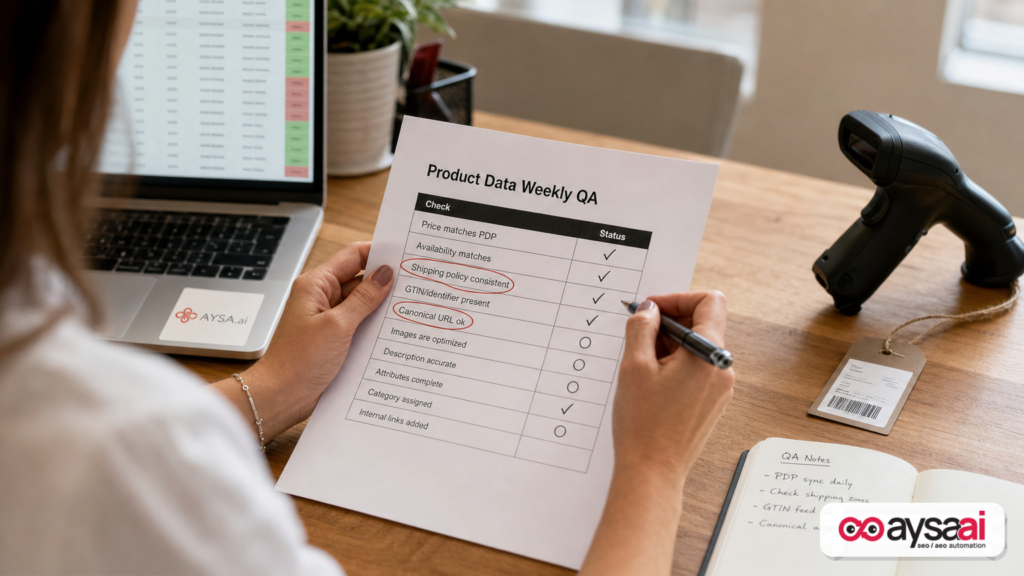
- SKU sample audit: rotate through a sample of products (best sellers, highest margin, and a few long-tail items).
- Check the basics: price, availability, shipping promise, and landing page behavior.
- Spot-check variants: confirm size/color selections resolve correctly and don’t generate broken pages.
- Escalate quickly: if the issue affects a meaningful portion of revenue-driving SKUs, treat it as immediate.
Monthly (60–90 minutes)
- Category coverage review: are top categories represented cleanly and consistently across your site and product data?
- Template drift check: any theme/app changes that affected product page rendering, structured signals, or URL behavior?
- Ownership check: are the same people still responsible, and is escalation working?
Event-driven (whenever these happen)
- Theme changes or platform migrations
- New shipping rules/carriers
- Inventory system changes
- Promotion launches/ends
- Large SKU imports or catalog restructuring
Connect monitoring to visibility (including AI-driven discovery)
Product data integrity is one side of the story. The other side is visibility: are you appearing where customers are searching and asking questions?
At AYSA, we approach this with two complementary layers:
- Monitoring that helps you detect technical and visibility issues early (before revenue drops).
- AI Search Visibility to understand how your brand shows up in AI-driven discovery and where you have gaps.
The point is not to collect more dashboards. The point is to reduce “surprise” and increase time-to-fix speed.
What agencies should rethink: reporting isn’t execution
If you run an agency (or hire one), the Merchant Center rename is a good excuse to revisit a painful truth in ecommerce: recommendations don’t pay the bills—execution does.
Many agencies are structured to deliver:
- audits,
- roadmaps,
- monthly reporting,
- campaign adjustments.
But ecommerce revenue leakage happens in the weeks between audits and the days between tickets. Agencies often identify the problem quickly and then wait weeks for implementation because:
- the client needs internal approval,
- dev resources are limited,
- ownership is unclear,
- the fix touches templates and feels risky.
My recommendation for agencies is to shift how you define “deliverables.” Instead of only delivering “insights,” deliver outcomes and shipped changes:
- Define a shared SLA for high-impact issues.
- Create a change approval workflow that doesn’t depend on one person being online.
- Measure time-to-fix as a KPI.
- Maintain a visible queue of recommended changes, approved changes, and executed changes.
AYSA’s model supports this operational reality: recommendations are prepared, approvals are requested, and accepted changes get executed—so agencies and in-house teams aren’t stuck in a perpetual “we told you what to do” loop.
Where AYSA fits: monitoring + approved execution for ecommerce teams
AYSA exists because modern SEO and ecommerce growth have a structural problem: everyone can find issues, but too few teams can ship fixes fast enough.
Our model is designed to make execution safer and more consistent:
- Monitor site visibility and performance signals so you’re not guessing.
- Prepare recommended changes in a practical, implementable form.
- Ask for approval so humans stay in control (governance matters).
- Execute accepted changes on the website so improvements actually go live.
In the context of Merchant Center and ecommerce visibility, AYSA tends to be especially useful when:
- you have a lean team and can’t afford “one more dashboard,”
- you rely on a developer backlog and need a faster path for safe improvements,
- you want governance (approvals) without paralysis,
- you want to improve how your product/category pages communicate value and reduce ambiguity for both users and machines.
Explore how we frame this on the platform:
Important clarification: AYSA is not a replacement for Google Merchant Center. Merchant Center is Google’s platform. AYSA is an execution system that helps you keep your website and content aligned with the outcomes ecommerce teams care about: discoverability, clarity, and stable performance over time.
What to do next (action list)
Use the rename as a prompt to tighten your operating system. Here’s a practical 7-day plan that works for SMEs and agencies alike.
Day 1: Clean up naming and internal confusion
- Remove “Next” from internal docs, SOPs, onboarding materials, and tickets.
- Tell your team and agency partners: “It’s Merchant Center—same platform, new naming.”
Day 2–3: Confirm ownership and escalation
- Assign a primary owner and a backup.
- Write down what constitutes an “immediate issue” vs “next sprint.”
Day 4: Run a quick SKU sample audit
- Pick 20 SKUs: best sellers, high margin, and a few variants.
- Check price, availability, shipping promise, landing page behavior, and variant selection behavior.
Day 5: Align the next promotion with a QA checklist
- If a promotion is coming up, define a before/during/after check.
- Decide who has authority to pause or adjust if drift is detected.
Day 6–7: Build your execution loop
- Create a single queue of issues and recommended fixes.
- Define an approval workflow (who approves what).
- Make sure accepted changes actually ship—this is where execution systems matter.
If you want to operationalize this with a monitoring-to-execution system, start with AYSA Monitoring, then layer in AI Search Visibility to understand where you’re gaining (or losing) ground in AI-mediated discovery.
Sources and further reading
- Search Engine Land: Google drops Next from Merchant Center Next
- Search Engine Land: Google Search Console gains reporting on social and video platforms (useful context on how reporting ecosystems evolve)
- Search Engine Land: Google’s Universal Commerce Protocol: The SEO implications (broader commerce standardization context)
- Search Engine Land: Gemini Intelligence signals a new era for search and commerce (AI + commerce direction)
- Search Engine Land: Winning the AI decision layer: From AI discovery to agentic commerce (AI-mediated discovery context)
Editorial note on claims
This article uses Search Engine Land as the source for the rename itself and treats other linked articles as context on broader industry direction. Where a claim can’t be verified from the provided research context, it’s framed as operational analysis (how ecommerce systems commonly fail) rather than as a statement of Google policy or a promise of specific outcomes. The goal is a practical operating framework: keep product data and website reality aligned, monitor frequently, and build a fast, controlled execution loop.
Continue the AI search topic inside AYSA.
Use these pages to connect the article with AI SEO tools, AI visibility monitoring, AI Overviews and approved website execution.
Turn this topic into a website action plan.
Use these AYSA hubs to move from reading to technical fixes, AI visibility monitoring, research, glossary context and approval-first SEO execution.

