
Stop Saying “Best Practice”: How to Win SEO Buy‑In With Proof, Not Opinions
SEO gets dismissed as “black magic” when we argue from opinion. Here’s a practical system for turning Google’s own documentation, your data, and controlled tests into proof that earns approvals—and ships changes faster with approved execution.

SEO doesn’t fail because it’s wrong. It fails because it’s unproven to the people who have to approve it.
Inside most companies—especially SMEs and agencies supporting them—SEO recommendations compete with dev sprints, product launches, compliance, brand reviews, and the unkillable status quo. When we show up with “best practice says…” we’re basically asking the business to take a leap of faith. That’s how SEO gets labeled as black magic.
This editorial is about replacing “trust me” SEO with receipts: what Google has publicly documented, what your own data shows, and what controlled rollouts can validate. The goal isn’t to worship documentation. The goal is to ship changes with confidence.
Primary research lead: Search Engine Land’s editorial on why we should stop saying “best practice” and start bringing proof (Stop saying ‘best practice’ and start bringing proof).
Concise summary

- “Best practice” is not an argument; it’s a preference signal. Proof is what earns prioritization.
- Google documentation isn’t gospel, but it’s an effective external reference point for cross-team alignment.
- Pair documentation with your own evidence (Search Console trends, crawl behavior, conversion impact) and a rollout plan.
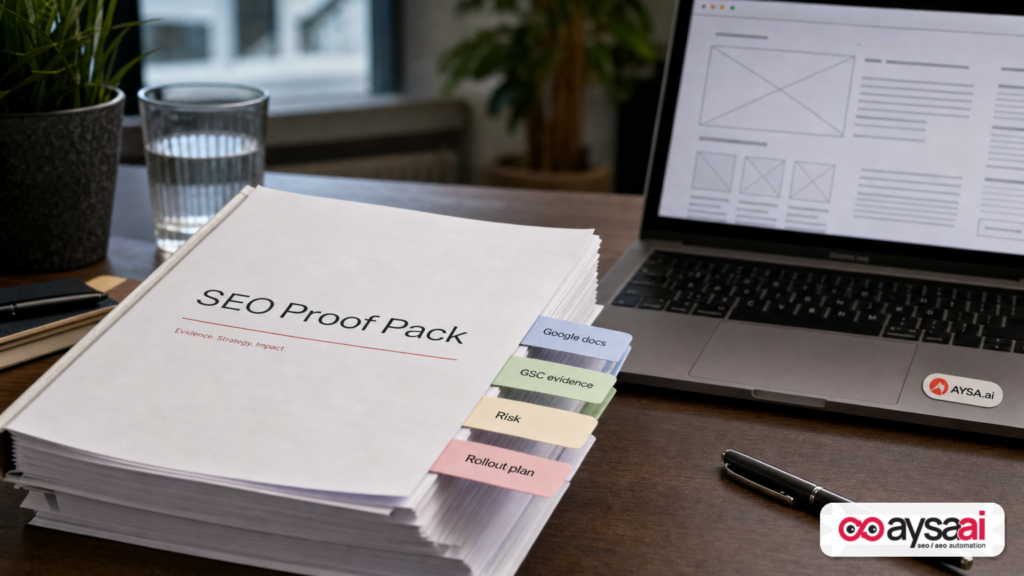
- Turn recommendations into an “SEO Proof Pack” that stakeholders can approve quickly.
- Execution is the bottleneck—approved, trackable implementation is where SEO becomes a business system.
Key takeaways (bookmark these)
- Stop selling SEO. Start de-risking decisions. Stakeholders don’t buy tactics; they buy reduced uncertainty.
- Use Google’s docs as a receipt, not scripture. They move the discussion from “opinions” to “documented behavior.”
- Bring a rollout plan. The best proof is reversible, measurable change.
- Build a repeatable approval workflow. Your organization needs a system, not heroic SEO effort.
Table of contents

- Why “best practice” fails inside real companies
- What changed (and why proof matters more now)
- Google documentation: not gospel, still useful
- The SEO Proof Pack: a repeatable template that earns approvals
- How to win developer buy-in without starting a war
- Proof for clients: turn “SEO advice” into risk-managed decisions
- A concrete SME scenario: the ecommerce brand losing revenue to “small” technical issues
- What to measure (so proof is real, not vibes)
- Where proof fails: common traps and how to avoid them
- What agencies should rethink: from deliverables to approvals
- Where AYSA fits: approved execution for SEO, AEO, and GEO
- What to do next (30/60/90-day action list)
- Sources and further reading
Why “best practice” fails inside real companies
“Best practice” is usually well-intended. It’s shorthand for “this has worked before.” The problem is that inside a real business, “best practice” translates to:
- Optional: It sounds like a nice-to-have, not a requirement.
- Unscoped: It doesn’t clarify effort, risk, or blast radius.
- Unmeasured: It doesn’t state what changes when you do it (or how you’ll know).
- Unowned: It doesn’t define who is responsible for implementation and verification.
Most SEO recommendations don’t die because they’re incorrect. They die because:
- Engineering is protecting uptime, performance, and security.
- Product is protecting roadmap commitments.
- Legal and brand are protecting risk and consistency.
- Finance is protecting spend and forecasting accuracy.
- Leadership is protecting their prior beliefs (“we’ve always done it this way”).
“Best practice” doesn’t compete well in that environment. Proof does—because proof changes the decision from “should we trust SEO?” to “do we accept this documented risk and measured upside?”
What changed (and why proof matters more now)
Search has always been competitive. But in 2026, there’s an added dynamic: more teams are asking “what’s the ROI?” while also juggling AI-driven changes to how discovery works.
Even if you’re not chasing every new acronym, a few realities are hard to ignore:
- Search visibility is fragmented. Users discover brands via classic results, video, social, marketplaces, and AI assistants.
- Traffic alone is less persuasive. Executives want quality, conversion, and defensible growth.
- Implementation is still the bottleneck. The best SEO strategy is useless if nothing ships.
Search Engine Land has also highlighted adjacent signals that reinforce this shift: the platform is covering how data and reporting are expanding (e.g., Search Console reporting changes) and how AI referral dynamics are evolving (Google Search Console gains reporting on social and video platforms; ChatGPT commands 92% of AI referral traffic…). You don’t need to accept every conclusion to recognize the trend: measurement and proof are now table stakes.
Google documentation: not gospel, still useful
Let’s be explicit: Google documentation is not a complete description of how ranking works. It’s written for a broad audience, it’s simplified, and it can omit edge cases. And yes—Google has incentives to guide site owners toward behaviors that make Google’s ecosystem healthier.
Still, documentation is powerful because it’s:
- External: It’s not “the SEO person’s opinion.”
- Stable: It’s referenceable in tickets, briefs, and approvals.
- Teachable: It helps non-SEOs understand why a change is requested.
Think of it like building code guidelines. They won’t tell you every way a building might fail. But if you’re arguing about whether a beam is required, the code reference changes the conversation.
When Search Engine Land argues to “stop saying best practice and start bringing proof,” that’s the core move: stop using insider language, start using verifiable references and business framing (source).
The SEO Proof Pack: a repeatable template that earns approvals
If you want SEO to get prioritized, you need a format that matches how organizations decide. I recommend standardizing every meaningful SEO recommendation into an “SEO Proof Pack.” Not a 40-page audit. A decision packet.
Here’s the template.
1) The decision statement (one sentence)
Example: “Update faceted category pages to prevent crawl waste and consolidate Indexing signals while preserving user navigation.”
2) The documented behavior (the receipt)
Attach one or two official references—ideally from Google Search Central documentation—relevant to the claim.
Rule: Never attach five links. One strong reference beats a pile of weak ones.
If you can’t find an official doc in your current research context, say so and rely more heavily on internal evidence and a cautious test plan. Don’t bluff.
3) The current state (what’s true on your site today)
Show the mismatch. Screenshots are fine, but data is better. Examples:
- A set of URLs returning unexpected status codes.
- Important content not present in rendered HTML.
- Robots rules blocking crawl access to critical resources.
- Canonical patterns that conflict with Internal linking.
4) The risk framing (what happens if we do nothing)
Business stakeholders respond to risk when it’s concrete. Typical SEO risks:
- Visibility risk: key pages lose Impressions because discovery/indexing is impaired.
- Efficiency risk: bots spend Crawl budget on junk URLs instead of money pages.
- Brand risk: outdated content appears in results or AI answers.
- Opportunity cost: slower shipping means competitors compound gains.
5) The proposed change (implementation-level, not vibes)
Write what needs to be changed in terms a dev can ship and QA can verify. Include acceptance criteria.
Bad: “Fix canonicals.”
Good: “For template X, output a self-referential canonical on indexable pages; remove canonical from paginated pages Y; verify by Crawling 1,000 URLs.”
6) The measurement plan (how we’ll know)
Define leading indicators and lagging indicators.
- Leading: Crawlability, indexation, internal link discovery, template validation, Search Console coverage patterns.
- Lagging: impressions, clicks, conversions, assisted conversions, revenue per landing page type.
7) The rollout plan (de-risk it)
Approval comes faster when you make the change reversible and scoped.
- Start with 5–10% of pages (or one directory).
- Monitor key metrics for 2–4 weeks.
- Expand only after validation.
8) Owner, timeline, and QA checklist
The silent killer of SEO initiatives is unclear ownership. Every Proof Pack must have:
- A single DRI (directly responsible individual)
- Ship date target
- QA steps (pre and post deploy)
How to win developer buy-in without starting a war
Developers are not your obstacle. They are your execution path.
Where SEOs often go wrong is treating recommendations like commands (“Do this because SEO”). That’s not persuasive to a team responsible for stability and performance.
Instead, treat technical SEO as an engineering conversation:
Start with shared goals
- Faster pages
- Fewer errors
- Cleaner architecture
- Predictable behavior in production
Use documentation to remove subjectivity
The best role for Google documentation isn’t “proving the SEO person right.” It’s creating a neutral reference point so the debate becomes:
- Not: “Is SEO making this up?”
- But: “Given documented behavior, what’s the safest implementation in our stack?”
Bring acceptance criteria that engineers respect
Engineers trust work that has testable outcomes. Examples:
- “These URLs should return 301 and remain 301 after deployment.”
- “Rendered HTML should contain the primary content block without requiring user interaction.”
- “Robots rules should allow crawling of JS/CSS resources needed for rendering.”
Make rollback part of the plan
A rollback plan reduces perceived risk—which increases speed. If you can’t roll it back, don’t call it a simple SEO change.
Proof for clients: turn “SEO advice” into risk-managed decisions
If you’re an agency or consultant, you’re often dealing with two trust gaps:
- The client doesn’t know SEO well enough to judge quality.
- The client has likely been burned by “mystery SEO” before.
This is where the Proof Pack becomes a client management tool, not just an internal alignment tool.
Use a consistent narrative:
- What Google documents: the baseline behavior and constraints.
- What we found: how your site differs from that baseline.
- What it risks: what can break or underperform.
- What we propose: scoped change with acceptance criteria.
- How we’ll measure: before/after and monitoring plan.
That positioning matters. You’re not selling a trick. You’re guiding a decision under uncertainty.
A concrete SME scenario: the ecommerce brand losing revenue to “small” technical issues
Let’s make this real.
Imagine a mid-sized ecommerce store (think: home goods) with ~5,000 products and a category structure built over years. They’re not doing anything shady. They have good products and decent reviews. But organic revenue is flat or declining.
They hire someone to “do SEO,” and they get a list like:
- “Fix canonical tags.”
- “Improve internal linking.”
- “Don’t block resources.”
- “Add structured data.”
The owner hears: “Spend money on technical details I don’t understand.” The dev hears: “Touch templates that could break checkout.” The marketer hears: “Another audit PDF.” Nothing ships.
How a Proof Pack changes the outcome
Pick one issue with a plausible, measurable impact. For example: faceted navigation generating thousands of near-duplicate URLs, causing crawl waste and index bloat.
Decision statement: “Consolidate faceted URLs so Google spends crawl effort on category and product pages that drive revenue.”
Current state: show (a) the explosion of parameter URLs, (b) a sample of low-value URLs getting indexed, and (c) that key categories are crawled less frequently than expected. (Use your own crawl and Search Console data; don’t invent numbers.)
Implementation: define which filters remain indexable, which become noindex, which get canonicalized, and how internal links will behave.
Rollout plan: apply to one category family first.
Measurement: monitor indexation patterns, crawl frequency for key categories, impressions for head categories, and conversions from organic landing pages in that directory.
The business owner can now approve a scoped, reversible change tied to revenue pages. The dev team can ship it with acceptance criteria. The marketer can communicate what’s happening. That’s how SEO becomes operational instead of mystical.
What to measure (so proof is real, not vibes)
Proof requires measurement, but not every team needs an advanced experimentation platform. You need a small set of reliable signals that move in the right order.
Leading indicators (days to weeks)
- Indexation signals: are intended URLs being discovered and retained?
- Crawl behavior: are bots spending time on money pages vs. junk?
- Template validation: are canonical/robots/meta directives output correctly?
- Internal link discovery: are key pages reachable without JS traps?
Google Search Console remains a primary source of truth for many teams. Search Engine Land’s coverage of expanding GSC reporting underscores why operational measurement keeps getting more important (SEL: GSC gains reporting on social and video platforms).
Lagging indicators (weeks to months)
- Impressions and clicks: directionally useful, especially by page type.
- Conversions and revenue: by landing page group (category/product/help center).
- Efficiency metrics: revenue per indexed page, conversions per crawlable URL set.
The “page type” lens (most teams skip this)
Stakeholders get confused when you report SEO as a single number. Instead, group by page type:
- Homepage
- Category pages
- Product pages
- Blog/help pages
- Location pages
Proof becomes much clearer when you can say, “Category pages improved after template changes,” instead of “SEO went up.”
Where proof fails: common traps and how to avoid them
Even with receipts, teams still get stuck. Here are the failure modes I see most often—and how to counter them.
Trap 1: “Here’s a Google link” with no translation
Dropping documentation into Slack isn’t a strategy. Your job is to interpret it for your system, your CMS, your risks, and your business goals.
Fix: Always include a 3–5 sentence “what it means for us” summary plus acceptance criteria.
Trap 2: Proving the tactic instead of proving the outcome
Stakeholders don’t care if a canonical is “technically correct.” They care if it reduces risk or increases results.
Fix: Tie changes to outcomes like indexing stability, fewer wasted crawls, higher visibility for revenue pages, or reduced support content risk.
Trap 3: Trying to prove everything at once
Big-bang SEO projects create fear. Fear delays approvals.
Fix: sequence changes. Pilot, measure, expand.
Trap 4: Confusing correlation with evidence
SEO is messy. Multiple initiatives overlap. Seasonality exists. Competitors move.
Fix: aim for credible directional evidence with scoping and timeboxing. Use holdout groups where feasible. Be honest about uncertainty.
Trap 5: “We can’t measure it” becomes an excuse
You can measure something for nearly every change—if you pick the right indicator.
Fix: if revenue attribution is hard, measure leading signals (crawl/indexation/template correctness) to prove the mechanism first.
What agencies should rethink: from deliverables to approvals
Agencies often optimize for “deliverables”: audits, roadmaps, reports. But clients don’t buy deliverables—they buy outcomes. And outcomes require implementation.
So the agency model that wins going forward looks less like “send a PDF” and more like:
- Monitor: detect issues and opportunities continuously.
- Prepare: package recommendations into Proof Packs.
- Get approval: stakeholders accept or reject specific changes.
- Execute: changes ship with QA and rollback ability.
- Report: measure outcomes by page type and business KPI.
This is where the concept of “approved execution” becomes a competitive edge. The agencies that win are the ones that reduce the client’s coordination burden, not the ones that generate the most slides.
Where AYSA fits: approved execution for SEO, AEO, and GEO
At AYSA.ai, my bias is simple: execution is the strategy. If your recommendations don’t ship, you don’t have an SEO program—you have a content of opinions.
AYSA is designed as an execution system that:
- Monitors site changes and SEO signals continuously (AYSA Monitoring)
- Prepares specific recommendations with context (what changed, why it matters)
- Requests approval so teams stay in control
- Executes accepted changes to the website—fast, consistent, trackable
That model aligns with the Proof Pack approach: you’re not asking stakeholders to “believe in SEO.” You’re asking them to approve a scoped change with evidence and a rollback plan.
Why this matters beyond classic SEO (AEO/GEO reality)
As discovery expands into AI-powered experiences, the cost of stale, inconsistent, or hard-to-parse content increases. Whether you call it AEO (answer engine optimization) or GEO (generative engine optimization), the operational need is the same: keep your site’s content and structure consistently machine-readable and aligned with what you want represented.
AYSA’s focus on monitoring and approved execution supports that operational requirement.
Where to start with AYSA
- Explore AI-driven SEO tooling: AI SEO Tools
- Understand AI search visibility and what you should monitor: AI Search Visibility
- See how continuous monitoring fits into operations: AYSA Monitoring
- Evaluate cost and fit for your team size: AYSA Pricing
- More execution-first guidance: AYSA Blog
What to do next (30/60/90-day action list)
You don’t need a new SEO philosophy. You need a new operating cadence. Here’s a practical plan that works for SMEs and agencies.
Next 30 days: stop the bleeding, create a proof workflow
- Pick one backlog item that is (a) technical, (b) measurable, (c) low rollback cost.
- Create your first SEO Proof Pack using the template above.
- Define acceptance criteria and a rollback plan with dev.
- Set baseline measurements in Search Console and analytics by page type.
Next 60 days: ship a pilot and measure leading indicators
- Deploy to a subset (one directory or page family).
- Monitor crawl/indexation/template outputs weekly.
- Document what happened (good, bad, unclear).
- Convert the outcome into a second Proof Pack for expansion.
Next 90 days: operationalize execution
- Standardize Proof Packs for all meaningful SEO requests.
- Implement an approval queue (owners, SLA, QA steps).
- Build a “shipped changes” log mapped to measurements.
- Automate monitoring and preparation where it reduces coordination cost (this is where AYSA fits naturally).
What to do next (fast checklist)
- Replace “best practice” language in your tickets with a Proof Pack.
- Attach one external receipt (Google doc) and one internal receipt (your data).
- Scope the change to reduce risk; include rollback.
- Measure leading indicators first; report by page type.
- Build an approval-and-execution workflow so good SEO actually ships.
Sources and further reading
- Search Engine Land: Stop saying ‘best practice’ and start bringing proof
- Search Engine Land: Google Search Console gains reporting on social and video platforms
- Search Engine Land: ChatGPT commands 92% of AI referral traffic. Here’s what 6.77 million sessions reveal.
- Search Engine Land: How to win SEO budget conversations with your CFO
- AYSA.ai: AI SEO Tools
- AYSA.ai: AI Search Visibility
- AYSA.ai: Monitoring
- AYSA.ai: Pricing
- AYSA.ai: Blog
Note on methodology: This editorial uses the provided Search Engine Land source as research input and builds an original framework and operational playbook. Where additional official Google documentation would be useful, teams should attach the most relevant Google Search Central references to their Proof Packs rather than relying on generalized “best practices.”
Continue the AI search topic inside AYSA.
Use these pages to connect the article with AI SEO tools, AI visibility monitoring, AI Overviews and approved website execution.
Turn this topic into a website action plan.
Use these AYSA hubs to move from reading to technical fixes, AI visibility monitoring, research, glossary context and approval-first SEO execution.

