Index Less, Earn More: What Google’s Latest Spam Guidance, Local Controls, and AI Mode Monetization Signal For 2027 SEO
Google is telling platforms to stop indexing shareable utility pages by default, giving restaurants more control over ordering providers, and admitting AI Mode monetizes differently. Here’s what changed, why it matters, and a practical execution plan for SMEs and agencies—built for AI search and real-world ROI.

Search is entering an era where the biggest SEO wins often come from Indexing less, controlling defaults better, and designing pages to serve both humans and AI answers. Google’s latest guidance and product updates—plus what Alphabet said about AI Mode revenue—create a clear theme: governance beats guesswork.
This editorial breaks down what changed, why it matters, and what to do next if you run an SME website, manage local listings, or lead an agency team. I’ll also show where AYSA fits as an Approved Execution system—Monitoring, preparing fixes, requesting approval, and executing accepted changes—because strategy without implementation is just a meeting.
Concise summary

Google is (1) advising platforms to keep shareable utility pages out of Search by default (using Noindex or crawl blocking), (2) giving restaurants more direct control over third-party ordering providers in Google Business Profile, (3) reminding everyone that Search Console reports have dates and can lag, and (4) implicitly confirming that AI Mode monetizes differently—meaning the economic incentives behind search UX are still in motion.
Key takeaways (read this if you’re busy)
- Indexing is now a product decision. If your site generates “share links,” previews, or collaboration/utility URLs, don’t let them become searchable by accident.
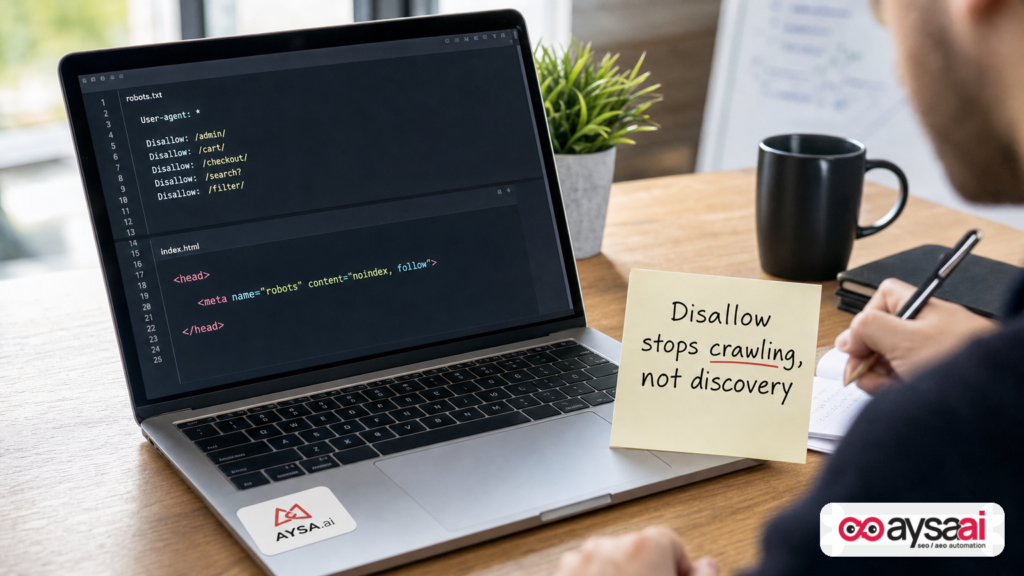
- Robots.txt is not “removal.” A disallow can stop crawling, but it doesn’t guarantee a URL won’t appear in results if Google discovers it elsewhere.
- Local defaults can leak revenue. If ordering providers are enabled by default, you need an audit routine—especially for multi-location brands.
- Stop overreacting to stale charts. In Search Console, check report dates and validate changes using multiple signals—especially the Performance report.
- AI Mode economics matter to your traffic. If AI experiences monetize lower, Google has incentive to evolve ads and formats—so your strategy must adapt to AI answers and citations.
- Execution speed is a moat. The teams that monitor, decide, and ship changes faster will win in both classic SEO and AI search visibility.
Table of contents

- What changed (and why these updates belong together)
- The big shift: Google wants “shareable utility pages” out of search by default
- Robots.txt vs noindex: the mistake that creates “phantom URLs” in Google
- If you run UGC or programmatic pages: how to avoid a spam classification spiral
- Local SEO reality check: restaurant ordering controls are a governance issue, not a “feature”
- Search Console data freshness: how to interpret page indexing when charts lag
- AI-cited pages & the “answer-first” pattern: what to change on your money pages
- AI Mode monetization: why revenue signals predict product behavior
- Concrete SME scenario: the hidden-indexing problem that kills lead quality
- What agencies should rethink: from deliverables to controls
- What to monitor weekly (SMEs) and daily (agencies)
- A practical 30-day action plan
- Where AYSA fits: approved execution for SEO, AEO, and GEO
- What to do next (checklist)
- Sources and further reading
What changed (and why these updates belong together)
The Search Engine Journal “SEO Pulse” roundup captured several separate updates, but they share a single operational message: defaults and measurement windows shape outcomes. What Google indexes by default, what local providers appear by default, and what data you see “by default” in reporting tools will influence the decisions you make.
Here are the specific threads we’re building on from the SEJ coverage:
- Google added spam-guide guidance: Only index content meant for Search, recommending
noindexor crawl blocking for pages made for direct sharing or collaboration. (Source: Search Engine Journal) - Restaurants can turn off specific ordering providers from Google Business Profile instead of waiting on provider actions.
- John Mueller pointed to report dates when asked about Search Console indexing charts that appeared stale, and suggested performance reports may reflect changes earlier.
- Agency research found AI-cited pages more often open with a direct answer compared to non-cited pages, as an observed association.
- Alphabet earnings commentary indicated AI Mode queries had lower monetization, contributing to search growth dynamics—an important incentive signal.
Put together, this is less about “one more SEO best practice” and more about search becoming a control system: define what is eligible for discovery, control third-party surfaces, interpret measurement correctly, and format information so AI systems can use it.
The Big Shift: Google Wants “Shareable Utility Pages” Out Of Search By Default
Historically, many businesses treated indexing as a binary: either you want traffic, or you don’t. In 2027-style search, indexing is more nuanced:
- Some pages are built for public discovery (services, categories, guides, locations).
- Some pages exist for utility and workflows (share links, previews, collaboration spaces, order status, quote drafts, internal search results, filtered views, app screens).
Google’s new spam-guide addition makes the expectation explicit: platforms should default to not indexing pages designed for direct sharing or collaboration. That’s not a “penalty” announcement—but it is a line in the sand about what counts as search-worthy versus workflow-worthy.
What counts as “shareable utility pages” in real businesses?
Even if you’re not a SaaS platform, your website probably creates URLs that are not meant to be searchable. Common examples:
- Share links: “Here’s my cart,” “Here’s a product comparison,” “Here’s a quote draft,” “Here’s a saved itinerary.”
- Collaboration spaces: client portals, project boards, document approval pages.
- Utility pages: internal site search results, filter permutations, sort permutations, print views, session-based pages.
- User-generated stubs: profiles, empty forum pages, tag pages created at scale.
If these get indexed, you can create:
- Brand risk (private-ish pages appearing in results).
- Spam risk (user-generated URLs become a spam vector).
- Quality dilution (Google sees lots of thin or repetitive pages, lowering overall trust).
- Crawl inefficiency (Googlebot spends time on junk instead of money pages).
Google’s updated guidance is best read as: make eligibility intentional.
Why “index less” can mean “earn more”
Many teams still equate “more indexed pages” with “better SEO.” That’s an outdated KPI. The modern KPI is:
- Are your right pages indexed?
- Do they earn impressions for valuable queries?
- Do they convert, get cited, or get chosen by AI?
A smaller, cleaner index footprint can improve:
- Ranking stability (less noise)
- Snippet and citation eligibility (clearer topical signals)
- Operational clarity (fewer “mystery URLs” to debug)
For a system like AYSA—built to monitor and execute improvements—this is a natural fit: identify patterns of low-value URLs, propose control changes, get approval, and ship.
Robots.txt vs noindex: The Mistake That Creates “Phantom URLs” In Google
SEJ’s summary surfaced an important nuance: Google’s guidance lists two options—noindex and crawl blocking (robots.txt). The difference matters more than most non-SEO teams realize.
Robots.txt disallow is not a guaranteed “keep out” mechanism
Google itself has long explained that robots.txt is about crawling, not necessarily indexing. If Google discovers a URL through links, it can still show up as a “known URL” with limited information—even if Google can’t crawl it. SEJ’s source noted this distinction and referenced Google’s own robots.txt documentation perspective.
Practical takeaway:
- Use robots.txt when you want to reduce crawling (save crawl budget, avoid crawling parameters) and you’re okay with the possibility the URL could still be discovered.
- Use noindex when you want to prevent the page from appearing in search results—but only if Google can crawl the page to see the directive.
Choosing the right control: a simple decision tree
For most SMEs, an overly complex SEO framework won’t get implemented. Here’s a simple, operational decision tree:
- If the page should be private: require authentication (best), or remove it entirely. Don’t rely on robots.txt as “security.”
- If the page can be public but should not rank (e.g., share links): set
noindexand ensure Googlebot can crawl it. - If the page is an infinite crawl trap (parameters, faceted navigation): use robots.txt to reduce crawl, and pair with canonicalization and internal linking rules where appropriate.
- If the page is duplicate or near-duplicate: consider canonical tags, parameter handling, and internal linking consolidation (implementation details depend on CMS/platform).
Common pitfall: disallowing a URL that you also want removed
A surprisingly common mistake is to disallow crawling via robots.txt and then expect the URL to disappear. But Google can’t see the noindex tag if it can’t crawl the page.
That’s how you get “phantom URLs” that linger in search results—especially if they’ve been linked externally, shared on social, or scraped.
If you want removal, prioritize strategies Google can process:
- Serve a 404/410 for URLs that shouldn’t exist.
- Allow crawling and return noindex for utility pages that must exist.
- Use authentication for anything sensitive.
If your team struggles to make these decisions consistently, this is exactly the kind of governance AYSA can enforce: define URL patterns, monitor newly created paths, and propose safe controls for approval.
If You Run UGC Or Programmatic Pages: How To Avoid A Spam Classification Spiral
Google placing “only index content meant for Search” inside a spam-prevention guide matters. It suggests indexing decisions are part of how Google expects platforms to reduce spam exposure.
If you host user-generated content (UGC)—reviews, forum posts, profiles, comments, marketplaces—or you generate pages at scale (programmatic SEO), you have two jobs:
- Keep legitimate content discoverable (the whole reason UGC is valuable).
- Reduce indexation of low-intent pages that degrade quality signals and attract spam.
Why platforms get in trouble (even with “good content”)
Platforms rarely fail because they have only spam. They fail because they allow:
- Indexation of thin pages at scale (empty profiles, zero-content tag pages)
- Indexation of duplicate permutations (filters, sorts, tracking parameters)
- Indexation of utility pages never meant for discovery
Once that happens, your domain starts sending mixed signals: “I’m a helpful public resource” and “I generate endless low-value pages.” You don’t want Google guessing which you are.
Platform controls that scale better than manual cleanup
Manual cleanup doesn’t work when URLs are generated continuously. Instead, implement controls at the source:
- Default noindex for share links (as Google’s guidance implies)
- Indexing eligibility rules: e.g., only index profiles with a minimum completeness threshold
- Lifecycle rules: if a page is inactive for X days, noindex it
- Parameter governance: prevent indexable links that produce infinite permutations
AYSA’s approach aligns with this: monitor changes and anomalies, propose rules, request approval, and execute—so you don’t depend on quarterly “SEO cleanups.” Explore AYSA’s monitoring approach here: AYSA Monitoring.
Local SEO Reality Check: Restaurant Ordering Controls Are A Governance Issue, Not A “Feature”
SEJ noted that restaurants can now disable specific third-party ordering providers directly in Google Business Profile—rather than submitting removal requests and waiting for providers to act. (Source: Search Engine Journal)
Even if you’re not in the restaurant industry, you should pay attention, because this is a template for how local search is evolving: Google is tightening the control plane for business-critical defaults.
Why it matters for restaurants
Ordering links affect:
- Customer experience: wrong provider, wrong menu, wrong service area, wrong hours.
- Margin: third-party fees can change the economics of a sale.
- Brand trust: if customers think the restaurant “messed up,” they blame you, not the provider.
When “all partner integrations are enabled by default” (as referenced in the SEJ context), that is not neutral. It creates a governance responsibility: you must audit and decide what should be shown.
Why it matters for non-restaurants too
This update signals a broader trend: Google’s local surfaces increasingly include third-party actions—booking, ordering, messaging, appointments, quotes. Any default integration can create misalignment:
- A hotel that prefers direct bookings
- A clinic that must control patient intake and compliance
- A home service business that doesn’t serve certain zip codes
If you manage many locations, this becomes a systems problem, not a marketing task. You need:
- Ownership: who is responsible for local profile governance?
- Cadence: how often do you audit provider settings?
- Evidence: how do you prove what changed and why?
A practical audit routine (SME-friendly)
Once per month per location (or weekly for high-volume brands):
- Open your Business Profile dashboard and review: ordering/booking providers, phone, hours, categories.
- Confirm providers align with your actual operations.
- Document changes in a simple log (date, what changed, who approved).
If that sounds basic, good. Basic routines get done. The difference between “we should audit” and “we do audit” is execution discipline.
Search Console Data Freshness: How To Interpret Page Indexing When Charts Lag
In the SEJ item, John Mueller’s response to stale Page Indexing charts was essentially: check the dates, and don’t expect every report to update constantly. He also implied that when indexing changes, you may see impact in Performance reporting first. (Source: Search Engine Journal)
Here’s the operational lesson: Search Console is not a real-time telemetry system. It’s a reporting product with update cycles.
What to check first when indexing charts look “stuck”
- Report date: look for the last update timestamp inside the report.
- Performance report: impressions/clicks trends can reveal whether pages are being shown.
- Recent releases: did you deploy redirects, noindex rules, canonical changes, CMS updates?
- Internal analytics: are organic landings shifting?
What not to do: ship random changes because a chart “looks wrong.” That’s how teams create self-inflicted SEO incidents.
Build a triage process (don’t escalate everything)
Teams waste weeks debating whether a report delay is “a bug.” The better question is: what decision are you trying to make, and what evidence do you need?
A simple triage system:
- If revenue is stable and Performance is stable: log it, monitor, avoid thrash.
- If Performance drops sharply: investigate technical SEO and deployments, then validate with additional signals.
- If only Page Indexing count changes but traffic doesn’t: treat it as informational, not urgent.
AYSA can help here by centralizing monitoring and highlighting anomalies that correlate across signals—so you’re not chasing one delayed chart. Learn more about how AYSA supports visibility monitoring: AYSA Monitoring.
AI-Cited Pages & The “Answer-First” Pattern: What To Change On Your Money Pages
SEJ cited agency analysis of AI answers across systems like ChatGPT, Google AI Mode, and AI Overviews, observing that cited pages more often start with a direct answer. The key word is association, not causation. Still, as an editorial principle, it’s a strong signal: format matters. (Source: Search Engine Journal)
In traditional SEO, you could sometimes bury the answer after a long intro and still rank. In AI-mediated discovery, the system is trying to extract and synthesize. If your page makes extraction hard, you may lose citations even if you rank.
A practical “answer-first” structure that doesn’t feel spammy
For service pages, product explainers, and key guides:
- Opening line: answer the question directly in one sentence.
- Next 3–6 lines: qualify the answer (who it’s for, key constraints, what varies).
- Then: expand with steps, examples, FAQs, pricing ranges (if appropriate), and proof.
This is not about writing “for robots.” It’s about respecting the user’s intent first. AI systems tend to reward clarity because clarity helps them do their job.
This is AEO/GEO, not just SEO
Classic SEO focuses on ranking pages. AI search visibility adds new goals:
- AEO (Answer Engine Optimization): make your content extractable and quotable.
- GEO (Generative Engine Optimization): make your brand and claims grounded, consistent, and attributable across sources.
AYSA’s positioning is exactly this intersection: SEO + AEO + GEO execution. If you want the broader framework, start here: AI Search Visibility.
AI Mode Monetization: Why Revenue Signals Predict Product Behavior
One of the most important lines in the SEJ roundup wasn’t a “tactical” SEO tip. It was a business signal: Alphabet’s leadership indicated that AI Mode queries had lower monetization, which weighed on search growth dynamics, even as AI Mode queries grew. (Source: Search Engine Journal)
Here’s why that matters to you even if you never buy an ad:
- If an experience monetizes lower, the company running it will experiment aggressively until it monetizes better.
- That means layouts, ad density, interaction patterns, and citation behaviors can evolve quickly.
- When UX changes, traffic distribution changes—sometimes without a “core update” announcement.
What you can infer (without inventing numbers)
We don’t have exact monetization deltas or traffic-to-sites figures from that summary. So we shouldn’t pretend to. But we can infer something reliable:
- Google is balancing two goals: satisfy users with better answers, and sustain revenue.
- Ads in AI experiences will expand and evolve (SEJ noted expansion to more countries and new formats).
- Organic opportunity will likely concentrate on brands that can be cited, trusted, and chosen—not merely ranked.
That’s the strategic north star: become the easiest source to cite and the safest brand to recommend.
Concrete SME Scenario: The Hidden-Indexing Problem That Kills Lead Quality
Let’s make this real with a scenario I see constantly across SMEs.
Scenario: A regional clinic with “shareable” appointment and form URLs
A regional clinic uses a modern website stack with:
- appointment confirmation pages
- shareable links for intake forms
- patient portal preview screens
- internal search results pages
None of these pages are meant for public search discovery. But because they are accessible without login (or partially accessible), they get discovered via:
- links in email templates forwarded outside the company
- referrer logs that leak URLs
- scrapers that crawl everything
What goes wrong
- Brand confusion: people land on a confirmation URL and think it’s the “main service page.”
- Low-quality leads: users hit dead ends, bounce, and call support.
- Index bloat: Search Console shows a growing number of “Discovered – currently not indexed” and parameter URLs.
- AI visibility loss: the clinic’s “money pages” compete with utility pages for attention and crawl priority.
The fix (simple, but requires discipline)
- Set noindex on all shareable utility URLs that must exist.
- Require authentication for anything remotely sensitive.
- Consolidate internal linking so only public pages are heavily linked.
- Update templates so shared links don’t create crawlable infinite permutations.
AYSA’s role in this scenario is executional: monitor URL patterns, prepare a proposed rule set, ask for approval (because these changes can impact user flows), then implement accepted updates. Start with the toolset overview here: AI SEO Tools.
What Agencies Should Rethink: From Deliverables To Controls
If you run an agency, these updates should make you uncomfortable—in a good way. They imply the future of SEO services is less about “deliverables” and more about operating controls:
- Indexing eligibility rules
- Local profile governance
- Content formatting for AI extraction
- Monitoring and incident response
A report doesn’t run your business
Many agencies still sell:
- monthly audits
- keyword reports
- content calendars
Those can be useful, but they don’t solve the core problem these updates highlight: defaults. Defaults require engineering, CMS control, profile governance, and change management.
The new differentiator: approved execution
In the real world, SEO fails when recommendations die in project management tools. The winning model is:
- Monitor continuously
- Detect issues and opportunities
- Prepare concrete changes
- Ask for approval (stakeholders stay in control)
- Execute quickly and safely
This is the heart of AYSA’s model, and it’s why we built the product as an execution engine—not a dashboard. If you want to see how this is positioned for modern AI search, explore: AI Search Visibility.
What To Monitor Weekly (SMEs) And Daily (Agencies)
Here’s a monitoring shortlist aligned to the themes in the SEJ roundup.
1) Indexing eligibility
- New URL patterns appearing (share links, parameters, previews)
- Indexation spikes or unexpected growth in low-value sections
- Changes in internal linking that promote utility pages
2) Local controls
- Ordering/booking providers enabled
- Primary category changes
- Hours edits, phone edits, and duplicate listings
3) AI visibility signals
- Whether key pages answer top questions in the first lines
- Consistency of brand claims across core pages (pricing, policies, locations)
- Whether “money pages” are being outranked by informational pages for high-intent queries
4) Report lag awareness
- Track last updated dates for key Search Console reports so you don’t panic on stale graphs
- Use performance trends as a first signal, then investigate deeper when needed
AYSA is designed to reduce the monitoring burden and turn what it finds into approved actions: AYSA Monitoring.
A Practical 30-Day Action Plan
If you want traction—not theory—run this plan. It’s designed for SMEs but scales for agencies.
Week 1: Inventory what should never be indexed
- List all known utility/share URL patterns (examples:
/share/,?preview=,/cart,/checkout, internal search results). - Decide for each pattern: authentication, noindex, removal, or crawl blocking.
- Confirm you can implement changes safely (stakeholder approval).
Week 2: Implement the lowest-risk controls
- Add
noindexto utility pages that must exist publicly. - Remove internal links to utility pages where unnecessary.
- Fix canonical tags for common duplicates (when applicable to your platform).
Week 3: Upgrade “money pages” to answer-first format
- Pick 10 pages that drive leads/sales.
- Rewrite openings to deliver a direct answer + qualification.
- Add concise FAQs where it improves clarity (don’t bloat).
Week 4: Governance and monitoring
- Set a recurring local profile audit (especially providers for restaurants).
- Define what counts as an indexing anomaly.
- Create a lightweight change log for SEO and local changes.
If you want a system to run this continuously (not as a one-time project), see AYSA pricing and deployment options: AYSA Pricing.
Where AYSA Fits: Approved Execution For SEO, AEO, And GEO
Most businesses don’t fail at SEO because they lack ideas. They fail because they lack a reliable execution loop.
AYSA is built to operationalize the exact themes in these updates:
- Monitor your site and visibility signals (indexing patterns, content quality signals, anomalies).
- Prepare recommended changes (technical controls, content edits, internal linking adjustments).
- Ask for approval before anything changes—so founders and stakeholders stay in control.
- Execute accepted changes quickly, consistently, and safely.
If your goal is to compete in classic search and stay visible as AI experiences expand, start here:
- AI SEO tools overview: AI SEO Tools
- AI search visibility (AEO/GEO): AI Search Visibility
- Monitoring: AYSA Monitoring
- Pricing: AYSA Pricing
- More editorials: AYSA Blog
What to do next (action checklist)
- Audit URL patterns for share links, previews, parameters, internal search results.
- Choose controls: authentication, noindex, 404/410, or crawl blocks—based on intent.
- Fix the “robots.txt removal” misconception inside your team with a one-page policy.
- Run a local profile governance pass (especially providers, hours, phone) for every location.
- Update 10 high-value pages so the first line answers the core question directly.
- Stop chasing stale charts: always check report dates, validate with Performance trends.
- Set up continuous monitoring + execution so these improvements don’t decay over time.
Sources and further reading
- Search Engine Journal: Spam Guide Update, Restaurant Controls & AI Mode Revenue – SEO Pulse
- Search Engine Journal: SEO coverage
- Search Engine Journal: Technical SEO coverage
- Search Engine Journal: Local SEO coverage
- Search Engine Journal: AI Search coverage
- Search Engine Journal: Google updates history
Continue the AI search topic inside AYSA.
Use these pages to connect the article with AI SEO tools, AI visibility monitoring, AI Overviews and approved website execution.
Turn this topic into a website action plan.
Use these AYSA hubs to move from reading to technical fixes, AI visibility monitoring, research, glossary context and approval-first SEO execution.