Great Content Isn’t Enough Anymore: How SMEs Win in AI Search with Influence, Evidence, and Approved Execution
AI answers are compressing clicks and commoditizing “good content.” The winners will be the brands that earn influence where customers actually pay attention—and ship provable improvements to their sites faster than competitors. Here’s a practical strategy (and execution system) for SMEs navigating the shift to AI search.

“Great content” used to be a reliable growth lever. You published useful pages, earned some links, climbed rankings, and watched Organic traffic compound. That playbook isn’t gone—but it’s no longer sufficient.
Across Google and the broader discovery ecosystem, AI answers reduce the need to click, and automation reduces the uniqueness of most content. The result: more brands publishing “good” material than ever, while fewer of them receive proportional traffic or attention.
This editorial is my practical take (as Marius Dosinescu, AYSA.ai) on what changed, why it matters for real businesses—not just publishers—and what to do next. The core shift is simple:
Influence is becoming the new traffic, and evidence is becoming the new on-page optimization.
We’re building AYSA to help SMEs and agencies operationalize this reality: monitor what AI systems and search engines are learning about your brand, prepare improvements, ask for your approval, and then execute accepted website changes—fast, safely, and continuously.
Concise summary
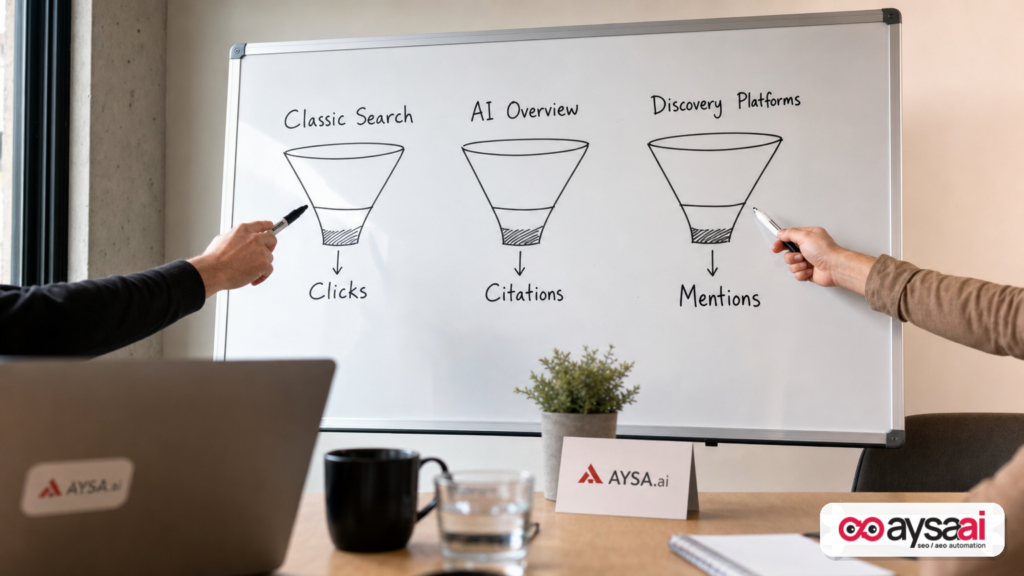
- AI answers compress clicks. Even when you “rank,” you may not get the visit.
- Content is easier to produce, which makes “good” content less differentiating and more commoditized.
- Winning shifts to influence + proof: third-party mentions, reviews, community presence, clear policies, original research, and real-world differentiation.
- SEO becomes a system, not a project: Monitoring, iteration, technical hygiene, and rapid execution matter more.
- SMEs can compete by focusing on inimitable value, local trust signals, and fast, approved improvements—rather than trying to out-publish everyone.
Table of contents

- Key takeaways (for busy owners)
- Why this conversation matters right now
- What actually changed: from “ranking” to “being cited”
- What the MIT AI exposure lens implies for marketing work
- Inimitable value: what AI can’t summarize away
- From your site to everywhere: influence across platforms
- Your website still matters—just differently
- The new scoreboard: metrics that don’t lie in an AI-first SERP
- What can go wrong (and how to prevent it)
- A practical 90-day plan for SMEs (with an example scenario)
- What agencies should rethink (offers, retainers, reporting)
- Where AYSA fits: monitoring → recommendations → approved execution
- What to do next
- Sources and further reading
Key takeaways (for busy owners)

- Stop treating content volume as the strategy. Publish less, prove more.
- Design pages to be quotable and cite-worthy: clear claims, verifiable facts, Structured data, and strong “proof blocks” (policies, reviews, credentials, photos, case studies).
- Build demand where people already are (communities, partner ecosystems, local platforms). Use those surfaces to create preference—then your site converts the intent.
- Invest in execution velocity: the advantage is not only “knowing what to do,” but shipping improvements weekly.
- Use AI to automate exposed tasks (drafting, analysis, planning), and keep humans focused on judgment, differentiation, and customer understanding.
Why this conversation matters right now
Two ideas landed close together and—when you connect them—explain why so many businesses feel like the ground is moving under SEO:
- “Influence is the new traffic.” Rand Fishkin’s argument (as discussed in Search Engine Journal) frames the reality of a more zero-click web and a “digital enclosure” where platforms extract value from creators’ work and deliver summarized answers without sending visits back. The SEJ article that sparked this editorial is here: Search Engine Journal.
- Marketing work is highly “AI-exposed.” MIT’s Work Analytics Lab / MIT Center for Transportation & Logistics built an AI Labor Exposure Map concept showing which tasks can be automated or assisted by current AI systems (SEJ references the map and related reporting). Even if AI doesn’t “replace” people, it absolutely changes the economics of how marketing work gets produced.
Put those together and you get the strategic issue for SMEs:
If AI makes content cheaper to produce and AI answers make clicks harder to earn, then “publish more great content” stops being a durable edge.
That doesn’t mean content is dead. It means content is now the entry fee, and differentiation comes from what AI can’t fake and what platforms can’t easily disintermediate: real-world products, original evidence, distribution, relationships, and brand preference.
What actually changed: from “ranking” to “being cited”
Classic SEO assumed a simple exchange:
- You create the best page for a query.
- Google ranks it.
- Users click.
- You earn revenue.
AI-driven search breaks that chain at the click step. Users can get a synthesized answer directly on the results page (or in a chat interface) and never visit any of the sources. In that world, the unit of value changes:
- From ranking → to being referenced/cited in answers that shape user decisions.
- From pageviews → to preference (brand recall, trust, shortlists).
- From “keywords” → to “entities + evidence” (who you are, what you offer, where you operate, and why you’re trustworthy).
For SMEs, this is not theoretical. It shows up as:
- Fewer informational clicks, even when Impressions remain steady.
- More “comparison” behavior: users ask AI to shortlist providers.
- More reliance on third-party validation: reviews, forums, Reddit threads, directories, and local platforms.
This is why Rand’s framing—again as covered by SEJ—lands: you can’t optimize your way out of a distribution shift. You have to adapt your marketing mix.
Why “great content” is getting commoditized
Even before AI answers, content became harder to differentiate because:
- Publishing costs dropped (templates, outsourcing, now generative AI).
- Search engines improved at satisfying intent without deep reading.
- Many topics reached “content saturation” (thousands of near-identical explainers).
AI accelerates all of that. The median “SEO article” becomes a commodity product. In commodity markets, winners aren’t the ones with slightly better prose—they’re the ones with better distribution, stronger brand, and differentiated supply.
Welcome to the citation economy
In AI Search, being the best source matters—but not always in the way SEOs are used to. Sources that get referenced tend to have some combination of:
- Clear, extractable facts and definitions.
- Strong brand/authority signals.
- Unique data or firsthand experience.
- Consistency across the web (same business details, same positioning).
That should shape how you build pages: not just to rank, but to be quotable.
What the MIT AI exposure lens implies for marketing work
The SEJ piece ties Rand Fishkin’s argument to MIT’s AI Labor Exposure Map concept: a way to estimate which job tasks can be performed or assisted by AI systems today.
I’m not going to repeat numbers as if I verified them independently; I’m using the SEJ discussion as the research lead. The editorial point stands even without the exact percentage:
A large share of day-to-day marketing tasks are now automatable or AI-assisted: drafting, summarizing, competitive scans, outlining, repurposing, and even basic analysis. That changes the value of human work.
The most important distinction: tasks vs. identity
Here’s what I want SMEs and agencies to internalize:
- Tasks are what you do (write outlines, pull reports, draft ads).
- Identity/expertise is why you’re effective (judgment, taste, customer empathy, risk management, ethical boundaries, strategy).
AI will continue to eat tasks. The winners will be teams that:
- Automate the commodity layer (faster, cheaper).
- Reinvest time into differentiation (evidence, product, brand, relationships).
- Ship changes faster than competitors—without breaking the site.
This is also why “using AI” isn’t a strategy. Using AI to free capacity for inimitable work is a strategy.
Inimitable value: what AI can’t summarize away
Rand Fishkin’s examples (as relayed by SEJ) are intentionally physical and visceral—crafted knives, bespoke suits, rare spirits—because they illustrate the principle: make something that can’t be scraped and repackaged.
Most SMEs aren’t selling luxury knives. But you still have inimitable edges. They just look different.
Eight practical forms of “inimitable” for normal businesses
- Real access: on-site inspections, consultations, local availability, same-day service, hands-on care.
- Original evidence: your own dataset, benchmarks, case studies, before/after photos, measured outcomes.
- Proprietary process: a named method, checklist, protocol, or guarantee you truly follow.
- Inventory & assortment reality: what you actually have in stock, what ships today, what’s discontinued.
- Trust & compliance: licenses, certifications, safety practices, HIPAA-conscious workflows (for clinics), refunds, warranties.
- Local nuance: neighborhood-specific details, travel times, seasonal constraints, city regulations.
- Community relationships: partnerships, sponsorships, real customer stories, earned mentions.
- Human judgment: expert recommendations tailored to edge cases, not generic advice.
When you translate these into web assets, you get pages and content that don’t just “read well,” but prove something.
“Proof blocks”: the on-page element most sites are missing
Most SEO content tries to be comprehensive. In the AI era, many pages need to be verifiable.
A “proof block” is a section that makes your claims hard to dismiss and easy to cite. Examples:
- Licenses/certifications (and what they mean).
- Service area boundaries and response times.
- Transparent pricing ranges and what changes the quote.
- Return/refund policies written in plain English.
- Photo evidence: your team, your facility, your work (not stock).
- Review summaries with links to profiles where appropriate (don’t fake).
It’s not flashy. But it’s what turns a generic page into a page that gets referenced and trusted.
From your site to everywhere: influence across platforms
One of the most actionable parts of Rand’s advice (again, as covered in SEJ) is to build audience and presence on platforms you don’t own—because that’s where attention lives. I’ll add a practical business framing:
Your website is your conversion engine. Platforms are your demand engine.
In an AI-mediated web, platform signals become the raw material AI systems learn from: reviews, discussions, citations, Brand Mentions, and consistency across profiles.
Where SMEs should show up (choose 2–3, not 12)
Pick based on your customers, not trends:
- Local businesses: major map/local directories, industry directories, review platforms, local news/community sites.
- Ecommerce brands: creator/affiliate ecosystems, comparison sites, communities relevant to the category.
- B2B services/SaaS: LinkedIn, partner marketplaces, webinars/podcasts, practitioner communities.
- Clinics: physician/clinic listings, patient education hubs, local community groups (with compliance in mind).
The goal isn’t “go viral.” The goal is consistent, credible presence where real customers ask for recommendations—because AI systems increasingly reflect those recommendations.
Distribution assets you can build without becoming a full-time creator
- Partner pages (integration/partner listings).
- Local sponsorship pages (events, charities) with proper citations.
- Expert commentary in industry publications.
- Customer story pages that are specific and evidence-driven.
- Comparison pages that are honest (who you’re for, who you’re not for).
Influence is earned through repetition and reliability, not one heroic post.
Your website still matters—just differently
When traffic gets less predictable, some teams overreact: “If AI steals the click, why invest in the site?”
Because the site becomes even more important as the source of truth—for customers, partners, and machines.
Machine readability is now a growth lever
To be quotable, your site needs to be legible to machines:
- Clear site architecture (services, products, locations, policies).
- Clean internal linking that indicates what’s important.
- Structured data where appropriate (don’t spam).
- Consistent entity signals: brand, address, phone, service area, authorship.
If you’re an SME, you don’t need to be perfect. You need to be consistent and auditable.
The content types that still win
Not every topic is worth writing anymore. Prioritize content that creates durable advantage:
- Decision content: comparisons, “how to choose,” pricing, objections, alternatives.
- Proof content: case studies, methodology, certifications, process pages.
- Local content: location pages that reflect reality (staff, photos, parking, hours, services).
- Original research: even small-scale (e.g., aggregated customer FAQs with quantified frequencies, or internal benchmarks).
These assets tend to earn mentions and citations because they answer real buying questions and provide verifiable specifics.
Technical SEO is now strategy, not maintenance
In a world of compressed attention, technical issues hurt more:
- Slow pages and messy templates reduce conversion on the traffic you do get.
- Duplicate and inconsistent information confuses both users and machines.
- Broken structured data and thin location pages reduce eligibility for rich results and references.
The irony: as content gets commoditized, site quality becomes a differentiator again.
The new scoreboard: metrics that don’t lie in an AI-first SERP
If you keep reporting only “sessions,” you’ll make bad decisions. You need a scoreboard that reflects discovery and influence.
A practical measurement model for SMEs
Use four layers:
- Demand: branded search volume (directional), direct traffic trends, returning visitors.
- Visibility: impressions, presence in SERP features, and—where measurable—citations/mentions in AI answers.
- Trust: review velocity/quality, third-party mentions, referral traffic from communities/partners.
- Outcomes: leads, qualified calls, bookings, revenue, retention.
Google’s own tools remain foundational. Google Search Console and GA4 won’t perfectly measure AI influence, but they still reveal what queries you show up for, what pages earn impressions, and where conversions happen. When you can’t measure something precisely, measure its proxies consistently.
What to stop over-optimizing
- Average position as a vanity KPI (especially on informational queries).
- Content velocity for its own sake.
- “More keywords” without a conversion plan or proof.
What to start tracking weekly
- Top pages by conversion contribution (not just traffic).
- Branded vs. non-branded performance trends.
- Review count and sentiment movement (where applicable).
- Indexation and template health (errors, duplicates, thin pages).
- Content decay: pages losing impressions or becoming outdated.
Execution beats analysis paralysis. The point of measurement is to decide what to fix next.
What can go wrong (and how to prevent it)
When teams hear “AI” and “influence,” they often swing into risky behavior. Here are the common failure modes I see—and how to avoid them.
1) AI content spam (volume without accountability)
Risk: You flood your site with generic pages that add little value, create duplication, and increase maintenance.
Prevention: Publish only when you can add proof: firsthand photos, real pricing logic, unique FAQs, or internal data. Use AI to draft, but require human verification.
2) Entity inconsistency across the web
Risk: Your site, profiles, and directories disagree on name, hours, services, or service area. Machines don’t know what to believe.
Prevention: Maintain a “single source of truth” page and synchronize profiles regularly. Treat accuracy as a growth lever.
3) Weak trust signals (“Why should I believe you?”)
Risk: You have content, but no credibility scaffolding—no author expertise, no policies, no proof of real operations.
Prevention: Add proof blocks, team pages, credentials, and transparent policies. Show your work.
4) Strategy without execution
Risk: You agree on changes, but they sit in tickets for weeks. Meanwhile the market moves.
Prevention: Build an operating system for SEO: monitoring → recommendations → approvals → shipping changes. This is exactly where AYSA is positioned.
A practical 90-day plan for SMEs (With an Example Scenario)
Let’s make this real with a scenario that isn’t a publisher.
Scenario: a regional dental clinic with two locations
The clinic has:
- A website with basic service pages (cleanings, implants, emergency).
- Blog posts written years ago.
- Good reviews, but uneven across locations.
- Declining organic traffic, stable bookings.
The old move would be: “Write more blog content.”
The modern move is: “Increase influence + proof + conversion reliability.”
Days 1–30: Fix the foundation (truth + proof)
- Location truth audit: ensure address, phone, hours, emergency instructions, parking, accessibility, insurance accepted, and service availability are consistent everywhere.
- Proof blocks on money pages: add dentist credentials, before/after galleries (with consent), sedation options, warranty/guarantee language (only if real), and clear pricing guidance (“starting at,” financing options).
- Conversion reliability: booking forms, click-to-call, tracking, and fast mobile performance.
Days 31–60: Become cite-worthy (clarity + structure)
- Rewrite service pages for quotability: crisp definitions, candid candidacy criteria (“who is a good candidate”), recovery timelines, and risks.
- FAQ pages that reflect real calls: “Do you take X insurance?”, “What qualifies as emergency?”, “How long does an implant take?”
- Structured data where appropriate: align page types and business details (done carefully; avoid spam).
Days 61–90: Build influence where people decide
- Review strategy: consistent review requests post-appointment, address negative feedback with process improvements.
- Local/community presence: partnerships with local employers, schools, or health organizations; sponsor a community event and earn a real mention.
- One inimitable asset: a downloadable “Emergency Dental Checklist” or “Implant Preparation Guide” that staff actually uses—then publish it.
Notice what we didn’t do: publish 40 generic blog posts.
We built durable trust signals and distribution loops that influence patient decisions—whether they click from Google, get referred by AI, or hear about the clinic in the community.
What agencies should rethink (offers, retainers, reporting)
Agencies are feeling the squeeze from both sides: clients want outcomes, but traffic is noisier; AI makes deliverables feel cheaper.
Productize outcomes, not outputs
Stop selling “X blog posts” and start selling systems:
- AI search visibility monitoring and brand truth management.
- Conversion reliability (speed, UX, tracking, templates).
- Evidence-based content (case studies, proof blocks, original research).
- Influence programs (partners, communities, reviews).
Report on preference and pipeline
When executives ask, “Why is traffic down?” the answer can’t be panic. The answer is: “Here’s what happened in the SERP, here’s what improved in leads, and here’s how we’re expanding influence.”
Useful reporting ingredients:
- Search Console visibility shifts by intent bucket (informational vs transactional).
- Brand demand proxies (branded queries, direct traffic trends).
- Lead quality and conversion rate improvements.
- Third-party mentions and review momentum.
- A shipped-changes log (what you improved on the site every week).
Close the execution gap
The biggest agency killer in 2026 isn’t “lack of ideas.” It’s slow execution across CMS, dev backlogs, and approvals.
That’s why SEO operations needs an “approved execution” layer: recommendations don’t matter until they ship.
Where AYSA Fits: Monitoring → Recommendations → Approved Execution
AYSA is built for the reality that SEO is now a continuous operations problem, not a one-time checklist.
Here’s the model:
- Monitor: track technical health, content changes, and signals that affect AI/search understanding of your brand.
- Prepare: generate prioritized recommendations and draft changes—titles, internal links, content improvements, structured data opportunities, template fixes—based on what’s observed.
- Ask for approval: you control what ships. Nothing “auto-publishes” without sign-off.
- Execute accepted changes: implement the approved updates to your website efficiently, with a change trail.
If you want the deeper context on our approach, explore:
- AI Search Visibility (how we think about being found in AI-driven experiences)
- Monitoring (ongoing detection of issues and opportunities)
- AI SEO Tools (the execution toolkit)
- Pricing (how teams adopt it)
- AYSA Blog (strategy + implementation guidance)
Why “approved execution” matters in the AI era
AI can draft changes quickly. But businesses still need governance:
- You can’t publish inaccurate medical/legal claims.
- You can’t alter pricing language without alignment.
- You can’t break templates and lose revenue for a week.
Approved execution is the compromise between speed and safety. It lets SMEs move fast without turning their website into an uncontrolled experiment.
How AYSA supports “influence,” not just “rankings”
Influence marketing still needs a strong website backbone:
- When a partner mentions you, the landing page must convert.
- When AI cites you, the cited page must be accurate, structured, and trustworthy.
- When users arrive with high intent, the site must be fast and clear.
AYSA is designed to keep that backbone healthy and improving continuously—so your platform marketing and your site performance reinforce each other.
What to do next
If you’re an SME owner, marketing lead, or agency lead, here’s your next move—practical and ordered.
Action list (start this week)
- Audit your money pages: do they contain proof blocks, pricing logic, clear service boundaries, and real FAQs?
- Choose 2–3 influence channels where your customers actually decide (not where marketers hang out). Commit to consistency.
- Build one inimitable asset: a benchmark, dataset, checklist, or process page you truly own.
- Clean up entity consistency: same business facts across site and profiles.
- Switch the KPI dashboard: report on outcomes + visibility proxies, not only sessions.
- Operationalize execution: implement a weekly cadence of approved site improvements instead of quarterly overhauls.
- Adopt a monitoring system so you’re not learning about problems after revenue drops.
If you’re stuck between “content” and “influence”
Use this rule:
- If the page answers a buying question, invest in it.
- If the page exists to capture an informational click that AI can summarize, think twice unless you can add original evidence.
Sources and further reading
- Search Engine Journal: Why Great Content No Longer Works: MIT Research Shows The Shift Reshaping SEO Strategy (primary research input for this editorial)
- Search Engine Journal: SEO section (ongoing industry context)
- Search Engine Journal: Latest news (to track how SERP features evolve)
- Search Engine Journal: Google Algorithm Updates hub (historical context)
- Search Engine Journal: Local SEO (for multi-location and local businesses)
Note on primary sources: The SEJ article references MIT’s Work Analytics Lab / MIT CTL and Anthropic’s research as inputs to the AI exposure discussion. Those primary links were not included in the supplied research context for this assignment, so I’m not linking them directly here to avoid implying I reviewed them firsthand. If you want, our editorial team can add the official MIT map and Anthropic index links once verified.
About the author: Marius Dosinescu is the founder behind AYSA.ai. We build an AI-assisted SEO/AEO/GEO execution system that monitors your site, prepares changes, asks for approval, and executes accepted improvements—so SMEs can adapt to AI search without turning their website into a risky experiment.
Continue the AI search topic inside AYSA.
Use these pages to connect the article with AI SEO tools, AI visibility monitoring, AI Overviews and approved website execution.
Turn this topic into a website action plan.
Use these AYSA hubs to move from reading to technical fixes, AI visibility monitoring, research, glossary context and approval-first SEO execution.