
How AI Forms an Opinion About Your Brand (and How to Make It Recommend You)
AI doesn’t “rank” your brand the way classic SEO does—it builds a working opinion from scattered signals across your website, reviews, mentions, and operational proof. Here’s a practical system to turn your real business knowledge into machine-readable credibility that shows up in AI answers and recommendations.

AI doesn’t wake up and “decide” it likes your company. But it does form a working opinion about your brand—based on whatever it can observe, verify, and connect across the web.
That difference matters. In the classic SEO era, you could focus on ranking a page for a Keyword and call it a win. In the AI Search era, you’re increasingly competing for something more fragile and more valuable: being the brand an assistive engine is willing to recommend with confidence.
This editorial is my practical guide to building the kind of digital footprint AI can understand, trust, and deliver to the right customer at the right time—without turning your site into a content farm or your team into a full-time “AI Optimization” department.
Concise summary
AI engines form opinions about brands by stitching together signals from your website, Structured data, reviews, third-party mentions, and the “hidden” proof inside your operations (support, onboarding, outcomes, and real customer language). If your footprint is inconsistent, thin, or overly marketing-led, AI confidence drops—and you get fewer mentions, fewer recommendations, and fewer qualified leads. The fix is not more content. The fix is better, more connected, more verifiable information—distributed across the surfaces AI uses and maintained with execution discipline.
Key takeaways
- AI forms an opinion, not a ranking. It needs clarity on who you are, proof you’re credible, and enough context to recommend you.
- Your “digital footprint” is often missing the best evidence. Day-to-day operational proof is persuasive and under-published.
- Consistency is a ranking factor for trust. Conflicting product names, pricing, positioning, and voice create doubt for both humans and machines.
- Third-party signals matter more when AI summarizes. The less “you” are involved in a claim, the more an engine can trust it.
- Execution is the bottleneck. Strategy is common. Shipping consistent, approved changes across your ecosystem is rare—and that’s where systems win.
Table of contents

- What changed: AI search is building opinions at scale
- The new funnel: from rankings to recommendations
- A practical model: Understandability, Credibility, Deliverability (UCD)
- Five streams of data that feed AI’s brand opinion
- 1) Products & services: fix your fundamentals
- 2) Authority content: necessary, not differentiating
- 3) Brand narrative & voice: where most brands drift
- 4) OPID operations: your hidden moat
- 5) Bring offline proof online
- One source of truth: organize once, distribute everywhere
- Where to publish: first-party vs second-party vs third-party
- Concrete SME scenario: local clinic vs. AI recommendations
- What can go wrong (and how to avoid it)
- What to monitor: signals that actually reflect AI visibility
- Where AYSA fits: approved execution for AI visibility
- What SMEs should do next: a 30–60–90 day action plan
- Sources and further reading
What changed: AI search is building opinions at scale
Search used to be a two-step dance: user searches, Google lists links, you fight to be one of them. Now a growing share of journeys look like this: user asks a question, an AI system synthesizes an answer, and the user either takes the next step without clicking—or Clicks only after an engine has already framed what’s “true” and which brands are “best.”
This is not theoretical. Search Engine Land recently highlighted research indicating that zero-click behavior is significant and trending upward (Google zero-click searches hit 68% in early 2026: Study). Whether the exact number holds for every category isn’t the point—the directional reality is: more decisions happen before a click.
As that happens, your brand’s visibility depends less on “Did our page rank?” and more on “Did the engine trust us enough to mention us, cite us, compare us, or recommend us?” That’s the new battleground: AI confidence.
This editorial is inspired by Jason Barnard’s Search Engine Land piece, How AI forms opinions about your brand. I’m building on that framework with an SME-first execution lens: what to do, what not to do, and how to operationalize it so it doesn’t die in a Google Doc.
The new funnel: from rankings to recommendations

In classic SEO, the funnel was often implicit:
- Awareness: rank for informational keywords
- Consideration: rank for “best X” and comparison queries
- Conversion: rank for branded and “near me” queries
In AI search, the funnel is more explicit—and more opinionated:
- Discover: the engine identifies a category and candidate solutions
- Evaluate: it weighs evidence and tries to reduce uncertainty
- Recommend/Deliver: it surfaces a short list (or one best answer) tailored to the user’s context
The engine is doing what a good salesperson does: qualifying and pre-framing. If your footprint is unclear, thin, or inconsistent, you fall out of the candidate set early. If your footprint is strong but unproven, you may be “mentioned” but not recommended. If your footprint is proven but poorly packaged, you may be credible but invisible.
This is why I tell business owners: AI visibility is not just SEO. It’s brand intelligence management across the open web.
A practical model: Understandability, Credibility, Deliverability (UCD)
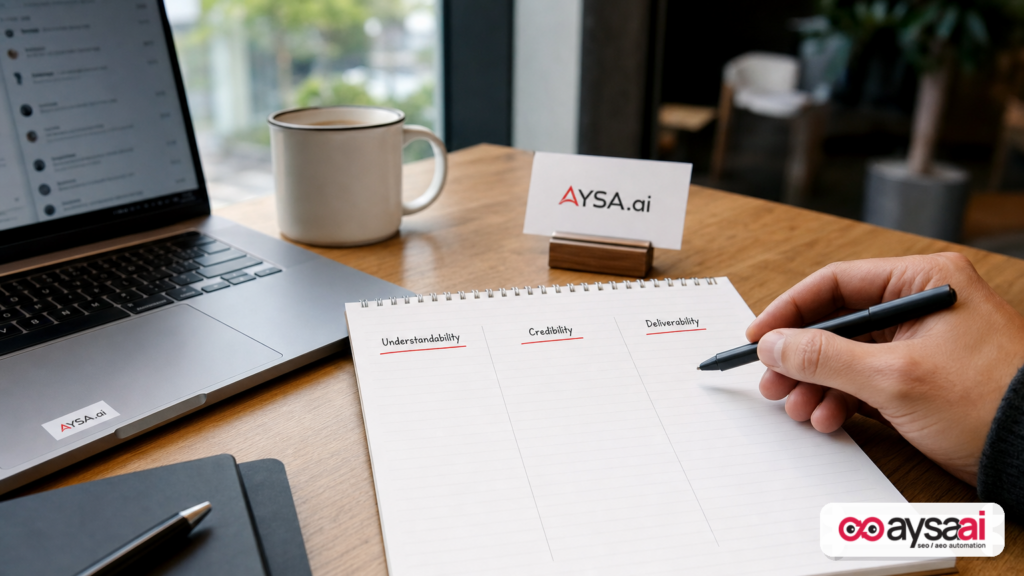
Here’s a simple model worth adopting because it forces your team to stop thinking like publishers and start thinking like systems designers.
1) Understandability
Can an AI engine clearly answer:
- Who are you (entity identity)?
- What do you do (offerings and outcomes)?
- Who do you serve (customer type + use case)?
- Where do you operate (markets, service areas)?
Understandability is the foundation. Without it, credibility and content won’t compound because the system can’t reliably connect your evidence back to your brand.
2) Credibility
Does the engine have enough evidence to believe your claims?
Search Engine Land’s source article frames credibility with an expanded take on E‑E‑A‑T (experience, expertise, authoritativeness, trust), adding additional layers like notability and transparency. Regardless of what acronym you prefer, the point is constant: AI is trying to reduce risk. It will prefer brands that look verifiable, consistent, and endorsed by others.
3) Deliverability
Do you have the right information in the right shapes, in the right places, so the engine can actually “hand you to” the right user?
Deliverability is where most teams waste time. They produce content, but not content aligned to real customer questions, real constraints, and real decision moments. In AI experiences, the “winning” content is often the content that answers the question in plain language with specifics: pricing constraints, tradeoffs, eligibility, timelines, compatibility, and limitations.
UCD gives you a blunt audit tool: if you’re not getting recommended, ask which letter you’re starving.
Five streams of data that feed AI’s brand opinion
Most businesses think their footprint is “our website + our blog.” It isn’t. Your footprint is a composite of what you publish, what others publish, and what your customers say—plus the operational reality behind your marketing.
Using the Search Engine Land framework as a starting point, here are five streams to intentionally harvest and ship.
1) Products & services: fix your fundamentals
If your product and service information is incomplete or inconsistent, everything built on top of it is fragile.
What “good” looks like for AI
- Consistent naming: same service names everywhere (site pages, PDFs, social profiles, directories).
- Clear scope: what it includes and what it doesn’t.
- Who it’s for: industry, company size, situation, and intent.
- Constraints: location limits, lead times, eligibility, compliance limitations.
- Commercial clarity: price ranges or pricing model (when possible), and what drives cost.
Many teams resist specifics because they want flexibility. But ambiguity is expensive in AI search because ambiguity reduces confidence. If your “Services” page is a list of buzzwords, AI can’t reliably match you to a user’s scenario.
Execution note
This is also where technical hygiene matters. It’s not enough to have a page; the information needs to be structured and consistent. That includes schema where appropriate (Organization, LocalBusiness, Product/Service where applicable), but also plain on-page clarity. Schema helps machines parse; copy helps humans and machines evaluate.
If you want an execution system that keeps these basics consistent over time, you need Monitoring plus controlled change deployment—more on that in the AYSA section.
2) Authority content: necessary, not differentiating
Yes, you should publish useful content. No, publishing alone is not a moat anymore.
AI systems can generate generic “what is X” content all day long. So when a business relies only on informational blogging to earn authority, it competes in the most commoditized arena.
So what does authority content need to do now?
- Prove reality: show evidence, examples, data, and constraints.
- Connect to operations: link advice to how you actually do the work.
- Be attributable: real authors with real experience and consistent bios help systems connect expertise.
- Map to decisions: content should align to real buying moments (“Is this right for me?” “What are the risks?” “How much does it cost?”).
Search Engine Land has also emphasized the limits of AI-written SEO content without real experience (AI can write SEO content, but it can’t replace real experience). That’s the correct instinct: the winning content isn’t the content that sounds good—it’s the content that reads like it came from someone who has done the work.
3) Brand narrative & voice: where most brands drift
AI doesn’t just look at what you say. It looks at whether your story holds together across surfaces and over time.
Narrative: clarity beats cleverness
Your narrative must clearly communicate:
- Identity: who you are
- Customer: who you serve
- Use cases: which situations you’re best for
- Differentiation: why you’re a better fit than alternatives
- Proof: what evidence supports those claims
Voice: consistency is a credibility signal
One of the easiest ways to leak trust is to sound like five different companies depending on the channel.
Common failure mode in SMEs and agencies alike:
- The website sounds polished and corporate.
- Social posts sound casual and reactive.
- Sales decks sound like a different offering entirely.
- Support emails sound defensive or vague.
Humans interpret that as “they’re not aligned.” Machines interpret it as “low confidence identity match.” If you want to show up in AI results, you need one coherent voice and one coherent set of claims—repeated consistently.
4) OPID operations: your hidden moat
This is the part I think most businesses underinvest in—and it’s why so many “SEO content strategies” stall. Your operational reality contains the most persuasive, most differentiating information you have. But it’s invisible to the web.
Search Engine Land describes OPID business operations as a stream almost nobody harvests: onboarding, performance, integrations, devotion—basically the day-to-day evidence that you do what you claim.
What counts as operational proof?
- Customer language: support tickets, call transcripts, live chat logs, Q&A from demos, onboarding questions, churn interviews, survey responses.
- Methods: SOPs, checklists, playbooks, definitions, internal glossaries (sanitized and productized for public use).
- Outcomes: case studies with clear baselines and results (without exaggeration), before/after screenshots where appropriate, benchmarks, public patents or publications if relevant.
- Constraints and tradeoffs: the honest “when we’re not a fit” content that increases trust.
Why operations beat marketing copy
Because operations contain what AI needs to answer real questions:
- What does implementation actually take?
- How long does it take before results show?
- What breaks?
- What’s required from the customer?
- What outcomes are realistic?
Marketing copy tends to avoid these specifics. But these specifics are exactly what a user asks in AI chat—and what a system needs to decide whether to recommend you.
How to publish OPID without oversharing
- Anonymize: remove personal data, client identifiers, and sensitive implementation details.
- Aggregate: “Top 20 questions we get from…” rather than “Client X said…”
- Sanitize process: publish a simplified SOP that demonstrates competence without revealing every internal lever.
- Turn it into formats AI can ingest: FAQ pages, glossaries, implementation guides, “what to expect” pages, and transcript-backed posts.
5) Bring offline proof online
Most businesses do credible things in the real world: speak at events, sponsor community meetups, support local causes, train teams, appear on podcasts, give talks, participate in panels.
But AI can’t trust what it can’t see.
Practical ways to convert offline activity into AI-visible proof
- Publish recap posts for talks and panels.
- Upload slides (where possible) with clear attribution.
- Transcribe podcast appearances and link to the original episode.
- Collect and link to third-party coverage (local news, community blogs).
- Maintain a consistent “Speaking / Press” page that consolidates appearances.
This isn’t about bragging. It’s about reducing uncertainty. A brand that consistently shows up in reputable places looks more real, more accountable, and easier to verify.
One source of truth: organize once, distribute everywhere
Here’s where strategy becomes an operating system.
Most organizations fail AI visibility because their information is scattered:
- Website has one version of services.
- Sales deck has another.
- LinkedIn page has a third.
- Directory listings are outdated.
- Review responses contradict the brand voice.
The fix is to treat brand information like product data: maintain a single source of truth that powers every surface.
What should be in that source of truth?
- Entity facts: official name, locations, service areas, contacts, leadership, history.
- Offer catalog: standardized service/product names, scope, pricing model, audience fit, exclusions.
- Proof library: case studies, testimonials, review excerpts (with permissions), third-party mentions.
- Operational knowledge: FAQs, process explanations, timelines, onboarding expectations.
- Style and voice rules: words you use, words you avoid, tone guidelines, positioning statements.
Then you publish that information in the formats each channel needs: web pages, structured data, knowledge panels (where applicable), social profiles, video descriptions, press pages, FAQ pages, and more.
This is also where execution discipline matters: the footprint must stay consistent as it grows. That means controlled updates and monitoring, not ad hoc edits by five different stakeholders.
Where to publish: first-party vs second-party vs third-party
Not all visibility is equal. AI systems weigh sources differently based on independence and reputation.
First-party: you claim
This is your website and your owned properties. It’s essential for understandability, and it sets the narrative. But it’s not “proof” because you wrote it.
Still, don’t underestimate first-party excellence. A sloppy website forces AI to do guesswork. And guesswork reduces confidence.
Second-party: you corroborate
These are platforms you control (profiles, channels) but where different audiences and norms apply—like YouTube, LinkedIn, Medium, press releases, community posts. You can publish your voice, and you can also publish customer voice (testimonials, interviews, case studies) in a way that rounds out the footprint.
Third-party: they prove you
Independent sources—customers, partners, journalists, analysts, forums, neutral review sites—carry outsized weight because they’re harder to manipulate.
Search Engine Land has also explored the importance of co-mentions and the “AI recommendation gap” (What co-mentions reveal about the AI recommendation gap). Even without diving into the technical weeds, the business takeaway is straightforward: being discussed alongside credible peers and categories helps engines place you correctly.
One more nuance worth noting from Search Engine Land’s surrounding coverage: AI visibility can be influenced by underlying search indexes and rankings (for example, discussion of Claude visibility and Brave Search signals: Claude visibility may depend heavily on Brave Search rankings, new data suggests). You don’t need to bet everything on one hypothesis, but you do need to respect the reality: AI systems pull from ecosystems, not just your site.
Concrete SME scenario: local clinic vs. AI recommendations
Let’s make this real with a scenario that mirrors what I see constantly.
The business
A local physical therapy clinic with two locations. Strong outcomes. Loyal patients. Great clinicians. But new patient growth has plateaued, and branded search is fine while non-branded discovery is slipping.
The symptom
Potential patients ask AI-style questions:
- “What’s the best physical therapy clinic for runners near me?”
- “Do I need a referral?”
- “How much does it cost without insurance?”
- “Who specializes in ACL rehab?”
And the clinic is either not mentioned, or it’s mentioned without a strong recommendation.
What’s actually wrong
- Understandability gap: service pages are generic (“sports rehab”) without conditions, timelines, and patient-fit details.
- Credibility gap: outcomes exist but aren’t published as case studies, and clinician experience is buried or inconsistent.
- Deliverability gap: the clinic has no strong “what to expect,” “pricing model,” “insurance/referral,” or “conditions treated” content that mirrors real questions.
- Operational proof is locked away: intake questions, treatment approach explanations, and patient feedback live in forms and conversations, not on the web.
The fix (without turning into a content factory)
- Publish a “Conditions & Programs” hub with clear subpages (ACL rehab, runner’s knee, shoulder impingement), each including who it’s for, what the first visit includes, typical timelines (as ranges), and what success looks like.
- Turn intake questions into FAQs in patient language (“Do I need imaging?” “How many visits is typical?”).
- Standardize clinician bios with consistent credentials, specialties, and community activities (talks, certifications) presented clearly.
- Collect and respond to reviews consistently to reinforce voice and service scope (without scripting patients).
- Publish anonymized mini-case studies with clear baselines and outcomes (careful: no medical overclaims).
This isn’t “SEO content.” It’s making the business legible and verifiable for both humans and machines.
What can go wrong (and how to avoid it)
AI visibility work can backfire if you chase the wrong incentives. Here are the failure patterns I’d actively avoid.
1) Inconsistency across surfaces
Different pricing, different service names, different promises depending on channel. This creates doubt and increases the chance the engine avoids recommending you. Fix with a source-of-truth approach and a change control process.
2) “More content” instead of “more proof”
Publishing 50 blog posts that rehash generic advice won’t replace the impact of:
- a transparent pricing page,
- a strong “who we’re for” page,
- real case studies,
- and customer-language FAQs.
3) Over-optimizing for machines and forgetting humans
Machine-readable doesn’t mean machine-only. If your pages feel like they were written for a crawler, customers won’t trust them either. The goal is dual clarity: plain English + structured support where appropriate.
4) Publishing sensitive operational details
Operational proof is powerful, but it must be sanitized. Don’t publish anything that compromises privacy, security, contracts, or competitive advantage. Use patterns, templates, and aggregated insights instead of raw artifacts.
5) Treating third-party credibility as “link building 2.0”
Third-party proof is not something you can brute-force. The more it looks manufactured, the less it helps. Focus on being genuinely useful in communities, earning reviews ethically, and building partner ecosystems where mentions are a byproduct of real collaboration.
What to monitor: signals that actually reflect AI visibility
Measurement is tricky because AI answers don’t always generate clicks. But you can still monitor meaningful leading indicators.
Category and brand query coverage
- Are you appearing for non-branded category queries in classic search?
- Are you being cited/mentioned in AI experiences where you compete?
- Are you seeing growth in branded search and direct traffic that correlates with wider exposure?
Consistency checks
- Do your offerings match across key pages and profiles?
- Are location/service area details accurate?
- Are review responses and support content aligned with your published narrative?
Entity clarity
- Can a new customer (or an engine) quickly understand what you do and who it’s for within 30 seconds?
- Do you have dedicated pages that match real “fit” scenarios?
AYSA publishes resources and tooling around monitoring and AI visibility that can support this operationally: Monitoring and AI Search Visibility.
Where AYSA fits: approved execution for AI visibility
Here’s my blunt opinion: most businesses don’t lose in AI search because they lack ideas. They lose because they can’t execute consistently.
AI visibility is a multi-surface discipline:
- Your website needs improvements (pages, internal links, structured data, clarity).
- Your operational proof needs to be harvested and converted into publishable content.
- Your messaging needs to stay consistent across the ecosystem.
- Your team needs a cadence: monitor → propose → approve → ship → verify.
That’s exactly where AYSA is designed to fit: as an SEO/AEO/GEO execution system that monitors, prepares changes, asks for approval, and executes accepted website changes—so strategy doesn’t sit idle.
- Start with the toolset: AYSA AI SEO Tools
- Make AI visibility measurable: AI Search Visibility
- Put monitoring on autopilot: Monitoring
- Understand rollout options and cost: Pricing
- Get more execution playbooks: AYSA Blog
In practice, this “approved execution” model matters because it matches how real businesses operate: you still control the final say, but you remove the friction that prevents updates from shipping.
What SMEs should do next: a 30–60–90 day action plan
If you’re an SME, you don’t need a six-month “AI strategy.” You need a practical plan you can complete while running the business.
Days 1–30: audit and stabilize (clarity first)
- Inventory your offerings: list every product/service name and reconcile duplicates.
- Fix your “who it’s for” messaging: rewrite top pages so a stranger understands fit quickly.
- Standardize narrative + voice: create a one-page “voice and claims” doc used by marketing, sales, support.
- Identify the OPID goldmine: pick one source (support tickets, call transcripts, onboarding Q&A) to harvest.
Days 31–60: publish proof (credibility that’s hard to fake)
- Launch/upgrade FAQ content based on real customer language.
- Publish 2–4 case studies with real constraints and outcomes (no exaggeration).
- Improve author and team credibility (real bios, experience, clear responsibilities).
- Start a third-party proof flywheel: ask for reviews ethically, participate in communities, and collect mentions you earn.
Days 61–90: expand deliverability (make it easy to recommend you)
- Create “fit” pages for top scenarios (industry, use case, constraints).
- Publish “what to expect” and “limitations” pages that reduce risk for buyers.
- Repurpose offline proof: publish recaps, transcripts, and a consolidated press/speaking page.
- Operationalize monitoring + change control so consistency doesn’t decay.
What to do next
- Pick your UCD weakness (understandability, credibility, or deliverability) and focus there first.
- Harvest one OPID source this week (support Q&A is usually easiest).
- Publish one “decision” page that answers a high-intent question (pricing model, timeline, what’s included, who it’s for).
- Fix inconsistency: names, claims, pricing language, service areas.
- Set a monthly cadence: monitor → propose → approve → ship → verify.
Sources and further reading
- Search Engine Land: How AI forms opinions about your brand
- Search Engine Land: Google zero-click searches hit 68% in early 2026: Study
- Search Engine Land: AI can write SEO content, but it can’t replace real experience
- Search Engine Land: What co-mentions reveal about the AI recommendation gap
- Search Engine Land: Claude visibility may depend heavily on Brave Search rankings, new data suggests
- AYSA: AI Search Visibility
- AYSA: Monitoring
- AYSA: AI SEO Tools
- AYSA: Pricing
- AYSA: Blog
Disclosure note: This article references third-party editorial analysis from Search Engine Land as research input and builds an original, execution-focused framework for SMEs and agencies. Where measurement claims depend on external studies, treat them as directional context and validate against your own analytics and market behavior.
Continue the AI search topic inside AYSA.
Use these pages to connect the article with AI SEO tools, AI visibility monitoring, AI Overviews and approved website execution.
Turn this topic into a website action plan.
Use these AYSA hubs to move from reading to technical fixes, AI visibility monitoring, research, glossary context and approval-first SEO execution.

