
Zero-Click Search Is the New Default: How SMEs Win When Google Answers Without Sending Traffic
Zero-click searches are surging as Google’s AI answers keep users on-platform. If your traffic curve is bending down, it may not be your SEO “getting worse”—it may be the interface changing. Here’s what to measure now, what to build next, and how to operationalize SEO/AEO/GEO with approved execution.
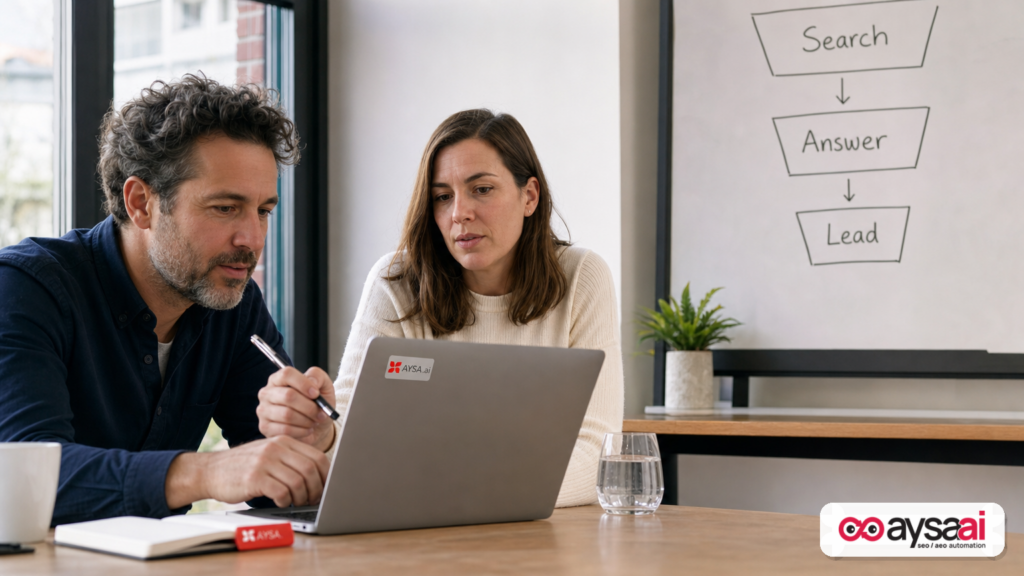
Zero-click search isn’t a theory anymore—it’s the operating environment. If you’re a business owner or marketing lead watching Organic traffic flatten or decline, you may be tempted to assume your SEO “stopped working.” But a growing share of search behavior is being satisfied directly on Google’s results page, especially as AI-generated answers expand.
Search Engine Land, citing SparkToro research based on Similarweb clickstream data, reported that 68.01% of Google searches in the U.S. ended without a click during the first four months of 2026—up from 60.45% in 2024. The same research also noted that AI Overviews appear on more than 20% of searches and that when they do, click-through rates drop by nearly 60% (within the study’s observed dataset and assumptions). Read the original coverage here: Google zero-click searches hit 68% in early 2026: Study (Search Engine Land).
I’m Marius Dosinescu, and from an AYSA.ai perspective, this isn’t just an SEO story. It’s an execution story: measurement, prioritization, and the ability to ship improvements to your website and brand presence fast—without breaking what already works.
Concise summary
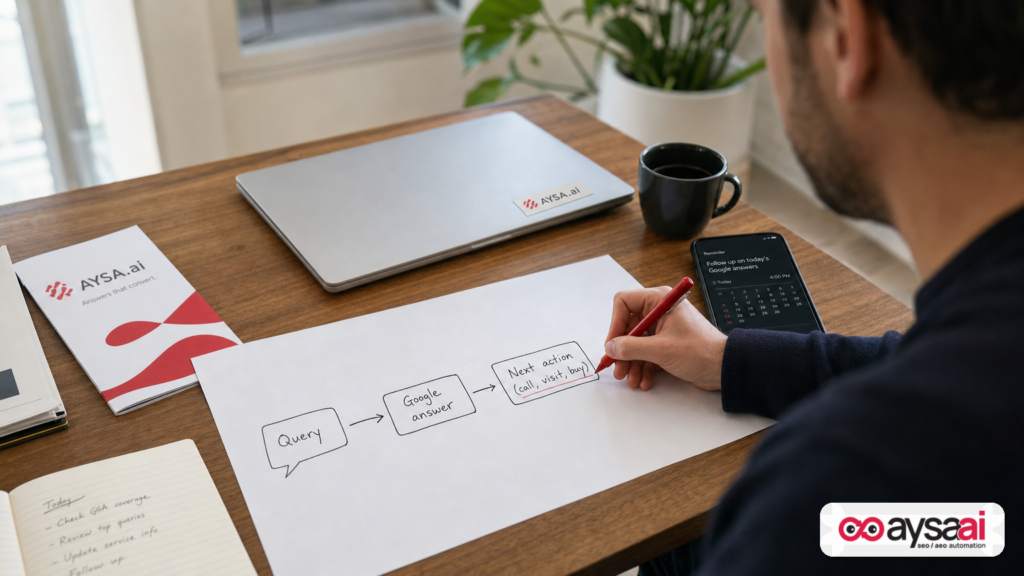
- Google is answering more queries directly, which increases “no-click” sessions and shifts value from website visits to on-SERP visibility and downstream actions (calls, bookings, store visits, brand search, purchases).
- AI Overviews reduce click-through rates when they appear; AI Mode is positioned to accelerate the trend as usage grows (though SparkToro found limited AI Mode transitions in early 2026 within their measurement scope).
- SEO still matters, but KPIs must expand beyond sessions and Clicks to include brand demand, conversions, lead quality, and visibility inside AI answers.
- Winning strategies change by query type: local, branded, and transactional searches behave differently than informational queries—so your playbook must be segmented.
- Operationally, the edge goes to teams that can monitor changes, prepare fixes, get approvals, and execute. That’s where AYSA.ai fits: monitoring → recommendations → approval → execution.
Table of contents
- What changed: the interface is now the destination
- What the 68% zero-click number really means (and what it doesn’t)
- Why it’s happening now: AI Overviews, AI Mode, and “answer-first” design
- The new SERP economics: answers, refinements, and “stay on Google” loops
- Who wins and loses: by business model and query intent
- The KPI reset: measure outcomes, not just clicks
- A practical playbook for SMEs: what to do when clicks decline but demand hasn’t
- Content strategy in a zero-click world: be quotable, not just rankable
- Technical + structured data: still necessary, but no longer sufficient
- Brand demand and distribution: your “non-Google” moat
- What agencies must change: deliver visibility and outcomes, not traffic charts
- Where AYSA fits: monitoring → recommendations → approved execution
- What to do next (action list)
- Sources and further reading
What changed: the interface is now the destination

For two decades, most SEO playbooks assumed a consistent exchange:
- User searches → Google lists links → user clicks → your website persuades → you convert.
That flow is breaking—not because websites stopped being useful, but because Google increasingly resolves the user’s first question on the results page. Even when users don’t “finish” their journey, they’re often nudged into a refinement loop: a follow-up query, a comparison, a local check, a new question.
This is why traffic-based thinking alone becomes dangerous. If your report is still a month-over-month sessions chart with a red arrow and a panic meeting, you’re playing the 2018 game with 2026 rules.
What the 68% zero-click number really means (and what it doesn’t)
Let’s treat the headline number—68.01% of U.S. Google searches ending without a click in early 2026—as a directional signal, not a weapon. It is a powerful indicator that the search interface is capturing more user satisfaction.
At the same time, it’s critical to interpret clickstream research carefully:
- “Zero-click” is not “zero value.” A user can see your phone number in a Local pack, read your review highlights, and call you. You may never see a website session, but you still earned revenue.
- “Zero-click” is not exclusively “AI.” Google has been moving toward on-SERP answers for years via featured snippets, local packs, knowledge panels, “People Also Ask,” and more. AI accelerates the trend, but it didn’t invent it.
- Methodology and data coverage matter. SparkToro notes its historical tracking relies on different providers and panels over time, which makes long-range comparisons imperfect. The early-2026 analysis used Similarweb desktop/mobile web panel data and excluded searches within Google’s mobile search app, where zero-click behavior may be higher (per SparkToro’s own caveat cited by Search Engine Land).
Still, as an operator, you don’t need perfect measurement to act. You need to accept that the center of gravity has moved—and redesign your marketing system accordingly.
Why it’s happening now: AI Overviews, AI Mode, and “answer-first” design
Search Engine Land’s coverage attributes much of the recent shift to Google’s increasing ability to satisfy queries directly in results, with particular attention to AI features:
- AI Overviews appear on more than 20% of searches in SparkToro’s research, and when present, click-through rates drop sharply in their measured set.
- AI Mode was a small slice of observed transitions (0.34%) during the study period, but Google has publicly pushed it as a major interface direction. Search Engine Land reported Google stated at I/O 2026 that AI Mode surpassed 1 billion monthly users and query volume was more than doubling each quarter (these are Google’s statements as reported; treat them as directional unless independently verified through primary documentation).
If you’re running an SME, here is the practical translation:
- When AI answers appear, they can “satisfy” informational intent without a click.
- When AI-driven interfaces encourage follow-ups, users may do more searching but less clicking.
- When Google can keep the user in its own properties (Maps, YouTube, shopping experiences), external sites become optional—especially early in the journey.
The new SERP economics: answers, refinements, and “stay on Google” loops
Historically, SEO teams optimized for the click. Now, Google is optimizing for the continuation of search behavior within Google.
The SparkToro findings highlighted by Search Engine Land included that the share of searches leading to another Google search increased over time. That’s a key mental model: search becomes conversational and iterative, and the platform benefits when the user stays inside that loop.
What does this change for you?
- Visibility is shifting from “ten blue links” to “being present in the answer.” That includes quotes, citations, entity panels, local packs, and product surfaces.
- Incremental value moves downstream. If fewer users click, the ones who do are often higher intent—or they’re comparing vendors and need reassurance fast.
- Your website still matters—but increasingly as a conversion engine and trust artifact, not the primary discovery surface.
Who wins and loses: by business model and query intent
Not every category is hit equally. Rand Fishkin’s comments reported by Search Engine Land point to categories that may still benefit disproportionately from SEO, including branded searches, local queries, and high-intent transactional searches.
Here’s how I’d segment it for decision-making:
1) Informational queries: the highest zero-click risk
If your growth model depends on publishing informational content, you’re in the blast zone. AI Overviews can compress your content into an on-SERP summary. You might still be cited, but the click becomes less reliable.
This doesn’t mean “stop content.” It means:
- Stop measuring content success primarily by sessions.
- Build content that earns brand recall, subscriptions, and repeat visitation.
- Design content for quotability and unique evidence (more on that later).
2) Local queries: high intent, but fewer website visits
Local packs can drive calls and direction requests without a click. If you’re a clinic, contractor, hotel, restaurant, florist, or local professional service, your “SEO” may live inside your GBP/Maps presence and reputation signals.
The danger: you might think SEO is failing because web sessions drop—while your phone is ringing.
3) Transactional queries: still competitive, still valuable
For ecommerce, B2B services, and SaaS, users still need to compare options, evaluate pricing, assess credibility, and complete transactions. AI features may reduce some top-of-funnel clicks, but purchase intent still produces clicks—and conversions.
The opportunity: treat informational SERPs as brand impressions and treat transactional SERPs as conversion real estate.
4) Branded searches: your best defense against platform risk
Branded search is the closest thing to “owned” demand you can get on Google. It’s also a visible outcome of brand-building beyond Google. If zero-click reduces generic discovery, brand becomes the lever that pulls people to you anyway.
The KPI reset: measure outcomes, not just clicks
When the interface keeps users on-platform, you have two choices:
- Complain about lost clicks.
- Upgrade your measurement so it aligns with business reality.
For SMEs, the second option is the only one that compounds.
Core KPIs to add (or elevate)
- Qualified leads (not just form fills): lead-to-close rate by source.
- Calls and bookings: especially for local and service businesses.
- Revenue and margin tied to organic/non-paid demand.
- Branded search demand trends (proxy for awareness and trust).
- AI search visibility: whether AI surfaces mention or cite you for your category queries.
AYSA.ai’s lens here is simple: if the KPI cannot be operationalized into a weekly backlog, it’s not a KPI—it’s a dashboard decoration.
Analytics realities: the data will get messier
As clicks decline, attribution gets more ambiguous. Users can discover you via an on-SERP answer, then later navigate directly, search branded, or click a retargeting ad. Traditional last-click attribution under-credits organic visibility.
That’s why your reporting needs to triangulate:
- Search Console impressions and query trends (when available).
- Brand search trends and direct traffic patterns.
- CRM pipeline and close rates.
- Customer surveys (“How did you hear about us?”) when feasible.
Search Engine Land has also published related measurement thinking like “New SEO KPIs you’re missing: How to measure SEO beyond clicks.” That headline alone signals the industry’s direction; if you’re still reporting only clicks, you’re late. (We’re not reprinting their guidance here—use it as a prompt to update your model.)
A practical playbook for SMEs: what to do when clicks decline but demand hasn’t
Let’s walk through a scenario that shows how this plays out in the real world.
Scenario: a local clinic that “lost traffic” but didn’t lose patients
Imagine a 4-provider physical therapy clinic in a suburban market. Historically, their SEO success was measured by website sessions and blog traffic. In 2026, they notice:
- Blog sessions down 25% year-over-year.
- Rankings roughly stable for “back pain exercises,” “runner’s knee stretches,” and similar terms.
- New patient inquiries are flat-to-up slightly.
What likely happened? Their informational queries are being answered on Google (AI Overviews, snippets, “People also ask”), reducing clicks. But their real business comes from:
- “Physical therapy near me” local pack visibility.
- Reviews and reputation.
- Insurance and specialty pages that convert high-intent searches.
Actionable fix: stop treating informational traffic as the main KPI. Keep the content, but redesign it to create brand preference and convert the minority of users who do click. Meanwhile, invest in local presence and conversion pages.
SME priorities that tend to work (in order)
- Protect the money pages. Your category/service pages must be the best answer for high-intent queries. That means clear pricing ranges (when possible), proof, FAQs, and frictionless conversion paths.
- Own your entity footprint. Ensure your brand is consistent across your site and key platforms; confusion kills AI understanding and user trust.
- Turn content into conversion assist. Add comparison guides, “who this is for,” timelines, and decision checklists—things AI summaries can’t fully replace.
- Build brand demand outside Google. Email list, partnerships, community presence, and social distribution that creates branded search later.
- Measure outcomes weekly. If your reporting cadence is monthly, you’ll react too slowly.
Content strategy in a zero-click world: be quotable, not just rankable
The biggest mistake I see is doubling down on “more articles” without changing the content thesis. In a zero-click environment, content must do at least one of these jobs:
- Create brand preference (so the user searches you by name later).
- Provide unique evidence (original research, real comparisons, firsthand experience).
- Drive high-intent conversions (templates, calculators, demos, pricing explanations, implementation guides).
- Earn citations/mentions in ways that AI systems can reference or summarize accurately.
How to build “quotable” content
AI Overviews and other answer features tend to synthesize. If your content is generic, it becomes raw material with no reason to click.
Instead, aim for content that contains:
- Clear definitions in your own voice (short, precise, non-fluffy).
- Decision frameworks (e.g., “If X, choose Y; if A, choose B”).
- Process details that demonstrate expertise (the “how,” not just the “what”).
- Comparisons grounded in real constraints (budget, timeline, team size).
- Firsthand experience signals: photos, examples, case notes (without inventing outcomes).
AEO/GEO is not “SEO with a new label”
Answer Engine Optimization (AEO) and Generative Engine Optimization (GEO) are emerging as practical disciplines: optimizing to be represented accurately in AI-generated answers and recommendations.
Whether you call it SEO, AEO, or GEO, the operational requirement is the same: your content must be structured, consistent, and unambiguous so machines don’t misinterpret it and humans trust it.
For more on how we think about AI-era visibility at AYSA, see: AI Search Visibility.
Technical + structured data: still necessary, but no longer sufficient
In 2016, you could often out-rank competitors with better technical hygiene. In 2026, technical SEO is table stakes. It won’t guarantee traffic, but it still determines whether you are eligible to be interpreted, cited, and trusted.
Structured data: use it to reduce ambiguity
Search Engine Land also referenced Schema.org usage reporting (as a separate related headline). We’re not assuming your business needs every schema type, but the principle is important: structured data helps machines understand “what this is”—product, organization, FAQ, service, review, etc.
Practical SME advice:
- Start with what you can maintain accurately (Organization, LocalBusiness, Product, FAQ where appropriate).
- Don’t spam markup for content that isn’t actually on the page.
- Keep NAP/contact details consistent across site and local listings.
If you want to operationalize these changes instead of adding them to an endless backlog, this is exactly the kind of work an execution system should manage: monitor, recommend, and ship with approvals.
Site quality and “conversion readiness” matter more when clicks are scarcer
If fewer people click, every click is more valuable. That means your website needs to be conversion-ready:
- Fast, stable pages (especially on mobile).
- Clear offers and next steps.
- Trust signals (reviews, policies, guarantees, certifications).
- Fewer dead-end pages and fewer thin posts.
Execution beats intention here. Many SMEs know what they “should” fix; they just don’t ship it.
Brand demand and distribution: your “non-Google” moat
The most durable response to zero-click isn’t a new on-page trick. It’s building a brand that customers search for by name.
Search Engine Land’s coverage included Fishkin’s recommendation to invest in brand awareness and influence on the platforms where your audience already spends time—even if those efforts don’t drive direct website visits. That advice can sound frustrating because it’s less measurable than SEO. But it’s the correct strategic posture when distribution becomes platform-mediated.
What “distribution” looks like for SMEs
- Local services: reviews, community partnerships, local Facebook groups (carefully), and referral loops.
- Ecommerce: creator partnerships, email/SMS retention, product education on social, and post-purchase advocacy.
- SaaS: integrations, marketplaces, webinars, community, and deep comparative pages that people share.
None of this replaces SEO. It reduces the risk of being dependent on one interface for discovery.
What agencies must change: deliver visibility and outcomes, not traffic charts
If you run an agency, zero-click search forces a business model update. Clients will keep asking, “Why is organic traffic down?” If your answer is, “Because Google,” you’ll lose accounts—even if you’re right.
Agencies need to evolve deliverables:
- From traffic to outcomes: leads, revenue, bookings, pipeline, and brand demand.
- From keyword lists to query segments: informational vs transactional vs local vs branded strategies.
- From content volume to content advantage: unique evidence, experience, and conversion assist.
- From recommendations to execution: most SEO value dies in Jira.
This is where “approved execution” becomes a competitive advantage. Clients don’t need a 40-page audit—they need change shipped safely.
Where AYSA fits: monitoring → recommendations → approved execution
At AYSA.ai, we treat SEO/AEO/GEO as an operational system, not a one-time project. In a world where Google’s interface changes faster than most SMEs can update their sites, the winners are the businesses that can:
- Monitor what’s happening (visibility, page changes, technical issues, content gaps).
- Prepare recommended fixes and improvements.
- Ask for approval—because businesses need control and governance.
- Execute accepted changes to the website and SEO stack reliably.
If you want to explore the system components:
- AI SEO tooling overview: AI SEO Tools
- AI search visibility approach: AI Search Visibility
- Monitoring: AYSA Monitoring
- Pricing and rollout expectations: AYSA Pricing
- More practical guidance: AYSA Blog
Why “approved execution” is the model that fits this moment
Zero-click pressures teams to move faster. But fully autonomous AI changes to a live website can create new risks:
- Accidentally changing messaging on regulated pages (health, finance).
- Breaking templates, internal linking, or conversion paths.
- Introducing compliance issues or brand claims you can’t substantiate.
Approved execution means you get AI speed without surrendering control. The system does the monitoring and preparation work; your team retains the final decision—and the accountability.
What to do next (action list)
If you only take one thing from this editorial, take this: don’t fight the interface—adapt your system. Here is a practical next-step checklist you can run in the next 30 days.
Next 7 days: stabilize measurement
- List your top 20 queries/pages by business impact (not traffic).
- Decide your “true north” outcomes: calls, leads, bookings, revenue, pipeline.
- Segment reporting into: branded, local, transactional, informational.
Next 14 days: protect conversion pages
- Rewrite key service/product pages to answer buyer questions directly (pricing ranges, timelines, who it’s for).
- Add trust: reviews, guarantees, policies, proof of work, certifications.
- Audit internal links so informational content routes users to money pages naturally.
Next 30 days: build AI-era visibility assets
- Create 2–4 “authority pieces” designed for quotability (frameworks, comparisons, checklists).
- Improve structured data where appropriate to reduce ambiguity.
- Launch one distribution loop (email series, partner content, community, creator collaboration).
Operationalize with a system
- Implement monitoring so you see issues before they compound: AYSA Monitoring.
- Track whether AI surfaces mention/cite your brand for category queries: AI Search Visibility.
- Turn recommendations into an approval queue and ship changes consistently.
Sources and further reading
- Search Engine Land: Google zero-click searches hit 68% in early 2026: Study
- Search Engine Land: Schema.org now shows you how many sites are using each schema type
- Search Engine Land: AI can write SEO content, but it can’t replace real experience
- Search Engine Land: What co-mentions reveal about the AI recommendation gap
- AYSA.ai: AI SEO Tools
- AYSA.ai: AI Search Visibility
- AYSA.ai: Monitoring
- AYSA.ai Blog
Note on claims and verification: This editorial relies on Search Engine Land’s reporting of SparkToro research and related context. Where Google usage claims (e.g., AI Mode users) are mentioned, they are described as statements reported by Search Engine Land; if you need primary-source confirmation for compliance or investor communications, validate those claims directly through official Google communications.
Continue the AI search topic inside AYSA.
Use these pages to connect the article with AI SEO tools, AI visibility monitoring, AI Overviews and approved website execution.
Turn this topic into a website action plan.
Use these AYSA hubs to move from reading to technical fixes, AI visibility monitoring, research, glossary context and approval-first SEO execution.

