Web Push Advertising in 2026: How to Win in a Privacy-First World Without Burning Trust (and How SEO Teams Should Think About It)
Web push isn’t dead in 2026—it’s maturing. The winners are shifting from volume to value: better consent, sharper targeting, stronger creative, and tighter measurement. Here’s a practical playbook for SMEs and agencies, plus where AYSA fits for execution and monitoring.

Web push advertising in 2026 is no longer a “cheap Clicks” hack. It’s a permission channel that either earns trust and repeat visits—or gets muted, unsubscribed, or blocked.
That shift is not hypothetical. Platform changes over the last couple of years have made unsubscribe options more visible, tightened content and messaging expectations, and raised the bar on what gets delivered reliably. The result: many marketers saw CTR volatility, subscriber list decay, and rising compliance risk. But the other side of the story is more interesting: when low-value volume gets squeezed out, the remaining inventory can become more engaged—if you operate with discipline.
This editorial is my practical take on what changed, why it matters, and what businesses should do next—especially SMEs and agencies that need repeatable systems, not one-off “growth tricks.” I’ll also show where AYSA fits as an execution engine: monitor what’s happening, prepare improvements, ask for approval, and execute accepted website changes so your push program is supported by a site that converts and a brand that can be trusted.
Concise summary (read this first)
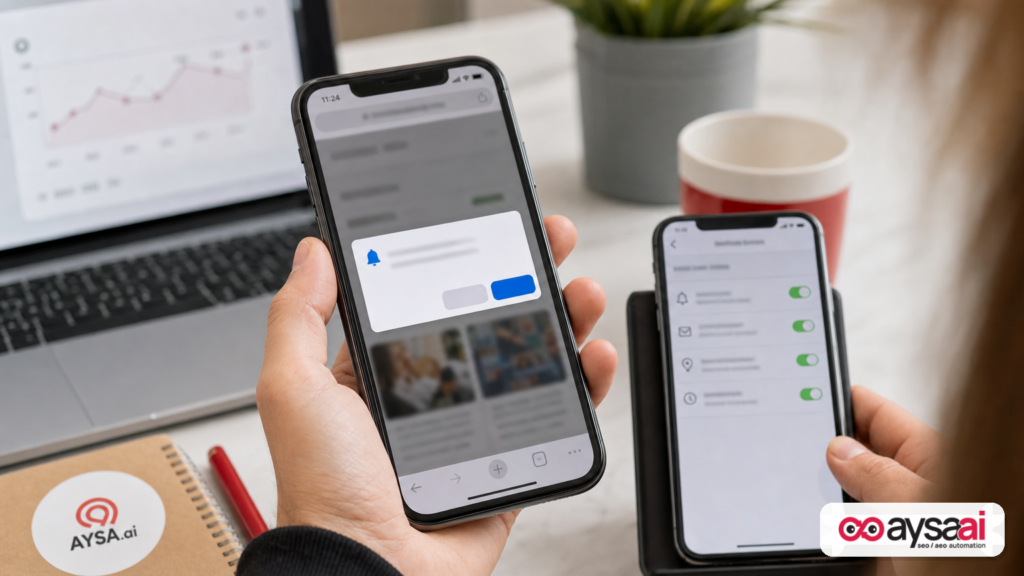
- Web push still works in 2026, but it’s maturing into a stability-and-quality channel, not a scale-at-any-cost channel.
- Platform policy and UX changes have increased user control and punished intrusive messaging—raising unsubscribe rates and compliance scrutiny for low-quality campaigns.
- Winning strategies look “boring”: transparent consent, fewer sends, better segmentation, better landing pages, and tighter measurement.
- Push can’t be isolated. Its best role is supporting a full demand/retention system: search visibility → onsite intent → permissioned re-engagement → repeat purchase.
- AYSA’s advantage is execution: Monitoring + prioritized recommendations + approved site changes so you can improve relevance and conversion without turning every fix into a months-long dev backlog.
Key takeaways

- Permission is the asset. Treat subscribers like a customer list, not a retargeting pool.
- Relevance beats reach. If your creative is generic, your unsubscribe rate becomes your “true” KPI.
- Send fewer messages. Frequency is a brand decision, not just a performance lever.
- Landing pages matter more than ever. Better click quality means every mismatch is costly.
- Measurement must shift beyond CTR. Focus on incremental return: repeat sessions, assisted conversions, LTV, and cohort retention.
Table of contents

- Where Web Push Fits in 2026 (and Why Smart Teams Still Use It)
- Market Maturity: Growth Is Slower, Discipline Matters More
- What Changed (2024–2026): Why CTR Dropped, Unsubs Rose, And “Permission” Became the Whole Game
- Why This Matters to SMEs (Not Just Media Buyers)
- The New Funnel: How Web Push Now Supports Search, AI Discovery, and Retention (Not Just “Clicks”)
- Consent UX That Doesn’t Backfire: How to Build a Subscriber List You Can Actually Keep
- Segmentation and Targeting in a Privacy-First World
- Creative That Survives the 2026 Reality: Relevance, Restraint, and “No-Regret” Messaging
- The Conversion Layer: Landing Pages, Technical Hygiene, and Post-Click Experience
- Measurement You Can Trust: What to Track When Attribution Gets Harder
- The SME Scenario: A Local Clinic + Ecommerce Hybrid That Uses Push Without Annoying Patients
- What Agencies Should Rethink in 2026: Packaging, Risk, and Accountability
- Where AYSA Fits: Monitoring + Approved Execution for the Work That Push Depends On
- What to Do Next (30/60/90-Day Action List)
- Sources and further reading
Where Web Push Fits in 2026 (and Why Smart Teams Still Use It)
Web push is one of the few digital channels where the user explicitly says “yes, you can reach me.” That alone makes it valuable in a world moving away from frictionless tracking and toward permissioned relationships.
But “permissioned” is not the same as “owned.” Push is ultimately mediated by browsers and operating systems. That means:
- Platforms can change how permissions are presented and how unsubscribes work.
- Content and safety rules can tighten quickly.
- User expectations shift: what felt acceptable in 2019 can feel spammy in 2026.
So the channel’s value is real, but it’s conditional. If you run it like a volume arbitrage machine, you’ll get volatility and churn. If you run it like a retention product—aligned with intent, content quality, and user experience—you can still generate meaningful incremental revenue and repeat visits.
This is the core idea: push is no longer a “campaign.” It’s a relationship layer.
Market Maturity: Growth Is Slower, Discipline Matters More
According to a sponsored analysis published by Search Engine Journal (via RollerAds), the web push advertising market is projected to grow steadily from 2026 through 2030, but at a relatively modest pace—signaling a more mature phase where efficiency and sustainability matter more than raw scale.
I’m intentionally not treating market size projections as gospel (forecasting is always messy), but the direction is useful: mature channels reward operators who can manage quality, compliance, and measurement with consistency.
That maturation changes how you should approach budgeting:
- Stop expecting infinite scale. Build for profitable steady-state performance.
- Shift from “buying traffic” to “growing cohorts.” The health of subscriber cohorts (retention, engagement) becomes the leading indicator.
- Operational excellence becomes the edge. Creative, segmentation, timing, and onsite experience matter more than negotiating pennies on CPC.
Primary research lead: Search Engine Journal: Web Push Advertising 2026: Market Trends, Challenges & Opportunities.
What Changed (2024–2026): Why CTR Dropped, Unsubs Rose, And “Permission” Became the Whole Game
The SEJ piece points to several Google-ecosystem shifts in late 2024 that reshaped the environment: more prominent unsubscribe controls on Android, enhancements to safe browsing protections, and clearer restrictions on certain content and messaging categories. The practical effect was predictable: more users unsubscribed, and more low-quality domains/campaigns faced restrictions.
Here’s my editorial translation for business owners:
- You don’t “own” deliverability. You rent it from platforms that are optimizing for user trust.
- User control is now a feature, not a bug. If your program depends on friction or accidental opt-ins, it will decay.
- CTR drops are often a symptom, not the disease. If your list quality worsens or your messaging is misaligned, CTR will wobble. The fix is not “more sends.”
The real problem: most push programs were built on a flawed assumption
The flawed assumption was: “If I can get the opt-in and send enough messages, I can always find a profitable pocket.”
In 2026, that assumption breaks because:
- Users exit faster.
- Platforms punish faster.
- Brands accumulate trust debt faster.
The teams still winning are doing less—but doing it better.
Why This Matters to SMEs (Not Just Media Buyers)
Push used to be framed as a “media buying tactic.” In 2026, it’s closer to lifecycle marketing—and that makes it a cross-functional issue for SMEs:
- Operations: if you promote something you can’t fulfill, you’ll get refunds and negative sentiment.
- Customer support: more complaints come from mismatch (“I clicked and it wasn’t real / the offer expired”).
- Brand: your notification style becomes part of your voice—like email.
- Website: a push click is a high-intent moment. If your landing page is slow, confusing, or irrelevant, you waste the best part of the channel.
SMEs also have less margin for error. A big publisher can absorb unsubscribe spikes. A local service business can’t—because the list might only be a few thousand people, and the brand is personal.
The New Funnel: How Web Push Now Supports Search, AI Discovery, and Retention (Not Just “Clicks”)
Push is most valuable when it’s connected to how people discover you and why they trust you.
In 2026, discovery is fragmented:
- Traditional search results are still important.
- AI-driven experiences (AI summaries, assistants, and “answer-first” interfaces) can reduce clicks for some informational queries.
- Social and communities can drive spikes—then disappear.
In that environment, push becomes a stabilizer: when someone finds you once (from search, social, referrals, or AI-driven discovery), push can help you bring them back—without paying again for the same attention.
Push and search are not competitors
Think of it like this:
- Search captures demand (someone is looking).
- Your website converts demand (someone takes action).
- Push recaptures attention (someone returns).
If your site is not prepared to convert and retain, push simply amplifies waste. That’s why this editorial lives at the intersection of paid retention and SEO/AEO/GEO execution: you can’t separate the channel from the site.
If you’re building for “AI Search visibility” and citation, start here: AI Search Visibility.
Consent UX That Doesn’t Backfire: How to Build a Subscriber List You Can Actually Keep
In 2026, the fastest way to kill a push program is to optimize for opt-ins without respecting user intent.
High-volume opt-in tactics tend to create three downstream problems:
- Accidental subscribers who churn immediately (or complain).
- Low engagement that drags down performance and increases risk of platform scrutiny.
- Brand distrust that harms conversion across all channels.
A practical consent checklist (SME-friendly)
- Ask at the right time: after value is experienced (reading, browsing, adding to cart), not at first page load.
- Set expectations: what type of messages and how often (even a simple “1–2/week” promise changes behavior).
- Offer preference choices: deals vs. back-in-stock vs. new content. (If you can’t do preferences, at least segment by intent.)
- Make it easy to stop: paradoxically, this increases trust and reduces “hard churn” later.
If you’re not sure what to fix first, this is where an execution system matters: monitoring the funnel and implementing changes without waiting for quarterly redesign cycles. AYSA’s monitoring foundation is here: AYSA Monitoring.
Segmentation and Targeting in a Privacy-First World
When platforms tighten privacy and user control, marketers often panic and assume targeting is “gone.” That’s the wrong conclusion.
The targeting mix changes. You lean harder on what you can do ethically and reliably:
- On-site behavior (pages viewed, categories, time on site).
- First-party data (when users authenticate, purchase, or subscribe to email).
- Contextual intent (what the user was doing when they opted in).
- Cohorts and recency (new subscribers vs. dormant, recent buyers vs. browsers).
Segmentation examples you can implement without a giant data team
- Ecommerce: “Viewed running shoes” vs. “Viewed dress shoes” (send different back-in-stock and sale messages).
- Local services: “Visited pricing page” vs. “Visited FAQs” (send appointment reminders vs. trust-building content).
- SaaS: “Read integration docs” vs. “Read pricing” (send onboarding tips vs. limited trial extension prompts).
This is also where your site structure matters: clean category taxonomy, Internal linking, and indexable pages make behavioral segmentation more meaningful. If your website is a mess, your segmentation will be a mess.
For practical tooling that connects site improvements with AI-era visibility, see: AI SEO Tools.
Creative That Survives the 2026 Reality: Relevance, Restraint, and “No-Regret” Messaging
In a mature push ecosystem, the best creative is “no-regret creative.” Meaning: if a user sees it out of context, it still feels legitimate and helpful—not like a trick.
That’s a high bar. It’s also the bar platforms are implicitly enforcing when they tighten restrictions on “certain types of content and messaging,” as described in the SEJ-sponsored piece.
Practical creative rules (what I’d enforce as policy)
- Be specific: “Back in stock: Women’s Size 8 Trail Runner” beats “Hot deal today!”
- Match the landing page exactly: same offer, same product, same promise.
- Avoid urgency theater: fake countdowns and vague “last chance” signals create churn.
- Use frequency caps: a win in week 1 isn’t worth a dead list in week 4.
Creative testing that doesn’t destroy your list
A/B testing is still essential, but push has a unique risk: bad tests can permanently damage the subscriber base.
Instead of testing “wild” ideas, test within safe constraints:
- Test value angles (shipping, availability, education) not deceptive hooks.
- Test timing before testing frequency increases.
- Test audience splits before blasting the full list.
The Conversion Layer: Landing Pages, Technical Hygiene, and Post-Click Experience
Here’s an uncomfortable truth: as platforms remove low-quality volume, the clicks you do get can be higher intent. That makes the onsite experience a bigger lever.
Most businesses over-invest in messages and under-invest in the place the message sends people.
Common post-click failures that quietly kill push ROI
- Mismatch: notification promotes Product A, landing page shows generic category grid.
- Slow pages: especially on mobile; the user bounces and your list takes the blame.
- Thin information: users need specs, availability, shipping info, and trust signals fast.
- Broken UTM discipline: you can’t measure what you can’t label consistently.
Where AYSA helps in the conversion layer
This is exactly where “approved execution” matters. A typical SME stack looks like: Shopify/WooCommerce/WordPress + a couple of plugins + a busy agency + no bandwidth. That environment produces a backlog of small-but-critical issues: missing internal links, outdated copy, messy metadata, broken tracking parameters, inconsistent headings, under-optimized category pages.
AYSA is designed to handle the operational reality: it monitors, prepares changes, asks you to approve them, then executes accepted website updates. That’s how you turn push clicks into revenue—not just sessions.
Learn more about the model here: AYSA Pricing and browse more playbooks here: AYSA Blog.
Measurement You Can Trust: What to Track When Attribution Gets Harder
CTR is a seductive metric because it’s immediate. In 2026, CTR alone is also a trap.
Why? Because you can increase CTR with tactics that hurt long-term value (spammy curiosity hooks, higher frequency, misleading messages). The real KPI is whether push increases incremental profitable behavior without eroding trust.
A minimum viable measurement stack for SMEs
- Consistent campaign tagging: UTMs or equivalent naming conventions, consistently applied.
- Cohort tracking: new subscribers by week/month and their downstream behavior (return visits, purchases, leads).
- Incrementality thinking: compare behavior of push subscribers vs. non-subscribers, controlling for obvious differences (it’s imperfect, but better than nothing).
- Quality signals: bounce rate on push sessions, time on site, pages/session, and assisted conversions.
What not to do
- Don’t declare victory on CTR spikes. Look for churn and complaint signals after spikes.
- Don’t over-attribute. Push may assist conversions rather than directly close them.
- Don’t ignore brand channels. If branded search rises while push runs, that’s part of the impact.
The SME Scenario: A Local Clinic + Ecommerce Hybrid That Uses Push Without Annoying Patients
Let’s make this real with a scenario that mirrors how many SMEs operate now: a local clinic that also sells products online.
Business: “Riverside Dermatology” (fictional), 3 locations, online store for skincare products, appointment booking, content blog for education.
Goal: Increase repeat purchases and reduce no-shows, without harming trust.
What they don’t do (and why)
- They don’t blast daily “deals.” In healthcare-adjacent industries, that feels wrong fast.
- They don’t ask for push permission on first visit. That invites accidental opt-ins.
- They don’t send users to generic pages. The click has to resolve the promise immediately.
What they do instead
- Permission timing: the opt-in appears after the user reads a full acne treatment guide or after a product is added to cart.
- Preference-based messaging: “appointment reminders” is separate from “product restocks.”
- Low frequency: 1–2 messages/week per category, with strict caps.
- High integrity creative: “Back in stock” means back in stock. No fake urgency.
- On-site support: landing pages are cleaned up, structured, and fast on mobile.
Where AYSA fits in this scenario
Most of the work is onsite: improving service pages, product pages, internal linking between educational content and products, clarifying policies, and fixing technical issues that reduce conversion.
AYSA can continuously monitor the site, propose updates (content and technical), route them for approval (clinic owner/marketing lead), then execute changes quickly—so the push program is supported by a site that earns trust and converts.
What Agencies Should Rethink in 2026: Packaging, Risk, and Accountability
If you run an agency, web push is tempting because it can produce fast results. In 2026, the risk profile is higher—and the operational burden is heavier.
Three agency mistakes I see repeatedly:
1) Selling push as “media buying,” not as lifecycle + UX
If you package push as “we’ll send X notifications per week,” you’ve already lost. The deliverable is not volume. The deliverable is incremental profitable return without list decay.
2) Ignoring compliance until something breaks
Platform policies and content restrictions are not a one-time checklist. They’re an ongoing discipline. If your client gets restricted or suffers list churn, the agency gets blamed—even if the root cause was “too aggressive creative” approved by the client.
Build a written “push code of conduct” and require sign-off.
3) Under-investing in landing pages and measurement
Agencies often treat landing pages as “the client’s problem.” That’s short-term thinking. If you can’t influence onsite conversion, you can’t reliably scale push. Period.
This is also where AYSA becomes a force multiplier for agencies: you can monitor, generate fixes, and execute approved changes without turning every update into an engineering ticket war. More on that in the next section.
Where AYSA Fits: Monitoring + Approved Execution for the Work That Push Depends On
AYSA is not a push platform. And that’s the point.
Most push performance problems in 2026 are not “push problems.” They’re site problems:
- Thin or mismatched landing pages
- Unclear offers and policies
- Slow mobile experience
- Weak internal linking and confusing site structure
- Content that doesn’t build trust (or isn’t maintained)
- Measurement gaps from inconsistent tagging and page templates
The workflow that matters
- Monitor what’s changing and what’s failing (pages, templates, search visibility signals, content quality signals). Start: AYSA Monitoring.
- Prepare prioritized recommendations tied to business goals (conversion, retention, visibility).
- Ask for approval so changes are accountable (especially important for regulated/trust industries).
- Execute accepted changes so improvements ship quickly, not “someday.”
How this connects to AI search (AEO/GEO) in plain English
As AI-driven discovery expands, the brands that get mentioned and cited are usually the ones with:
- clear, structured, up-to-date content
- strong topical authority
- consistent messaging and trust signals
Those are the same ingredients that make push subscribers stay subscribed. So even if your push program is purely “paid retention,” the underlying work (content quality, structure, clarity) benefits search, AI visibility, and conversion.
To explore that side of the strategy: AI Search Visibility.
What to Do Next (30/60/90-Day Action List)
This is the practical implementation plan I’d use for an SME or a mid-market brand that wants a durable push program in 2026.
Days 1–30: Stabilize trust and stop list decay
- Audit opt-in UX timing (remove first-page-load prompts).
- Add or tighten frequency caps.
- Review top messages from the last 30 days: remove anything that feels misleading or generic.
- Ensure every notification has a precise landing destination (no generic homepages).
- Define “unsubscribe rate thresholds” that trigger a pause and review.
Days 31–60: Build segmentation + creative discipline
- Create 3–6 core segments based on intent (category interest, recency, cart behavior, content topics).
- Write “no-regret” creative templates per segment.
- Run controlled A/B tests within safe boundaries (timing, specificity, offer framing).
- Build a simple preference center if feasible; if not, simulate preferences through segment membership.
Days 61–90: Improve the conversion layer and measurement
- Fix top landing pages for speed, clarity, and trust (shipping, returns, availability, proof).
- Standardize campaign tagging and naming conventions.
- Set up cohort reporting: new subscribers by period and retention/return behavior.
- Connect push learnings back into onsite content strategy (what topics/offers drive engaged cohorts?).
What to do next (simple checklist)
- Read the SEJ source for the ecosystem overview: SEJ: Web Push Advertising 2026.
- Decide your push “brand posture” (helpful, infrequent, specific) and document it.
- Pick one high-intent segment (cart abandoners, pricing visitors, back-in-stock) and perfect it first.
- Improve the landing pages those messages point to (this is where most ROI is hiding).
- Implement monitoring and an execution cadence so changes ship continuously. Start with: AYSA Monitoring.
Sources and further reading
- Search Engine Journal (Sponsored): Web Push Advertising 2026: Market Trends, Challenges & Opportunities
- Search Engine Journal: Latest news (research lead)
- Search Engine Journal: PPC News (research lead)
- Search Engine Journal: SEO (research lead)
- Search Engine Journal: Google Algorithm Updates history (research lead)
Relevant AYSA links
Note on sourcing: The supplied research context primarily references the SEJ sponsored post and general SEJ section links. Where the ecosystem implies platform-level policy changes, I’ve treated them as directional context rather than quoting or inventing policy language. If you want a stricter compliance/legal treatment, we should add direct citations from official platform documentation in a follow-up revision.
Continue the AI search topic inside AYSA.
Use these pages to connect the article with AI SEO tools, AI visibility monitoring, AI Overviews and approved website execution.
Turn this topic into a website action plan.
Use these AYSA hubs to move from reading to technical fixes, AI visibility monitoring, research, glossary context and approval-first SEO execution.