LinkedIn Ads vs Google Ads CPC for B2B: The Real Benchmark Story (and How to Budget Without Guesswork)
LinkedIn CPCs look expensive until you compare the right campaign types. Here’s how to benchmark LinkedIn against Google Search for real B2B acquisition, what CPC actually means in each channel, and how to set budgets that produce pipeline—not vanity clicks.

B2B marketers love to argue about cost per click. LinkedIn is “expensive.” Google is “efficient.” The truth is messier—and if you budget off the wrong comparison, you’ll either underfund growth or burn money chasing cheap Clicks that don’t turn into pipeline.
This editorial is my practical take on what recent benchmark analysis suggests about LinkedIn Ads CPCs vs Google Ads CPCs—and what to do with that information if you’re a founder, a marketing lead, or an agency trying to build predictable revenue. The research input here comes from a year-long analysis published by Search Engine Land, which compared LinkedIn and Google Ads CPCs across campaign types in B2B accounts.
My goal isn’t to repeat their post. It’s to translate the decision implications: how to compare channels correctly, how to set budgets that create enough learning velocity, how to avoid Attribution traps, and how to connect ad insights to the one thing that usually limits performance: your website.
Concise summary
- Blended CPC comparisons are misleading. Google’s blended CPC often includes cheap display and Branded Search, which makes the platform look cheaper than it is for new customer acquisition.
- Compare like with like. For reaching cold, high-intent B2B buyers, LinkedIn prospecting CPCs can be close to non-branded Google Search CPCs (per the Search Engine Land analysis).
- LinkedIn CPC varies massively by objective. “Traffic” and “engagement” can look affordable; lead gen forms can look shocking. That doesn’t mean lead gen is bad—it means you need a conversion-based view.
- Budget should be based on learning, not hope. If you can’t buy enough clicks/leads to learn within 2–4 weeks, you’re not running a channel—you’re donating to it.
- Paid success compounds only when the website evolves. Ad data tells you which audiences and messages work. If your landing pages and content don’t adapt quickly, you cap performance. That’s where AYSA fits: monitor, prepare changes, ask for approval, execute accepted improvements.
Table of contents
- What changed: the industry is finally comparing CPCs the right way
- The comparison that tricks teams: blended CPC vs acquisition CPC
- What CPC actually buys you in each channel (and why intent is the missing variable)
- LinkedIn CPC by objective: why one number isn’t a benchmark
- Industry effects: why professional services often pay more
- Google campaign types: why “Google CPC” isn’t one number either
- How to run an apples-to-apples benchmark in your own account
- A budget framework that doesn’t lie to you: plan for clicks, then validate with pipeline
- Concrete SME scenario: a $25k ACV B2B services firm deciding where to spend
- Measurement reality: attribution is a story, not a fact
- Creative and landing pages: where most “high CPC” problems really come from
- The channel mix I’d build in 2026: capture, create, and compound
- Where AYSA fits: turning ad learnings into approved website changes (fast)
- What to do next: the operator’s checklist
- Sources and further reading
What changed: the industry is finally comparing CPCs the right way
For years, the LinkedIn vs Google debate was mostly a meme:
- LinkedIn: “$15+ CPCs, who can afford that?”
- Google: “$3 CPCs, scale it.”
The problem is that those numbers usually compare different realities. LinkedIn is often used for cold audience targeting (prospecting). Google is often reported as an average across:
- branded search (people already looking for you),
- display (low intent, cheap clicks),
- remarketing (warm audiences),
- and sometimes non-branded category search (high intent, expensive clicks).
The Search Engine Land analysis is useful because it makes a point most teams ignore: when you compare cold acquisition to cold acquisition, LinkedIn’s “premium” shrinks. That doesn’t make LinkedIn cheap. It makes the budgeting conversation more honest.
The comparison that tricks teams: blended CPC vs acquisition CPC
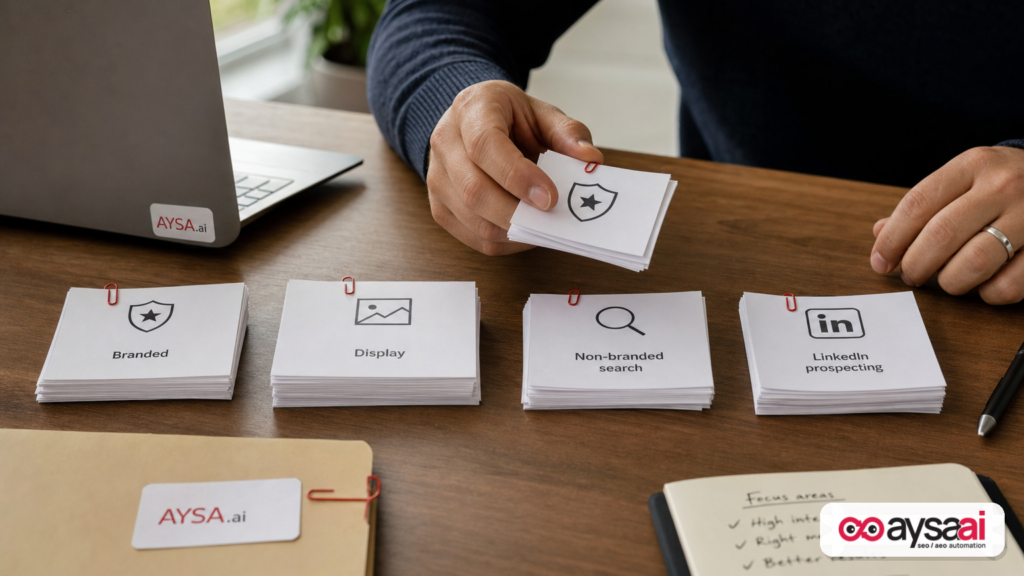
Here’s the trap: blended CPC is a weighted average of everything you run. If you have a lot of low-CPC campaigns, your blended CPC looks great even if your actual acquisition campaigns are expensive.
From the research input: Google’s blended CPC looked much lower than LinkedIn’s blended CPC, but a large share of Google clicks came from campaign types that are structurally cheaper (like display and branded search). That’s not “wrong.” It’s just not the same job.
If the business question is:
- “How cheaply can we get clicks?” then sure—blended CPC is interesting.
- “How much does it cost to reach new, qualified buyers?” then blended CPC is close to useless.
In practice, I recommend you maintain two CPC benchmarks for internal reporting:
- Efficiency CPC (includes branded + remarketing + lower-intent coverage). This measures how well you monetize existing awareness.
- Acquisition CPC (non-branded search + LinkedIn prospecting). This measures your cost to create net-new pipeline.
What CPC actually buys you in each channel (and why intent is the missing variable)

CPC is a price for an action (a click). But the economic value of that click depends on what the person was doing right before they clicked.
Google Search: you buy declared intent
On Google non-branded search, the user is effectively saying: “I have a problem. I’m researching solutions.” You can argue about how commercial that query is, but the intent is explicit.
That’s why non-branded search CPCs can be high: you’re bidding in an auction for the most valuable moment in the journey.
LinkedIn: you buy access to an identity graph
On LinkedIn, you don’t usually buy declared intent. You buy:
- job title/seniority,
- industry,
- company size,
- sometimes lists (accounts, contacts),
- and an environment where “professional problems” are contextually relevant.
You’re paying for precision access—and then you have to create the spark (message, offer, creative, landing page).
So why do teams get it wrong?
Because they treat CPC as a universal “cost of growth.” In reality:
- In Search, CPC is tied to auction demand for keywords.
- In LinkedIn, CPC is tied to auction demand for specific audiences and objectives.
That’s why a “high CPC” on LinkedIn can still be rational if it buys you the right human beings early—especially in long sales cycles where being known changes who makes the shortlist.
LinkedIn CPC by objective: why one number isn’t a benchmark
One of the most actionable insights in the Search Engine Land analysis: LinkedIn CPCs vary dramatically by objective. That matters because many teams talk about “LinkedIn CPC” as if it’s fixed.
As the research suggests, LinkedIn website visit campaigns can land in a relatively moderate CPC band, while lead gen form campaigns can show much higher CPCs. That can feel absurd until you remember:
- A lead gen form click is not the same as a website click.
- The platform is optimizing delivery differently.
- You’re often trading click volume for Conversion rate and lead friction reduction.
How I interpret objectives (operator view)
- Website visits / engagement: good for message testing, audience discovery, and warming. Not a final KPI.
- Website conversions: good when your site is already conversion-competent and the buying journey is clear.
- Lead gen forms: good when the offer is strong and you can qualify quickly. Dangerous when you can’t follow up fast or don’t have qualification gates.
- Video views: CPC is the wrong lens. If you run video, you should have a view-through strategy and downstream retargeting plan.
The budgeting mistake
Teams see a high CPC on lead gen and panic—then switch to cheaper traffic objectives and celebrate. But if the cheaper clicks don’t convert, you didn’t save money. You just bought a nicer-looking spreadsheet.
Industry effects: why professional services often pay more
The source analysis found different CPC profiles between B2B SaaS and professional services. That aligns with what I see in the market: professional services often face one or more of these realities:
- Smaller qualified audience pools (e.g., specific executives in specific geographies).
- Higher competition for the same titles (every firm targets “VP,” “Director,” “Head of…”).
- Harder differentiation (many services sound identical in ads).
In other words: higher CPCs aren’t always a “platform tax.” They can be a signal that your category is crowded, your audience is narrow, or your message isn’t sharp enough to earn high relevance.
Google campaign types: why “Google CPC” isn’t one number either
Google Ads reporting often collapses very different campaign types into one “Google CPC.” But each one serves a different purpose:
- Branded search: demand harvesting. Usually cheaper CPC, strong conversion rate, limited scale.
- Non-branded search: acquisition and category capture. Usually more expensive CPC, requires better landing pages and offer clarity.
- Display / some programmatic-like inventory: cheap clicks, weaker intent, useful mostly for awareness/remarketing support.
- Other network formats (e.g., Google’s newer campaign types): can help fill gaps, but frequently complicate measurement and blur intent.
So when someone says, “Google CPC is $X,” your next question should be: “Which Google?”
How to run an apples-to-apples benchmark in your own account
You don’t need industry reports to do this correctly. You need clean segmentation and a couple of definitions your team agrees on.
Step 1: define “acquisition”
For most B2B companies, acquisition means one of these:
- non-branded category search,
- competitor/conquest search (if you do it),
- LinkedIn prospecting to ICP audiences (cold),
- and sometimes partner placements (if you can track them).
Exclude branded search and remarketing from acquisition benchmarks. Keep them in the overall model—but don’t let them distort your comparison.
Step 2: align the “click” you’re pricing
A LinkedIn lead gen form click is not equivalent to a Google click to a landing page. If you want fairness, compare:
- Google non-branded search → landing page click
- LinkedIn website conversion/visit prospecting → landing page click
Then separately compare:
- Google non-branded search → cost per lead (CPL)
- LinkedIn lead gen forms → CPL
Step 3: normalize to “qualified outcomes”
At minimum, define a qualified lead (even if it’s imperfect). For example:
- company size matches ICP,
- job title indicates influence,
- business email,
- and a reason for inquiry that maps to your offer.
Then report:
- CPC (acquisition)
- CPL (qualified)
- Cost per meeting (or demo)
- Cost per opportunity (if you can track)
This is where many teams stop because it’s work. But without it, you’re basically choosing channels based on vibes.
A budget framework that doesn’t lie to you: plan for clicks, then validate with pipeline

Budgeting isn’t a moral judgment; it’s math plus discipline.
Start with learning velocity
If you can’t generate enough volume to learn, you’ll keep “testing” forever and never converge on what works.
The source analysis suggests a practical baseline: you should be able to afford at least ~100 clicks per month for a channel to generate meaningful signals. That’s not a magic number, but it’s a useful sanity check.
Then build a test matrix (small but intentional)
For example, for LinkedIn prospecting:
- 2 audiences (e.g., titles vs functions)
- 2 offers (e.g., “ROI calculator” vs “benchmark report”)
- 3 creatives (testimonial, problem/solution, founder POV)
That’s 12 cells. You probably can’t fund all 12 at once. So you stage it:
- Run 4–6 cells for 2–3 weeks
- Keep winners, cut losers
- Introduce the next set
Budget for the objective you actually need
If your revenue model requires booked meetings, you should expect higher acquisition costs than if you sell a low-ACV self-serve product.
The key is to avoid two common lies:
- Lie #1: “We’ll start small and scale once it works.” (You often can’t get it to work without enough volume.)
- Lie #2: “CPC is high, so it’s not working.” (CPC is a price. Working is pipeline.)
Concrete SME scenario: a $25k ACV B2B services firm deciding where to spend
Let’s make this real for an operator, not a spreadsheet.
Business: a 12-person cybersecurity consultancy selling $25,000–$60,000 projects to mid-market companies.
Team debate:
- The founder wants Google Search because it “captures intent.”
- The marketer wants LinkedIn because they can target CISOs and IT Directors.
- The CFO wants whichever has lower CPC.
What happens if they choose based on blended CPC?
If they run Google and include branded search + display, Google looks cheap. They feel smart. But they might be mostly buying:
- existing awareness (branded), and
- cheap clicks that don’t convert (display).
Meanwhile, they underfund LinkedIn and conclude it “doesn’t work” because they never bought enough volume to learn.
What happens if they choose based on acquisition reality?
They treat the job as two different problems:
- Capture demand: non-branded Google Search for “SOC 2 readiness,” “incident response retainer,” “penetration testing for SaaS,” etc.
- Create demand: LinkedIn prospecting to CISOs/IT Directors in the right company size, with a strong POV offer (e.g., “Top 10 SOC 2 failures we see in 2026 + checklist”).
Now CPC comparisons become less emotional. They expect non-branded search to be expensive and treat it like a pipeline engine. They expect LinkedIn CPCs to vary by objective and treat it as an audience engine.
How AYSA changes the outcome
In this scenario, the biggest constraint usually isn’t the platform. It’s the site experience:
- service pages that read like a brochure,
- no clear next step,
- weak proof,
- no content that matches the ad promise.
With AYSA, you can set up monitoring so ad-driven learnings don’t die in a Google Doc. AYSA helps prepare website changes (content updates, Internal linking, page improvements), asks for your approval, and then executes the approved work—so conversion improvements keep pace with media spend.
Measurement reality: attribution is a story, not a fact
One reason CPC debates never end: measurement is inherently imperfect.
In B2B, buying journeys are messy:
- A prospect sees your LinkedIn ad today.
- They Google your category next week (non-branded).
- They click a competitor ad.
- They come back via a branded search later.
- Then they ask a peer and finally fill out your form.
Which channel “deserves” credit? Analytics tools will give different answers depending on model, lookback window, and tracking quality.
How I recommend SMEs handle this without turning into data scientists
- Use directional attribution, not courtroom attribution. You’re trying to allocate budget, not win a trial.
- Track a small set of outcomes: leads, qualified leads, meetings, opportunities.
- Separate brand vs non-brand reporting. Branded conversion rates will always flatter your account.
- Watch for “assist” signals: branded Search volume, direct traffic, returning visitors, and time-to-close changes.
If you want deeper measurement, you can layer in CRM-based reporting and multi-touch models. Just be honest: the model is still a model.
Creative and landing pages: where most “high CPC” problems really come from
When CPC is high, teams instinctively blame the platform. But often, CPC is a symptom of relevance problems:
- Targeting too narrow without a strong offer
- Creative that looks like everyone else’s
- Landing pages that don’t match the ad promise
- Slow sites, unclear CTAs, weak proof
Simple rule: your ad is a promise; the landing page is the proof
If your LinkedIn ad says “Get the SOC 2 readiness checklist,” and the landing page is a generic “Contact us,” you’ll pay more and convert less. You’re breaking the psychological contract.
Turn paid learnings into website improvements (the compounding move)
Paid campaigns generate high-quality signals quickly:
- Which headline gets attention?
- Which pain point resonates?
- Which industries click and convert?
Most companies don’t operationalize those insights. They keep the website static and just “optimize ads.” That’s backwards: ads are an experiment layer; the website is the asset.
This is exactly where AYSA is designed to help: it’s an execution system for SEO/AEO/GEO improvements that’s safe for real businesses—monitor, prepare, approve, then execute. If you want to see how we approach visibility across modern search experiences, start here: AI search visibility and our AI SEO tools.
The channel mix I’d build in 2026: capture, create, and compound
If you’re a B2B company with a real sales motion, I generally like a parallel approach—similar to the strategic conclusion in the source analysis:
1) Capture existing demand with non-branded search
When people are already searching, you want to show up. That includes Google Ads and often Microsoft Advertising as well (depending on your audience). Non-branded search is usually expensive, but it’s one of the cleanest paths to active buyers.
2) Protect and monetize brand demand with branded search + remarketing
This is defense. If you don’t run branded, competitors can intercept interest. Remarketing keeps you in the consideration set.
3) Create demand with LinkedIn audience-led programs
This is offense. For narrow ICPs—specific job roles at specific company sizes—LinkedIn can be uniquely powerful because you can reach the right people before they search.
4) Compound with site improvements (where most teams fail)
Don’t just “run ads.” Use ads to discover what the market wants, then build the website into a higher-converting, more authoritative destination.
That’s how you reduce your dependency on auctions over time. It’s also how you improve performance in organic search and emerging AI-driven discovery, where clear entities, strong pages, and credible proof matter.
If you want to operationalize this, AYSA can help you run the website like a living system: monitoring and controlled execution, with transparent pricing at aysa.ai/pricing.
Where AYSA fits: turning ad learnings into approved website changes (fast)
At AYSA.ai, my bias is simple: strategy without execution is theater. Most SMEs and agencies don’t lose because they picked the wrong channel. They lose because:
- landing pages don’t get updated,
- content doesn’t get refreshed,
- technical issues linger,
- internal linking is random,
- and nobody owns “shipping improvements” every week.
AYSA is built as an approved execution system:
- Monitors your site and visibility signals so you catch issues and opportunities early.
- Prepares specific recommended changes (not vague advice).
- Asks for approval so humans stay in control (important for brand, compliance, and risk).
- Executes accepted changes so improvements actually happen.
This matters directly to paid media because the fastest way to improve CPA isn’t always bidding tricks. It’s:
- matching message to landing page,
- improving conversion rate,
- building pages that answer the questions buyers ask,
- and making sure your brand is consistently represented across your web presence.
If you’re trying to connect paid programs with durable visibility, you’ll also want your organic and AI-search readiness to keep up. Explore more on our blog.
What to do next: the operator’s checklist
Use this as a practical action list you can run in the next 7–14 days.
1) Fix your benchmarking definitions
- Define “acquisition CPC” vs “efficiency CPC.”
- Segment brand vs non-brand everywhere.
- Stop comparing LinkedIn prospecting to Google branded search.
2) Decide what you’re optimizing for (per campaign)
- Awareness (reach/frequency, video views)
- Consideration (site engagement, downloads)
- Conversion (forms, booked meetings)
3) Fund enough volume to learn
- Commit to a minimum click volume per month (directionally ~100+ clicks as a baseline).
- Don’t declare a channel “dead” after 10 clicks and 1 lead.
4) Build a simple test matrix
- 2 audiences
- 2 offers
- 3 creatives
Stage it and iterate. Keep a written hypothesis per test.
5) Upgrade your landing pages before you scale spend
- Match headline to ad promise.
- Add proof (case studies, logos if allowed, metrics if verifiable).
- Add friction reducers (FAQ, clear steps, qualification).
6) Operationalize execution
- Set up ongoing site monitoring: AYSA Monitoring
- Use an approved workflow to ship improvements weekly, not quarterly.
- If you want help bridging paid learnings to site improvements and modern visibility, start with AI search visibility and our AI SEO tools.
Sources and further reading
- Search Engine Land: LinkedIn Ads CPC benchmarks: How costs compare with Google Ads
- Search Engine Land: How campaign structure shapes Google Ads performance (useful context for why structure changes outcomes)
- Search Engine Land: Google tests AI-generated summaries in Search ads (context on how ad experiences evolve)
- Search Engine Land: Google adds Channel Diagnostics to Performance Max (context on performance reporting complexity)
- Search Engine Land: Microsoft expands Performance Max testing with new experiment types (context for multi-channel testing)
Note: The benchmark numbers discussed here are based on the dataset and methodology described by Search Engine Land’s contributor analysis. Your CPCs will vary based on audience, geography, creative, landing pages, competition, and objective. Treat benchmarks as guardrails, not guarantees.
Continue the AI search topic inside AYSA.
Use these pages to connect the article with AI SEO tools, AI visibility monitoring, AI Overviews and approved website execution.
Turn this topic into a website action plan.
Use these AYSA hubs to move from reading to technical fixes, AI visibility monitoring, research, glossary context and approval-first SEO execution.