SEO For AI Agents: What Google’s John Mueller Really Means (And What SMEs Should Do Next)
AI agents like Gemini can browse and act on the web for users—but Google’s core SEO expectations aren’t being rewritten. The real shift is operational: accessibility for agentic browsers, measurable AI visibility, and faster approved execution of technical and content changes.

AI agents are moving from “cool demo” to “default behavior.” That shift makes a lot of business owners nervous for one reason: if an AI can browse your site and answer on your customer’s behalf, doesn’t that rewrite the rules of SEO?
Google’s John Mueller recently addressed that exact concern—specifically in the context of Gemini’s agentic browsing capabilities—saying the core principles largely remain the same: websites that are useful for humans will generally also work for agentic browsers, with some operational details evolving (including a new baseline: don’t blindly block agentic browsers). This was covered by Search Engine Journal.
I agree with Mueller’s direction, but I’ll add a sharper business lens: AI agents don’t change what “good” looks like as much as they change what “good execution” requires. The winners won’t be the brands with the spiciest “AI strategy deck.” They’ll be the brands that can (1) stay accessible to new types of automated browsing, (2) present information in a way machines can reliably interpret, and (3) ship improvements fast—without breaking governance, compliance, or brand standards.
This editorial is the practical playbook for that reality—written for SMEs, in plain English, with enough depth for serious marketers and agencies.
Key takeaways
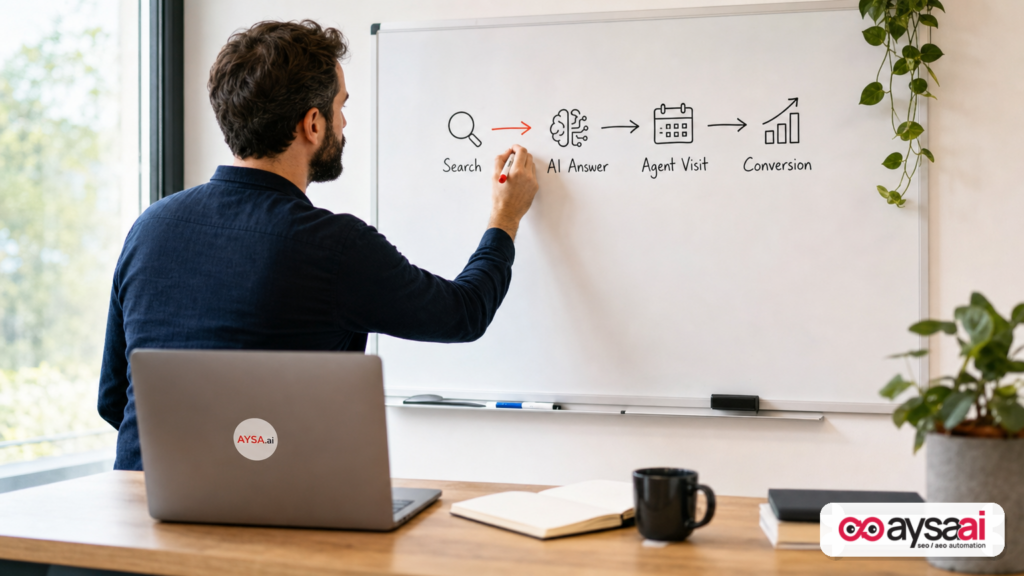
- Google’s quality principles aren’t being rewritten. If your site is genuinely useful for humans, you’re aligned with what Google wants—even when AI agents do the browsing.
- The new risk is technical and operational. Blocking agentic browsers (intentionally or accidentally) can become a visibility problem, even if your content is excellent.
- “AI SEO” is mostly “clarity + access + proof.” Clear structure, crawlable pages, consistent facts, and measurement discipline matter more than gimmicks.
- Execution speed is now a competitive advantage. The orgs that can monitor, propose, approve, and implement changes quickly will compound gains while others stay in meetings.
- AYSA fits as an execution system. We monitor site and search signals, prepare recommended changes, request approval, and execute accepted updates—so “strategy” becomes shipped work.
Table of contents
- The short version (concise summary)
- Context: what “AI agents” mean for search (without hype)
- What Google said—and what SEOs often misread
- Why “useful for humans” still wins (and where it fails)
- The new failure mode: blocking agents (and not realizing it)
- Accessibility is the new moat: crawl, render, understand, act
- Content that works in an agentic world: from pages to answers
- Authority signals still matter—just the loop gets shorter
- Measurement: what to monitor when clicks aren’t the whole story
- A concrete SME scenario: a local clinic competing in AI answers
- What agencies should rethink: deliverables → outcomes → execution
- 90-day action plan: agent-ready SEO without overreacting
- Where AYSA.ai fits: monitoring + approved execution for AI search
- What to do next
- Sources and further reading
The short version (concise summary)

AI agents (like Gemini with “computer use” capabilities) can navigate websites and complete tasks for users. That doesn’t invalidate SEO. It does, however, compress the path between discovery and decision—and that puts pressure on your site to be:
- Accessible (not blocked by Robots.txt, WAF rules, or brittle JS rendering)
- Unambiguous (clear headings, scannable answers, consistent policies, stable URLs)
- Machine-interpretable (helpful Structured data where appropriate, consistent entities)
- Operationally shippable (changes can be made fast with approval controls)
If your organization is slow to implement technical fixes and content improvements, AI agents won’t “punish” you out of spite—but you will lose the compounding gains that faster competitors capture.
Context: what “AI agents” mean for search (without hype)
For years, search was mostly a human interface: a person typed a query, scanned results, clicked a page, and navigated manually.
Agentic browsing changes the flow. The user can now say something like:
- “Find me a same-day florist delivery near downtown, under $80, with white lilies, and place the order.”
- “Compare these two billing software options and summarize which is best for a 5-person agency.”
- “Book a hotel with parking and late checkout within walking distance of the venue.”
In these journeys, an AI system may:
- Interpret intent and constraints
- Browse multiple sites
- Extract key details (pricing, availability, policies, product specs, location hours)
- Complete steps (fill forms, add to cart, book a slot) depending on capabilities and permissions
- Return an answer or complete a transaction
This raises a legitimate business question: is SEO still about human experience when the “visitor” is an agent?
Mueller’s answer implies something important: the agent is acting for the human, and the end goal is still user satisfaction. That’s a continuity story—plus a warning that the operational details (access) can become a new baseline.
What Google said—and what SEOs often misread
According to the SEJ coverage, the question posed to Mueller was essentially: as agentic browsing becomes more common, will Google’s guidance about satisfying page experiences (including principles around things like images and design) evolve because the “satisfying experience” is now mediated by an information agent?
Mueller’s response, as reported, had two core parts:
- Most principles will remain the same.
- Some details will evolve—including the idea that site owners shouldn’t blindly block agentic browsers.
Here’s the common misread I see in the market:
- Misread #1: “Nothing changes.” Businesses take comfort and do nothing. But the browsing layer is changing, and it can change who gets surfaced and who gets cited.
- Misread #2: “Everything changes.” Businesses panic and rewrite their sites for bots, stripping out brand differentiation and replacing it with generic AI-shaped copy.
The correct interpretation sits in the middle: the definition of quality remains human-centered, but the mechanics of being discoverable and usable by new automated visitors expands.
Why “useful for humans” still wins (and where it fails)
Let’s make “useful for humans” concrete. For most SMEs, this means the site can answer the questions that actually decide a purchase:
- What is this product/service?
- Who is it for (and who is it not for)?
- How much does it cost?
- What does the process look like?
- What are the risks, limitations, and policies?
- How do I contact you or buy now?
Now translate that into an agentic context: the agent needs to extract these answers reliably, compare them across options, and sometimes act on them. If your information is buried behind:
- heavy client-side rendering that fails intermittently,
- unclear navigation,
- inconsistent pricing or location info,
- thin pages that require “human inference,”
…then you’re creating friction for both humans and agents.
Where “useful for humans” sometimes fails in practice is when it becomes aesthetic rather than informational. Beautiful sites can still be confusing. If your page is a brand mood-board with no direct answers, an agent will struggle to extract facts—and a human will bounce anyway.
The agentic gap: when a good-looking site is a bad source
Many businesses unknowingly build pages that rely on a salesperson’s presence. The site hints at value, but hides specifics to “force a call.” In AI-mediated discovery, that’s increasingly a tax you pay for being vague.
If your competitor publishes clear, structured details—scope, timelines, packages, pricing ranges, service areas, exclusions—the AI system can compare and recommend them faster. That doesn’t mean you must publish every detail, but you do need to publish enough to be a credible option.
The new failure mode: blocking agents (and not realizing it)
Mueller’s line about “not blindly blocking agentic browsers” is the part I would underline for every operator who has security tooling, performance tooling, or an overzealous IT policy.
Businesses block automated traffic for valid reasons:
- protecting infrastructure costs,
- reducing scraping,
- limiting attack surfaces,
- complying with legal and privacy constraints.
But “block bots” policies often get implemented as blunt instruments: blocks based on behavior patterns, user-agent strings, headless browsing signals, geography, request velocity, or unknown origin networks.
Here’s the SEO problem: agentic systems may look like bots—because they are automated. If your site rejects them, you might be opting out of entire discovery and comparison loops.
Where accidental blocking happens
- robots.txt directives that are overly restrictive
- CDN/WAF rules that block “automated browsers” by default
- JavaScript challenges that are impossible for certain automated clients
- Login walls where critical information is gated unnecessarily
- Rate limits that are too strict for legitimate Crawling patterns
None of this means “open your site to everything.” It means adopt a grown-up posture: measure, segment, allow where it’s beneficial, and protect what must be protected.
A parallel worth remembering: when technical “hacks” backfire
The SEJ piece draws a historical analogy to past SEO behaviors where site owners made technical decisions (like aggressively sculpting link signals) that later caused unintended consequences—like starving important informational pages. The agentic era will have its own version of that: organizations that block too much will later discover they blocked their way out of visibility.
Accessibility is the new moat: crawl, render, understand, act
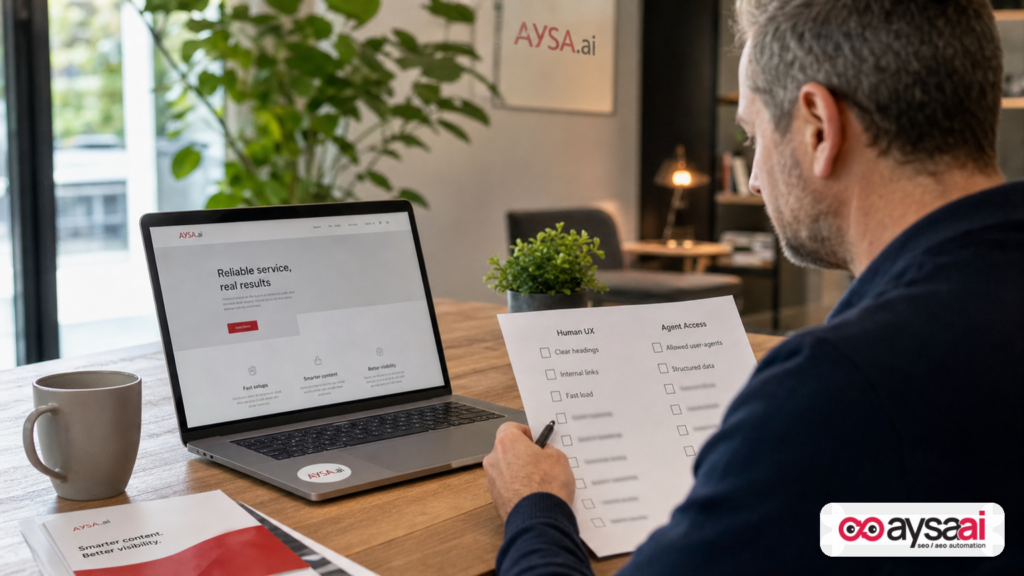
To be “agent-ready,” think in four layers. This is the framework I push because it’s simple enough for SMEs but rigorous enough for technical teams:
- Crawlability: Can an automated client fetch your URLs without being blocked?
- Renderability: Does the meaningful content load reliably without a perfect browser environment?
- Understandability: Is your information structured so it can be extracted correctly?
- Actionability: Can a user (or agent) complete the task without unnecessary friction?
1) Crawlability: the basics still pay rent
Even in 2026, basic crawl hygiene remains non-negotiable:
- Important pages return proper HTTP status codes
- Canonicalization is consistent
- Duplicate parameter URLs are handled sensibly
- Internal linking makes key pages discoverable
If you want an operational way to keep this tight, build a Monitoring habit. This is exactly why we built AYSA Monitoring: you can’t manage what you don’t continuously inspect.
2) Renderability: don’t make your business depend on perfect JS
Agentic clients may not behave like standard browsers in every case. If your critical content only appears after complex client-side rendering, you’re increasing the chance of extraction errors.
This doesn’t require dogma (not every site needs to be fully server-rendered), but it does require that your critical information is reliably present in the HTML response or in a render path that’s stable and accessible.
3) Understandability: write for humans, structure for machines
Humans can infer meaning from messy pages. Machines need signals.
Practical ways to improve extractability without making your site sound robotic:
- Use descriptive H2/H3 headings that match real questions
- Put the answer near the top, then expand with detail
- Use consistent labels for prices, availability, and policies
- Keep addresses, hours, service areas, and contact info consistent sitewide
- Use structured data where it fits (without spamming)
AYSA’s approach here is simple: we help you operationalize this through AI search visibility initiatives and the workflows that keep content aligned over time.
4) Actionability: reduce friction for tasks that agents will attempt
If agentic systems can browse and complete steps, your conversion path becomes part of your “AI readiness.” Examples:
- Booking forms that fail on mobile
- Checkout flows that require unnecessary steps
- Pricing hidden until the last moment
- Key policy info only in images or PDFs without accessible text
These are conversion problems today. In an agentic world, they’re also selection problems: if the agent can’t complete a task on your site, it may choose the competitor it can complete the task on.
Content that works in an agentic world: from pages to answers
AI-driven discovery pushes brands from “ranking for keywords” toward “being the best source of an answer.” That’s AEO (Answer Engine Optimization) and GEO (Generative Engine Optimization) in practice: not a new religion—just a new distribution layer.
What changes is the unit of competition:
- Old: You competed for a click on a results page.
- New: You compete to be included in the AI’s comparison set, then to be cited or selected.
Make answers legible without flattening your brand
A common fear is that “writing for AI” makes content bland. It doesn’t have to. The trick is separating:
- Answer clarity (structure, specificity, consistency)
- Brand differentiation (unique approach, proof, voice, positioning)
You can have both. Example for a service business:
- Clear: “Emergency plumbing: 24/7 in Austin. Typical response: 60–120 minutes depending on traffic and job type.”
- Differentiation: “We carry parts for the top 10 water heater models so most fixes happen in one visit.”
Re-architect content around decisions, not blog calendars
If you run an SME, you don’t need 200 blog posts. You need a website that answers the 30–50 questions that drive revenue. In an agentic world, that becomes even more true.
High-leverage page types to strengthen:
- Service pages that define scope, pricing ranges, timelines, and FAQs
- Location pages with consistent details (where applicable)
- Product/category pages with unique specifications and comparisons
- Policy pages (returns, shipping, cancellations) written clearly
- About pages that establish credibility and real-world presence
If you want tools and processes around this, start with AYSA’s AI SEO tools and then build an execution rhythm from there.
Authority signals still matter—just the loop gets shorter
Even as interfaces evolve, one truth remains: systems need a way to separate “confident” information from noise. In classic SEO, that often shows up as authority signals—reputation, references, consistency, and engagement.
Mueller’s comment (as covered by SEJ) also points to external user signals and popularity still being meaningful. You shouldn’t interpret that as “chase vanity metrics.” Interpret it as: if real users prefer you, it tends to leak into the ecosystem in many ways.
What to build that reliably earns trust
- Clear proof: case studies, customer stories, before/after examples (truthful, not inflated)
- Transparent policies and pricing logic
- Expertise signals: authorship where appropriate, and real-world credentials
- Consistent brand entity details (company name, location, contact, leadership)
In AI answer environments, your brand can be evaluated without a click—so the “trust objects” must be easy to extract and verify.
Measurement: what to monitor when clicks aren’t the whole story
The hardest part of AI search for SMEs is psychological: you can’t always see the impact in the same way you used to.
Traditional SEO reporting centered on:
- rankings,
- organic sessions,
- conversion rates from organic traffic.
Those are still useful, but AI-mediated journeys can reduce direct clicks while still influencing decisions. That creates a measurement gap.
What to track without inventing fake precision
Because we’re not going to pretend we have perfect attribution here, the goal is disciplined triangulation:
- Google Search Console trends for queries and pages that represent high-intent discovery (watch changes over time; avoid overreacting to daily noise).
- GA4 landing page quality and conversion paths: are key pages improving in engagement and assisted conversions?
- Brand demand indicators: search interest for your brand name queries inside your available tools (again, directionally, not as absolute proof).
- Operational metrics: lead quality, sales cycle length, phone inquiries, and customer support questions. If AI answers are working, your inquiries often become more qualified.
On the AYSA side, the thesis is: don’t just monitor traffic—monitor visibility and readiness. That’s why we treat monitoring as a first-class product capability: AYSA Monitoring.
A concrete SME scenario: a local clinic competing in AI answers
Let’s make this real with a scenario I’ve seen repeatedly across local services (clinics, dentists, physical therapy, urgent care, private practices).
The situation: A clinic depends on organic search and referrals. New patients increasingly ask AI tools questions like:
- “Is there a clinic near me that treats X and accepts my insurance?”
- “Which clinic has availability this week?”
- “What should I expect at my first appointment?”
What the AI agent tries to do:
- Identify services, specialties, and eligibility criteria
- Confirm hours, location, and contact methods
- Extract insurance/payment info
- Understand booking steps and constraints
Where clinics commonly fail:
- They bury insurance info in a PDF or a phone script
- They use vague service descriptions (“comprehensive care”)
- They have inconsistent hours across pages
- The booking flow breaks on mobile or requires too many steps
Agent-ready fixes that also help humans:
- Create a clear “Services” hub with individual service pages and FAQs
- Publish a simple “Insurance & Payments” page that’s accurate and updated
- Standardize hours and location details sitewide
- Make booking instructions explicit (“Call,” “Request appointment,” “Online scheduling”)
The business outcome: Patients self-select better. Front desk time drops. Fewer “basic questions,” more ready-to-book inquiries. And yes—visibility tends to improve because the site is now a clearer source of truth.
What agencies should rethink: deliverables → outcomes → execution
If you run an agency, the agentic shift will pressure your model in two ways:
- Clients will demand AI visibility outcomes (citations, inclusion, qualified demand), not just ranking reports.
- Clients will need faster implementation cycles because the surface area of “agent readiness” includes technical configurations that change frequently.
The agencies that win will be the ones that can:
- run repeatable audits for access + structure + clarity,
- prioritize changes by business impact,
- ship improvements continuously without chaos.
This is where a system like AYSA becomes a force multiplier: it’s not just analysis; it’s approved execution so recommendations become changes.
90-day action plan: agent-ready SEO without overreacting
Here’s a practical 90-day plan for SMEs (and the agencies serving them). It is intentionally grounded: no hype, no “rewrite the internet,” just high-leverage work.
Days 1–15: establish baseline access + visibility monitoring
- Inventory your key money pages: top services/products, location pages, booking/checkout, policies.
- Review robots.txt and key WAF/CDN rules with a specific lens: are you blocking legitimate automated browsing patterns?
- Confirm your most important pages load reliably and show critical info without fragile rendering dependencies.
- Set up ongoing monitoring. If you don’t have a disciplined internal process, start here: AYSA Monitoring.
Days 16–45: restructure content around decisions
- For each core offering, create/refresh a page that answers: what it is, who it’s for, price range, timeline, process, FAQs, and next step.
- Ensure internal links connect: homepage → category/service hub → detail pages → conversion pages.
- Standardize facts (hours, addresses, shipping/returns, cancellation terms) across the site.
- Remove friction: reduce steps, clarify requirements, improve mobile usability.
If you need a system to continuously identify gaps and propose updates, this is the lane for AI search visibility workflows.
Days 46–90: build trust objects + prove what’s working
- Add proof sections where they belong: testimonials, case studies, comparisons, methodology, credentials (only what’s true and supportable).
- Refine “About” and “Policy” pages to be unambiguous sources of truth.
- Track directional change in Search Console and GA4 (avoid false precision).
- Create a monthly execution cadence: monitor → propose → approve → implement → measure.
This cadence is where AYSA is designed to live—monitoring signals, preparing the changes, requesting your approval, and executing what you accept. You can explore that model on AYSA pricing and see ongoing thinking on the AYSA blog.
Where AYSA.ai fits: monitoring + approved execution for AI search
Most businesses don’t lose in SEO because they lacked ideas. They lose because they lacked throughput—the ability to turn insights into shipped improvements consistently.
That execution gap becomes more expensive as AI agents shorten the path from question → decision. If your competitor fixes accessibility and clarity faster, they become the default option in more answer sets.
AYSA’s role is straightforward:
- Monitor technical and search visibility signals over time (Monitoring)
- Prepare recommended site changes (technical + content structure)
- Ask for approval so stakeholders stay in control (brand, legal, compliance, leadership)
- Execute accepted changes to keep momentum and reduce backlog
If you’re just starting, use AYSA AI SEO tools as the entry point. If you’re already feeling the squeeze from AI answers, go deeper on AI search visibility.
What to do next
- Audit access: Review robots.txt, WAF rules, and automated-browser blocks. Replace “default block” with a deliberate policy.
- Strengthen your money pages: Make them answer-first, specific, and internally well-linked.
- Standardize facts: Hours, addresses, shipping/returns, cancellations, pricing logic—make them consistent and extractable.
- Reduce friction: Make booking/checkout/contact steps obvious and resilient on mobile.
- Set a monthly cadence: Monitor → propose → approve → implement → measure. Don’t run SEO as a quarterly project.
- Operationalize execution: If your team can’t ship changes reliably, adopt a system built for it: AYSA Monitoring and AYSA plans.
Sources and further reading
- Search Engine Journal: Google Answers Question About SEO For AI Agents (primary source for the Mueller comments referenced here)
- Search Engine Journal: SEO (ongoing coverage and context)
- Search Engine Journal: Latest News (broader search and AI updates)
- Search Engine Journal: Google Algorithm Updates (historical perspective)
- AYSA.ai: AI Search Visibility
- AYSA.ai: AI SEO Tools
- AYSA.ai: Monitoring
- AYSA.ai: Blog
Note on sourcing: The supplied research context provides the SEJ report and SEJ section links. Where readers want deeper official documentation (e.g., specific Google policies on agent access or user-agent handling), those primary sources should be consulted directly; they were not included in the provided research context, so this editorial avoids claiming specific directives beyond what SEJ reported.
Continue the AI search topic inside AYSA.
Use these pages to connect the article with AI SEO tools, AI visibility monitoring, AI Overviews and approved website execution.
Turn this topic into a website action plan.
Use these AYSA hubs to move from reading to technical fixes, AI visibility monitoring, research, glossary context and approval-first SEO execution.