
Measuring Prompt-Level Visibility in AI Search: A Practical Framework SMEs Can Actually Run
AI search doesn’t have stable rankings—so businesses need a new measurement model built around prompt libraries, inclusion rate, response quality, and repeatable baselines. Here’s how to track what matters, avoid fake precision, and turn insights into approved site updates with AYSA.

AI Search is changing how customers discover, compare, and decide—often without ever clicking a blue link. That’s a problem if you’re still measuring “visibility” with the same playbook you used for traditional SEO. It’s also an opportunity if you adopt a measurement model that matches how AI systems actually behave.
I’m Marius Dosinescu, and at AYSA.ai we’ve been building around one simple truth: measurement is only valuable if it leads to executed improvements. In AI search, that means moving from “Rank tracking” to prompt-level visibility—and then closing the loop with approved, shippable changes on your site.
Concise summary
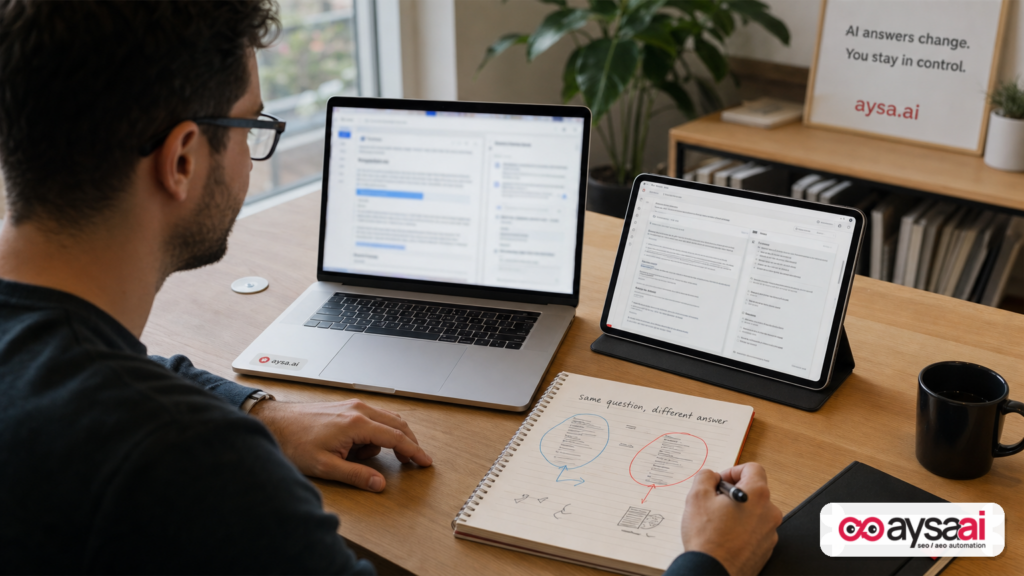
- AI search doesn’t have stable rankings. Responses vary by context, model version, history, and phrasing—so visibility is probabilistic.
- Your new unit of measurement is a prompt library (and prompt clusters), not a short Keyword list.
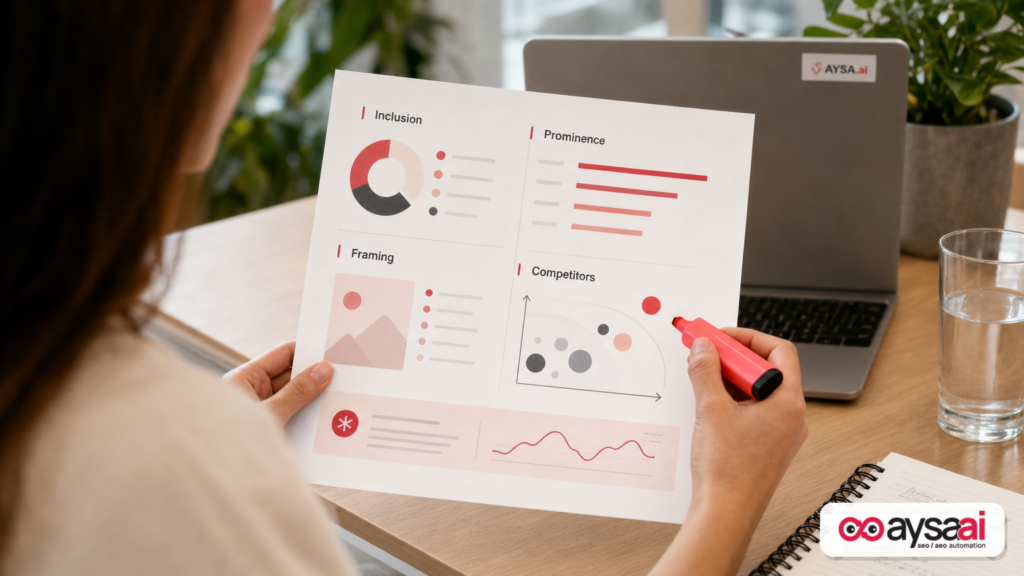
- Track inclusion, prominence, framing, sentiment, and competitor share—not imaginary “position #1.”
- Measure multi-turn conversations, because buyers refine their questions and vendors often appear later in the journey.
- Don’t chase perfect Attribution. Build a repeatable baseline and trend line, then execute improvements and re-test.
Table of contents

- What changed: AI search is probabilistic, not ranked
- Why it matters for SMEs: influence without clicks
- What you can’t reliably measure (yet) and why vendor claims matter
- Build a prompt library (not a keyword list) that reflects real buying journeys
- Use prompt clusters to reduce noise and find signal
- Synthetic prompts vs. real prompts: how to blend them responsibly
- Measure multi-turn conversations (the reality of AI-assisted research)
- The metrics that matter (and the ones that mislead)
- A practical dashboard structure: visibility, quality, technical signals, outcomes
- A concrete SME scenario: local clinic vs. “AI recommendations”
- What to change on your website to improve prompt-level visibility
- Where AYSA fits: monitor → prepare → approval → execute → recheck
- What to do next (a step-by-step action list)
- Sources and further reading
What changed: AI search is probabilistic, not ranked
Traditional search trained businesses to think in rankings: you publish a page, Google indexes it, and over time your position is relatively trackable for a query. Even when results fluctuate, the model is still mostly deterministic: the SERP is visible, the results are list-based, and measurement is built on Impressions and Clicks.
AI search breaks that mental model. A “best X” question asked in an AI assistant can yield different outputs depending on factors you don’t fully control: the exact phrasing, conversation context, model version, retrieval behavior, and (sometimes) personalization. That means you can’t treat AI visibility as a single, stable line item like “we rank #3 for ‘best CRM.’”
Casey Nifong’s article on Search Engine Land frames it well: the right question isn’t “Do we rank?” but “How often are we included across the conversations that matter?” (Search Engine Land).
From an operator’s point of view, this is the key shift:
- SEO used to be about positions.
- AI search is about probabilities and coverage.
Once you accept that, measurement becomes possible again—just with different objects and different expectations.
Why it matters for SMEs: influence without clicks
Many SMEs are feeling something uncomfortable: their analytics show fewer organic clicks, but their sales team still hears “I found you online.” Or pipeline stays stable, but traffic is down. Or branded search changes while overall sessions fall. AI answers can compress the journey: users ask, refine, shortlist, and decide—sometimes never clicking through until they’re ready to buy, or never clicking at all.
So visibility isn’t just “traffic.” Visibility is:
- Getting mentioned in a shortlist
- Being framed as the best fit for a segment
- Being compared favorably against alternatives
- Being “trusted” enough to be recommended with confidence
This is why prompt-level visibility measurement matters even if it feels less clean than GA4 dashboards. It’s about tracking presence and persuasion upstream of the click.
What you can’t reliably measure (yet) and why vendor claims matter
There’s a temptation in every new channel to over-promise measurement. AI search is no exception. Some tools and vendors imply they can observe “all prompts” or “every recommendation” about your brand across every model. In reality, AI platforms don’t generally provide comprehensive, user-level visibility into all conversations happening in the wild.
What you can do instead is build a representative measurement system based on repeatable prompt libraries and controlled testing. That’s not perfect attribution—and you shouldn’t pretend it is—but it is useful for trend lines, competitive benchmarking, and prioritizing website changes.
If a vendor claims total coverage, pressure-test how they collect the data and what’s actually being sampled. Ask whether results are gathered from controlled prompts, whether outputs are reproducible, and how multi-turn conversations are handled. The most honest programs acknowledge limitations and still produce actionable trends.
Build a prompt library (not a keyword list) that reflects real buying journeys
Keywords still matter, but keywords aren’t the whole story anymore. Buyers don’t just type “crm software.” They ask for the best option for their context, then they negotiate tradeoffs:
- Industry fit (“for dental practices,” “for manufacturing,” “for nonprofits”)
- Constraints (“under $X,” “small team,” “HIPAA,” “GDPR”)
- Existing stack (“integrates with X,” “replaces Y”)
- Objections (“downsides,” “complaints,” “is it worth it”)
- Implementation (“migration,” “training,” “setup complexity”)
The right starting point is a prompt library organized by intent. Search Engine Land provides a useful intent-based model (discovery, comparison, evaluation, validation, objections, alternatives, implementation) that maps to how people actually decide (source).
How big should a prompt library be?
For most SMEs, you don’t need thousands of prompts to start. You need enough prompts to cover:
- Your core categories/services
- Your core customer types (industries, segments, locations)
- Your biggest objections and differentiators
- Your top competitors and alternatives
A practical initial goal is 50–150 prompts for an SME (as a baseline), then expand as you learn. Larger brands and agencies will typically monitor more, but scale should follow clarity, not ego. The goal is repeatable measurement you can actually maintain monthly.
Prompt hygiene: write prompts the way humans ask
AI systems respond differently to “robot prompts” than to real user prompts. Avoid making every prompt look like a keyword. Include natural constraints and context, especially for complex purchases. That context is where AI assistants often differentiate recommendations.
Use prompt clusters to reduce noise and find signal
One of the biggest mistakes I see is treating a single AI response as truth. One prompt is an anecdote. A cluster is evidence.
Prompt clusters group variations of the same underlying intent. For example:
- Category cluster: “best project management tool,” “best PM platform,” “project management software for teams”
- Industry cluster: “best CRM for healthcare,” “best CRM for construction,” “best CRM for manufacturing”
- Feature cluster: “CRM with automation,” “CRM with forecasting,” “CRM with mobile field sales”
- Competitor cluster: “Brand A vs Brand B,” “alternatives to Brand A,” “Brand A pricing and limitations”
Clusters do two critical things:
- They smooth out randomness from one-off responses.
- They reveal where you win (and where you’re invisible) by segment.
Operationally, clusters also make reporting clearer for non-SEO stakeholders. A founder may not care about one prompt, but they’ll care that you show up in “Healthcare CRM prompts” 12% of the time while competitors show up 60%.
Synthetic prompts vs. real prompts: how to blend them responsibly
Most companies don’t have a neat export of “what customers asked ChatGPT.” So teams create prompts synthetically—expanding keywords into questions, generating variations, and building structured coverage.
Synthetic prompts are valuable because they’re repeatable and benchmarkable. But they’re not the whole truth. Real prospects ask messy questions with constraints, context, and emotional weight.
Where real prompts come from (without guessing)
You can responsibly collect real-world language from places you already control:
- Sales call notes and discovery transcripts
- Support tickets (“How do I…?” “Why doesn’t…?”)
- On-site search logs
- Community and forum questions your team sees repeatedly
- Customer interviews and onboarding sessions
The goal is not to “spy” on private AI chats. The goal is to listen to your customers and mirror their language in the prompt library you use for measurement.
Your prompt library should evolve
Products change, competitors change, and customer language changes. Treat your library as a living asset—review it quarterly. Retire prompts that don’t match how people buy today, and add prompts that mirror emerging needs and objections.
Measure multi-turn conversations (the reality of AI-assisted research)
Single-prompt measurement can miss the moment you actually get recommended. Buyers often start broad and then narrow:
- “What are the best options for X?”
- “Which are best for Y industry?”
- “Which integrates with Z?”
- “Compare pricing and implementation effort.”
If you only measure step 1, you might conclude you’re invisible—when you actually become a top recommendation at step 3 or 4. Search Engine Land makes this point clearly: modern tracking should evaluate conversation paths, not just isolated questions (source).
How to structure conversation paths
For each key intent cluster, design 3–6 turn sequences that emulate a real buyer narrowing down:
- Broad category prompt
- Industry-specific prompt
- Feature constraint prompt
- Comparison prompt (include 1–3 competitors)
- Objection/validation prompt
Then measure whether you appear at any step, and where the “entry point” happens. If you consistently appear only at late steps, your top-of-funnel framing and authority may be the gap.
The metrics that matter (and the ones that mislead)
Let’s be direct: “rank” is a comforting metric, but in AI search it often becomes fake precision. Instead, use metrics that map to how AI answers influence decisions.
1) Inclusion rate
This is the foundational metric: in what percentage of tracked prompts does your brand appear?
It’s simple, but powerful—especially when segmented by:
- Buying stage (discovery vs evaluation vs objections)
- Industry cluster
- Feature cluster
- Geography (for local businesses)
- Model/platform (where you test)
2) Prominence (position within the response)
Being mentioned isn’t the same as being recommended. Track whether you are:
- Presented as a top option
- Included mid-list
- Only listed as an “alternative”
- Excluded from comparisons that matter
Even without “rankings,” the order and emphasis shape perception.
3) Brand framing (how you’re described)
Framing is where AI search becomes strategically interesting—and where many brands get blindsided.
Common framing patterns that matter:
- Who you’re “for” (SMBs vs enterprise, specific industries)
- What you’re “best at” (speed, support, compliance, integrations)
- Price positioning (budget, premium, hidden costs)
- Tradeoffs (complexity, learning curve, limitations)
If AI consistently frames you as “best for small teams,” but you’re targeting enterprise, that’s a messaging and proof problem—usually solvable with clearer pages, stronger comparisons, and better third-party corroboration.
4) Sentiment and confidence
Don’t reduce sentiment to “positive vs negative.” Track the confidence level: “strongly recommended,” “worth considering,” “may be a fit,” “depends,” “often criticized for…”
AI systems frequently hedge. When you see hedging around your brand (or certainty around competitors), treat it as a signal that the available web evidence is uneven.
5) Competitive share of voice (who shows up instead of you)
Your visibility alone is not enough. AI answers tend to be comparative by nature. Measure how often competitors appear in the same clusters—and whether category-level shifts affect everyone or just you.
Search Engine Land highlights this as essential for distinguishing broad model shifts from brand-specific problems (source).
Metrics that mislead when used alone
- Clicks (AI can influence without a click)
- Traditional “rank” (often not meaningful in AI outputs)
- One prompt screenshots (anecdotes, not a measurement system)
- Vanity “AI score” metrics that aren’t explainable or auditable
A practical dashboard structure: visibility, quality, technical signals, outcomes
A measurement program works when it’s repeatable and executive-readable. Here’s a dashboard structure that SMEs and agencies can run without turning measurement into a full-time job.
1) Visibility coverage
- Inclusion rate (overall + segmented)
- Prompt coverage (how many prompts, how many clusters)
- Model coverage (which AI experiences you test)
- Competitive share of voice
2) Response quality
- Prominence
- Brand framing themes
- Sentiment + confidence/hedging patterns
- Message consistency across clusters
3) Technical and retrieval signals (where observable)
Different AI systems retrieve and summarize information differently, and not all provide transparent signals. But when you can observe citations or sources, track:
- Citation frequency (how often your site is referenced)
- Freshness issues (old pricing, old features, outdated “about” info)
- Entity consistency (brand name variations, product naming conflicts)
4) Business outcomes (directional, not perfect attribution)
- Referral traffic from AI surfaces (where visible)
- Assisted conversions (use caution; keep it directional)
- Branded search lift
- Direct traffic trend lines
- Sales team feedback (“Where did you hear about us?”)
The point is not to pretend you can connect every AI mention to revenue. The point is to align measurement with business reality: awareness, consideration, and trust often happen before the click.
A concrete SME scenario: local clinic vs. “AI recommendations”
Let’s make this real with a scenario I’ve seen repeatedly (names changed, but the situation is common).
Business: a local physical therapy clinic with two locations.
Old measurement mindset: “We need to rank #1 for ‘physical therapy near me.’”
New customer behavior: prospects ask AI: “I’m a runner with knee pain, I want a clinic that does gait analysis and takes my insurance. Who’s best near [city]?”
In that AI-assisted journey, the clinic’s website might never get clicked until the patient is ready to book. But the recommendation can still be decisive.
A prompt-level visibility plan for this clinic would include:
- Discovery prompts: “best physical therapy clinic for runners in [city]”
- Feature prompts: “gait analysis physical therapy [city]”
- Validation prompts: “is [clinic name] good for sports injuries?”
- Objection prompts: “what are the downsides of [clinic name]?”
- Alternatives prompts: “alternatives to [clinic name]”
- Multi-turn path: broad → sports-specific → insurance constraint → appointment availability
Then you measure:
- Inclusion rate for “runner/sports” clusters vs general clusters
- Whether the clinic is framed as “sports-focused” (if that’s the positioning)
- Whether key differentiators (gait analysis, certifications, insurance) show up in AI descriptions
- Which competitors dominate the same clusters
This measurement naturally turns into an action list: add or improve service pages, clarify insurance info, publish a clinician credentials page, strengthen location pages, and ensure consistent entity signals across the site.
What to change on your website to improve prompt-level visibility
Measurement should create a prioritized backlog. If you’re invisible, buried, or mis-framed, your website (and broader web presence) likely isn’t giving AI systems enough consistent, corroborated evidence.
Here are changes that tend to matter across industries, without leaning on unverifiable claims:
1) Build “clarity pages” that match how AI comparisons work
AI responses love structured comparisons: who it’s for, top features, pricing approach, pros/cons, integrations, setup time, support, and constraints.
Most SME sites avoid direct comparisons. That’s understandable—but the absence of clear pages forces AI to infer your positioning from scattered sources.
Create pages such as:
- “Who we’re best for” (industries, use cases)
- “Alternatives to [your product/service]” (honest, fair, useful)
- “[Competitor] vs [You]” where appropriate
- Implementation/setup expectations
- Transparent pricing philosophy (even if not exact pricing)
2) Strengthen evidence, not adjectives
AI systems tend to reflect what’s consistently stated across the web. If your site is mostly marketing adjectives (“best,” “leading,” “innovative”) but thin on verifiable details, you’ll see hedging and generic framing.
Prioritize:
- Specific capabilities and constraints
- Clear “how it works” explanations
- Updated feature lists
- Credible policies (returns, cancellations, guarantees, compliance statements)
3) Fix entity and naming inconsistencies
If your product is referred to by multiple names (old brand, new brand, abbreviations), you create ambiguity. AI models can mirror that ambiguity back as uncertain recommendations.
Align naming across:
- Site navigation and page titles
- About page and brand story
- Pricing and product pages
- Docs/help center (if applicable)
4) Refresh the pages that shape framing
Outdated pages often cause outdated AI framing (old target market, old features, old pricing assumptions). Create a refresh cadence for the pages that AI is most likely to summarize: product/service pages, pricing pages, “best for” pages, and comparison pages.
5) For local businesses: make locality explicit and structured
Local AI prompts include proximity and intent. Make it easy for systems to understand your service areas, hours, appointment/booking methods, and specialties. (We’re not asserting a specific schema requirement here because implementations vary; focus on clarity and consistency.)
Where AYSA fits: monitor → prepare → approval → execute → recheck
This is where most teams get stuck. They can collect interesting AI screenshots, but they can’t turn it into a reliable operating rhythm. Or they can run a one-time study, but they can’t maintain it month over month. Or they can measure, but execution is slow, political, or risky.
AYSA is built as an execution system for modern SEO/AEO/GEO:
- Monitors what matters (visibility signals, content/site signals) over time
- Prepares recommended changes as specific, reviewable tasks
- Asks for approval before publishing anything
- Executes accepted changes on the website
- Rechecks impact so measurement turns into a learning loop
If you want to explore how this works in practice, start here:
The big idea: measurement becomes an engine for approved change, not a monthly report that no one acts on.
What to do next (a step-by-step action list)
If you’re an SME founder, marketing lead, or agency operator, here’s a practical sequence you can run in weeks—not quarters.
1) Pick the AI journeys that matter
- Choose 2–4 customer segments (industry, use case, location)
- Choose 2–3 primary offers (services/products)
- List the top 3 competitors or alternatives per offer
2) Build your v1 prompt library (50–150 prompts)
- Organize by intent: discovery, comparison, evaluation, objections, alternatives, implementation
- Write prompts in real customer language (constraints included)
- Create clusters (category, industry, feature, competitor)
3) Add multi-turn paths (at least 10)
- Design 3–6 turn sequences that narrow from broad to specific
- Track when you enter the conversation and how you’re framed
4) Define your KPI set (keep it small)
- Inclusion rate (overall + by cluster)
- Prominence (top vs mid vs alternative)
- Framing themes (strengths/weaknesses, “best for”)
- Competitive share of voice
5) Turn insights into a prioritized backlog
- Which cluster has the biggest revenue impact?
- Where are you missing entirely?
- Where are you mis-framed?
- Where do competitors dominate—and why?
6) Execute improvements with an approval workflow
Don’t let execution bottlenecks kill momentum. Use a system (like AYSA’s approved execution approach) to propose changes, route them for review, ship them safely, and re-test.
7) Re-test monthly, refresh quarterly
- Monthly: measure trends, catch shifts, ship improvements
- Quarterly: refresh prompt library and conversation paths
Sources and further reading
- Search Engine Land: How to measure prompt-level visibility in AI search
- Search Engine Land: Used or cited: The two ways brands appear in AI search
- Search Engine Land: 6 SEO priorities to rethink for AI search
- Search Engine Land: Paid media is becoming an SEO investment in AI search
- Search Engine Land: Google Search Console gains reporting on social and video platforms
- Search Engine Land: What 1 million keywords reveal about AI’s impact on search
Note: This editorial intentionally avoids claiming platform-level “complete visibility” or precise attribution for AI-driven influence. Where AI systems do not expose underlying data, the most honest approach is repeatable sampling, clustering, and trend-based decision-making—followed by executed improvements.
Continue the AI search topic inside AYSA.
Use these pages to connect the article with AI SEO tools, AI visibility monitoring, AI Overviews and approved website execution.
Turn this topic into a website action plan.
Use these AYSA hubs to move from reading to technical fixes, AI visibility monitoring, research, glossary context and approval-first SEO execution.

