
Only 28% Trust AI Search. That’s Not Bad News—It’s the Biggest SEO Opening in 2026.
Americans are cautious about AI answers—and that skepticism is a gift to businesses that can prove, verify, and earn the click after the AI summary. Here’s how to win the “receipt moment” with practical SEO/AEO/GEO execution you can start this week.

AI Search is growing, but in the U.S. it still has a trust problem—and that’s the most underpriced advantage in SEO right now.
When only a minority of Americans say they trust AI-generated answers, the winners won’t be the brands that “get mentioned by a chatbot.” The winners will be the brands that become the receipt: the page people click after the AI summary to verify, compare, and decide. That click is where revenue happens—and it’s still very available in 2026.
This editorial is written from my perspective as Marius Dosinescu at AYSA.ai. I’m going to be direct: most “GEO” strategies are optimizing for the wrong moment. You don’t win by being summarized. You win by being verifiable.
Concise summary
- AI trust is low in the U.S. According to YouGov data discussed by Search Engine Journal, only 28% of Americans trust AI assistants for information—far below trust in search engines. That skepticism creates a massive opening for brands that provide proof and clarity. (SEJ coverage)
- Search engines still start the journey. For common tasks (questions, product research, purchases), people still begin with traditional search more often than AI assistants, per the same YouGov survey summary.
- The money moment is the verification click. People who use AI often still click source links to validate answers. The practical goal is to earn that click and convert it.
- Trust signals are operational, not philosophical. Visible sources, “official” status, freshness, authorship, policies, Structured data, and consistent business facts are your levers.
- Execution beats strategy decks. Monitoring, preparing changes, getting approval, and publishing updates consistently is what separates winners—exactly the workflow AYSA is built to support.
Table of contents
- What changed (and what didn’t)
- The trust gap is your opportunity, not your threat
- The new funnel: Search → AI summary → verification click → decision
- The “receipt moment”: the most valuable click in modern search
- Trust is a UX problem… but it’s also an evidence problem
- Content that survives AI summaries: how to structure pages for verification
- Local and multi-location: where AI answers go wrong fastest
- Ecommerce: AI can summarize, but it can’t assume your policies
- What agencies should rethink: packages built for a world that’s gone
- Measurement without fantasies: what to track when AI is in the middle
- What can go wrong (and how to avoid self-inflicted damage)
- A practical plan you can start this week
- Where AYSA fits: monitor → prepare → approve → execute (without chaos)
- What to do next
- Sources and further reading
What changed (and what didn’t)
Let’s separate signal from noise.
What changed: AI assistants (and Google’s AI features) can compress a messy research process into a single answer. That changes how people scan information and how quickly they form a shortlist of “maybe” options.
What didn’t change: People still don’t like being wrong—especially when money, health, travel, legal risk, or reputation is involved. When stakes are real, consumers verify. They compare. They look for proof. They want receipts.
The Search Engine Journal article based on YouGov’s research is useful because it doesn’t guess about behavior; it reports how people say they start tasks, what they trust, and what they do after an AI answer appears. And the U.S. stands out as a cautious market: trust in AI answers is low, and search engines remain the default starting point. (SEJ: Only 28% Of Americans Trust AI Search)
This matters because many 2026 roadmaps are being built on an assumption that “AI is replacing search.” The data suggests something more nuanced: AI often rides on top of search behavior rather than replacing it outright—especially in the U.S.
The strategic takeaway: don’t replatform your entire marketing plan around AI answers. Replatform around the verification layer that AI triggers.
The trust gap is your opportunity, not your threat
Low trust is not a blocker; it’s a wedge.
When audiences don’t trust AI outputs, they look for confirmation elsewhere. That “elsewhere” is your opening—if your site is built to be the confirming source.
Here’s the trap: many brands interpret “AI visibility” as a pure branding game—get cited, get mentioned, get in the answer. But if the next step is a click to verify, then you’re not optimizing for the answer; you’re optimizing for the moment right after it.
In my view, this is the most important mindset shift for SMEs and agencies: AI didn’t kill Clicks; it re-priced them. Some clicks may decline in low-intent informational queries, but the clicks that remain (verification clicks) are higher intent and closer to purchase or contact.
If your business can become the “official source” in your category—meaning you publish the clearest policy, the most current specs, the most transparent pricing framework, the most credible explanations—then AI’s existence can actually make your traffic better.
The new funnel: Search → AI summary → verification click → decision

Most people still picture the funnel like this:
- Search query → SERP → click → browse → convert
Now the funnel often looks like this:
- Search (Google, Bing, Maps, App Store, YouTube, Amazon—depending on the task)
- AI summary (AI Overview, assistant answer, “best option” narrative)
- Verification click (source link, official website, reviews, policies, product page, location details)
- Decision (call, booking, add to cart, request a quote)
You can debate whether step 2 reduces step 1 traffic in some contexts. But step 3 is where you should be allocating real operational effort.
Why? Because step 3 is where:
- buyers confirm if you’re legitimate
- people confirm the details (pricing, availability, insurance, returns, warranties, shipping time, restrictions)
- stakeholders confirm your authority (expertise, credentials, methodology)
And yes: YouGov’s findings summarized by SEJ suggest a meaningful portion of AI searchers still click through to source links rather than stopping at the answer. So the opportunity is not hypothetical. It’s behavioral. (SEJ coverage referencing YouGov livestream findings)
The “receipt moment”: the most valuable click in modern search
I’m going to use a phrase from the SEJ article because it’s the right mental model: receipts.
When someone reads an AI answer and thinks, “Okay, prove it,” they’re asking for receipts. That could be:
- an official policy page
- a government or standards reference
- manufacturer specs
- credentials and licensing
- published methodology
- a price list (or at least a transparent pricing framework)
- freshness signals (last updated, current year, version notes)
The receipt moment is where small and mid-sized businesses can beat bigger brands. Large brands often have more content, but it’s frequently generic, over-lawyered, or buried in UX layers. SMEs can win by being clear and specific.
Here’s the uncomfortable truth: many business websites are built like brochures. AI can summarize brochures. Verification clicks don’t reward brochures. They reward proof.
A “receipt-ready page” checklist
- Answer the real question (not just the keyword): who it’s for, what it costs, what’s included, what’s excluded, what to expect next
- Show the source: link to primary references when applicable (standards, regulators, manufacturer docs)
- Be explicit about exceptions: constraints, eligibility, location limits, lead times
- Make it current: last updated date that reflects real maintenance, not a fake timestamp
- Make it attributable: author/editor, company responsibility, contact, address
- Make it machine-readable: structured data where relevant (organization, local business, product, FAQ—used responsibly)
- Make conversion frictionless: call, book, buy, quote, directions—right there
None of this is “AI optimization.” It’s trust optimization. AI just increases the number of times people demand it.
Trust is a UX problem… but it’s also an evidence problem
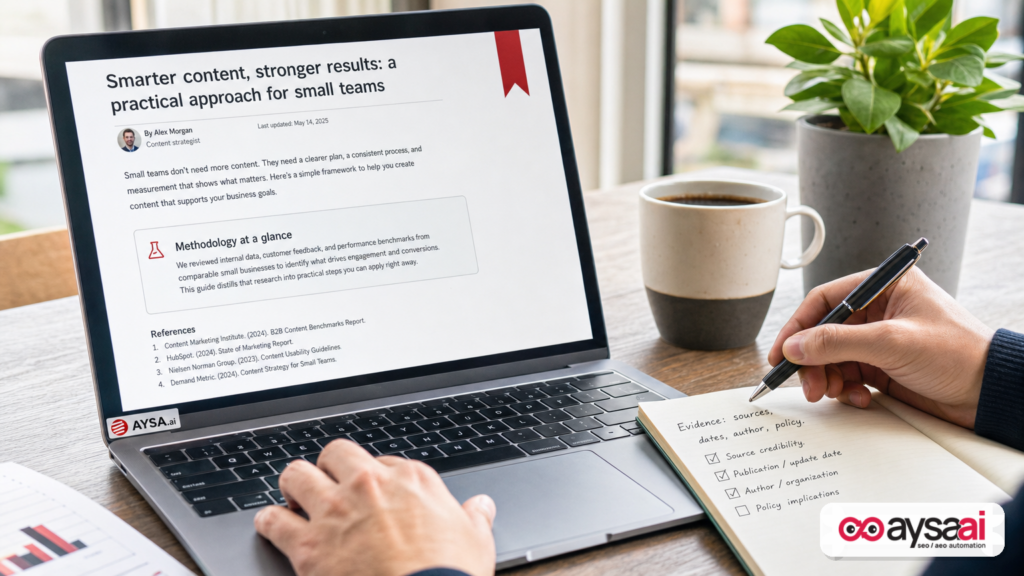
Marketers like to solve trust with design tweaks: icons, badges, trust bars, “as seen in” sections. Some of that helps. But the SEJ summary of YouGov data also highlights something important: transparency features may deepen trust for existing AI users more than they convert skeptics.
So what works reliably across both groups?
Evidence. The kind that stands up even when a user is actively looking for reasons not to believe you.
Evidence assets that win verification clicks
- Methodology pages (how you test, source, review, diagnose, ship, guarantee, or price)
- Editorial policies (how you handle updates, corrections, conflicts of interest, affiliate relationships if applicable)
- Clear authorship (bio pages, credentials, lived experience, review process)
- Customer-facing policies (returns, cancellations, shipping, insurance, warranties, privacy)
- Primary-source citations where relevant (regulators, standards bodies, manufacturer docs)
- Change logs for docs and specs (especially in SaaS, healthcare guidance, finance, and legal-adjacent content)
This is also where traditional SEO and “AI SEO” stop being separate disciplines. The same assets that build user trust also build crawling clarity and entity understanding.
A note on Google’s direction: “helpful” and “reliable” aren’t optional
Even without getting into any single update, Google’s public guidance has been consistent: create content for people, provide a good page experience, and demonstrate trust and transparency.
For example, Google has long documented structured data and how it helps systems understand page meaning (not “rank you magically,” but improve interpretation). See Google’s documentation on structured data and Search features for implementation guidance. (Google Search Central: Intro to structured data)
Similarly, for local businesses, Google maintains official guidance on managing your presence and business info (which is increasingly a foundation for AI-assisted local answers). (Google Business Profile Help)
Those are not “AI-only” resources. They’re the baseline. AI search makes the baseline more valuable.
Content that survives AI summaries: how to structure pages for verification
If AI can summarize your page in 5 lines, your job is to make the click worthwhile.
That doesn’t mean “write longer.” It means design for depth that matters.
Build in layers: summary, proof, action
Here’s a structure that consistently converts verification clicks:
- Layer 1: A clear summary (what it is, who it’s for, the key takeaway)
- Layer 2: Proof and specifics (details AI tends to flatten: constraints, pricing logic, steps, timelines, citations)
- Layer 3: Next action (book, buy, call, compare, get a quote)
AI often compresses nuance. So place nuance where humans can find it quickly.
The page types most businesses underinvest in
In the AI era, the pages that “feel boring” are frequently the pages that win verification clicks:
- Pricing & cost explanation (with ranges, drivers of cost, what changes the price)
- Policies (returns, cancellations, refunds, shipping, appointment rules)
- Comparisons (X vs Y, option A vs option B, DIY vs professional)
- Service area / eligibility (who you serve, where you don’t, and why)
- Implementation / process (what happens after you buy or book)
- Glossary and definitions (especially in regulated or technical spaces)
These pages do two things: they reduce friction and they reduce disputes. Both are growth.
FAQ pages: useful, but only when they’re real
FAQ content is everywhere because it’s easy. The problem is most FAQs are written for search engines, not customers.
Make FAQs “receipt-grade”:
- Answer with specifics, not slogans
- Include constraints and exceptions
- Link to the deeper policy/service page
- Put “last updated” dates where appropriate
When you do this well, AI summaries can become your distribution layer—and your site becomes the place people go to confirm and convert.
Local and multi-location: where AI answers go wrong fastest
If you run a local business—or worse, a multi-location brand—AI trust problems can become your problem fast. Because when AI gets a local detail wrong, customers don’t just get misinformed; they show up at the wrong time, call the wrong number, or expect a service you don’t offer.
Local is where the “receipt moment” is often brutally practical:
- Are you open today?
- Do you take my insurance?
- Is parking available?
- Do you offer emergency appointments?
- Is this service offered at this specific location?
Local foundations that support AI answers
- Google Business Profile accuracy (hours, categories, services, photos, attributes, appointment links) (GBP Help)
- Location pages with real differentiation (not duplicated templates)
- Consistent NAP (name, address, phone) across the site and major citations
- Clear service menus by location (what’s available where)
- Review strategy that reflects actual services (without incentives or shady tactics)
This is also where monitoring matters. Local details change constantly. Humans forget to update pages. AI systems don’t forgive stale data.
Ecommerce: AI can summarize, but it can’t assume your policies
Ecommerce brands are already living the “receipt moment,” whether they call it that or not.
AI can tell someone “this is a good option,” but it can’t safely assume:
- shipping timeline to a specific state
- return window exceptions
- warranty coverage nuances
- compatibility details
- what’s actually in the box
Those details are where conversions (and support tickets) are won or lost.
Receipt-ready product pages
If you sell products online, build pages that make verification easy:
- specs that match manufacturer language (and note when they differ)
- compatibility tables (plain English)
- shipping/returns right on the product page (not hidden)
- Q&A that answers real objections
- clear variation logic (size, color, bundles) with transparent pricing
Google’s documentation on product structured data exists for a reason: machines need clarity to represent products accurately. (Google Search Central: Product structured data)
But again, don’t treat structured data as “AI bait.” Treat it as clarity for systems and for customers.
What agencies should rethink: packages built for a world that’s gone
Agencies are under pressure in 2026 because the old deliverables are too easy to commoditize:
- publish X blog posts
- build Y links
- optimize title tags
Those aren’t worthless. But they’re not a strategy for the verification era.
The agency shift: from deliverables to operating system
The best agencies are shifting to:
- Monitoring as a product (visibility changes, local facts drift, content decay)
- Evidence assets (policy pages, methodology, comparison pages, proof-focused content)
- Speed of iteration (ship improvements weekly, not quarterly)
- Stakeholder approvals baked into workflow (legal, compliance, brand)
This is where an execution system matters more than another reporting dashboard.
If you’re an agency: your differentiation isn’t “we understand AI.” Your differentiation is “we can ship verified improvements reliably while keeping clients in control.”
Measurement without fantasies: what to track when AI is in the middle
One of the most damaging trends right now is marketers pretending they can attribute everything perfectly in an AI-mediated journey. You often can’t. Not cleanly. Not across platforms. Not with privacy constraints.
So we measure what’s real and actionable.
What SMEs should measure
- Branded search trends (are more people looking for you by name?)
- High-intent landing pages (pricing, contact, booking, product pages)
- Conversion rates by landing page group (verification pages should convert better over time)
- Local actions (calls, direction requests, appointment clicks—depending on your model)
- Content freshness and decay (which pages lose performance after 90–180 days without updates)
Use the basics well: GSC + GA4
Google Search Console and GA4 remain the practical foundation for most SMEs. If your fundamentals aren’t right there, “AI optimization” is theater.
If you need official starting points:
And if you’re trying to evaluate how AI features influence traffic: do it with controlled tests where possible, and focus on outcomes (leads, sales, calls), not just impressions.
What can go wrong (and how to avoid self-inflicted damage)
AI search creates new opportunities—and new failure modes.
Risk #1: You optimize for mentions and forget conversions
Getting “cited” feels like winning. But if the cited page is thin, outdated, or untrustworthy, verification clicks bounce and your brand takes a credibility hit.
Fix: treat citation as an invitation to be audited. Build pages that pass that audit.
Risk #2: Inconsistent facts across locations or products
AI systems and humans both punish inconsistency. Conflicting hours, mismatched policies, and duplicated location pages destroy trust.
Fix: centralize key facts, implement change control, and monitor drift continuously.
Risk #3: “Publishing velocity” without governance
Some teams react to AI disruption by publishing more—faster. That can amplify errors, legal exposure, and customer confusion.
Fix: ship improvements through an approval workflow. Speed is good; chaos is expensive.
Risk #4: Over-reliance on personalization assumptions
The SEJ summary of the YouGov data suggests many users are uncomfortable with AI personalization. Whether that changes in the future is a separate question. Today, your strategy should not require users to “opt in” to being tracked in order to trust you.
Fix: build trust that works in a low-data environment: proof, clarity, policies, and strong on-site UX.
A practical plan you can start this week
Here’s a plan designed for SMEs and lean teams. It’s built around one goal: own the verification click.
Step 1 (This week): identify your “receipt queries”
List the 25 questions prospects ask right before they convert. Examples:
- “How much does it cost?”
- “Do you take my insurance?”
- “What’s your return policy?”
- “Is this product compatible with X?”
- “Do you service my area?”
- “How long does it take?”
These questions are usually handled by phone calls, support tickets, and sales emails. That’s exactly why they’re valuable in search.
Step 2: audit the pages that should answer those questions
For each question, identify the page that should be the “official source.” If the best answer is currently on a third-party site, a PDF, a social post, or buried in a terms page—fix that.
Minimum requirements per page:
- clear answer above the fold
- supporting detail below
- last updated date (real maintenance)
- link to deeper policies or references
- CTA aligned to intent
Step 3 (Next week): publish 3–5 proof upgrades
Don’t rewrite the whole site. Ship a small set of high-leverage updates:
- rewrite your returns/cancellation policy in plain English
- add a pricing-explainer page with ranges and drivers
- create a “What to expect” process page
- add author/editor info and an editorial policy (if you publish advice)
- fix location page duplication and add unique service details per location
Step 4: add structured clarity (only where it helps)
Use structured data appropriately, aligned with Google’s documentation. Avoid spammy markup. Start with Organization/LocalBusiness basics, and expand to product and FAQ where it truly matches the page.
Official guidance to reference:
Step 5: instrument conversions and monitor drift
Track the outcomes that matter:
- form submissions
- calls
- bookings
- purchases
Then monitor for drift: content getting outdated, local hours changing, policies evolving, product availability shifting. The verification click only works when your information is accurate.
A concrete SME scenario: the local clinic that wins the “receipt click”

Let’s make this real.
Imagine a mid-sized clinic with two locations: primary care + urgent visits. The clinic notices fewer “blog” clicks and gets spooked by AI summaries in search. They assume they need “AI content.” They don’t.
What they actually need is to win the receipt moment. Here’s how:
What prospects verify before booking
- Is the clinic open on Saturday?
- Do they accept my insurance?
- Can I book same-day?
- What does a visit cost without insurance?
- Which services are offered at which location?
The clinic’s high-leverage fixes
- Create a plain-English pricing page with ranges and what changes cost (lab work, imaging, etc.).
- Create an insurance page that lists accepted networks, plus “how to confirm coverage” steps.
- Build separate location pages with distinct hours, service lists, parking notes, and booking links.
- Maintain Google Business Profile accuracy for each location. (GBP Help)
- Add a “What to expect” page for urgent visits (triage, paperwork, typical timelines).
Now when an AI answer summarizes “best urgent care near me,” the skeptical user clicks to verify. The clinic’s pages provide receipts—clear, current, specific—and the booking happens.
This isn’t hypothetical. This is how local decisions get made.
Where AYSA fits: monitor → prepare → approve → execute (without chaos)
Most businesses don’t fail at SEO because they don’t know what to do. They fail because execution is inconsistent.
That’s the gap AYSA is designed to close: it’s an approved execution system for modern SEO/AEO/GEO work. The model is simple:
- Monitor what’s happening across visibility and site health
- Prepare recommended improvements (content, technical, local, structured data)
- Ask for approval so stakeholders stay in control
- Execute the accepted website changes reliably
If you want to see how we frame this:
Why approved execution matters in the AI era
Because the “receipt moment” is fragile.
If your hours are wrong, your pricing is outdated, your cancellation policy changed, or your location page is duplicated, AI will amplify the confusion. Monitoring catches drift. Prepared changes reduce workload. Approval keeps you safe. Execution makes it real.
For agencies: productize verification
If you’re an agency, the fastest path to differentiation is offering a “verification-first” program:
- monitoring and alerts
- monthly proof upgrades (policies, pricing, comparisons, methodology)
- local accuracy maintenance
- technical hygiene and structured data improvements
- approval workflows with clients
AYSA supports that operational model so you spend less time chasing approvals and more time shipping improvements. Learn more at AYSA pricing and see practical examples on the AYSA blog.
What to do next
- Pick your receipt pages: pricing, policies, process, comparisons, location pages, top product pages.
- Upgrade proof: sources, authorship, dates, methodology, constraints, and clear next steps.
- Fix local accuracy: ensure Google Business Profiles and location pages are consistent and current.
- Ship weekly: small updates compound faster than big rebrands.
- Measure outcomes: bookings, calls, qualified leads, and conversion rates on verification pages.
- Operationalize execution: use a monitor → prepare → approve → execute loop so improvements don’t die in a spreadsheet.
Sources and further reading
- Search Engine Journal: Only 28% Of Americans Trust AI Search – And That Gap Is Your SEO Opening (references YouGov livestream and survey findings)
- Search Engine Journal: SEO section (context on ongoing SEO changes)
- Google Search Central: Intro to structured data
- Google Search Central: Product structured data
- Google Business Profile Help
- Google Search Console Help
- Google Analytics Help
AYSA resources:
Continue the AI search topic inside AYSA.
Use these pages to connect the article with AI SEO tools, AI visibility monitoring, AI Overviews and approved website execution.
Turn this topic into a website action plan.
Use these AYSA hubs to move from reading to technical fixes, AI visibility monitoring, research, glossary context and approval-first SEO execution.

