
Quality Content in 2026: What Google Actually Rewards and How to Turn It Into Execution
A practical, source-backed guide to quality content in modern SEO: search intent, originality, E-E-A-T, AI-assisted content, helpful updates and how AYSA turns content improvements into approved website execution.
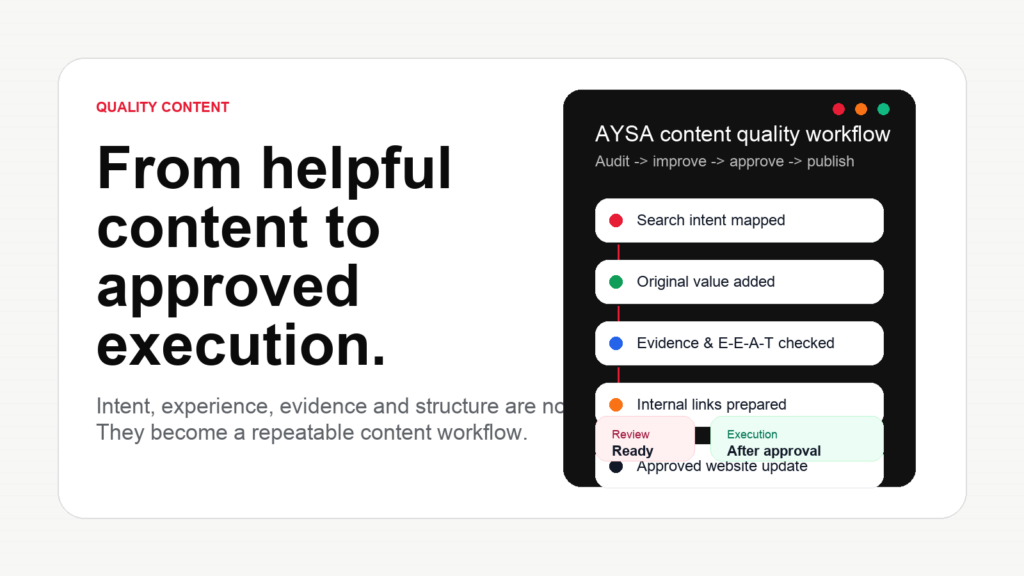
Executive summary: Quality content in 2026 is not a writing style, a word count, or a trick for ranking. It is the ability of a page to satisfy a real search need better than alternatives, with original value, visible expertise, trustworthy evidence, strong structure, technical accessibility and a clear path to action. Google’s public guidance keeps returning to the same idea: create helpful, reliable, people-first content, avoid scaled or deceptive content, and make pages that users would trust even if search engines did not exist.
For AYSA, the commercial lesson is simple: content quality must become an operating workflow. A business has to detect weak pages, understand why they underperform, prepare better content, approve important changes and publish those changes consistently. Reports alone do not improve a website. Approved Execution does.
Quality content is not “more content”
Many SEO teams still treat content quality as a production problem: publish more articles, make them longer, add keywords, insert a few internal links and hope the page earns visibility. That approach may create inventory, but it does not automatically create value.
Quality content starts with a harder question: what would make this page the most useful result for a specific user, at a specific stage of the journey, in a specific market? A page about “best pediatric clinic in Bucharest” should not look like a generic medical directory. It should help a parent compare options, understand when to choose emergency care, see real criteria, evaluate trust signals and decide what to do next. A page about “Technical SEO audit” should not only define the term. It should explain the checks, risks, examples, prioritization and what happens after issues are found.
The best content usually has a practical job. It answers a question, reduces uncertainty, makes a decision easier, teaches a process, compares alternatives, or helps someone take a safer next step. If a page does not do one of those jobs clearly, adding more paragraphs will not fix it.
What Google actually says about quality
Google’s public documentation does not give a secret ranking formula, but it gives enough direction to build a responsible content system. In its guidance on helpful, reliable, people-first content, Google recommends asking whether content provides original information, reporting, research or analysis; whether it gives a substantial, complete or comprehensive description of the topic; whether the page is the kind of result users would want to bookmark, share or recommend; and whether the content is written primarily for people rather than search engines.
The same guidance warns against shallow automation, content made mainly to attract search visits, and pages that promise answers but do not deliver satisfying value. This matters because a lot of low-quality SEO content is not technically wrong. It is just empty. It repeats what already exists, adds no first-hand experience, avoids specifics, and leaves the user no better equipped than before.
Google’s documentation on AI-generated content is also important. Google does not say that AI assistance is automatically bad. The emphasis is on quality, originality, helpfulness and whether content is created primarily to manipulate rankings. In other words, AI is not the problem by itself. Bad process is the problem.
The Google Search spam policies are the other side of the same coin. Scaled content abuse, expired domain abuse, site reputation abuse, Cloaking, hidden text, doorway pages and other manipulative tactics are not quality strategies. They may create short-term volume, but they weaken trust and create long-term risk.
Finally, Google’s Search Quality Rater Guidelines are useful because they explain how human raters are trained to evaluate search quality. Raters do not directly set rankings, but the guidelines reveal what Google means when it talks about quality: purpose, page quality, reputation, experience, expertise, authoritativeness and trust. The official PDF is available from Google’s rater guideline host: Google Search Central: Creating helpful, reliable, people-first content.
The practical signals of a quality page
A business does not need to memorize every SEO acronym to improve content quality. It needs a practical checklist that can be applied page by page.
1. Search intent is clear
The page should match what the user is trying to do. Informational searches need explanation. Commercial searches need comparison and decision support. Local searches need location, services, availability and trust. Ecommerce searches need product detail, filters, category logic, delivery, price expectations and reasons to buy.
2. The page adds original value
Original value can come from first-hand experience, examples, data, local context, product testing, founder perspective, customer questions, process details, screenshots, comparison criteria or a stronger explanation than the generic results already ranking.
3. The content is complete enough, but not bloated
Completeness does not mean every page should be 5,000 words. It means the page covers the important parts of the user’s question. A complete service page may need pricing guidance, process, service area, proof, objections, FAQs and next steps. A glossary page may need definition, example, common mistakes and related concepts. A blog article may need evidence, context and actionable interpretation.
4. The structure helps humans and machines
Headings should create a useful outline. The introduction should make the answer clear. Lists should simplify steps. Tables should compare things that are actually comparable. Schema should match visible content. Internal links should connect related topics, not randomly distribute PageRank.
5. Trust is visible
Trust can be shown through author information, sources, company details, experience, examples, transparent limitations, review signals, editorial standards and clear contact or business information. For YMYL topics, trust becomes even more important because wrong advice can affect health, money or safety.
6. The page is technically accessible
Quality content that cannot be crawled, indexed or loaded properly is underperforming content. Technical SEO is not separate from content quality. Indexability, canonical tags, mobile experience, page speed, Structured data, Image optimization and internal links all influence whether content can be discovered and understood.
Does the page answer the real task?
Mapped
Is there first-hand, useful context?
Needs examples
Are claims supported and trustworthy?
Improving
Can users and crawlers follow it?
Ready
Are changes approved and applied?
After approval
AI-assisted content can be excellent, or it can be noise
AI has made content production faster, but speed is not the same as quality. The cheapest version of AI content is easy to recognize: generic introductions, predictable definitions, no examples, no original point of view, no real business context, no sources, and no reason for the page to exist except covering a keyword.
The useful version is different. AI can help collect angles, draft outlines, identify missing questions, compare intent patterns, rewrite unclear sections, prepare metadata, generate FAQ candidates and organize a content plan. But the final output still needs business context, editorial judgment and a reason to be trusted.
This is where many teams fail. They do not fail because AI cannot write. They fail because nobody controls the workflow. Nobody checks whether the page reflects the business. Nobody connects it to Search Console data. Nobody adds examples from customers. Nobody updates internal links. Nobody approves the change. Nobody tracks whether the page improves.
Quality AI content requires governance: what gets created, what gets reviewed, what gets approved, what gets published, what gets monitored and what gets refreshed later.
A repeatable content quality workflow
A strong workflow looks like this:
- Detect the opportunity. Use search data, impressions, rankings, competitors, internal search, support questions and sales objections to find pages that need improvement.
- Classify the intent. Decide whether the user needs a definition, comparison, local answer, buying help, tutorial, checklist, product proof or expert interpretation.
- Audit the current page. Check whether the page answers the query, shows expertise, uses sources, has useful headings, includes internal links, supports conversion and can be crawled/indexed.
- Prepare the improvement. Rewrite weak sections, add examples, improve headings, add FAQs, update metadata, prepare internal links, improve schema where appropriate and remove filler.
- Review for risk. Check claims, regulated topics, brand voice, legal sensitivity, medical or financial advice, and anything that should not be automated blindly.
- Approve and execute. Publish accepted changes inside the website workflow, then monitor results.
- Refresh when search changes. Content quality decays when markets, competitors, products and search behavior change. Quality is maintained, not only created.
Before
Generic article targeting a keyword, no local context, no examples, weak internal links, no clear next step.
Risk: The page exists, but it does not deserve to be chosen.
After
Where AYSA fits: quality content as approved execution
AYSA is built for companies that do not want SEO to remain trapped in documents, dashboards or agency reports. A content audit is only useful if it becomes action. AYSA monitors the website, identifies weak pages and search opportunities, prepares improvements, explains why they matter, asks for approval and can execute accepted updates inside the website workflow.
That matters for quality content because the work is continuous. A page may need a better title today, a clearer answer next month, new internal links after a content cluster grows, a refresh after a Google update, or additional proof when AI search systems start favoring more explicit entity and trust signals.
For example, AYSA can help identify pages that get impressions but weak CTR, pages that rank but do not fully satisfy the query, topics where the business lacks enough coverage, internal links that should connect related pages, service pages missing pricing or process details, FAQ opportunities for answer readiness, schema opportunities that match visible content, and technical issues that reduce crawlability or indexability.
The important part is what happens next. AYSA does not only show the issue. It prepares the work, asks for approval and executes accepted changes. That is the difference between a content quality report and a content quality operating system.
Quality content examples by business type
Local services
A quality local service page should explain the service, location, availability, process, pricing expectations, proof, reviews, FAQs and what the customer should do next. It should not be a thin city page with swapped location names.
Ecommerce
A quality ecommerce category page should help users choose. That means filters, buying guidance, product differences, delivery details, return information, internal links to related categories, and useful copy that supports decisions rather than repeating keywords.
Medical and professional services
A quality page should be careful, transparent and trust-oriented. It should show qualifications, explain limits, avoid unsupported claims and help users understand options safely.
Publishers and blogs
A quality article should not simply summarize the obvious. It should add reporting, analysis, examples, sources, and a clear point of view that helps the reader understand what changed and what to do.
Common mistakes that weaken content quality
- Publishing pages only because a keyword has volume.
- Using AI to generate generic articles without business context.
- Writing long introductions that delay the answer.
- Adding FAQ schema for questions that are not visible or useful.
- Copying competitor structure without adding original value.
- Ignoring internal links between related topics.
- Forgetting to update old content after search behavior changes.
- Treating technical SEO and content quality as separate departments.
- Making claims without sources, proof or clear limitations.
The AYSA point of view
The future of content quality is not “humans versus AI.” It is weak process versus strong process. A company that uses AI with no context, no review and no execution discipline will create noise faster. A company that uses AI inside a controlled workflow can improve faster, maintain more pages and respond to search changes with less manual work.
Quality content is not a one-time writing project. It is a business system: detect what users need, prepare better answers, approve important changes, publish safely and keep improving. That is where organic growth becomes operational.
Less SEO work. More organic growth.
Turn content quality into approved website action.
AYSA monitors content opportunities, prepares SEO and AI visibility improvements, asks for approval and executes accepted updates inside your website workflow.
Continue the AI search topic inside AYSA.
Use these pages to connect the article with AI SEO tools, AI visibility monitoring, AI Overviews and approved website execution.
Turn this topic into a website action plan.
Use these AYSA hubs to move from reading to technical fixes, AI visibility monitoring, research, glossary context and approval-first SEO execution.

