
Reddit Reviews Is A New Reputation Layer: How To Turn Community Conversations Into Search Visibility, Better Product Pages, And Higher Conversion
Reddit’s new Reviews experience summarizes what communities say about products—likes, dislikes, and comparisons. Here’s what changed, why it matters for AI Search and ecommerce, and a practical system to turn recurring threads into approved website updates you can measure.

Reddit just made it easier for shoppers to see what communities say about products—and that’s not just a “social” update. It’s the emergence of a new reputation layer that will influence how people search, how they decide, and what language they use when they compare you to alternatives.
Reddit’s new Reddit Reviews test summarizes product conversations into themes: what people like, what they dislike, and what products they commonly compare. The key detail is that these summaries link back to the original comments, so a user can validate context instead of trusting a standalone snippet. That matters because summaries can be wrong, incomplete, or missing conditions—especially when experience, version differences, or use-cases change the recommendation.
In this editorial, I’ll break down what changed, why it matters for Ecommerce SEO (and AI Search in general), what can go wrong if you treat community summaries as truth, and—most importantly—how to convert “Reddit language” into measurable on-site improvements: clearer product pages, better comparison content, stronger FAQs, and higher conversion. I’ll also show how AYSA fits as the execution system that monitors, prepares changes, requests approval, and ships updates you can track.
Concise Summary
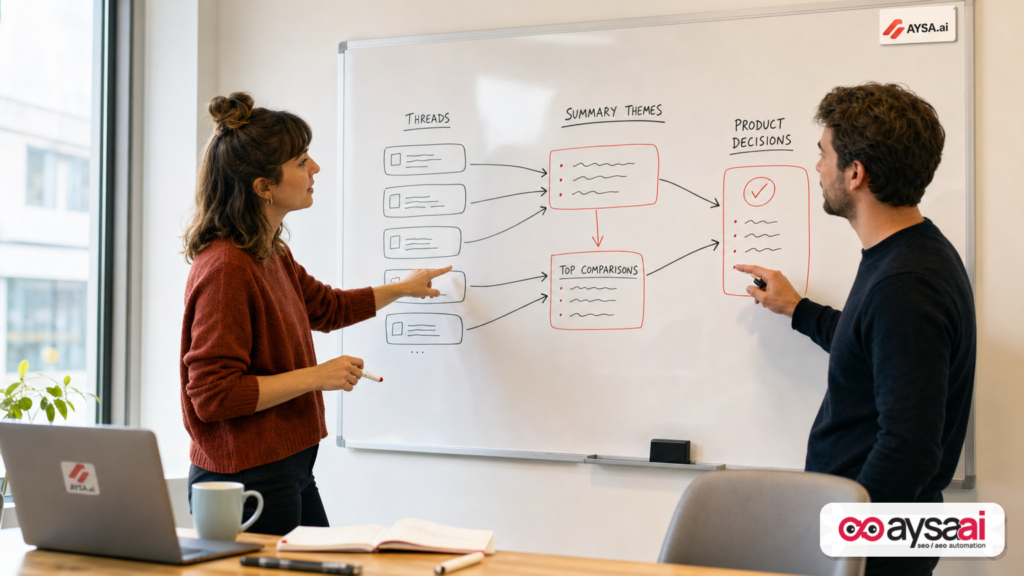
- What changed: Reddit is testing product review pages that summarize community threads into themes and comparisons, with links to source comments. (Source: Search Engine Journal)
- Why it matters: Shoppers increasingly validate decisions with real-user conversations; summarized community sentiment can shape brand perception and comparison behavior.
- What can go wrong: Verified purchase is not required, context can be missed, and summaries can overgeneralize. Your job is to validate themes by reading the source threads.
- What to do: Use Reddit Reviews as a listening feed; translate repeated objections into product-page clarifications, “vs” comparisons, compatibility notes, and FAQ content; then measure with your own analytics.
- Where AYSA fits: AYSA can monitor emerging themes, propose structured updates (PDP, FAQ, internal links, schema), ask for approval, and execute accepted changes—so your insights turn into shipped improvements.
Table of Contents
- What Changed: Reddit Reviews Turns Threads Into A Product Summary Layer
- Why This Matters Now: Search Is Becoming A Conversation Engine
- How Reddit Reviews Works (And The Parts Brands Should Care About)
- The Big Risk: Summaries Without Context (And Why Marketers Misread Them)
- What Reddit Reviews Can Reveal That Your Analytics Can’t
- A Practical Workflow: From Reddit Themes To Revenue (Without Guesswork)
- What To Change On Your Website: PDP, FAQs, Comparisons, And Internal Linking
- AI Search Implications: AEO/GEO And The “Citable” Product Page
- What SMEs Should Monitor Weekly (Without Building A Research Department)
- What Agencies Should Rethink: From Reporting To Execution
- SME Scenario: A DTC Skincare Brand Uses Reddit Reviews To Reduce Returns
- The AYSA Perspective: Approved Execution For Reputation-Driven SEO
- What To Do Next (Action List)
- Sources And Further Reading
What Changed: Reddit Reviews Turns Threads Into A Product Summary Layer

Reddit has always been a decision-validation machine. People go there to ask: “Is this worth it?” “What’s the catch?” “What should I buy instead?” The difference now is that Reddit is packaging those conversations into product-centric pages—summaries that are easy to scan, easy to compare, and easy to click through.
According to Search Engine Journal’s coverage, Reddit announced a Reviews test that summarizes product conversations into:
- Themes about what people like and dislike
- Commonly compared products (the “shortlist” behavior shoppers already have)
- Links to source comments so users can inspect the context behind the summary
That shift sounds small, but strategically it’s big: the platform is moving from “threads you must discover” to “product pages you can browse.” For brands, that means the conversation around your product becomes easier to find and easier to interpret—by consumers, by journalists, and by AI systems trained to summarize the web.
Why This Matters Now: Search Is Becoming A Conversation Engine
For years, ecommerce teams treated reviews as something that lived on their own site or on retailer marketplaces. Then social proof spread to YouTube, TikTok, and niche forums. Reddit is different because it’s where people describe tradeoffs in plain language: “It’s great, but…” “It works if you…” “Don’t buy it unless…”
Those phrases aren’t just opinions—they’re query templates. They become search behavior:
- “Is [product] worth it?”
- “[brand] vs [competitor] for [use-case]”
- “Why does [product] break / irritate / leak?”
- “Best alternative to [product]”
Reddit Reviews matters because it compresses thousands of long-form conversations into an accessible layer. If you’re responsible for growth, you should read that as: the language of your market is being summarized in public, and you need a system to respond—on your own website, where you control accuracy and conversion.
How Reddit Reviews Works (And The Parts Brands Should Care About)
Based on the SEJ summary, Reddit’s initial rollout is for U.S. users in English and covers around 10,000 products across categories like electronics, health and beauty, home and garden, and fashion/apparel, with plans to expand categories and geographies over time. (See: SEJ article.)
The brand-relevant parts aren’t the novelty of summaries—they’re the mechanics:
1) Themes Are A Shortcut To Objections
When a summary clusters what people like/dislike, it effectively surfaces your top objections. Objections are usually the missing content on your product pages: the “I’m not sure if…” fears you didn’t answer clearly.
2) Comparisons Reveal Who You’re Actually Competing Against
Many brands think they compete with a neat set of category rivals. Reddit comparisons often tell a messier truth: shoppers cross-shop based on budget, usage constraints, and lifestyle. If your internal competitor list doesn’t match what customers compare, your positioning is off.
3) Source Comment Links Make This Useful (And Auditable)
The source-comment link is the difference between a dangerous summary and a usable research lead. Marketers should treat it like this:
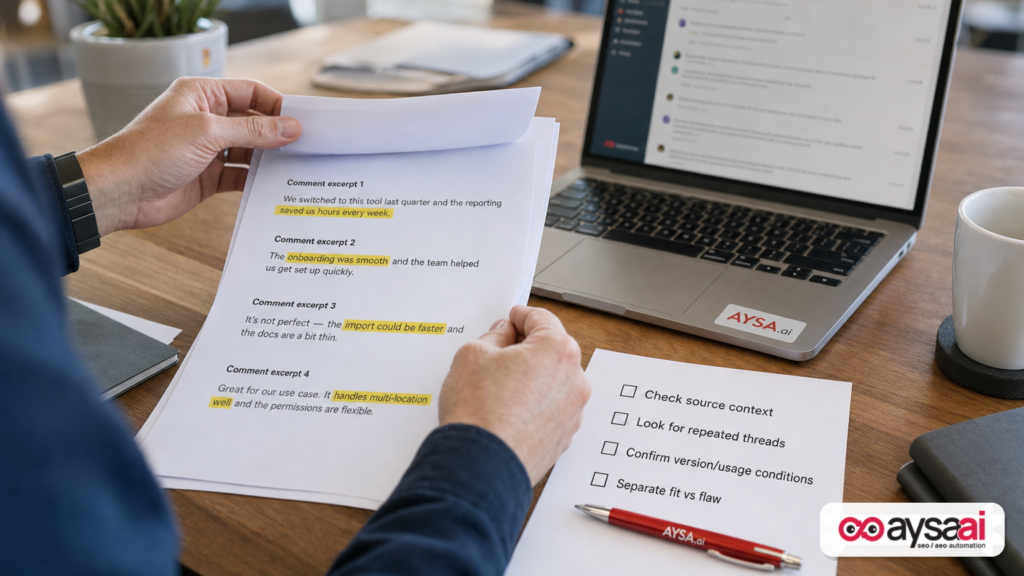
- Summary = hypothesis generator
- Source comments = evidence and nuance
4) Catalog Info May Appear—But Validate It
SEJ notes some pages may include images, prices, and purchase links supplied via brand/retailer catalogs, and that brands should check accuracy (e.g., price mismatches, outdated product info). That’s a practical warning: if a shopper sees inconsistent info, trust drops fast.
The Big Risk: Summaries Without Context (And Why Marketers Misread Them)
Let’s address the uncomfortable part: summarized community sentiment is not the same thing as verified customer data. SEJ highlights the limitations Reddit itself explains in FAQs:
- No verified purchase requirement—Reddit doesn’t confirm a commenter bought/used a product.
- AI can miss context—conditions that change a recommendation may not be captured.
- Sentiment displays are directional, not exact representation of all customers.
That means two equal-and-opposite mistakes are common:
Mistake #1: Treating A Theme Like A Statistic
Example: “The summary says people complain about durability. That means our product has a durability problem.” Not necessarily. It could be:
- A specific version or production batch
- Misuse due to unclear instructions
- A mismatch between expectations and reality
- A competitor’s users brigading a thread (rare, but possible)
Your move is to open the source comments and ask: is the same complaint repeated across multiple independent threads, in different communities, with similar usage conditions?
Mistake #2: Ignoring It Because It’s “Just Reddit”
The other mistake is dismissing it. Even if not everyone on Reddit is a customer, Reddit often acts as the pre-customer filter for high-consideration products. People use it to validate assumptions before buying—SEJ makes this exact point about the purchase journey and validation behavior. If you ignore the conversation, you lose the chance to clarify, differentiate, and reduce friction.
The Trust Question Is Real
SEJ points out that even moderators raised concerns about the challenge of verifying first-hand experience in recommendations. That’s not a reason to panic; it’s a reason to work like a professional: treat summaries as leads, confirm with evidence, and align with your internal data (support tickets, returns, QA, NPS comments, etc.).
What Reddit Reviews Can Reveal That Your Analytics Can’t
If you only look at GA4 dashboards and ad ROAS, you’ll miss the “why” behind buyer hesitation. Community conversations can surface signals your analytics usually can’t provide cleanly:
1) The Buyer’s Real Language (Not Your Brand Language)
People don’t describe products the way brands do. They describe outcomes, annoyances, and workarounds. That language is your best input for:
- Product page copy that answers objections
- FAQ phrasing that matches how people ask questions
- Comparison pages that mirror how people decide
2) The Hidden Conditions That Make Or Break Satisfaction
Many “negative reviews” are conditional: “It’s great if you have X, terrible if you need Y.” That’s not purely a product issue—it’s a qualification problem. Your website should qualify buyers honestly so the right customers convert and the wrong-fit customers self-select out.
3) The Competitor Set You Don’t Track
Reddit comparisons can reveal you’re not just competing with similar SKUs—you’re competing with:
- Different form factors
- DIY solutions
- Service substitutes
- Older models and refurbished options
4) The “Moment Of Doubt” In The Funnel
Threads often start at a moment of uncertainty: “I’m about to buy, but…” If you map those moments, you can create content that intercepts doubt on your own site—instead of letting the user go offsite and maybe not come back.
A Practical Workflow: From Reddit Themes To Revenue (Without Guesswork)
Listening is easy. Shipping improvements is hard. Here’s the workflow I recommend for SMEs and lean ecommerce teams that want to use Reddit Reviews responsibly.
Step 1: Build A “Theme Intake” Cadence
Weekly is enough for most SMEs. Your goal is not to read everything—it’s to identify repeated patterns.
- List your top products (by revenue or margin impact).
- Check if Reddit Reviews pages exist for them (where available).
- Capture recurring themes and comparisons into a simple doc.
Rule: a theme becomes actionable only when it shows up across multiple threads or communities, or aligns with your support/returns data.
Step 2: Validate With Source Comments
For every theme you’re tempted to act on, click through and read enough context to answer:
- What version/model are they talking about?
- What use-case and environment?
- What expectations did they have (and why)?
- Is there a workaround your site should document?
Step 3: Translate Themes Into On-Site “Fix Types”
Most community insights map into a small set of website changes:
- Clarification: add missing details (compatibility, sizing, ingredients, setup steps)
- Expectation setting: clarify who it’s for / not for
- Proof: add evidence (testing notes, certifications, warranty terms) where appropriate
- Comparison: create “vs” content for the real cross-shop set
- Support reduction: add troubleshooting, setup, and care instructions
Step 4: Prioritize By Impact, Not Noise
Use a simple prioritization grid:
- High frequency + high revenue product = ship quickly
- High frequency + low revenue product = batch updates
- Low frequency + high risk (legal/medical) = escalate for review
- Low frequency + unclear context = monitor, don’t act
Step 5: Measure On Your Site (Not On Reddit)
SEJ makes an important point: there’s no conversion result to claim yet from Reddit Reviews itself; brands should watch how pages appear and check their own referral and conversion data before drawing conclusions. That’s the right posture.
Measure what you can control:
- Product page Conversion rate (directional changes after edits)
- Return reasons / support ticket volume for recurring issues
- Search Console queries shifting toward clearer intent (where applicable)
- Engagement on new FAQ/comparison sections
If you want to operationalize this end-to-end, this is where systems beat heroics.
What To Change On Your Website: PDP, FAQs, Comparisons, And Internal Linking
When brands ask, “How do we respond to Reddit themes?” they often jump straight to PR or social replies. That’s usually the wrong first move.
Your best first move is to update the place you control: your website. Specifically, the product detail page (PDP) and the supporting content that shapes decision-making.
1) Product Pages: Add The Missing Decision Details
Most PDPs are built to sell, not to qualify. Reddit themes can reveal where qualification is missing. Common fixes:
- Compatibility blocks: “Works with X / Doesn’t work with Y”
- Setup/learning curve notes: “Expect 15 minutes to set up”
- Care and maintenance: “How to clean it” or “How to store it”
- What’s included: reduce surprises that trigger returns
These changes help ecommerce SEO indirectly because they improve conversion and reduce pogo-sticking behaviors—plus they make your page more “explainable” to AI systems that summarize product info.
2) FAQs: Write Them Like Reddit Questions
FAQ sections should mirror how people actually ask. If Reddit threads start with “Is it safe for…” or “Does it work with…”, that phrasing belongs in your FAQ headings.
Important: don’t add claims you can’t substantiate. If you can’t verify a performance claim, frame it carefully or omit it.
3) Comparison Content: Build For The Real Cross-Shop Set
Reddit’s “commonly compared products” is a gift because it shows the shortlist in public. Your options:
- Create a neutral “X vs Y” page that highlights differences honestly.
- Add a “Compare to alternatives” module on your PDP.
- Publish a “Which one is right for you?” guide (best for use-case A vs B).
Done well, this reduces buyer anxiety and keeps the comparison happening on your property—not in a thread you can’t control.
4) Internal Linking: Connect Objections To Answers
If a recurring theme is “Does it fit in a small space?” link the PDP to a sizing guide. If the theme is “Hard to set up,” link to setup steps. Internal linking is not glamorous, but it’s how you build a decision path.
5) Merchant & Catalog Accuracy: Reduce Trust Erosion
SEJ notes Reddit may show prices and purchase links from catalogs, and warns they can be outdated. You can’t control every third-party rendering, but you can reduce downstream confusion by keeping your own product data accurate and consistent across channels (titles, variants, availability messaging).
AI Search Implications: AEO/GEO And The “Citable” Product Page
Whether you call it AI Search, AEO (answer engine optimization), or GEO (Generative Engine Optimization), the underlying requirement is similar: your site needs to be easy to summarize correctly.
Reddit Reviews accelerates this reality because it’s a high-volume source of natural language about products. If AI systems increasingly surface “what people say,” then your job is to ensure your site provides:
- Clear definitions (what it is, who it’s for)
- Constraints (who it’s not for, what it won’t do)
- Decision criteria (how to choose between options/variants)
- Support clarity (setup, care, troubleshooting)
This is exactly where AYSA’s focus on AI search visibility becomes operational: you monitor what the market is asking, then you update the site so the answers exist in a structured, indexable, user-friendly way.
If you want the broader framework, start here: AI Search Visibility and the toolset overview here: AI SEO Tools.
What SMEs Should Monitor Weekly (Without Building A Research Department)
Most small teams don’t have a “voice of customer” research function. That’s fine. You just need a lightweight monitoring routine.
A Weekly Checklist
- Theme changes: Did a new complaint appear repeatedly this week?
- Comparison changes: Are you being compared to a new competitor or substitute?
- Version/context issues: Are comments about an older model or a specific variant?
- Expectations gap: Are people misunderstanding what the product does?
- Metadata drift: Are there public pages showing incorrect price/spec info?
To run this consistently, you need monitoring and task capture. AYSA’s monitoring is built for exactly that: track visibility and changes, then prepare the recommended site updates. Start here: AYSA Monitoring.
What Agencies Should Rethink: From Reporting To Execution
Agencies are going to feel this shift too. Historically, agencies reported rankings, traffic, and maybe “sentiment.” But Reddit Reviews is a reminder that growth often comes from fixing decision friction, not just chasing keywords.
If you run an agency, here’s the uncomfortable truth: clients don’t pay for insights. They pay for outcomes. Outcomes require shipping changes—often across PDP templates, internal linking, and content operations.
That’s why I believe the agency model needs an execution layer:
- Listen to community + search intent shifts
- Propose changes in a structured, reviewable way
- Get approvals (brand/legal/product)
- Execute and measure
This is the gap AYSA is designed to close with an approved execution approach: monitor, prepare, ask for approval, execute accepted website changes. For many teams, this is the difference between “we should update our PDPs” and “it shipped this week.”
SME Scenario: A DTC Skincare Brand Uses Reddit Reviews To Reduce Returns
Let’s make it tangible with a realistic example.
Business: A small DTC skincare brand selling a hero moisturizer and two serums.
Problem: Paid social drives traffic, but returns are creeping up. Support tickets include “it caused irritation” and “it pilled under makeup.” The team suspects the formula, but product changes are expensive and slow.
What Reddit themes might show:
- People love texture but complain about pilling when layered with certain sunscreens.
- Users with sensitive skin recommend patch testing and avoiding overuse in week one.
- Comparisons frequently mention a competitor product “better under makeup” but “less hydrating.”
What the brand does next (without guessing):
- Validate context by reading source comments: identify that pilling is mostly tied to a specific layering routine.
- Ship PDP updates:
- Add a “How to layer” section with clear steps.
- Add a “Works best with” note (without naming competitors if they don’t want to).
- Add a sensitive-skin onboarding note (patch test guidance, gradual introduction) reviewed by internal stakeholders.
- Add an FAQ written in user language: “Why does it pill?” “Can I use it under makeup?”
- Measure: track support ticket tags, return reasons, and PDP conversion directionally after the update.
The point: The first fix wasn’t reformulation. It was clarifying usage and setting expectations—reducing wrong-fit purchases and confusion-driven returns.
The AYSA Perspective: Approved Execution For Reputation-Driven SEO
Reddit Reviews is not “just another channel.” It’s a signal source. But signal sources only matter if you can turn them into execution safely.
Here’s how AYSA fits into this new reality, without pretending any magic:
1) Monitor The Market Language And Visibility
Use monitoring to catch changes in what people ask, compare, and complain about—then log those themes as actionable items. Start with AYSA Monitoring.
2) Prepare Proposed Changes (Structured, Reviewable)
Instead of “someone should update the PDP,” AYSA can help prepare specific edits: new FAQ entries, comparison sections, clarifications, internal links—mapped to a theme and a page.
3) Ask For Approval (Brand/Legal/Product Governance)
Community-driven updates can create brand and compliance risk if handled casually—especially in categories like health and beauty. The solution is a clear approval gate before changes go live.
4) Execute Accepted Changes Consistently
Execution is where strategies die. AYSA’s value is turning approvals into shipped updates reliably, so you can measure outcomes.
If you want to evaluate whether this fits your team and pace, see AYSA Pricing and explore more implementation ideas on the AYSA blog: AYSA Blog.
What To Do Next (Action List)
- Pick 10 products that drive revenue or margin and create a weekly “theme intake” routine.
- For each product: capture recurring complaints, praised features, and the most common comparisons.
- Click through to source comments for context before making any decision based on a summary.
- Map each theme to a website fix type (clarification, expectation, comparison, support reduction).
- Update PDPs and FAQs using customer language—avoid unverified claims.
- Create one comparison asset for the top cross-shop scenario (“X vs Y for Z use-case”).
- Track outcomes on your site: conversion direction, support ticket tags, return reasons.
- Operationalize execution with an approval workflow so insights become shipped changes (see: AYSA Monitoring and AI search visibility).
Sources And Further Reading
- Search Engine Journal: What Reddit Reviews Reveals About Your Products
- Search Engine Journal: AI Search coverage
- Search Engine Journal: SEO coverage
- Search Engine Journal: Technical SEO
- Search Engine Journal: Local SEO
- AYSA: AI Search Visibility
- AYSA: AI SEO Tools
- AYSA: Monitoring
- AYSA: Pricing
- AYSA Blog
Continue the AI search topic inside AYSA.
Use these pages to connect the article with AI SEO tools, AI visibility monitoring, AI Overviews and approved website execution.
Turn this topic into a website action plan.
Use these AYSA hubs to move from reading to technical fixes, AI visibility monitoring, research, glossary context and approval-first SEO execution.