
Gemini 4 Hydrogen in Google Search: What the “Biggest Model Upgrade Yet” Means for Visibility, Content, and Execution
Google is rolling out Gemini 4 Hydrogen across Search globally, promising more visual, more structured, more intent-aware answers. Here’s what changed, why it matters for SMEs and agencies, and how to adapt your SEO/AEO/GEO execution when Search can fan out queries, call tools, and summarize in richer formats.

Google just told the market something we should treat as a business signal, not a tech headline: it’s rolling out Gemini 4 Hydrogen globally inside Google Search, framing it as the biggest model upgrade to Search so far. In plain terms, Search is leaning harder into understanding what you mean (even when you ask messy, multi-part questions), fanning out across sub-questions at once, and presenting results in more visual and structured ways—tables, images, and custom “tools” embedded in the response.
As a result, the old mental model of “rank a page for a Keyword” keeps losing ground to a new one: “earn a role inside an answer journey.” That journey might be a structured comparison, a multi-step plan, a short list, a table, a shopping-style decision, or a set of links chosen because they satisfy different parts of the same intent.
I’m writing this as Marius Dosinescu from AYSA.ai, and I’m going to be direct: SMEs and agencies don’t lose in AI Search because they lack a clever strategy. They lose because they can’t execute fast enough—updating the site, policies, product data, location information, FAQs, and content structure to match how Search now interprets and re-assembles information. If Hydrogen accelerates intent understanding and query fan-out, it also accelerates the penalty for being unclear, inconsistent, or outdated.
Concise summary
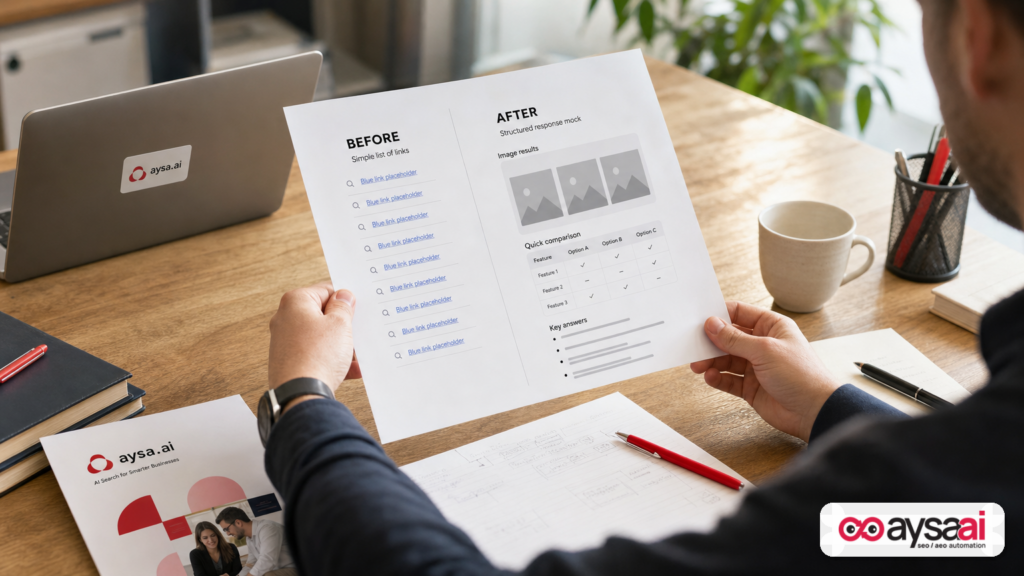
- What changed: Google is bringing Gemini 4 Hydrogen into Search globally, improving intent understanding, simultaneous sub-query exploration (“fan-out”), visual/structured responses, and language nuance. (Google Search Blog)
- Why it matters: More searches will end in Structured answer experiences, and “being link #3” is less meaningful if the answer is a table, a checklist, or a set of cited sources chosen for sub-intents.
- What businesses should do: Build content and Site architecture around intent packages (policies + FAQs + comparisons + decision helpers), make key facts machine-readable, reduce ambiguity, and monitor how your brand appears across AI-driven answers—not just rankings.
- Where AYSA fits: AYSA is built for this exact gap: monitor AI-search visibility, prepare site changes, ask for approval, and execute accepted updates—so you can keep up with the new pace of Search. See Monitoring and AI Search Visibility.
Key takeaways (for busy operators)

- Search is getting more “multi-intent”: Users won’t separate questions the way SEO tools separate keywords. They’ll ask one long query that includes constraints, preferences, and exceptions.
- Fan-out changes discovery: If Google runs multiple sub-queries on your behalf, your site can surface for narrower subtopics—if your pages are structured to be eligible.
- Presentation is part of ranking now: To be included in structured responses, you need clean, consistent facts and page sections that map to answer components (definitions, steps, comparisons, pros/cons, compatibility, policy details, pricing caveats, etc.).
- Execution speed becomes a moat: The best content plan is useless if shipping it takes 6 weeks.
- AI answers amplify mistakes: Outdated return policies, inaccurate specs, conflicting location hours, or vague medical/service claims can become “summarized misinformation.” Your site needs governance.
Table of contents

- What Google actually changed: the practical meaning of “Hydrogen in Search”
- Context: how we got from blue links to answer journeys
- The new user behavior Hydrogen encourages (and why your funnel will feel it)
- Query fan-out: why long-tail content is back (but not the way you remember)
- More visual, more structured: tables, images, and the rise of “answer formats”
- Richer language understanding: global nuance is now a core ranking battleground
- What can go wrong: traffic shifts, misrepresentation, and compliance risk
- A concrete SME scenario: the boutique hotel, the family clinic, and the ecommerce brand
- What SMEs should monitor weekly in an AI Search world
- What agencies should rethink: deliverables, reporting, and accountability
- The execution gap: why “strategy-only SEO” breaks under AI Search
- Where AYSA fits: visibility monitoring + approved execution (no more strategy-only SEO)
- What to do next: a 30–60–90 day action plan
- Sources and further reading
What Google actually changed: the practical meaning of “Hydrogen in Search”
Google’s own framing is clear: Gemini 4 Hydrogen is being brought into Google Search globally to make Search responses more helpful, visual, intuitive, and precise. Google highlights four practical capabilities:
- Better intent understanding (including multi-part questions, typos, and highly specific requests)
- Improved instruction following and tool calling (Search follows what you asked more precisely)
- Improved “query fan-out” and linking (Search runs simultaneous queries across relevant subtopics and connects you to more websites)
- More visual and structured responses (images, tables, structured answers, and custom tools)
All of that is described in Google’s announcement: Google Search gets a major upgrade with Gemini 4 Hydrogen.
Now, here’s what matters for businesses: Google isn’t just “answering more.” It’s assembling more. It’s taking the user’s intent, splitting it into components, retrieving information across those components, and returning a response that’s optimized for comprehension and speed—not for sending traffic to any single website.
That doesn’t automatically mean “zero-click apocalypse.” Google explicitly says fan-out connects users to a broader range of helpful links. But it does mean your role in the journey might be different: you may be cited, compared, summarized, or used as the source behind a table row—rather than simply being the destination link.
So, the core question becomes: What makes your site eligible to be used as a reliable building block in a structured answer?
Context: how we got from blue links to answer journeys
Search has been on a long trajectory:
- From retrieval (find documents matching a query)
- To interpretation (understand intent, entities, and context)
- To assistance (help complete the task: compare, plan, decide, and act)
Gemini 4 Hydrogen in Search is a continuation—and acceleration—of that assistance phase. When Google says the model can follow instructions better and call tools, it’s telling you Search is becoming more like a task layer on top of the web.
For SEO, that shifts the center of gravity:
- Less focus on “how do I rank for one keyword?”
- More focus on “how do I become the best source for one piece of a complex decision?”
That’s why I keep coming back to execution. Because the winning sites won’t just publish more. They’ll publish and maintain clearer information—policies, specs, comparisons, limitations, and structured FAQs—so Search can confidently assemble them into answers.
The new user behavior Hydrogen encourages (and why your funnel will feel it)
Hydrogen-style improvements encourage users to ask what they already want to ask—without forcing themselves into “keyword language.” That means queries will increasingly look like this:
- “I’m traveling with two kids and a dog—what’s the best area to stay in near downtown, and which hotels have parking and late check-in?”
- “Compare accounting software for a 5-person agency: must integrate with Stripe, handle multi-currency, and support invoice reminders—show pros/cons.”
- “What’s the difference between ceramic and mineral sunscreen for acne-prone skin, and which ingredients should I avoid?”
Those queries have:
- Constraints (two kids, dog, parking, late check-in)
- Decision criteria (integrations, currency, reminders)
- Risk/avoidance (ingredients to avoid)
- Format expectations (compare, pros/cons, show)
Hydrogen’s promise is that Search will handle that complexity and present something easy to scan. When that happens, your funnel changes in two ways:
- More pre-qualification happens inside Search. Users may arrive later in the journey, with fewer pageviews but higher intent—if you’re included.
- Brand Impressions become less linear. Users might see your brand inside a table, then later click a different site, then come back via a follow-up question. Last-click thinking gets weaker.
So if you only measure “rankings and sessions,” you’ll miss what’s actually happening: your visibility may be rising in AI-style responses even as traditional clicks flatten. That’s why you need Monitoring designed for AI Search visibility—not just classic SERP Position Tracking. (This is exactly the problem space behind AYSA AI Search Visibility.)
Query fan-out: why long-tail content is back (but not the way you remember)
Google’s announcement explicitly calls out “query fan-out”: when Search understands the question thoroughly and conducts simultaneous queries across relevant subtopics, then surfaces a broader range of helpful links. (Source)
Here’s the practical implication: your site can win without being the “best overall page” for the head term—if you are the best source for a sub-intent that fan-out explores.
But this only works if your content is structured and explicit enough for those sub-intents to be retrievable and trustworthy. That means:
- Stop burying answers in long prose. You can still write deeply, but include clear sections, headings, lists, and tables where appropriate.
- Expose constraints. If you have limitations (shipping regions, eligibility, appointment requirements, warranties), make them obvious and consistent across pages.
- Build “component content.” Create pages or sections that answer sub-questions directly: sizing guides, compatibility matrices, “who it’s for,” “not recommended for,” refund timelines, what to bring, what to expect, etc.
A lot of teams misread fan-out as “we need 1,000 blog posts.” No. You need coverage of decision components that users actually need in order to decide and act.
In other words: you’re not writing for keywords; you’re engineering for answer assembly.
More visual, more structured: tables, images, and the rise of “answer formats”
Google says Hydrogen will produce more visual responses, including structured answers, comparison tables, and custom tools. (Source)
This matters because visual structure is a selection mechanism. If Search wants to show a table, it needs comparable fields. If it wants to show a structured list, it needs consistent categories. If it wants to show images, it needs unambiguous mapping between an item and its visuals.
The new competition isn’t only “sites”—it’s formats
In classic SEO, you competed against pages. In AI Search, you compete against:
- A table
- A checklist
- A “top considerations” card
- A step-by-step plan
- A local pack-like selection
- A tool-like interaction (filters, selectors, decision helpers)
If your content can’t be cleanly mapped into those formats, it may be less likely to be used—even if it’s accurate.
What to build on your site to match those formats
For most SMEs, the fastest wins come from creating (or fixing) the basics:
- Comparison-ready pages: “X vs Y” pages, “plans comparison,” “materials comparison,” “service tiers,” “before/after expectations.”
- Decision guides: “How to choose,” including constraints, tradeoffs, and who each option is best for.
- Policies as structured content: returns, shipping, cancellations, appointment rules, deposits, warranties. Avoid PDFs as the primary source if possible.
- FAQs that are real: not marketing fluff. Actual questions customers ask.
- Image clarity: accurate alt text, consistent naming, and images that represent the product/service (not just lifestyle shots).
And because Hydrogen emphasizes “custom tools,” consider lightweight interactive elements where they genuinely help users (and can be crawled and understood): calculators, selectors, compatibility checkers, or “what you need” checklists. Even if Search doesn’t directly “run” your tool, the presence of clearly structured inputs/outputs tends to improve the clarity of your offering.
Richer language understanding: global nuance is now a core ranking battleground
Google also says Hydrogen provides richer language understanding and more nuanced responses “in all languages supported by our AI models today.” (Source)
For businesses operating in multiple markets—or even in one market with multilingual customers—this has a few implications:
- Literal translation is not enough. If Search understands nuance better, it will also detect when your localized pages are thin, awkward, or inconsistent with local expectations.
- Local intent becomes more specific. A query in Spanish in the U.S. might include different constraints than the same query in Spanish in Spain. Nuance matters.
- Support content becomes a visibility channel. Policies, shipping, sizing, warranty, and “how it works” content often gets asked in natural language—and can be surfaced across languages.
If you’re an SME, the play is not “translate everything.” The play is “make your core decision content and policies crystal clear in the languages you truly support.” Then maintain consistency across pages and across time.
What can go wrong: traffic shifts, misrepresentation, and compliance risk
AI-driven responses can help users. They can also create business risk when your site is unclear or inconsistent. Here are the main failure modes I’d plan for—without panic, but with seriousness:
1) Traffic quality changes (not always down, but different)
If Search answers more directly, some informational queries may generate fewer clicks. But some “consideration stage” queries may send better clicks because users are pre-qualified by the summary. The mistake is to obsess over total sessions without tracking what’s happening to:
- Lead quality
- Conversion rate by landing page type
- Brand search volume (directionally)
- Assisted conversions (if you can measure them responsibly)
2) Misrepresentation via summarization
If your pages contain contradictory information—different return windows, inconsistent service availability, unclear eligibility—AI summaries can amplify the confusion. Users may not click through to find the exception, and your support team pays the price.
3) Regulated industry risk (clinics, finance, legal)
Google’s post does not provide compliance guidance, so I won’t invent it. But as a practical operator, you should assume that richer summarization increases the importance of:
- Clear disclaimers and scope of service
- Up-to-date pages (especially pricing, policies, and medical/service guidance)
- Avoiding vague claims that could be interpreted too broadly
4) Brand dilution in “table-first” experiences
When results are presented as comparisons, you may be reduced to a row in a table. That’s not inherently bad, but it means differentiation must be legible in short form: what you include, what you don’t, who you’re for, and your proof points.
The fix isn’t “fight Google.” The fix is to make your differentiation and constraints explicit and structured so that when you’re included, you’re included correctly.
A concrete SME scenario: the boutique hotel, the family clinic, and the ecommerce brand
Let’s make this real with three scenarios that map directly to Hydrogen’s capabilities: intent understanding, fan-out, and structured responses.
Scenario A: Boutique hotel (local + travel intent)
Query behavior: “Best boutique hotel near the convention center with parking, late check-in, and quiet rooms—also what’s the cancellation policy?”
What Hydrogen encourages: The user expects a structured answer: a short list of options, a table of amenities, a quick policy summary, maybe images.
Where hotels lose:
- Parking info is vague (“parking available”) without details (cost, reservation, height limits).
- Late check-in policy is buried in an email template or a PDF.
- Cancellation terms vary by room type but aren’t clearly explained.
What to do:
- Create a single, authoritative “Parking & Arrival” page with specifics and a short FAQ.
- Make cancellation policies scannable by rate type with a simple table.
- Use consistent naming for room types and amenities across the site.
Scenario B: Family clinic (regulated-ish, trust heavy)
Query behavior: “Do you treat seasonal allergies for kids, do you accept my insurance, what should I bring, and can I book online?”
What Hydrogen encourages: A structured path: services offered, insurance/coverage info, prep checklist, booking link.
Where clinics lose:
- Insurance info is outdated or generic (“we accept most insurance”).
- Services are listed but not explained (what you do vs what you don’t).
- Booking is hidden behind a phone-only workflow.
What to do:
- Publish a clear insurance page with a “call to confirm” note where needed, but don’t be vague.
- Create service pages with “who it’s for,” “what happens,” and “when to seek urgent care” style boundaries (appropriate for your business).
- Make booking pathways explicit, with clear hours and expectations.
Scenario C: Ecommerce brand (comparisons + policies + constraints)
Query behavior: “Compare two products, but only if they ship to me in 2 days, have free returns, and work with my device—also show the differences.”
What Hydrogen encourages: A comparison table plus policy summary plus compatibility checks.
Where ecommerce loses:
- Compatibility information is incomplete or inconsistent.
- Returns policy is unclear (restocking fees, condition requirements).
- Shipping estimates are hidden until checkout.
What to do:
- Create compatibility tables and keep them updated.
- Turn policy pages into structured, scannable content (tables, FAQs).
- Expose realistic shipping expectations on product/category pages (with caveats), not only at checkout.
Notice the theme: none of these fixes are “write another blog post.” They’re operational content improvements—clarity, structure, consistency. That’s the kind of work that wins when Search becomes a better intent interpreter and answer assembler.
What SMEs should monitor weekly in an AI Search world
If Hydrogen makes Search more dynamic and structured, your monitoring needs to expand beyond classic rank tracking. Here’s a practical weekly checklist for SMEs (even if you’re not an SEO expert):
1) AI answer visibility for your core intents
- Are you appearing for your “money” questions (pricing, comparisons, “best for,” “near me,” “does it work with…”)?
- When you appear, are you described correctly?
This is the type of monitoring we built for at AYSA: see AI Search Visibility and Monitoring.
2) Consistency of your “facts” across the site
- Return window: same everywhere?
- Business hours: same everywhere?
- Service area: clear and consistent?
- Pricing: aligned across landing pages?
3) Structure coverage: do you have pages for the sub-intents?
Pick 10 customer questions your team answers repeatedly. Then verify:
- Do you have a page/section that answers it directly?
- Is it scannable (headings, lists, tables where relevant)?
- Is it updated?
4) Link opportunity shifts
Google says fan-out connects to a broader range of sites. That means there’s upside for SMEs that become best-in-class sources for specific subtopics. Monitor which pages start getting impressions for “oddly specific” variations—and double down by improving those pages.
5) Language and location nuance (if relevant)
If you serve multilingual audiences, test core intents in each language you support. If you serve multiple locations, test each location’s unique constraints (parking, appointment availability, shipping timelines, licensing restrictions, etc.).
What agencies should rethink: deliverables, reporting, and accountability
Agencies are going to feel Hydrogen in two places: reporting and production.
Reporting: rankings will be less satisfying (and less honest)
When responses become structured and multi-source, “position #2” is not the whole story. Agencies should evolve deliverables toward:
- Intent coverage maps: which sub-intents the client owns vs lacks
- Answer-format readiness: comparison tables, FAQs, policy clarity, “who it’s for” blocks
- Visibility in AI-style responses: not just classic web results
- Execution logs: what changed, when, and why (because changes matter more than reports)
Production: shipping beats brainstorming
Hydrogen’s promise—better instruction following, tool calling, fan-out—means that Search will find and use precise information faster. So the agency that wins is the one that can:
- Identify gaps
- Prepare fixes
- Get approvals quickly
- Implement changes safely
- Measure outcomes
This is exactly why we position AYSA as an execution system, not a reporting tool. Strategy without shipping is theater.
The execution gap: why “strategy-only SEO” breaks under AI Search
Here’s the uncomfortable truth: many SEO programs are optimized for presentation, not outcomes.
- Big audits that sit in a Google Doc.
- Content briefs that never get implemented correctly.
- Recommendations blocked by dev queues for months.
- Monthly reports that explain why nothing changed.
That approach was already fragile. Hydrogen makes it worse, because:
- User expectations move faster.
- Search formats change faster.
- Competitive gaps close faster.
So the winners won’t necessarily be the brands with the best “SEO knowledge.” They’ll be the brands that can run a tight loop:
- Monitor visibility and issues
- Prioritize changes that affect decision clarity
- Prepare updates
- Approve quickly
- Ship
- Re-check how Search represents you
Where AYSA fits: visibility monitoring + approved execution (no more strategy-only SEO)
AYSA is designed around a simple operational truth: businesses don’t need more SEO theory. They need a system that turns insight into shipped website improvements—without losing control.
That’s why AYSA’s model is:
- Monitor what matters (including AI-search visibility): AYSA Monitoring
- Prepare prioritized website changes
- Ask for approval (human-in-the-loop governance)
- Execute accepted changes reliably
If you’re an SME, this matters because you don’t have time to manage a dozen SEO tasks across writers, devs, and tools. If you’re an agency, it matters because it creates a clean operational backbone: you can focus on strategy and creative direction while the system handles consistent monitoring and execution.
Relevant AYSA resources to explore:
- AI SEO Tools (how we think about automation and practicality)
- AI Search Visibility (built for this shift)
- Monitoring (track what changes and what breaks)
- Pricing (evaluate fit quickly)
- AYSA Blog (ongoing playbooks)
What to do next: a 30–60–90 day action plan
This is a pragmatic plan designed for SMEs and agencies who need to move without boiling the ocean.
Days 1–30: stabilize facts and coverage
- List your top 25 “decision intents.” Not keywords—questions customers ask before buying or booking.
- Audit your “facts” for consistency: pricing ranges, policies, hours, service areas, shipping/returns, compatibility, requirements.
- Fix the top 5 contradictions. This alone reduces the risk of incorrect summarization.
- Build/refresh 10 high-impact FAQs on the pages where decisions happen (product/service pages, not only a blog).
- Set up monitoring for AI-search visibility and representation. (Start with AYSA AI Search Visibility.)
Days 31–60: engineer for answer formats
- Create at least 3 comparison assets (tables, “X vs Y,” tier comparisons) that match how users decide.
- Publish 2 decision guides (“how to choose,” “best for,” “avoid if,” “what to expect”).
- Upgrade your policy pages into scannable, structured pages (not PDFs).
- Improve images and clarity on top landing pages: ensure visuals map cleanly to products/services.
Days 61–90: operationalize execution
- Implement a weekly change cadence: 5–10 small improvements shipped weekly beat one big quarterly redesign.
- Build an “approval queue” habit so stakeholders can review and approve changes quickly.
- Review how Search represents you for top intents and adjust content structure where you’re misunderstood.
- Align measurement to outcomes: leads, bookings, qualified traffic, and brand demand—alongside visibility signals.
What to do next (action list)
- Pick 10 messy, multi-part queries your customers would ask. Write them down exactly as they’d say them.
- Check whether your site answers each query component clearly (policy, compatibility, pricing caveats, who it’s for).
- Turn hidden operational knowledge into pages (arrival/parking, returns, eligibility, prep checklists).
- Add comparison structure where choices exist (tiers, models, services, packages).
- Start monitoring AI-search visibility and build an execution loop. Explore AYSA Monitoring.
- Commit to shipping weekly—even if it’s small.
Sources and further reading
- Google Search Blog: Google Search gets a major upgrade with Gemini 4 Hydrogen
- Google DeepMind blog (context on Google’s AI research direction; linked from the source page)
- Google Research blog (research context; linked from the source page)
- Google Developers blog (developer-facing context; linked from the source page)
- Google Cloud blog (platform context; linked from the source page)
- Google Ads & Commerce blog (commerce ecosystem context; linked from the source page)
- Google Security blog (safety and security context; linked from the source page)
- AYSA: AI Search Visibility
- AYSA: Monitoring
- AYSA: AI SEO Tools
- AYSA: Pricing
- AYSA Blog
Note: This editorial is based on Google’s public announcement and the official related blog links surfaced on that page. Where specific technical implementation details are not provided in the announcement, I’ve intentionally framed recommendations as practical operational guidance rather than definitive statements about internal ranking systems.
Continue the AI search topic inside AYSA.
Use these pages to connect the article with AI SEO tools, AI visibility monitoring, AI Overviews and approved website execution.
Turn this topic into a website action plan.
Use these AYSA hubs to move from reading to technical fixes, AI visibility monitoring, research, glossary context and approval-first SEO execution.