
Why Schema Alone Is Not Enough for AI Search Visibility
Structured data helps machines understand a page, but AI search visibility also needs crawlable content, entity clarity, authority, internal links and approved execution.
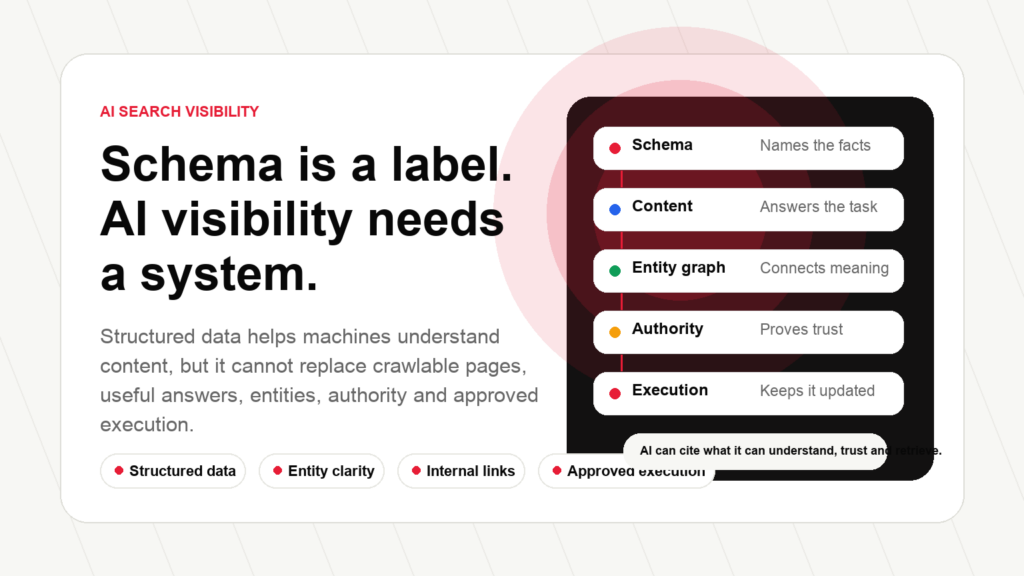
Executive summary: Schema markup is useful, but it is not an AI Search strategy by itself. Structured data helps search engines understand parts of a page. It can clarify entities, page type, breadcrumbs, products, organizations, articles and visible facts. But AI visibility depends on a much bigger system: crawlable pages, useful content, internal links, entity consistency, authority signals, technical health, freshness and the ability to turn recommendations into approved website changes.
The dangerous mistake for SMEs is to treat schema as a magic switch. Add JSON-LD, wait for AI Overviews, get cited by answer engines. That is not how modern search works. A page that is thin, outdated, isolated, slow, poorly linked or unsupported by real authority will not become trustworthy just because the markup is valid. Schema can label what exists. It cannot invent usefulness, expertise or execution.
There is a quiet misunderstanding spreading through SEO and AI search conversations: if we add structured data, the website becomes ready for AI search. I understand why the idea is attractive. Schema is visible to tools. It can be validated. It feels technical, precise and controllable. For a business owner, that sounds more concrete than “be useful” or “build authority.”
But schema is not the strategy. It is a layer in the strategy.
Google’s own structured data documentation frames structured data as a standardized format for providing information about a page and classifying page content. That is important. Google’s AI Optimization guidance also points website owners back to the fundamentals: make sure content can be crawled, indexed, served, understood and useful. In other words, AI search does not remove SEO fundamentals. It raises the cost of weak fundamentals.
For AYSA, this matters because we work with businesses that do not want to become technical SEO specialists. They do not want to spend their evenings reading Schema.org types, debugging JSON-LD, checking Search Console coverage, rewriting service pages and deciding which internal links should be added. They want the website to become more visible, more understandable and more useful without turning SEO into a second job.
Schema-only thinking
- Add markup
- Validate JSON-LD
- Hope for citations
- Ignore page quality
AI visibility system
- Crawlable content
- Clear entities and facts
- Useful answers and examples
- Authority and internal links
- Continuous approved execution
What schema actually helps with
Structured data is a way to make page information easier for machines to parse. Schema.org provides shared vocabulary. Google supports structured data for specific search features and explains that eligible rich results still depend on following technical and content quality guidelines.
Used correctly, schema can help with three practical jobs.
First, schema clarifies page type. A page can be an Article, Product, Organization, LocalBusiness, FAQPage, BreadcrumbList, Event, Review or another type. This gives search systems a cleaner clue about what kind of content they are looking at. A page about “Technical SEO audit” and a product category page are not the same thing. Markup can help separate those meanings.
Second, schema clarifies entities and properties. A product has a name, image, price, availability and brand. A local business has a name, address, phone number, opening hours and service area. An article has an author, publication date and headline. These are not decorative details. They help machines connect facts.
Third, schema can support eligibility for search features where those features exist. Rich results have rules, limitations and availability constraints. The important word is “eligibility.” Structured data does not guarantee a rich result, a ranking improvement, an AI citation or a sale. It only helps a system understand certain data more explicitly.
That is why schema is worth doing. But it is also why schema is easy to overstate.
Why schema is not enough
The main limitation is simple: schema describes content. It does not make the content valuable.
If a page says very little, structured data cannot turn it into a complete answer. If a product page has copied manufacturer text, no delivery information, no unique comparison value and no reviews, Product markup will not magically make it useful. If a clinic page lacks doctor information, location details, booking flow, patient FAQs and trust signals, LocalBusiness markup cannot carry the entire decision.
Search systems, including AI-assisted systems, need more than labels. They need reliable material to retrieve, summarize, compare and cite. A page must contain visible information that can answer real user tasks. That means schema must match the visible content. Marking up hidden or exaggerated information is not strategy; it is risk.
Another limitation is that schema does not solve crawlability. If important pages are buried, blocked, orphaned, slow, canonicalized incorrectly or missing from the internal architecture, structured data may not matter. Google still needs to crawl and process the page. AI systems also need accessible, stable content. A beautifully marked-up page that is technically unreliable is like a clean label on a locked box.
Schema also does not solve authority. A business that wants to be cited for a topic needs evidence beyond its own claims. That evidence can come from useful content depth, internal topical coverage, external mentions, reviews, publisher references, expert authorship, consistent brand/entity signals and a history of being useful. Structured data can help describe those elements, but it does not create them.
Finally, schema does not solve maintenance. Websites change. Products go out of stock. Pricing changes. Authors leave. Service areas expand. FAQ rich result policies evolve. AI search behavior changes. A one-time schema implementation can become stale quickly if there is no monitoring and execution workflow.
What AI search needs instead
AI search visibility is not one tactic. It is a retrieval and trust problem.
When a user asks a longer question, the system may need to understand the task, expand the query, retrieve candidate pages, compare sources, extract passages, evaluate usefulness and produce an answer. Whether your website is included depends on many layers: technical access, content clarity, entity consistency, authority, freshness and whether your pages actually answer the user’s problem.
For example, a page about “best pediatric clinic in Bucharest” should not be a generic directory. It should help a parent compare options, understand when to choose emergency care, see review signals, evaluate practical logistics, understand booking, parking and specialties, and make a safer decision. Schema can mark up a clinic. It cannot write that useful comparison on its own.
A page about “technical SEO audit” should not only define the term. It should explain what is checked, why each issue matters, how priorities are set, what examples look like, what can be automated, what needs manual review and what happens after issues are found. Again, schema can label the article. It cannot replace the actual usefulness.
In my opinion, AI search rewards websites that are easier to retrieve and easier to trust. That means the page should be:
- crawlable: bots can access and render the important content;
- indexable: the page is eligible to be included where appropriate;
- specific: the page answers a real user task, not a generic keyword;
- structured: headings, lists, examples and definitions make extraction easier;
- entity-consistent: brand, author, product, location and service details align across the site;
- linked: related concepts and pages are connected internally;
- supported: external trust signals, reviews, mentions and citations reinforce the topic;
- maintained: content is updated when the market, product or search behavior changes.
The missing layer: a website memory system
The phrase “memory layer” is useful because it explains what many websites lack. A website should not be a pile of disconnected pages. It should remember what the business does, who it serves, what topics it owns, what products or services matter, what pages already exist, what has been changed, what has been approved and what needs to be improved next.
For AI search, this matters because retrieval depends on relationships. A single page can answer one query. A connected website can explain a market. If your site has pages about technical SEO, crawlability, indexability, canonical tags, structured data, internal linking and approved execution, those pages should reinforce each other. They should not sit isolated.
Schema can describe some relationships, but the website still needs the relationships to exist. Internal links are part of that. Glossary pages are part of that. Case studies are part of that. Product pages, help documentation and blog articles are part of that. Search engines and AI systems need a coherent map, not only individual labels.
This is especially important for SMEs. A large brand may have authority by default. A smaller business must earn clarity. It has to show what it does, where it operates, what problems it solves, what proof exists and why the page deserves to be used. That does not happen through schema alone. It happens through disciplined content and technical execution.
What SMEs should do before obsessing over advanced markup
If you run a small or mid-sized business, the first question is not “which schema type can I add?” The first question is “what would make this page the most useful and trustworthy result for a specific user?”
For a local service business, that may mean better service pages, real locations, clear prices or price ranges, reviews, before-and-after proof, process explanations and FAQs. For an ecommerce business, it may mean better category pages, unique product descriptions, product data, stock clarity, comparisons, delivery details and internal links. For a publisher, it may mean clearer authorship, better topical coverage, expert review, original examples and updated articles.
After that, schema becomes easier. You are not inventing markup. You are marking up real content that already exists and deserves to be understood.
The right order is:
- Make the important page crawlable and indexable.
- Make the visible content genuinely useful.
- Clarify the entities: business, author, product, service, location, topic.
- Connect related pages internally.
- Add structured data that matches visible content.
- Monitor how the page performs in search and AI-assisted discovery.
- Prepare improvements and execute approved changes.
This sounds simple, but it is operationally hard. Most businesses do not fail because they never heard of schema. They fail because they do not have a repeatable system for turning SEO research into action.
Where AYSA fits: from markup to approved execution
AYSA is built around the idea that SEO should move from research to approved action. In this context, schema is one part of a larger operating system.
AYSA can help identify pages where structured data is missing, duplicated, invalid or disconnected from visible content. But the more important work is what happens around the markup. The agent can also detect weak content, missing FAQs, unclear service details, poor internal links, technical crawl issues, low-value pages, metadata opportunities, authority gaps and AI visibility problems.
Then AYSA prepares the work. That distinction matters. A normal SEO tool may show an issue. AYSA is designed to prepare the fix, explain why it matters, ask for approval and execute accepted changes inside the website workflow.
For a business owner, this is the difference between “you have missing schema” and “here are the approved updates that make this page clearer for search, AI systems and users.” The first creates work. The second removes work.
AYSA does not need to promise guaranteed AI Overview inclusion or guaranteed citations. Nobody should promise that. The practical promise is better readiness: clearer pages, stronger structure, better internal links, cleaner technical signals, stronger entity consistency and a workflow that keeps improving the website as search changes.
Tired of treating SEO as a list of technical chores?
AYSA monitors your website, prepares SEO and AI visibility actions, asks for approval and executes accepted changes inside your website workflow.
A practical checklist for AI search visibility beyond schema
If I had to simplify the work into a practical checklist for SMEs, I would use this:
1. Confirm crawlability and indexability
Check robots.txt, noindex directives, canonical tags, redirects, sitemap inclusion, status codes and internal links. AI visibility cannot stand on pages that search systems cannot reliably access.
2. Make the page genuinely useful
Do not write for a keyword alone. Write for the user’s task. Add examples, decision criteria, definitions, steps, comparisons and practical details. A useful page is easier to extract and cite.
3. Clarify entities
Make sure the business, author, service, product, location and topic are consistent. Entity confusion weakens both classic SEO and AI search readiness.
4. Build internal semantic links
Connect related articles, glossary terms, product pages, help pages and case studies. Internal links tell machines which concepts belong together.
5. Add schema only after the visible content supports it
Structured data should describe what users can see. Do not use markup to claim hidden facts, fake reviews or unsupported offers.
6. Monitor and update
AI search and classic search are changing quickly. A page that was complete last year may be incomplete today. Monitor impressions, rankings, AI visibility, citations, crawl issues and competitor movement.
7. Turn findings into execution
The final step is the one most businesses miss. Insights must become approved actions: updated content, corrected schema, better internal links, refreshed metadata, fixed canonicals, improved service pages and stronger authority signals.
Final thought
Schema is not dead. Schema is not useless. Schema is a good and necessary layer for many websites. But schema alone is not enough for AI search visibility.
The future belongs to websites that are easy to crawl, easy to understand, easy to trust and easy to keep updated. For SMEs, the winning advantage will not be memorizing every schema type. It will be having a system that continuously prepares the right work, explains it in plain language, asks for approval and executes what was accepted.
That is the shift from SEO markup to SEO operations. And that is where I believe the next serious advantage will be.
Sources and further reading
Continue the AI search topic inside AYSA.
Use these pages to connect the article with AI SEO tools, AI visibility monitoring, AI Overviews and approved website execution.
Where schema fits inside the visibility system
Schema is useful when it clarifies real visible content, but it cannot rescue a weak page by itself. AYSA looks at the full system: crawlability, headings, answer clarity, entity consistency, source credibility, internal links, evidence, pricing clarity and conversion paths. Structured data should annotate a strong page, not replace the work of making the page useful and citeable.
Turn this topic into a website action plan.
Use these AYSA hubs to move from reading to technical fixes, AI visibility monitoring, research, glossary context and approval-first SEO execution.

