
Search + AI Agents Are One Product: The One Playbook SMEs Need To Win AI Search
Google is turning search into an agent manager, but the optimization fundamentals didn’t split into “SEO vs AEO.” For SMEs and agencies, the winning move is one playbook: machine-readable pages, extractable content, real experience, and fast approved execution.

Search is becoming more “agentic,” but that doesn’t mean your business needs two separate strategies—one for SEO and another for “AEO/GEO.” It means the same strategy now has to work for two types of visitors: humans and machines acting on behalf of humans.
Google executives have been unusually clear about this direction. In a recent Search Engine Journal piece, Slobodan Manić summarized two key signals: (1) Search is evolving into an “agent manager,” and (2) the way to optimize for AI Search is the same as optimizing for search—create genuinely great, useful content (and go deeper than surface summaries).
My take at AYSA.ai is straightforward: the “two playbooks” pitch is mostly a consulting artifact, not a durable operating model. What businesses actually need is one playbook—with higher standards for technical accessibility, content depth, and execution speed.
Concise summary

- What changed: Search interfaces are increasingly completing tasks, not just listing links. That creates more “agent” visits and fewer obvious Clicks.
- What didn’t change: Websites still need crawlable, extractable, structured, fast content—and credible expertise.
- What this means for SMEs: If your site is hard for machines to read (JS-only rendering, thin pages, unclear entity signals), you’ll lose visibility in both classic search and AI answers.
- What to do now: Build one operational playbook: technical readiness + content that adds non-commodity value + measurement + fast, Approved Execution.
- Where AYSA fits: AYSA helps you monitor visibility, prepare changes, request approval, and execute improvements—so your strategy doesn’t die in a backlog.
Table of contents
- What changed: from “ten blue links” to an agent manager
- Why the “separate AEO strategy” narrative is collapsing
- The one playbook: what “agent-ready” websites actually require
- Content that wins: depth, experience, and non-commodity value
- From keywords to entities: being understandable to machines
- Agents don’t just read—agents act: designing “discoverable actions”
- Measurement in the agent era: what to monitor (without guessing)
- What can go wrong: visibility gaps, attribution gaps, and brand risk
- A concrete SME scenario: a local clinic competing in AI answers
- What agencies need to rethink: org design, deliverables, and incentives
- Where AYSA fits: monitoring, preparing changes, approval, and execution
- 90-day action plan: unify your playbook
- What to do next
- Sources and further reading
What changed: from “ten blue links” to an agent manager

For most small and mid-sized businesses, SEO used to be a fairly simple mental model:
- A person searches.
- Google shows links.
- The person clicks your site.
- You convince them with content, pricing, trust, and a call-to-action.
That model isn’t gone—but it’s being wrapped in additional layers. The new layers are what people call AI Overviews, AI Mode, and increasingly agents: systems that can read, compare, and sometimes initiate tasks (booking, form-fill, research, shortlisting) on behalf of the user.
The key point from the SEJ source is not that “everything is different.” It’s that Google itself is communicating convergence: search and agents are becoming one product surface, not two separate channels with separate rules. If the same product is serving users via classic results, AI answers, and agentic experiences, your website can’t be optimized for one and neglected for the others.
So what is actually changing in practice?
1) More searches end earlier
If a search interface answers the first question itself, a portion of users won’t click. That’s not new—featured snippets did this too—but AI summaries can cover more ground.
2) The “visitor” is increasingly a machine
Even when a website is used, it may be visited by an automated system to extract information, verify details, or compare options. In that world, your content has to be extractable, not just pretty.
3) The winning experience is a loop, not a page
Users may iterate: ask, refine, compare, ask again, complete a task. Your content must support that journey: clear structure, clear claims, clear proof, and easy next steps.
Why the “separate AEO strategy” narrative is collapsing
In the last two years, a lot of businesses were sold an idea: “Traditional SEO is for links; AEO (Answer Engine Optimization) is for AI; GEO is for generative engines; you need a separate strategy.”
Sometimes the pitch was well-intentioned. AI search surfaces do create new constraints and new opportunities. But the conclusion—separate playbooks—often leads to waste:
- Duplicate audits
- Conflicting advice to content teams
- Two reporting frameworks that don’t reconcile
- Tech teams overwhelmed by competing “must do” lists
The SEJ article argues that when Google leadership says “it’s the same playbook,” the vendor is effectively collapsing that market category. You can still use “AEO” as a helpful shorthand, but operationally it should roll up into your SEO program—not become a second organization.
My perspective: the separate-playbook era is mostly a symptom of a deeper problem—execution latency. When teams can’t ship improvements, they rebrand the work. When they can ship improvements, they don’t need to rebrand it; they just win.
The one playbook: what “agent-ready” websites actually require
If you want one practical definition of “agent-ready,” it’s this:
Your website must be easy for machines to retrieve, parse, and trust—and easy for humans to act on.
That’s it. No hype. No magic prompt engineering. Just engineering and editorial discipline.
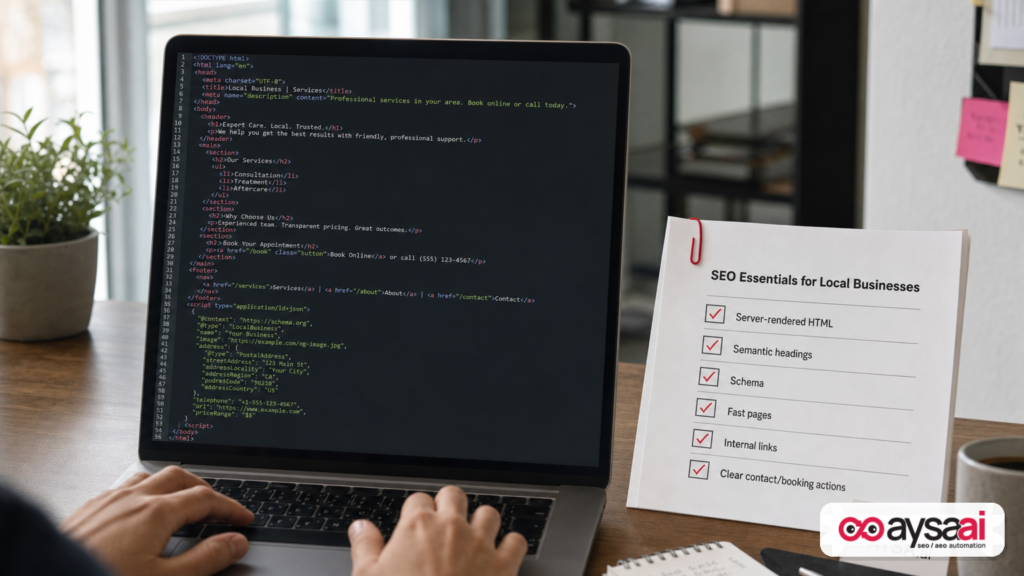
1) Server-rendered, crawlable HTML (don’t hide your business behind JavaScript)
If your core content only appears after heavy client-side JavaScript runs, you are creating risk. The SEJ source highlights a real-world pattern: many sites unintentionally deliver empty or partial HTML to crawlers and automated readers. Even if modern search bots can render JavaScript, you are betting your visibility on rendering time, resource constraints, and edge cases.
Practical SME translation:
- If your service descriptions, product details, location info, or FAQs aren’t in the initial HTML response, fix that.
- If your CMS outputs a blank shell and “hydrates” everything later, fix that.
For WordPress and many ecommerce stacks, this is solvable. The best sites treat HTML as the source of truth, and JS as enhancement.
2) Semantic structure (headings, lists, tables, and clear page purpose)
Agents don’t “admire” design. They extract meaning. Semantic structure is how you make meaning cheap to extract:
- Use one clear H1 per page, then H2/H3 sections that match user questions.
- Use bullet lists for steps and requirements.
- Use comparison tables when you’re comparing options.
- Use FAQ blocks where it’s legitimate—not as fluff.
This is not about gaming a system; it’s about removing ambiguity.
3) Structured data (schema) where it truly clarifies identity
Structured data doesn’t guarantee rankings, but it can reduce confusion about what something is: a local business, a product, an article, a medical organization, a review policy, a person, etc.
If you want the primary reference on what Google supports, Google maintains documentation in its Search Central ecosystem (not included in the supplied research context). I won’t link to a specific page without it present here—but the general principle stands: use schema to clarify identity and key attributes, not to spam.
4) Internal linking and information architecture
Agents need paths. So do crawlers. So do humans. The sites that win in AI answer environments tend to have:
- Clear hubs (category pages, service pages, location pages)
- Supportive detail pages that go deeper
- Strong cross-links between related topics
- “Next step” CTAs that are consistent (call, book, quote, demo)
If your site is a collection of disconnected pages, you’re asking both Google and agents to do extra work to understand you. They won’t.
5) Performance and reliability
Fast sites are easier to crawl, easier to render, and easier to use. Performance is also a proxy for operational excellence: companies that can keep sites fast can usually keep sites accurate. Agents will prefer reliable sources over flaky ones.
Content that wins: depth, experience, and non-commodity value
One of the most useful ideas surfaced in the SEJ source is the distinction between commodity content and non-commodity content.
- Commodity content restates what the model already “knows” (generic definitions, reworded summaries, obvious lists).
- Non-commodity content includes elements the model can’t safely invent—real experience, original data, specific comparisons, precise constraints, and verifiable claims.
When an SVP says “create great content” and “go beyond the surface level,” that’s the subtext: if AI can answer the basic version, you must publish what AI cannot confidently generate.
What “go deeper” looks like for SMEs
Here are content upgrades that real businesses can execute without becoming media companies:
- First-hand experience: “What we learned after installing 100+ mini-split systems in coastal climates” (local services) or “How our clinic handles same-day cancellations” (healthcare operations).
- Original comparisons: Not “best software” fluff—real tradeoffs, implementation time, who it’s for, who it’s not for.
- Operational specifics: Lead times, return policies, shipping cutoffs, service areas, appointment rules—details that reduce buyer uncertainty.
- Proof and constraints: Photos of real work, documented processes, credentials, safety measures—anything verifiable.
- Decision tools: Simple calculators, checklists, printable guides (even basic ones) that demonstrate expertise and help a user decide.
If you’re thinking, “That’s just good marketing,” you’re right. That’s the point: AI didn’t kill good marketing; it punishes lazy marketing.
From keywords to entities: being understandable to machines
Classic SEO taught businesses to think in keywords. Agentic search pushes you to think in entities and relationships:
- Who are you?
- What do you sell?
- Where do you operate?
- What makes you credible?
- What are you known for?
- How do people take action?
In practical terms, entity clarity comes from consistency:
- Consistent business name, address, phone (for local businesses).
- Clear “About” page with leadership, credentials, and real photos.
- Service pages that explicitly name what you do and for whom.
- Policies and documentation that reduce ambiguity (returns, shipping, warranties, privacy).
These are also brand-building elements. That’s why “SEO vs branding” is a false separation in 2026: agents cite what they can understand and trust, and trust is brand-shaped.
Agents don’t just read—agents act: designing “discoverable actions”
Here’s a shift many SMEs miss: if an agent is helping a user, it’s not only extracting facts. It’s also looking for actions—the next step that completes the user’s task.
Actions should be:
- Obvious: Book, buy, request a quote, call, email, check availability.
- Low-friction: Minimal fields, clear steps, transparent confirmation.
- Accessible: Works on mobile, works with assistive tech, loads fast.
- Consistent: Same CTA language across pages.
Examples
- Hotel: Availability, room types, policies, fees, cancellation terms, parking—structured and easy to extract. The booking action must be clean and reliable.
- Florist: Delivery areas, cutoff times, substitution policy, real product photos, and easy category navigation (sympathy, birthday, same-day).
- B2B SaaS: Transparent pricing assumptions, implementation timeline, security docs, and a demo request that doesn’t feel like a trap.
When agents become more common, “conversion rate optimization” stops being separate from “SEO.” Your pages have to satisfy both discovery and completion.
Measurement in the agent era: what to monitor (without guessing)
A lot of AI-search measurement content online is speculation dressed as certainty. Let’s be disciplined: if we can’t verify a claim, we treat it as analysis, not a promise.
What is reasonable to monitor right now?
1) Visibility diagnostics: are you machine-readable?
- Does your server return meaningful HTML content?
- Are key pages indexable?
- Are there broken internal links?
- Are important pages slow or unstable?
This is boring, and it’s where most businesses leak value.
2) SERP and brand demand signals
Even if click patterns change, brand demand still matters. If more users see AI answers, brand trust often becomes the deciding factor for who gets the eventual click or purchase.
3) Lead quality, not just volume
In some categories, fewer clicks can still produce better leads—because the summary step pre-qualifies. That’s not guaranteed, but it’s plausible. The only honest approach is to watch CRM outcomes, not just sessions.
At AYSA, we think measurement must connect to execution. Monitoring without shipping fixes is just analytics theater. That’s why our approach is built around monitoring plus approved changes—not just dashboards. Explore how we think about AI visibility here: AI Search Visibility.
What can go wrong: visibility gaps, attribution gaps, and brand risk
When search becomes more agentic, three risks increase.
1) Visibility gaps (your content isn’t extractable)
If your site relies on JS rendering, hides details in accordions that don’t render server-side, or buries key info behind interactions, an agent may miss it. A human might find it; an automated reader might not.
2) Attribution gaps (you can’t prove what influenced what)
If a user reads an AI summary and later searches your brand name directly, last-click attribution will lie. This isn’t new, but it gets worse as summaries become a bigger part of the journey.
3) Brand risk (summaries can be wrong or “too opinionated”)
The SEJ source highlights a critical nuance: Google leadership has acknowledged AI answers can be “more opinionated than they should be.” Whether you agree with that wording or not, it’s a signal: the product is evolving, and mistakes will happen.
Your defense is:
- Publish clear, verifiable statements.
- Keep pages updated.
- Make policies explicit.
- Build recognizable brand signals across the web.
A concrete SME scenario: a local clinic competing in AI answers
Let’s make this real with a scenario that mirrors what we see every week.
The business
A 3-location outpatient clinic offers physical therapy and sports injury rehab. They’re not trying to “rank for everything.” They want qualified new patients in a radius around each location.
The new AI search reality
A prospective patient searches:
- “Do I need a referral for physical therapy in [state]?”
- “Physical therapy for runner’s knee near me”
- “How long does rehab take after ankle sprain?”
AI answers can summarize general info, but the patient still needs a local provider and a booking action.
The clinic’s one-playbook approach
Technical foundation
- Each location has a server-rendered page with address, hours, phone, and services.
- Fast mobile performance.
- Clear internal links: conditions → treatments → locations → booking.
Non-commodity content
- Detailed guides written with clinician input: what to expect, timelines, warning signs, home exercises (with medical disclaimers).
- Real clinician bios and credentials.
- Clear policies: referral needs, insurance handling, first visit checklist.
Discoverable actions
- Appointment request is simple and consistent across pages.
- Phone number is clickable on mobile.
- FAQ answers include “what to do next” steps.
Monitoring and execution
- If a location’s hours change, it’s updated the same day.
- If a high-intent page slows down, it’s fixed immediately.
This clinic doesn’t need a separate “AEO department.” They need one system that keeps the website accurate, structured, and shippable.
What agencies need to rethink: org design, deliverables, and incentives
If you run an agency or rely on one, the agent era pressures your operating model.
1) The deliverable can’t be “recommendations”
AI search rewards execution. If an agency sends a 60-page audit and nothing ships for 90 days, it’s not strategy—it’s delay.
2) Technical + content + brand must collaborate
The SEJ source hints at a broader truth: optimization is not isolated. Content depth requires subject-matter input. Technical accessibility requires dev time. Brand trust requires consistency. The winning agencies become cross-functional coordinators, not siloed “SEO teams.”
3) Reporting must evolve beyond sessions
Sessions still matter, but they’re not the only truth. Agencies will need to connect search visibility to pipeline quality, branded demand, and conversion outcomes.
Where AYSA fits: monitoring, preparing changes, approval, and execution
At AYSA.ai, we built for the reality that most businesses don’t fail because they lack ideas. They fail because:
- They don’t notice problems early.
- They can’t prioritize what matters.
- They can’t execute changes safely.
- They can’t maintain improvements over time.
That’s why our model is not “here’s a dashboard, good luck.” It’s an execution system:
- Monitor: Track site health and visibility signals (learn more: AYSA Monitoring).
- Prepare: Identify and draft specific website changes (technical and content structure).
- Ask for approval: You keep control—nothing ships without acceptance (this is core to our approved execution approach).
- Execute accepted changes: Improvements actually go live.
This is how you operationalize one playbook. Strategy is easy. Sustained execution is rare.
If you’re evaluating tooling, start here:
- AI SEO toolset overview: AI SEO Tools
- AI search visibility approach: AI Search Visibility
- Pricing and fit: AYSA Pricing
- More editorials and playbooks: AYSA Blog
90-day action plan: unify your playbook
This is a practical plan for an SME marketing lead (or a founder wearing the hat) to move fast without chaos.
Days 1–15: Confirm machine readability and baseline health
- Pick your top 20 revenue-driving pages (services, categories, top products, top locations).
- Check that meaningful content appears in raw HTML (not only after JS).
- Fix indexability blockers (noindex mistakes, canonical confusion, broken internal links).
- Ensure contact/booking/buy actions are consistent and fast on mobile.
Days 16–45: Upgrade content to non-commodity depth
- For each major service/product category, publish one “deeper than the summary” guide.
- Add first-hand experience: photos, process details, real comparisons, clear constraints.
- Write FAQs based on actual customer questions (sales calls, support tickets).
Days 46–75: Build entity clarity and trust signals
- Improve About/Team pages with credentials, policies, and proof.
- Strengthen internal links so every guide points to a service/product page and a clear next step.
- Validate that each location (if applicable) has consistent details and a unique value proposition.
Days 76–90: Set up monitoring + an execution cadence
- Define weekly checks: uptime, speed regressions, broken pages, content freshness.
- Define monthly checks: top page performance and conversion friction.
- Create a simple approval workflow so changes ship without fear.
This is where “one playbook” becomes real. It’s not a strategy deck. It’s a routine.
What to do next
- Decide: Are you running one unified search playbook—or two competing ones?
- Audit quickly: Verify your key pages are readable in raw HTML and clearly structured.
- Pick one content theme: Create one deep guide that AI can’t easily synthesize from generic sources.
- Fix the action path: Make booking/buy/quote dead simple and consistent.
- Operationalize execution: Implement monitoring + approved changes so improvements ship weekly, not quarterly.
If you want AYSA to help you run that execution loop, start with our monitoring and AI visibility resources:
Sources and further reading
- Search Engine Journal — “Search And Agents Are One Product. You Only Need One Playbook”
- Search Engine Journal — SEO coverage hub
- Search Engine Journal — Technical SEO coverage (research lead)
- Search Engine Journal — On-page SEO coverage (research lead)
- Search Engine Journal — Local SEO coverage (research lead)
- Search Engine Journal — Google algorithm updates history (research lead)
Note: The SEJ source references statements made in interviews and events. This editorial does not add additional quotes beyond what is described in the supplied source context, and it avoids making unverifiable claims about specific Google documentation not provided here.
Continue the AI search topic inside AYSA.
Use these pages to connect the article with AI SEO tools, AI visibility monitoring, AI Overviews and approved website execution.
Turn this topic into a website action plan.
Use these AYSA hubs to move from reading to technical fixes, AI visibility monitoring, research, glossary context and approval-first SEO execution.

