
SEO Gets You Found. GEO Gets Your Brand Chosen.
A practical explanation of GEO for business owners: SEO helps people and search systems find you, while GEO helps AI systems understand, trust and recommend you.
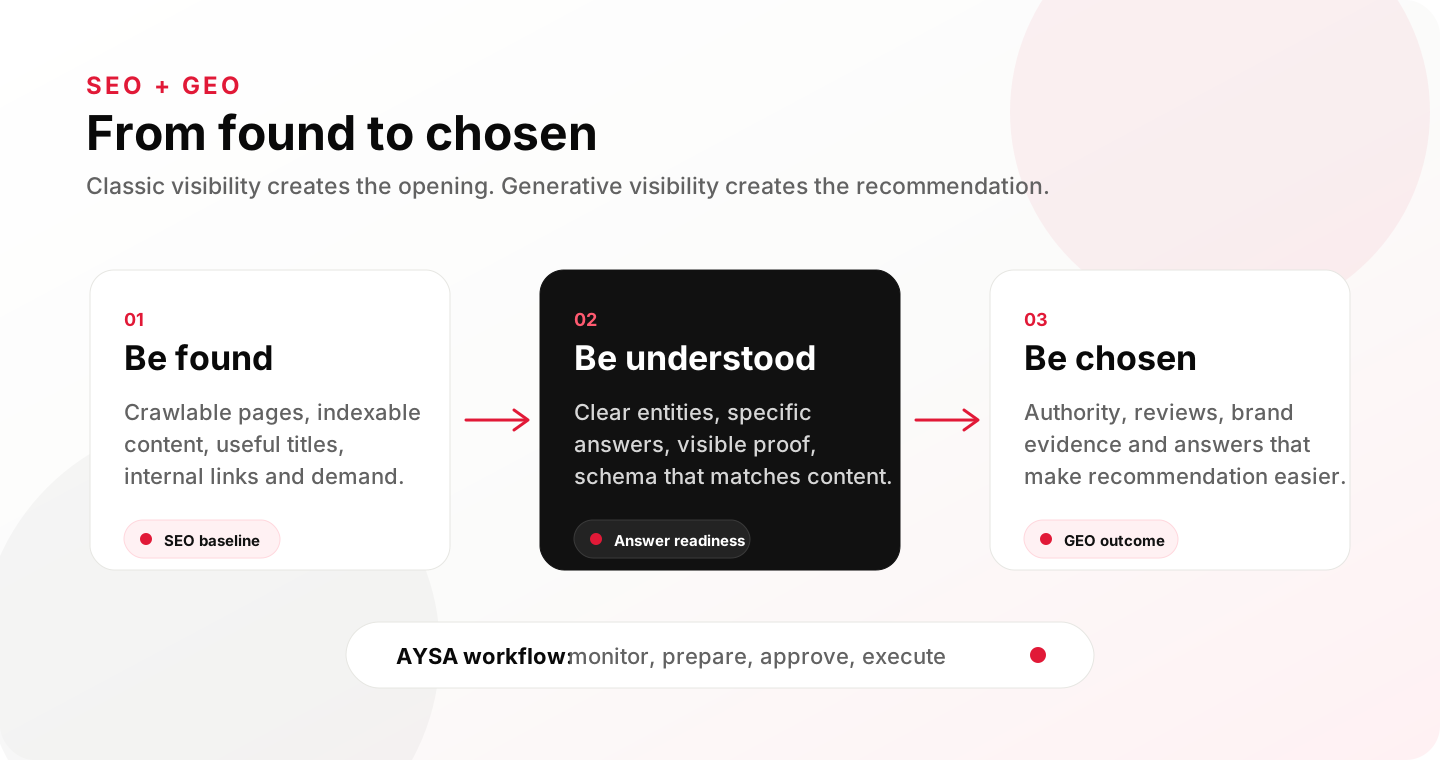
The simplest way to explain GEO is this: SEO helps your business get found. GEO helps your business get chosen. That distinction is more useful than another debate about acronyms. Business owners do not wake up wanting “Generative Engine Optimization.” They want their company to be visible when buyers search, trusted when buyers compare options, and recommended when AI systems summarize the market.
Andrew Holland recently framed GEO in a way that is easy to understand: the difference between being found and being chosen. That is the right direction. Classic SEO has always been about discoverability, Crawlability, relevance and authority. GEO adds a new layer: can an AI system understand who you are, what you do, where you are strong, why you deserve trust, and when you should be recommended?
Executive summary
- SEO is still the foundation. Search engines and AI systems still need crawlable, indexable, useful pages.
- GEO is not a replacement for SEO. It extends SEO toward answer engines, AI Overviews, AI Mode, ChatGPT-style search and synthesized recommendations.
- The business goal is not just citation. A citation is useful, but being recommended with the right context is more valuable.
- AI systems need evidence. Clear website content, Structured data, reviews, Brand Mentions, topical authority and trusted external references all help reduce ambiguity.
- The advantage is execution speed. Knowing what to improve is not enough. The work has to be prepared, approved and published consistently.
SEO vs GEO in plain language
SEO asks: can the website be found, crawled, indexed and ranked for relevant search demand?
GEO asks a broader question: when a generative system prepares an answer, comparison, recommendation or summary, is your business understandable enough, credible enough and specific enough to be included as a good option?
That does not mean businesses should abandon traditional SEO. In fact, weak SEO makes GEO harder. If your pages are unclear, thin, duplicated, technically blocked or disconnected from real search demand, an AI system has less reliable material to work with. GEO builds on SEO, but it changes the target from “rank me for this Keyword” to “make my business easy to select for this situation.”
Why “being found” is no longer the whole job
For many years, the SEO workflow was straightforward: pick keywords, improve pages, build authority, track rankings and improve click-through rates. That still matters. But search journeys are becoming less linear. A buyer may see a classic Google result, an AI Overview, a local pack, a Reddit discussion, a YouTube result, a ChatGPT answer, a comparison article and a brand mention before they ever visit your website.
Google’s own documentation for AI features says site owners should focus on helping Google understand content and should ensure that preview controls and structured data align with visible page content. That is an important clue. AI-assisted search is not only reading keywords; it is trying to synthesize meaning from content, structure, context and source quality.
In this environment, a business can be technically “visible” and still not be persuasive. The better question becomes: does the available evidence make your company a safe recommendation?
What AI systems need before they can recommend a business
AI systems do not “trust” a brand in the human sense. They work from signals, documents, citations, entities and patterns. That means your website and surrounding web presence need to reduce uncertainty.
For most businesses, that means improving five evidence layers:
- Entity clarity: who you are, what you sell, where you operate, who you serve and what makes you different.
- Topical authority: enough useful coverage around the problems, services, products and questions your market cares about.
- Answer readiness: direct, visible answers to real questions, not vague marketing copy.
- External validation: reviews, press, publisher mentions, citations, backlinks and references that support your claims.
- Technical accessibility: crawlable pages, clean internal links, indexable content, structured data and fast enough page experience.
This is why GEO should not be treated as “write a few AI-friendly paragraphs.” It is closer to brand evidence engineering. You are building a web presence that makes your business easier to understand and easier to recommend.
Where SEO still does the heavy lifting
There is a dangerous misconception that AI search makes classic SEO irrelevant. It does not. Google still documents the fundamentals of useful, accessible, search-friendly websites. Bing’s webmaster guidance also emphasizes quality, relevance, user value and avoiding manipulative tactics. OpenAI documents crawler behavior and bot access, which reminds us that AI search still depends on discoverable web content and permissions.
The practical conclusion is simple: technical SEO, content quality, internal links, structured data and authority still matter. GEO changes how those signals may be used, not whether the underlying work matters.
If a local clinic wants to be recommended for “best pediatric clinic near me,” it still needs clear service pages, location information, reviews, doctor or team credibility, appointment process details and trustworthy references. If an ecommerce store wants to be selected in AI-assisted product research, it still needs clean product data, category relevance, price and availability clarity, helpful buying guides and evidence that the store is legitimate.
The real difference: recommendation context
Traditional SEO often optimizes for a page-keyword relationship. GEO optimizes for a business-situation relationship.
For example, “accounting software” is a keyword. But an AI answer may need to recommend accounting software for:
- a Romanian SME with limited accounting knowledge;
- a Shopify store selling internationally;
- a freelancer who wants invoicing and tax reminders;
- a company that needs integrations with payroll and CRM;
- a non-specialist owner who wants less manual admin.
If your website only says “best accounting software,” it gives the system little context. If your website explains use cases, integrations, pricing logic, limitations, support model, compliance concerns and customer profiles, it gives the system more usable evidence.
How to build GEO without turning the website into spam
Good GEO is not about writing pages for bots. It is about making the business more legible. The best GEO work usually improves the website for humans too.
A practical GEO checklist looks like this:
- Create pages that explain who the product is for and who it is not for.
- Answer buying questions directly: pricing, process, setup, limitations, support, timeline and outcomes.
- Use consistent entity information across the website, profiles and publisher mentions.
- Add FAQ sections only where the questions are visible and useful.
- Use structured data that matches visible page content.
- Strengthen internal links between related topics, services and proof pages.
- Build authority through relevant publisher opportunities, not random link buying.
- Monitor how the brand appears across search, AI answers and answer-engine surfaces.
What most companies get wrong about GEO
The first mistake is thinking GEO is a content-only problem. Content matters, but evidence matters more. A recommendation engine needs reasons to choose you, not just more words about you.
The second mistake is chasing AI citations as a vanity metric. Being mentioned is useful, but the quality of the mention matters. Are you mentioned as a leader, an option, a warning, a source, a competitor, or just a passing reference?
The third mistake is doing GEO manually in disconnected tools. A business can spend weeks exporting keywords, reading dashboards, writing briefs, checking schema, updating pages, tracking mentions and asking developers for changes. That is not a sustainable workflow for SMEs.
Where AYSA fits: from GEO theory to approved execution
AYSA is built around a simple operational belief: SEO and GEO only create growth when the work becomes approved website action.
In the GEO context, AYSA can help identify:
- important pages that receive impressions but do not answer the query well;
- topics where the business lacks enough coverage to build topical authority;
- weak internal links between related pages and proof pages;
- service pages that lack clear pricing, location, process or eligibility information;
- FAQ opportunities for answer readiness;
- schema opportunities that match visible content;
- technical issues that reduce crawlability or indexability;
- authority-building opportunities that need review and approval;
- AI visibility gaps where the brand is not easy to identify, cite or recommend.
The important part is what happens next. AYSA does not only show the issue. It prepares the work, explains why it matters, asks for approval and can execute accepted changes inside the website workflow. That is the difference between a GEO report and a GEO operating system.
A simple example: local business
Imagine a dental clinic. Traditional SEO may target “dentist Bucharest,” “emergency dentist,” “dental implants” and location pages. GEO asks whether the clinic can be recommended in specific decision contexts:
- Which clinic is good for anxious patients?
- Which clinic has transparent pricing?
- Which clinic is suitable for children?
- Which clinic offers emergency appointments?
- Which clinic has strong reviews and credible doctors?
That requires more than keywords. It requires page clarity, service proof, review workflows, Google Business Profile consistency, local authority and content that answers real buyer concerns. AYSA’s role is to turn those gaps into approved work instead of leaving them as a strategy document.
A simple example: ecommerce
For ecommerce, GEO means product and category pages need to be useful in comparison scenarios. An AI system may answer questions like “best ergonomic chair for a small home office” or “what should I buy for sensitive skin under $50.” If your category pages only list products, they may be less useful than competitors that explain fit, materials, use cases, constraints, delivery, returns and product differences.
The execution work becomes practical: improve category intros, create buying guides, add FAQs, strengthen internal links, improve product data, clarify availability, add comparison content and monitor which topics start generating demand. Again, the winning layer is not only research. It is fast, controlled execution.
How to measure GEO sensibly
GEO measurement is still evolving, so businesses should avoid false precision. A useful measurement model combines several signals:
- classic organic clicks, impressions and average position;
- visibility in AI-assisted search surfaces where measurable;
- brand mentions and citation quality across answer engines;
- growth in non-branded and branded demand;
- topic coverage and internal link depth;
- execution velocity: how many recommended improvements are approved and published;
- business outcomes such as leads, sales, appointments or qualified inquiries.
The last point matters most. GEO is not a trophy for being cited. It is a business discipline for becoming a better, clearer and more trusted answer.
My point of view
GEO will be misunderstood for a while because the industry loves new acronyms. But the actual work is not mysterious. Businesses need to become easier to understand, easier to verify and easier to recommend.
That is good news for SMEs. You do not need to become an SEO engineer to compete. You need a system that continuously detects the gaps, prepares the work, explains the trade-offs and lets you approve what should be executed. That is exactly where SEO, AEO, GEO and AI visibility converge.
SEO gets you found. GEO helps you get chosen. The companies that win will be the ones that turn both into an operating system.
Sources and further reading
- Andrew Holland: How to explain GEO to anyone
- Google Search Central: AI features and your website
- Google Search Central: SEO Starter Guide
- Google Search Central: Introduction to structured data markup
- Bing Webmaster Guidelines
- OpenAI: crawlers and user agents
Continue the AI search topic inside AYSA.
Use these pages to connect the article with AI SEO tools, AI visibility monitoring, AI Overviews and approved website execution.
Turn this topic into a website action plan.
Use these AYSA hubs to move from reading to technical fixes, AI visibility monitoring, research, glossary context and approval-first SEO execution.

