SEO Is a Product. AEO Is Brand.
A practical AYSA perspective on why SEO needs product ownership, why AEO is built on brand clarity, and how SMEs can turn visibility work into approved execution.
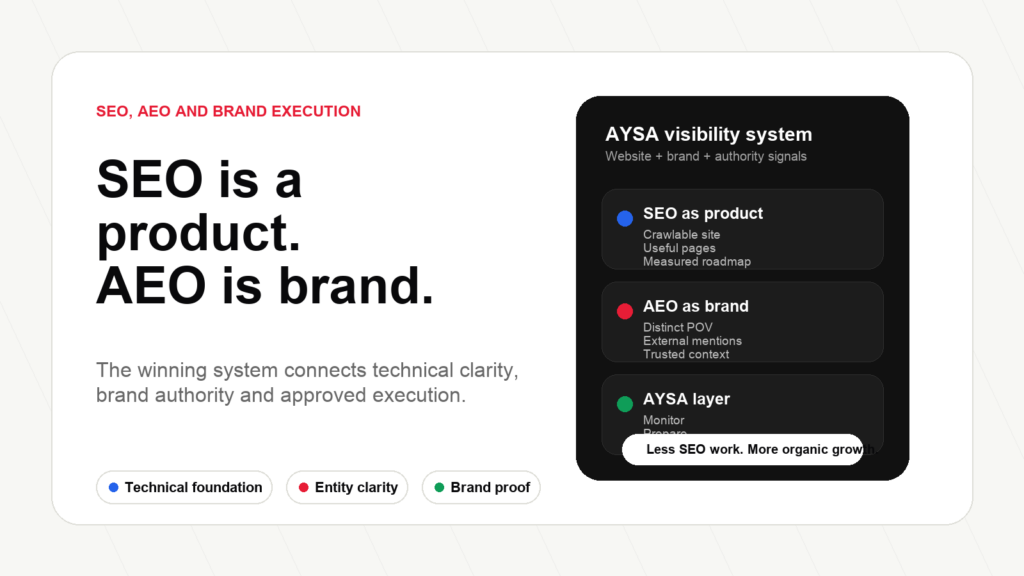
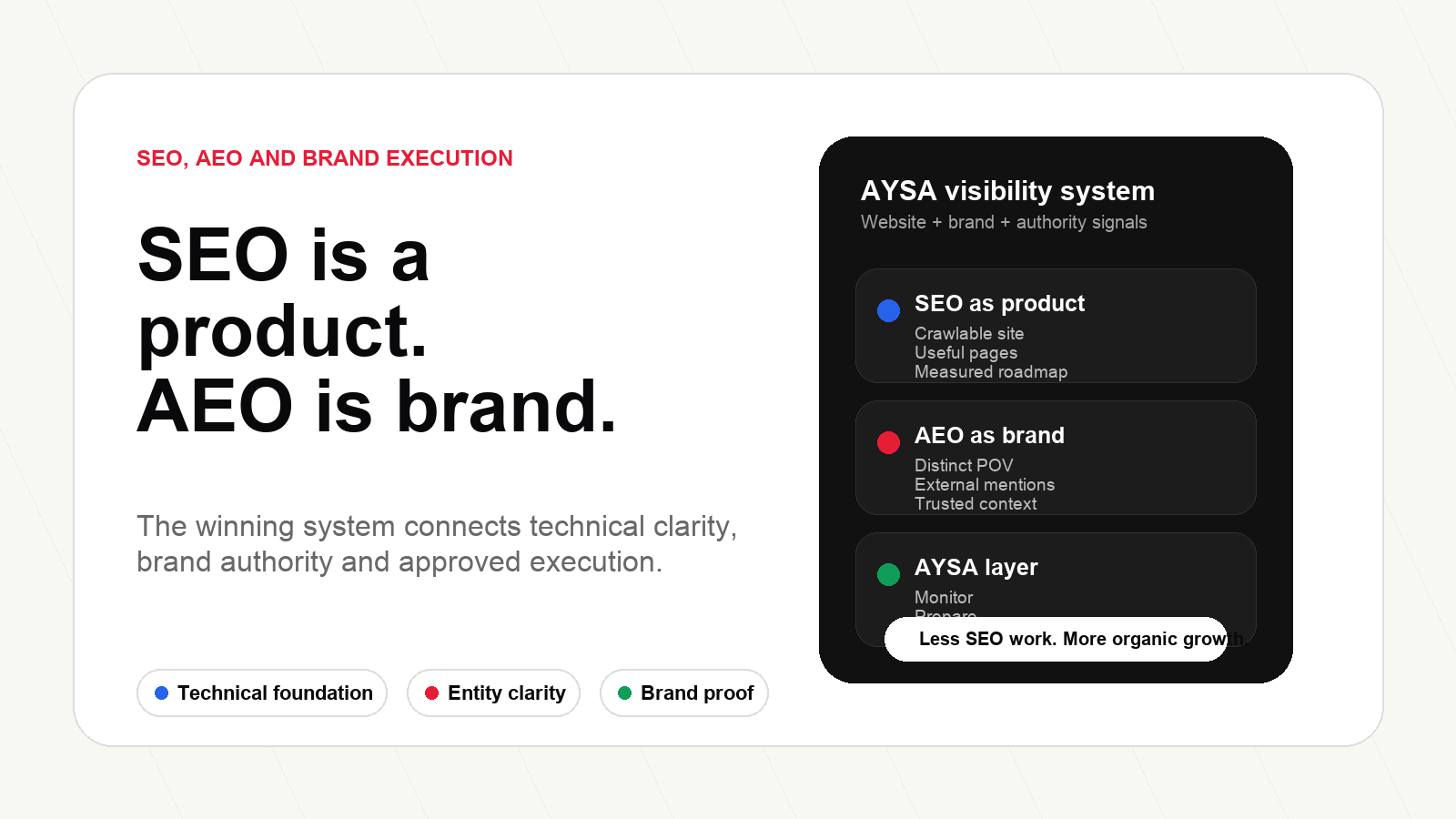
The ProductLedSEO article “SEO is a product, AEO is brand” captures one of the most important shifts happening in search. The old SEO model treated visibility as a set of tactics: publish pages, optimize titles, build links, fix technical issues, wait for rankings. The new model is more demanding. Visibility has to be built into how the business describes itself, how the website works, how pages are maintained, how authority is earned and how updates are approved.
My view is simple: SEO is becoming a product function because it needs shipping discipline. AEO is becoming a brand function because it needs trust discipline. And for small and mid-sized businesses, the hard part is not understanding the sentence. The hard part is doing the work every week without hiring a full SEO department.
The Core Idea: SEO Is Not Just Marketing Anymore
SEO still belongs to marketing in the sense that it creates demand, visibility and revenue. But the work itself now touches product, engineering, content, analytics, customer experience, PR, brand and operations. A Technical SEO fix may require template changes. A content improvement may require product knowledge. A Local SEO page may require accurate business details. An AEO improvement may require clearer entity information, stronger evidence and external proof.
This is why the phrase “SEO is a product” makes sense. A product is not only a page. It is a system that has users, requirements, bugs, releases, metrics and owners. Modern SEO needs the same discipline. You need a roadmap. You need prioritization. You need quality control. You need release notes. You need to know what changed, when it changed and whether the change helped.
Google’s own documentation points in this direction. The guidance on helpful, reliable, people-first content is not a recipe for Keyword Stuffing. It asks whether pages serve people, show expertise, provide value and avoid being created primarily for search engines. The documentation on AI features and your website also reinforces fundamentals: make content accessible, useful, crawlable, indexable and supported by strong page experience and Structured data where appropriate.
That means visibility is not a one-time campaign. It is a product-like system that must be maintained.
Why SEO Is a Product Discipline
SEO becomes product-like for five reasons.
1. SEO has users
The user is not “Google.” The user is the person trying to solve a problem. A parent searching for a pediatric clinic, a florist customer looking for same-day delivery, a business owner comparing SEO tools, or a warehouse manager searching for parking near an airport. A strong SEO page must serve that person better than the alternatives.
2. SEO has requirements
A good page needs a purpose, an audience, a search intent, proof, internal links, crawlability, indexability, page speed, clear headings, useful structure and a next step. These are product requirements. If the page fails them, the page is not ready.
3. SEO has bugs
Broken internal links, redirect chains, canonical mistakes, thin pages, duplicated titles, orphan pages, slow templates and incorrect structured data are bugs. They may not look like classic software bugs, but they reduce the product’s ability to be discovered, understood and trusted.
4. SEO has releases
When you update a title, consolidate two pages, add schema, improve internal links or publish a new guide, you are releasing a change. That change should have a reason, an owner and a way to measure impact. Without release discipline, SEO becomes memory work: “What did we change last month?” “Why did traffic move?” “Who approved that redirect?”
5. SEO has a roadmap
A real SEO roadmap is not a dump of crawler exports. It is a prioritized sequence of work. It should explain what gets fixed first, what gets monitored, what gets tested and what waits. This is exactly how product teams think.
- Write blog posts.
- Fix meta descriptions.
- Add schema.
- Build links.
- Define page purpose and audience.
- Ship approved changes with history.
- Measure queries, pages and conversions.
- Improve the roadmap based on evidence.
Why AEO Is a Brand Discipline
AEO, answer engine optimization, is not only about adding FAQs. It is about making the business easy to understand and easy to cite when a system tries to answer a user’s question. That requires brand clarity.
Classic SEO often begins with a keyword. AEO often begins with an entity: who is the business, what does it do, who is it for, where does it operate, what proof exists, what opinions or expertise does it have, and why should an answer engine trust it enough to include it in a synthesized answer?
This is why AEO is brand. A brand is not a logo. A brand is a pattern of meaning. It is what the market associates with you. If your website says one thing, your Google Business Profile says another, your reviews say something else and your content is generic, AI systems have less reliable context. If your website, author profiles, external mentions, reviews, case studies and content all reinforce the same expertise, the brand becomes easier to retrieve and summarize.
For AI search, this matters because users ask complex questions. They do not always search “technical SEO audit.” They ask: “Why did my WordPress traffic drop after a redesign?” or “What should a small ecommerce store fix first if it has slow pages and duplicated categories?” The answer may cite brands, websites, experts, documentation and examples. AEO is the discipline of making your brand a credible part of those answers.
What SMEs Usually Get Wrong
Small and mid-sized businesses often make two opposite mistakes.
The first mistake is treating SEO as something fully external. They hire an agency, receive recommendations and assume the work is handled. But many recommendations still need business knowledge, website access, approvals and technical implementation. If the work does not reach the website, nothing meaningful changes.
The second mistake is treating AI search as a magic content problem. They publish more AI-assisted articles, add generic FAQs or chase phrases like “optimize for ChatGPT” without improving the underlying business clarity. That can create more pages without stronger authority.
For SMEs, the real opportunity is practical. They do not need to become SEO specialists. They need a system that keeps asking:
- Is the website technically understandable?
- Are the important pages clear and useful?
- Does the business show enough proof?
- Are customer questions answered directly?
- Do internal links connect related topics?
- Are reviews, examples and trust signals visible?
- Are authority-building opportunities controlled and approved?
- Is every change tracked?
That is not a one-off SEO campaign. It is an operating model.
The Visibility Operating System: Website, Brand, Authority and Execution
If SEO is product and AEO is brand, the business needs a visibility operating system. I would define that system through four layers.
Layer 1: Technical foundation
The website must be crawlable, indexable, fast enough, structured clearly and free from obvious technical waste. This includes canonical control, sitemap hygiene, redirect management, Core Web Vitals, internal linking and structured data that matches visible content. Google’s structured data policies are important here because markup should support real visible content, not invent facts for machines.
Layer 2: Content usefulness
Pages should answer real questions in the right depth for the user’s stage. A page about a service should explain what it is, who needs it, how it works, what it costs or how pricing is decided, what proof exists and what the user should do next. A glossary page should define the term, explain why it matters, show examples and link to related concepts.
Layer 3: Brand and entity clarity
The business should be easy to identify. Names, people, services, locations, products, categories, values, proof points and external references should be consistent. This is where brand becomes technical enough to matter for retrieval.
Layer 4: Authority and distribution
Authority is not only backlinks. It includes relevant mentions, citations, reviews, expert commentary, publisher coverage, partnerships and proof that other parts of the web recognize the brand. For AYSA, this is why the Adverlink integration matters: authority-building opportunities can be surfaced, reviewed and approved in a controlled workflow rather than handled through messy outreach and spreadsheets.
Layer 5: Approved execution
This is the layer that most websites miss. Someone has to do the work. Someone has to prepare the title changes, content improvements, internal links, redirects, schema updates, content briefs, authority opportunities and monitoring tasks. Someone has to ask for approval and then execute what was approved. Without this layer, SEO and AEO remain advice.
How to Measure SEO Product and AEO Brand Work
Measurement should match the type of work.
For SEO product work, measure the website system: indexation, crawlability, page speed, internal links, impressions, clicks, CTR, average position, conversions and affected pages. Google Search Console’s Performance report is useful for understanding queries and pages, while analytics tools can help connect organic traffic to business outcomes.
For AEO brand work, measure more than rankings. Track branded search demand, brand mentions, citations, answer engine visibility, external references, review quality, entity consistency, AI answer inclusion where observable and the quality of pages that explain the business. Some of these metrics are still immature, but the direction is clear: if AI systems are going to summarize the web, brands must become easier to summarize correctly.
One warning: do not confuse measurement with certainty. Search systems are noisy. AI answers vary. Rankings fluctuate. The goal is not to pretend every change has a perfect causal line. The goal is to create enough action history and enough signal to make better decisions over time.
Where AYSA Fits
AYSA is built for this exact transition. It does not treat SEO as a static report. It treats SEO, AEO, GEO and AI visibility as an execution workflow.
The agent learns the business, connects website and Google data, monitors opportunities, prepares actions, explains why they matter, asks for approval and executes accepted changes inside the website workflow. That matters because the future of visibility will not be won by the company with the longest SEO checklist. It will be won by the company that can learn, approve and ship useful improvements faster than the market changes.
For SMEs, this is the practical bridge between SEO as product and AEO as brand. You get the product discipline without hiring a product team for SEO. You get brand visibility work without turning the owner into a full-time search specialist. You get action history, approval safety and execution.
That is the core belief behind AYSA: less SEO work, more organic growth. Not less thinking. Less manual chaos.
If your website is visible but your brand is not easy to understand, AYSA can help.
AYSA monitors SEO, AEO and AI visibility signals, prepares the work, asks for approval and executes accepted website changes without turning you into an SEO specialist.
Sources and Further Reading
Continue the AI search topic inside AYSA.
Use these pages to connect the article with AI SEO tools, AI visibility monitoring, AI Overviews and approved website execution.
Turn this topic into a website action plan.
Use these AYSA hubs to move from reading to technical fixes, AI visibility monitoring, research, glossary context and approval-first SEO execution.