Shopify Campaign Autopilot and the Rise of Autonomous Marketing: What It Changes for SMEs, Agencies, and Search
Shopify’s new Campaign Autopilot points to a bigger shift: marketing is becoming autonomous, cross-channel, and increasingly “invisible” to the operator. Here’s what changed, why it matters, where it can go wrong, and what to do next—especially if you care about profitable acquisition, accurate measurement, and AI-era search visibility.

Shopify’s new Campaign Autopilot is a signal, not just a feature. The signal is that ecommerce marketing is moving from “you run campaigns” to “you set intent and constraints, the system runs campaigns.” That shift changes how small businesses buy growth, how agencies prove value, and how websites must be maintained to convert traffic from anywhere—paid, email, marketplaces, and increasingly AI-driven discovery.
This editorial breaks down what Shopify launched, why it matters beyond Shopify, and what businesses should do next to avoid the classic autopilot failure mode: spending more while learning less.
Concise summary
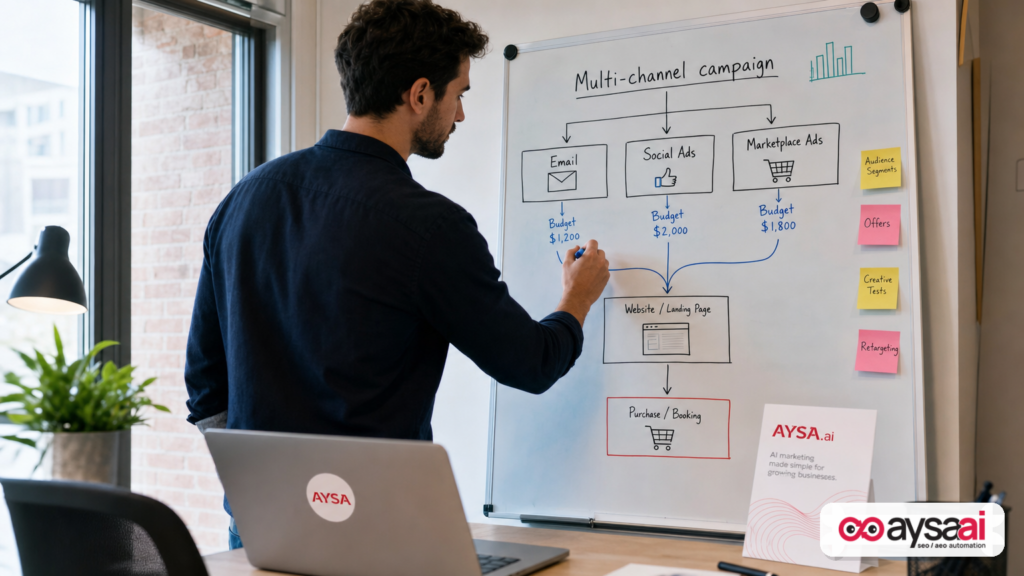
- What changed: Shopify introduced Campaign Autopilot (early access), an AI-driven system inside Shopify Admin that can create, manage, and optimize campaigns across channels from one place.
- Why it matters: Cross-channel automation lowers the skill barrier, but it also concentrates risk. If measurement is wrong or the site is weak, automation scales inefficiency fast.
- What could go wrong: “Optimizing” toward easy-to-claim conversions, over-investing in discount-driven sales, audience overlap, creative fatigue, and weak landing experiences.
- What to do next: Define guardrails, audit tracking and conversion quality, prepare your site for higher traffic, and build a feedback loop that connects ads → landing pages → product data → retention.
- Where AYSA fits: AYSA is an approved-execution SEO/AEO/GEO system that monitors performance and prepares website changes for your approval—so when paid automation turns up the volume, your owned web experience keeps up.
Table of contents

- What Shopify Just Launched (and What’s Actually New Here)
- Why This Is Happening Now (and Why It’s Bigger Than Shopify)
- The Autonomous Marketing Stack: What Gets Automated vs. What Still Breaks
- The Strategic Trade-Off: Convenience vs. Control
- Measurement Is the Make-or-Break Layer (Attribution vs. Incrementality)
- How Autonomous Marketing Connects to AI Search and “Zero-Click” Discovery
- Your Website Becomes the Constraint: CRO, Merchandising, and Technical Readiness
- A Concrete SME Scenario: The $80k/Month Shopify Brand That ‘Automated Everything’
- What Agencies Should Rethink (Before Autopilot Eats Retainers)
- What to Monitor Weekly: A Practical Control Panel for Owners
- Where AYSA.ai Fits: Approved Execution for the AI + Paid Era
- What to Do Next (Action List)
- Sources and further reading
What Shopify Just Launched (and What’s Actually New Here)

According to Search Engine Land, Shopify is rolling out Campaign Autopilot in early access as an AI-powered marketing tool inside the Shopify admin. The promise is straightforward: merchants set a monthly budget, connect channels, establish approval rules/guardrails, and the system will create campaigns, allocate budget across channels, adjust spend based on performance, recommend email automations, and keep optimizing.
A few details in the report matter more than the headline:
- It’s multi-channel by design: The tool is positioned to operate across channels like Meta, Shop Campaigns, and email, with more channels on the roadmap (including ChatGPT Ads, Microsoft Advertising, and Snapchat, per the report).
- It’s inside the commerce platform: This is not “just another ad tool.” It’s embedded where product data, inventory signals, merchandising, discounts, and customer lists already live.
- It’s separate from existing campaigns: If you’re already running ads, Shopify says those won’t be altered by Autopilot (as reported). That’s important for adoption: it reduces the fear of a system rewriting your current setup.
- It claims to learn from patterns across many stores: Shopify positions this as leveraging performance data across millions of Shopify stores. Treat this as a product positioning claim rather than a guarantee; the takeaway is that Shopify is leaning into “network-level learning.”
- Sidekick is part of the workflow: Shopify’s AI assistant can be used to review recommendations and trigger actions, per the report. That’s a hint of the future interface: conversation + approvals instead of dashboards + spreadsheets.
What’s actually new isn’t “automation”—we’ve had automated bidding, rules, and performance-based optimization for years. The new part is the consolidation of planning, execution, and optimization into a single merchant workflow, increasingly abstracted away from channel-native complexity.
Why This Is Happening Now (and Why It’s Bigger Than Shopify)
Campaign Autopilot is Shopify’s version of a broader shift: marketing platforms are racing to become autonomous operators, not just tools. A decade ago, most “automation” was scheduled email and basic bid rules. Then came algorithmic bidding and dynamic creative. Now the trajectory is:
- You provide intent (budget, goals, constraints, brand rules)
- The system translates that intent into actions (campaign creation, targeting, creative assembly, budget allocation)
- The system optimizes continuously based on platform feedback loops
In the same Search Engine Land ecosystem, you can see adjacent signals: changes in ad platforms, AI-driven campaign tools, and measurement debates. For example, Search Engine Land has also covered features like bulk tools and conversion bidding in “ChatGPT Ads” (source) and ongoing discussions about Attribution versus incrementality (source). You don’t need every detail of those stories to understand the direction: platforms are standardizing around automation + optimization + simplified operator controls.
The business reason is simple: the long tail of merchants can’t hire specialists for each channel, and even bigger teams can’t scale manual experimentation across creative, audiences, and landing pages. Platforms that make “good enough” marketing easy will capture more spend.
The strategic reason is more subtle: once campaign operations are abstracted, the real competitive advantage moves “upstream” and “downstream”:
- Upstream: positioning, offer design, product differentiation, content and creator assets, customer insights.
- Downstream: on-site conversion, checkout friction, retention, email/SMS, customer experience, and—now—AI Search visibility.
The Autonomous Marketing Stack: What Gets Automated vs. What Still Breaks
Autopilot-style marketing works best when you understand what’s actually being automated—and what still requires human governance.
What systems like Campaign Autopilot can do well
- Cross-channel budget allocation: shifting spend to wherever the system believes marginal performance is best.
- Campaign assembly: creating campaign structures that map to objectives without you touching every setting.
- Optimization loops: adjusting bids/budgets and prioritizing audiences and placements based on observed outcomes.
- Always-on operations: never getting tired, never forgetting to check pacing, never missing an opportunity to test.
What still breaks (often invisibly)
- Wrong objective selection: If you optimize to a cheap “conversion” that doesn’t map to profit, the system will happily deliver more of it.
- Offer and margin mismatch: Automation can scale discounting because it lifts short-term Conversion rate—while damaging long-term margin and brand equity.
- Creative fatigue: Systems can rotate creative, but they can’t invent a genuinely differentiated angle without input. “New creative” is not the same as “better creative.”
- Audience overlap and channel cannibalization: Multi-channel tools may increase “total conversions credited” while adding limited net-new demand.
- Landing page debt: If the site is slow, confusing, or weak at answering questions, more traffic just means more expensive disappointment.
- Measurement blind spots: Attribution can over-credit last-touch or easy-to-measure channels. Incrementality is harder—but essential.
The pattern I’ve seen repeatedly in ecommerce: automation amplifies whatever your system is already optimized for. If you’re optimized for cheap Clicks, you’ll get cheap clicks. If you’re optimized for short-term conversions, you’ll get short-term conversions. If you’re optimized for customer lifetime value and retention, you have a shot at building a real growth engine—but only if your measurement and site experience support it.
The Strategic Trade-Off: Convenience vs. Control
Every “autopilot” product sells time savings. That’s real. But the business trade-off is control—especially over:
- Where budget goes (and why)
- What creative claims are being made (and whether they’re on-brand and compliant)
- What the system learns (and whether it’s learning the truth or a measurement artifact)
Shopify’s approach—per the report—is to let merchants define approval rules and guardrails, and to allow merchants to pause or modify at any time. That’s the right framing. The execution detail that matters is the guardrails you set.
Guardrails SMEs should consider before turning on autopilot
Even if your team is tiny, you can implement basic governance. Here are practical guardrails that protect you from “fast failure at scale”:
- Objective guardrail: Don’t optimize for the easiest event. Choose events that correlate with profit (e.g., purchase, qualified lead, subscription) and monitor quality.
- Budget pacing guardrail: Define daily/weekly pacing expectations so you don’t spend the whole month in five days because the system “found opportunity.”
- Product exclusions: Exclude low-margin SKUs or items with supply constraints from being aggressively promoted.
- Discount governance: If promotions are involved, limit discount depth and frequency.
- Geo and customer guardrails: If you only ship to certain states/countries, or if returns are high in certain regions, constrain accordingly.
- Brand safety and claim controls: Make sure ad copy and creative variations don’t drift into misleading language.
- Learning period rules: Decide in advance what “success” looks like after 14/30/60 days and what triggers a pause.
Automation doesn’t remove responsibility; it changes what you’re responsible for. You become less of an operator and more of a systems designer.
Measurement Is the Make-or-Break Layer (Attribution vs. Incrementality)
If you take one idea from this article, take this: autonomous marketing without measurement discipline is just automated spending.
Search Engine Land’s broader coverage includes the ongoing tension between attribution and incrementality (Attribution vs. incrementality: Why you need both). That framing is useful here because autopilot tools optimize using observable signals—signals that are often “attribution-shaped.”
Attribution answers: “Who gets credit?”
Attribution is the accounting system: which channel, campaign, or click gets credit for the conversion. It’s necessary for operations, budgeting conversations, and directional optimization.
Incrementality answers: “Did this create net-new business?”
Incrementality is the scientific question: if you hadn’t spent this money, would the conversion have happened anyway? Incrementality is harder because it requires either controlled tests, holdouts, or a strong counterfactual model.
Why autonomous optimization tends to overfit attribution
- Platforms see what they can measure. If a channel has clearer Conversion tracking, it may look “better,” even if it’s capturing demand you already created elsewhere.
- Retargeting can look incredible. It often captures people already on the path to purchase.
- Brand search can look like a hero. It frequently harvests intent created by other channels, PR, creators, or word of mouth.
What should SMEs do if they can’t run sophisticated tests? Start with lightweight discipline:
- Track contribution margin, not just ROAS: Promotions and shipping/returns change the math.
- Monitor new vs. returning customers: If “growth” is mostly existing customers buying again, you’re reallocating, not expanding.
- Use simple geo or time-based holdouts where possible: Even a small, imperfect holdout beats blind faith.
- Watch blended CAC and blended MER: Platform ROAS is not the business.
And be honest about a painful truth: the better automation gets, the more important it is to measure what the platform doesn’t naturally optimize for—like long-term profitability and brand durability.
How Autonomous Marketing Connects to AI Search and “Zero-Click” Discovery
At first glance, Campaign Autopilot is a paid marketing story. But it’s also a search story, because the modern customer journey is fragmented:
- Someone discovers you in social or a creator’s recommendation.
- They ask an AI assistant which brand to trust.
- They Google your brand (or your category) to validate.
- They land on your site—then bounce if it doesn’t answer questions fast.
Search Engine Land has been covering how creator content fits into AI-era visibility (Why creator content belongs in your AI search strategy) and how brands should think about their presence in AI systems (How to audit your AI entity footprint). You don’t need to become an AI researcher to act on the business implication:
When discovery moves into AI answers and summaries, your website must be structured, clear, and trustworthy—because your site becomes both a conversion engine and a source of truth.
Autonomous paid systems will send you traffic. AI search systems may or may not send you traffic—but they will influence who is considered, trusted, and clicked. Either way, your owned web presence needs to perform.
This is one reason we built AYSA to focus on monitoring and execution, not just reporting. You can’t “dashboard” your way out of a broken site experience.
Your Website Becomes the Constraint: CRO, Merchandising, and Technical Readiness
Here’s the uncomfortable dynamic I see with SMEs: when paid becomes easier to run, brands buy more traffic before they earn the right to convert it.
Before you scale budget—autonomously or manually—pressure-test these areas:
1) Landing page clarity (for humans and AI)
- Do you answer the top five buyer questions within 10 seconds?
- Is the offer clear without scrolling?
- Is the difference between products obvious?
2) Merchandising fundamentals
- Do product pages have strong titles, descriptions, sizing/fit info, shipping/returns clarity?
- Do category pages help people decide, or just list items?
- Do you have comparison content for “A vs B” decisions?
3) Technical performance
- Is the site fast enough on mobile?
- Is tracking implemented cleanly across checkout?
- Are there indexation or duplication issues that confuse search engines?
4) Trust and proof
Trust isn’t only about reviews; it’s about transparency. Search Engine Land has covered Google guidance on not using fake or undisclosed incentivized reviews in review snippet structured data (source). The broader principle applies even outside structured data: don’t build growth on shaky credibility. Autonomous systems can scale exposure, but they can’t repair trust once it’s damaged.
5) Retention readiness
Autopilot can bring first purchases. Profit often comes from the second and third. Make sure your email and post-purchase flows are strong before you pour fuel on acquisition.
If you’re reading this thinking “that’s a lot,” you’re right. This is why execution systems matter. Monitoring is easy; fixing is hard.
AYSA is designed to help here: we monitor, prepare specific website improvements, ask for approval, and then execute accepted changes. See how we approach ongoing monitoring at AYSA Monitoring and our AI SEO toolset at AI SEO Tools.
A Concrete SME Scenario: The $80k/Month Shopify Brand That ‘Automated Everything’
Let’s make this real with a scenario I see often. (This is a composite example, not a claim about a specific Shopify merchant.)
The setup
- A Shopify-based ecommerce brand doing ~$80k/month.
- Two-person team: founder + part-time marketer.
- They sell a product that’s easy to advertise visually, with a few hero SKUs and a long tail of variants.
They turn on autopilot
They set a monthly budget, connect channels, and let the system build and optimize campaigns. For two weeks, results look promising: more conversions, more traffic, and a sense of relief.
What breaks in month 2 (the typical autopilot trap)
- Blended profit falls. ROAS looks fine in-platform, but returns and discounting increase. Margin shrinks.
- New customer rate drops. Retargeting and brand capture expand because those conversions are easiest to measure and claim.
- Inventory stress appears. The system leans into one hero SKU, causing stockouts and shipping delays, which then drives negative reviews and refund requests.
- On-site confusion persists. Traffic increases, but the product detail pages still don’t answer basic objections (fit, compatibility, shipping timelines). Bounce rate rises.
The fix isn’t “turn off automation”—it’s redesign the system
- Reset objectives: optimize for what correlates with quality (e.g., purchase with minimum order value, or purchase excluding deep-discount SKUs).
- Implement product-level controls: exclude low-margin items and throttle spend when inventory is low.
- Upgrade landing experiences: rebuild category navigation, add comparison content, improve FAQs, strengthen trust elements.
- Establish measurement discipline: track blended CAC/MER and use lightweight holdouts to understand incrementality.
This is exactly where “approved execution” becomes a competitive advantage. It’s not enough to know what to fix—you need a system that reliably fixes it without a six-month backlog.
If you want to build visibility in AI-era discovery as well, start at AI Search Visibility.
What Agencies Should Rethink (Before Autopilot Eats Retainers)
Agencies aren’t going away—but the easy part of the job is. If an embedded tool can create and optimize baseline campaigns, the agency value proposition must move to higher ground.
What changes for agencies
- Campaign operations become commoditized. The platform can build structures and optimize faster than a human.
- Strategy and creative become the differentiators. Messaging, angles, creator partnerships, and offer strategy matter more.
- Measurement becomes the battleground. Clients will ask: “Is this incremental, or just re-labeled demand?”
- Landing pages and on-site conversion become paid performance work. You can’t separate ads from the site anymore.
The agency opportunity: become the system designer
The best agencies will:
- Design guardrails and governance for autonomous tools.
- Build creative testing pipelines and angle libraries.
- Run incrementality experiments and build client trust through honest measurement.
- Own the conversion journey: page speed, product detail page strategy, SEO/AEO, and retention flows.
In other words: agencies that remain “button pushers” will get squeezed. Agencies that become “growth system architects” will be more valuable than ever.
AYSA can support agencies here as an execution layer that turns audits into approved changes. If you’re curious how we think about operationalizing SEO in 2026, explore AYSA Blog and the tool stack at AI SEO Tools.
What to Monitor Weekly: A Practical Control Panel for Owners
Autonomous marketing still needs a human weekly review. The goal is not to micromanage—it’s to catch failure modes early.
Ask these weekly questions
- Are we acquiring new customers, or recycling existing demand? Look at new vs returning customer mix.
- Are we profitable after returns, shipping, and discounts? Don’t let platform ROAS be your north star.
- Which products are driving spend? Ensure spend aligns with margin and inventory.
- Is creative performance decaying? Watch frequency, CTR trends, and conversion rate trends.
- Are we seeing channel cannibalization? If multiple channels all claim the same conversions, be skeptical.
- Is the site converting better as traffic increases? If conversion rate drops as traffic rises, your targeting or landing experience is off.
- Did anything on the site change? Theme edits, app installs, and tracking changes can break measurement and UX.
A simple SME dashboard (no fancy tooling required)
- Blended CAC / MER
- New customer %
- Contribution margin trend
- Top SKU spend share
- Refund/return rate trend
- Site conversion rate (overall and by landing page type)
If you don’t have confidence in your site and measurement, automation will feel chaotic. If you do, automation becomes leverage.
Where AYSA.ai Fits: Approved Execution for the AI + Paid Era
Shopify’s Campaign Autopilot is about automating paid execution. AYSA is about automating owned execution—the website and content layer that determines whether paid traffic turns into durable growth and whether your brand is eligible to be recommended in AI-driven discovery.
Here’s the operational gap most SMEs face:
- Paid tools can generate traffic quickly.
- But the website improvements required to convert that traffic (and to strengthen search/AI visibility) are slow, scattered, and stuck in backlogs.
AYSA solves that by acting as an execution system:
- Monitor: Track site health, visibility, and change-impact signals over time. (Monitoring)
- Prepare: Generate specific, prioritized fixes and improvements (technical, content, structured data, internal linking, on-page clarity).
- Ask for approval: You stay in control. Nothing ships without your sign-off.
- Execute accepted changes: Reduce the gap between insight and implementation.
Where AYSA helps most when you adopt paid automation
- Landing page readiness: Improve category and product pages so they answer buyer questions and reduce bounce.
- Technical SEO and performance hygiene: Keep the site fast and crawlable as you add apps and tracking.
- Content that supports conversion: Build FAQs, comparisons, and use-case pages that reduce pre-purchase anxiety.
- AI search visibility: Monitor whether AI systems recommend your brand and what entity signals you’re missing. (AI Search Visibility)
If you’re evaluating automation across your stack, the question isn’t “should we automate?” It’s “what layer should be automated, with what controls, and how do we keep learning?” For pricing and fit, see AYSA Pricing.
What to Do Next (Action List)
If you’re a Shopify merchant (or any ecommerce operator) considering autopilot marketing, follow this sequence. It’s designed for SMEs without a huge team.
1) Define your constraints before your goals
- Set a maximum acceptable CAC or a minimum contribution margin target.
- List products you don’t want aggressively promoted (low margin, high returns, low stock).
- Decide what approvals are required (new creatives, new offers, budget increases).
2) Audit tracking and conversion quality
- Confirm the conversion events you optimize toward reflect real purchases/leads.
- Watch for double-counting and post-purchase event inflation.
- Separate new vs returning performance wherever possible.
3) Fix the top 5 landing pages before scaling spend
- Identify the pages that will receive the most traffic (home, top category pages, top SKU pages).
- Improve clarity: what it is, who it’s for, why it’s different, and what happens next.
- Strengthen trust: shipping, returns, support, proof, and transparent policies.
4) Establish a weekly measurement ritual
- Blended metrics (MER/CAC) + new customer rate + margin trend.
- One insight, one action each week.
- If possible, run a simple holdout test quarterly to sanity-check incrementality.
5) Build an execution loop for your website
- Use a system that turns findings into changes without endless tickets.
- Keep approvals tight so you don’t introduce brand and compliance risk.
That’s the gap AYSA is built to fill: monitoring + prepared improvements + approved execution. Start with AI SEO Tools and AYSA Monitoring.
Sources and further reading
- Search Engine Land: Shopify launches AI-powered marketing automation tool
- Search Engine Land: Attribution vs. incrementality: Why you need both
- Search Engine Land: ChatGPT Ads adds conversion bidding, geo exclusions and bulk campaign tools
- Search Engine Land: Why creator content belongs in your AI search strategy
- Search Engine Land: How to audit your AI entity footprint
- Search Engine Land: Google says don’t include fake or undisclosed incentivized reviews in review snippet structured data
AYSA internal reading:
Continue the AI search topic inside AYSA.
Use these pages to connect the article with AI SEO tools, AI visibility monitoring, AI Overviews and approved website execution.
Turn this topic into a website action plan.
Use these AYSA hubs to move from reading to technical fixes, AI visibility monitoring, research, glossary context and approval-first SEO execution.