
AI-Flagged Pages Still Rank in Google: What the Data Really Says (and What SMEs Should Do Next)
New Ahrefs data (covered by Search Engine Journal) suggests pages that “read as AI-written” tend to rank slightly lower and appear in Google’s index less often—yet heavily AI-flagged pages still show up across the top 10. Here’s the practical, business-first takeaway: detectors aren’t the strategy. Execution quality, indexing discipline, and measurable outcomes are.

By Marius Dosinescu (AYSA.ai)
AI detectors are having a moment in SEO—again. And the conversation keeps swinging between extremes: “Google can’t detect AI” vs. “Google will wipe you out if you use AI.” Reality is more boring and more useful.
New data reported by Search Engine Journal, based on an Ahrefs analysis using their own AI detector, suggests two things at the same time:
- Pages that score as more “AI-written” tend to rank slightly lower in Google’s top 10.
- Heavily AI-flagged pages still rank at every position in the top 10—including the top 3.
That combination is the story. If you’re an SME owner, a marketing lead, or an agency trying to scale content profitably, the takeaway isn’t “stop using AI.” It’s: stop using detector scores as a proxy for quality, and start managing the operational risks that correlate with bad AI publishing—index bloat, sameness, factual slop, weak Internal linking, and pages that don’t earn trust or conversions.
In this editorial, I’m going to do four things:
- Translate the data into plain-English business implications.
- Explain what may have changed since prior studies without inventing algorithm rumors.
- Lay out a practical playbook for using AI without producing “AI-shaped content.”
- Show where AYSA fits as an execution system: we monitor, propose changes, get approval, and execute accepted updates—so you can scale safely.
Concise summary
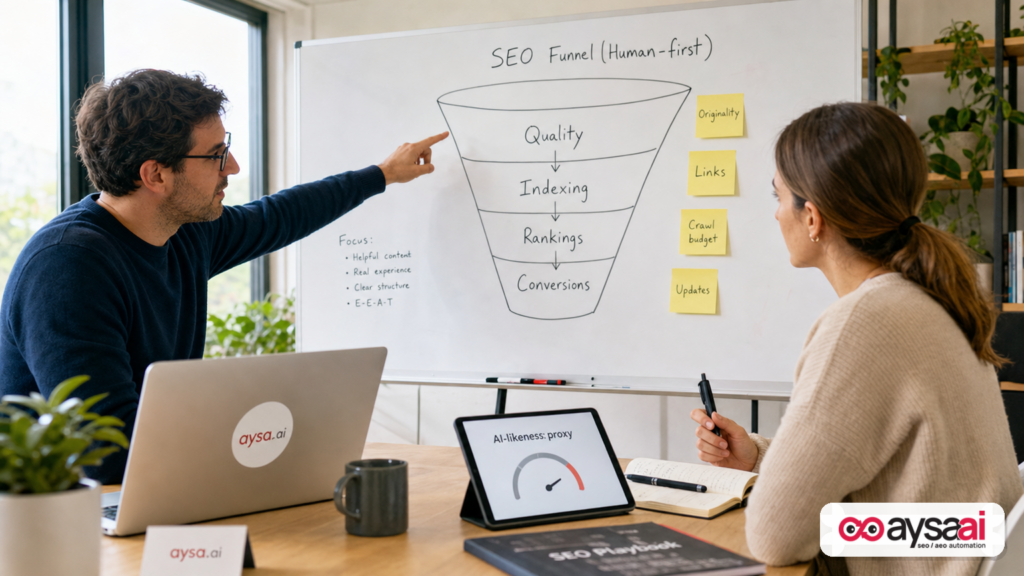
AI-flagged pages can still rank in Google’s top 10. But higher AI detector scores appear to correlate with (a) slightly worse average positions and (b) fewer pages meeting index-signal checks. That doesn’t prove Google is “penalizing AI.” It more likely reflects that many AI-heavy pages are lower effort, less original, less maintained, and less aligned to user needs. The winning move is to treat AI as a drafting assistant and invest in differentiation, accuracy, internal linking, Indexing discipline, and measurable outcomes.
Key takeaways (for busy operators)

- Detectors are not Google. A high “AI score” is not a ranking verdict. It’s an audit hint.
- Correlation ≠ penalty. If AI-heavy pages rank a bit lower on average, it can be because of quality patterns that come with scaled production.
- Indexing is the silent battleground. The bigger risk for SMEs isn’t “Google detects AI.” It’s publishing so many low-yield pages that you waste Crawl budget and attention.
- Google rewards outcomes. Pages that satisfy intent, demonstrate expertise, stay updated, and earn trust can rank—regardless of how you drafted them.
- Execution is the advantage. The companies that win won’t be the ones with the most AI pages. They’ll be the ones that can reliably ship improvements, measure impact, and iterate.
Table of contents

- What the data actually says (and what it doesn’t)
- AI detectors: useful as a smoke alarm, terrible as a steering wheel
- What changed since 2025: why correlation can “appear”
- Why this matters in 2026: search behavior, AI Overviews, and trust
- The real risk: index bloat, crawl waste, and brand dilution
- Concrete SME scenario: the local clinic that “scaled content” and lost leads
- A quality framework that beats detector games
- Technical & indexing checklist (non-negotiables)
- Content checklist: how to make AI-assisted pages genuinely better
- Measurement: KPIs that prevent you from fooling yourself
- What agencies should rethink: from “content output” to “approved execution”
- Where AYSA fits: monitor → propose → approve → execute
- A practical 30-day playbook
- What to do next
- Sources and further reading
What the data actually says (and what it doesn’t)
The SEJ piece summarizes an Ahrefs study based on a large sample of pages in Google’s top 10 results. Ahrefs used their own AI detector to estimate how much text “reads as AI-written,” then compared those scores with ranking positions and with a separate index-signal analysis.
Here’s what matters operationally:
- AI-heavy pages exist throughout the top 10. That alone should kill the idea that “AI content can’t rank.”
- The averages move gradually. Higher AI scores trend toward slightly lower positions (not a cliff).
- Index-signal rates drop as AI scores rise. In a separate sample, pages with higher detector scores were less likely to meet at least one of Ahrefs’ index signals (rankings, Search Console Impressions, or appearing in a
site:query).
Now, what the data does not say:
- It doesn’t prove Google uses this detector (Ahrefs explicitly cautions against that).
- It doesn’t prove Google “penalizes AI.”
- It doesn’t isolate cause. AI score might correlate with thinness, duplication, lack of originality, stale pages, poor internal linking, weak topical authority, and more.
This is why I treat AI-detection research the way I treat any single-variable SEO claim: interesting, directionally useful, but not a strategy. Strategy lives in controllable systems: quality, intent, internal linking, technical hygiene, indexing discipline, and iteration.
AI detectors: useful as a smoke alarm, terrible as a steering wheel
Most businesses want a simple answer: “Is this safe to publish?” Detectors promise that. But they can’t actually provide it, because they’re measuring something squishy: linguistic patterns that resemble model output.
That’s still useful—just not in the way people want.
How I recommend using a detector score
- As a triage filter: “Which pages should we review more carefully?”
- As a process signal: “Are we shipping too much unedited model output?”
- As a consistency check: “Why do our best-converting pages read human and our new pages read generic?”
How I do not recommend using a detector score
- As a publishing gate: “If the score is high, don’t publish.”
- As an SEO KPI: “We reduced AI score by 30%, so rankings will rise.”
- As a replacement for editing: Trying to “beat the detector” can make content worse.
Google’s public stance for years has been consistent: it cares about content quality, not the method used to produce it—while spammy automation intended to manipulate rankings is a problem. The SEJ article reflects that context and frames the results as gradual, not disqualifying.
If you want a practical interpretation: detector scores are often picking up on a set of behaviors that also harm performance—rushed publishing, generic phrasing, no original examples, no firsthand perspective, stale pages, and no accountability for accuracy.
What changed since 2025: why correlation can “appear” without a single algorithm switch
SEJ notes that an earlier Ahrefs analysis (2025) found essentially no relationship between AI score and rankings, while the newer dataset suggests a gentle relationship.
It’s tempting to treat that as “Google changed something.” Maybe. But you don’t need an algorithm change to get a different correlation result. You just need different inputs.
Four non-mysterious reasons the headline can change
- Sampling differences. Different queries, different industries, different languages, different SERP Features. Any of those can change outcomes.
- SERP depth differences. Top 10 vs top 20 isn’t a detail—it’s a different competitive environment. Positions 11–20 often include more “good enough” pages.
- Segmentation differences. Grouping by “80%+” vs “100%,” or mixing page types (blog posts vs product pages) changes patterns.
- The web changed. In 2026, AI assistance is embedded in everyday tools. The average “human-written” page may now include AI edits, while “AI-written” pages may be mass-produced and unmaintained.
The most plausible interpretation is not “Google now detects AI better.” It’s: the ecosystem matured. Many publishers learned to ship AI content at scale, and the average quality of scaled pages is often lower than the best editorial pages competing for top 3 spots.
Which leads to the only business question that matters: are you using AI to increase value, or only to increase volume?
Why this matters in 2026: search behavior, AI Overviews, and trust
Even if you ignore detectors entirely, there’s a bigger shift happening: search results pages are evolving, and visibility is no longer just “blue links.” SEJ itself has ongoing coverage and resources about AI-driven search experiences (for example, their material on AI Overviews and ranking considerations). You can start from SEJ’s news section and their SEO coverage for updates.
For SMEs, the practical implication is this: as search interfaces add more AI summaries and answer-style experiences, the bar for “worthy to cite” increases. Generic content becomes invisible faster because it’s interchangeable.
That’s why the detector conversation is a distraction. The actual competitive shift is toward:
- Originality and specificity: Real examples, real constraints, real pricing factors, real inventory rules, real outcomes.
- Accuracy and accountability: The content that survives is the content that can’t be easily contradicted.
- Brand trust: Users (and systems summarizing the web) prefer sources that look maintained and credible.
If your AI workflow produces “perfectly grammatical generic advice,” you’re building an asset that’s easiest to replace.
The real risk: not ranking—wasting crawl budget and index space with scaled, low-yield pages
SEJ highlights a key operational point: indexing. Even without direct access to Google’s internal index status, the Ahrefs approach (rankings, Search Console impressions, and site: checks) is a reasonable way to estimate whether pages are getting any meaningful index footprint.
Here’s why indexing matters more than the detector score for most SMEs:
- If it’s not indexed, it can’t rank. You can spend weeks “optimizing” a page that never becomes eligible.
- Index bloat creates opportunity cost. Publishing thousands of low-yield pages can dilute internal linking signals and consume crawl attention that could have refreshed your money pages.
- Maintenance debt compounds. AI makes publishing cheap; updating is still work. The web rewards upkeep.
Think of your website like a store. You can’t just keep adding aisles of products nobody buys, never update pricing labels, and expect the best items to sell more. Search engines have the same problem: too much low-yield inventory makes it harder to identify what matters.
So the real question becomes: do you have an execution system that prevents low-value pages from piling up?
Concrete SME scenario: the local clinic that “scaled content” and lost leads
Let’s make this real with a scenario I see constantly (details generalized):
A local clinic wants to grow bookings for high-margin services (say: sports injury treatment, physical therapy, or cosmetic procedures). Someone recommends “publish 200 location pages and 300 informational posts using AI.” The clinic does it. In a month, the site has 500 new URLs.
What happens next is predictable:
- Indexing becomes inconsistent. Some pages get crawled, some don’t. Many get discovered and then ignored. Search Console impressions scatter thinly across hundreds of pages without clear winners.
- Content overlaps. “Treatment in City A” and “Treatment in City B” are near-identical except for the city name. Users don’t trust it, and it doesn’t earn links.
- Conversion rate drops. People land on thin pages with no real proof—no therapist bios, no outcomes, no FAQs specific to that clinic’s process, no appointment flow clarity.
- The team can’t maintain it. Medical info changes, pricing changes, service availability changes. Nothing is updated.
The clinic didn’t fail because “Google detected AI.” They failed because they scaled unowned content—pages that don’t carry the clinic’s real expertise, constraints, or differentiators.
The fix isn’t “write everything by hand.” The fix is: publish fewer pages, make them genuinely helpful, attach them to real business outcomes, and maintain them. AI can help produce drafts, summaries, and variations—but humans must supply the clinic’s reality.
A quality framework that beats detector games
If I strip this down to a framework you can run as an SME, it’s this:
1) Intent fit (does the page solve the job?)
- What is the visitor trying to decide or do?
- What would make them confident enough to take the next step?
- Does the page answer the next 2–3 questions they’ll ask?
2) Differentiation (why this page, not any other?)
- Unique policy, unique inventory, unique process, unique constraints.
- Original photos, original examples, original checklists.
- Specific comparisons (not fluffy “benefits”).
3) Verifiability (can the claims be trusted?)
- Clear authorship/ownership signals (who is responsible for this info?).
- Dates and update cadence where it matters.
- Supportive references when making factual claims (especially in regulated niches).
4) Maintenance (does it stay true over time?)
- Content is not a one-time publish. It’s a living asset.
- Have an update trigger: pricing changes, product changes, seasonality, new regulations.
Notice what’s missing: “lower your AI score.” You can hit all four of these while using AI heavily—if your process is disciplined and the content is anchored in your real business.
Technical & indexing checklist (non-negotiables)
When indexing signals drop for AI-heavy pages, the likely culprit is not the “AI-ness.” It’s that scaled pages often ship with technical and structural flaws. Here are the non-negotiables I’d audit before debating detector scores.
Make sure Google can discover and prioritize your best pages
- Internal linking: New pages need links from relevant, already-performing pages. Otherwise, they’re orphans.
- Sitemaps: Ensure XML sitemaps are accurate and not bloated with low-value URLs.
- Canonicalization: Avoid accidental duplicates and parameter variants cannibalizing signals.
- Noindex strategy: If a page is purely for internal navigation or has no search value, consider
noindexinstead of hoping it ranks.
Reduce “wasted” pages before you add new ones
- Consolidate overlapping posts into a single strong guide.
- Merge near-duplicate location/service pages into a hub + genuinely unique local proof pages.
- Remove or noindex thin tag pages and internal search pages (common on CMS and ecommerce setups).
Use Search Console as your reality check
Even if you’re not an SEO, you can use Google Search Console to answer three simple questions:
- Are pages getting impressions?
- Are new pages being discovered and indexed?
- Which queries are expanding (or collapsing) over time?
If you don’t see meaningful impressions growth after publishing at scale, the answer isn’t “publish more.” It’s “publish better and prune.”
AYSA is built for this operational reality: you need monitoring that flags changes in visibility and indexing patterns, and an execution loop that turns those signals into approved site changes.
Content checklist: how to make AI-assisted pages genuinely better
Here’s what “quality” looks like in the AI era—written for operators, not SEO purists.
Stop producing “generic completeness”
AI is great at producing content that looks complete: definitions, bullet lists, and safe advice. That’s not what wins.
Winning content contains:
- Constraints: “Here’s when this doesn’t work.”
- Tradeoffs: “Option A is faster; option B is safer.”
- Decision support: “If you’re in scenario X, choose Y.”
- Local proof: photos, staff bios, processes, policies, warranties, certifications (where relevant).
Add elements AI cannot invent responsibly
- Real pricing ranges with explanation (what drives price up/down).
- Real timelines (shipping windows, appointment lead times, onboarding stages).
- Real FAQs from sales/support tickets.
- Real before/after constraints (care instructions, limitations, prerequisites).
Build a “citation-ready” posture
If search experiences increasingly summarize the web, you want your pages to be easy to reference. That means:
- Clear page purpose and scope.
- Well-structured headings that match real questions.
- Definitions only where they help decisions (not filler).
- Unique media (original photos, short explainer videos where feasible).
AYSA’s resources on AI search visibility and AI SEO tools are built around this principle: don’t just “rank,” become the most referenceable source in your niche.
Measurement: KPIs that prevent you from fooling yourself
AI publishing makes it dangerously easy to feel productive without being effective. So measurement has to get stricter, not looser.
KPIs I trust for SMEs
- Indexed + impressioning pages: not just “published pages.”
- Query spread: are you earning impressions for more relevant queries, not just your brand name?
- Top pages driving leads/revenue: are your money pages improving, or are you adding long-tail noise?
- Conversion rate by landing page: especially for service pages and product categories.
KPIs that often mislead teams
- Word count shipped. More words are not more value.
- Number of posts per week. Activity is not progress.
- Detector score improvements. You can lower the score and still be generic.
The goal is simple: fewer pages that do more work. That requires a system that can monitor, prioritize, and ship improvements consistently—which is exactly the lane AYSA plays in.
What agencies should rethink: from “content output” to “approved execution”
Agencies are under pressure: clients want more content, faster, cheaper, and with clearer ROI. AI seems like the fix. But output without accountability becomes churn.
Here’s the shift I believe agencies need to make:
- From deliverables to outcomes. Don’t sell “50 AI articles.” Sell “indexing + visibility + conversions” with a measured plan.
- From one-time publishing to lifecycle management. Updates, pruning, consolidation, internal linking improvements.
- From ambiguous responsibility to governed execution. Clients want control over what changes on their site.
This is where an approved execution model matters. Instead of emailing spreadsheets and hoping something gets implemented, you need a system that:
- Monitors what’s happening.
- Prepares specific recommended changes.
- Requests approval (so stakeholders can govern risk).
- Executes accepted changes consistently.
That’s the operational gap between “we published AI content” and “we built a compounding search asset.”
Where AYSA fits: monitor → propose → approve → execute
AYSA is designed for the part of SEO that most teams struggle with: execution discipline.
In the AI-content debate, that matters because the biggest failures are not philosophical. They’re operational:
- Teams publish too much, too fast.
- No one owns fact-checking.
- No one consolidates overlapping pages.
- No one strengthens internal links and information architecture.
- No one measures and iterates.
AYSA helps by:
- Monitoring performance and visibility patterns (Learn more about Monitoring).
- Preparing changes that map to outcomes (content improvements, internal linking actions, technical fixes).
- Asking for approval so changes don’t go live blindly—this matters for regulated niches and brand risk.
- Executing accepted updates so your site actually improves instead of living in project-management limbo.
If you want to explore how that works in practice, start with AI search visibility, browse the AYSA blog, and check pricing when you’re ready to operationalize it.
A practical 30-day playbook: how to use AI without becoming “AI-shaped content”
This is a realistic plan for a busy SME team (or an agency running a program) that wants results without betting the brand on content volume.
Week 1: Audit for waste and opportunity
- Identify pages with impressions but low clicks: improve titles/snippets and intent match.
- Identify pages with zero impressions for months: decide consolidate, update, or noindex.
- Find near-duplicates (common with AI scale): cluster them and pick a canonical “winner” page.
Week 2: Fix indexing and internal linking
- Add internal links from top-performing pages to the pages that matter commercially.
- Clean up sitemaps and remove low-value URLs from being pushed as priorities.
- Ensure each key page has a clear role in the site architecture.
Week 3: Upgrade 5–10 high-impact pages (not 100 mediocre ones)
- Add unique proof: policies, processes, photos, comparisons, real FAQs.
- Rewrite openings to match intent and reduce “generic AI throat-clearing.”
- Improve scannability: headings that mirror user questions.
- Attach conversions: clear CTAs, forms, inventory status, contact options.
Week 4: Measure, iterate, and set publishing rules
- Track which upgraded pages gained impressions and expanded query footprint.
- Set a publishing rule: no new page unless it’s (a) unique, (b) linked, (c) owned for updates.
- Create a monthly prune-and-refresh ritual.
AI can support every step—drafts, summarization, rewrite suggestions, clustering—but the operating model must be governed.
What to do next
- Stop asking, “Will Google detect AI?” Start asking, “Is this page uniquely useful and maintained?”
- Run an indexing reality check. If a large share of your pages get no impressions, you have a strategy problem, not a writing problem.
- Pick 5–10 pages to upgrade. Build proof, specificity, and conversion clarity. Measure change.
- Set publishing governance. No page goes live without intent fit, internal linking, and an update owner.
- Operationalize execution. If you’re stuck in “recommendations,” adopt a monitor → approve → execute workflow.
If you want to build this into your day-to-day, start here:
Sources and further reading
- Search Engine Journal: Heavily AI-Flagged Pages Still Rank Across Google’s Top 10
- Search Engine Journal: SEO section
- Search Engine Journal: Latest news
- Search Engine Journal: Google algorithm updates history (context)
- Search Engine Journal: On-page SEO resources
Note: This editorial references the SEJ summary of Ahrefs’ analysis and stays within what’s present in the supplied research context. Where claims cannot be independently verified here (e.g., exact detector mechanics or Google internal signals), they are treated as analysis rather than fact.
Continue the AI search topic inside AYSA.
Use these pages to connect the article with AI SEO tools, AI visibility monitoring, AI Overviews and approved website execution.
Turn this topic into a website action plan.
Use these AYSA hubs to move from reading to technical fixes, AI visibility monitoring, research, glossary context and approval-first SEO execution.

