
Beyond Navigation: Site Architecture That Wins in SEO, AI Search, and Real User Journeys
Site architecture isn’t a “menu problem” anymore. It’s the system that determines whether search engines and AI assistants can find, understand, and confidently surface your content—while humans actually complete tasks. Here’s a practical framework to fix navigation, taxonomy, internal linking, and content access—with an execution plan that SMEs and agencies can run.

Site architecture used to be a quiet technical topic—something you “fixed” once, launched, and forgot. That era is over. Today, architecture decides whether your content is reachable and understandable to search engines, AI assistants, and real customers who are trying to get something done.
Search is fragmenting. People still use Google, but they’re also asking AI systems for recommendations, summaries, and comparisons. Those systems don’t “read” your site like a human. They follow paths. They infer meaning from structure. And they reward clarity.
This editorial is inspired by the ongoing industry conversation highlighted by Search Engine Land’s announcement of an SMX Now session on building better site architecture for SEO, AI, and users (source). The core idea is simple: advanced architecture is no longer just “navigation.” It’s the model that controls labeling, taxonomy, wayfinding, wireframes, and AI access to content—and teams are still relying on myths and outdated shortcuts.
My point of view (Marius Dosinescu, AYSA.ai): architecture is now a compounding business asset. When it’s right, every new page you publish is easier to find, easier to understand, and easier to recommend. When it’s wrong, you can publish more and more content and still get less and less visibility—because your content isn’t connected, isn’t crawlable, or isn’t interpretable in a predictable way.
Concise summary
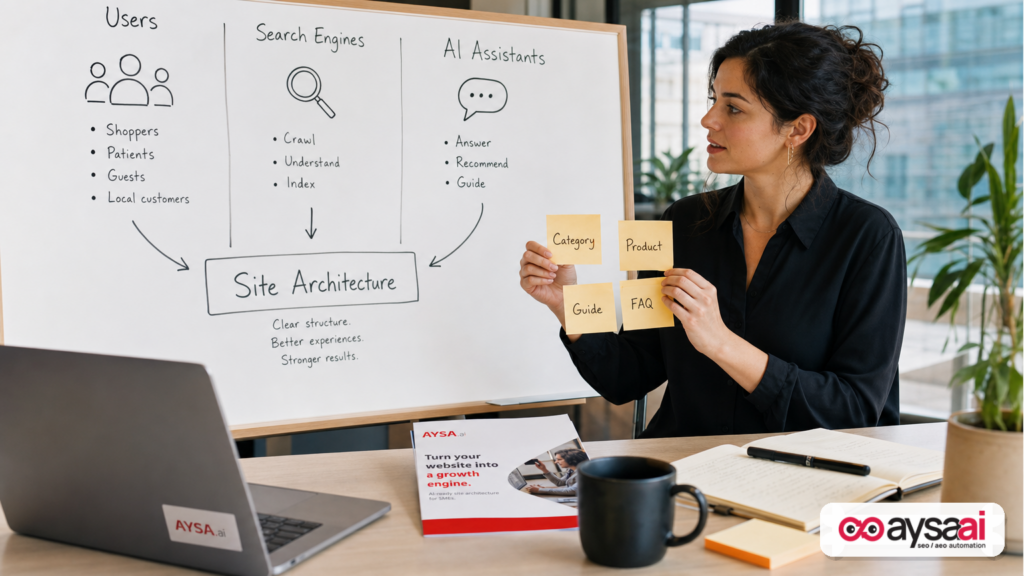
- Architecture is your discoverability system: it governs Crawling, Indexing, Internal linking, and how AI interprets and retrieves your content.
- Navigation is only one surface area; taxonomy, templates, URL patterns, faceted filters, and cross-linking matter just as much.
- Old rules break in AI Search: “three-click rule,” “taxonomy = hierarchy,” and “AI can generate wireframes” are unreliable without a deeper model.
- Most failures are operational: teams don’t monitor drift, don’t maintain naming systems, and don’t execute changes safely at scale.
- AYSA’s role: monitor architecture signals, prepare specific fixes, ask for approval, and execute accepted changes—so improvements actually ship.
Table of contents

- What changed: architecture now affects SEO, AI visibility, and user success
- The new job of site architecture: make your content accessible to humans and machines
- Three misconceptions that quietly sabotage growth
- A practical five-phase architecture framework (that doesn’t die in a deck)
- Phase 1: Diagnose reality (not what the sitemap claims)
- Phase 2: Build a labeling system people actually use
- Phase 3: Taxonomy + wayfinding networks (and how internal links should work)
- Phase 4: Wireframes and templates that scale clarity
- Phase 5: AI access, crawl efficiency, and index hygiene
- SME scenario: the “invisible inventory” problem in ecommerce
- What to monitor monthly (so architecture doesn’t decay)
- What agencies must rethink: architecture as an ongoing product, not a project
- How AYSA fits: monitor, prepare changes, get approval, execute—without chaos
- What to do next
- Sources and further reading
What changed: architecture now affects SEO, AI visibility, and user success

Let’s get specific about what changed and why it matters now.
1) Discovery is moving from “ten blue links” to “answers, summaries, and recommendations”
Even without inventing traffic numbers, the trend is visible across the industry: more results include summaries, comparisons, and synthesized answers. That pushes your site into a new competition: not just ranking a page, but becoming a retrievable and citable source in AI experiences.
Search Engine Land has been tracking AI-driven shifts and measurement challenges, including how to think about prompt-level visibility and “used vs. cited” patterns in AI search (prompt-level visibility, used or cited). You don’t need to accept any single framework to understand the implication: if machines can’t reliably traverse your site and map it into concepts, you’ll be underrepresented in the new discovery layer.
2) Sites grew faster than their architecture matured
Most SMEs and mid-market companies didn’t “design” architecture. They accumulated it: a blog here, product pages there, landing pages for campaigns, location pages, help docs, a few PDF resources, then years of redirects and plugins. The result is a structure that exists but doesn’t communicate.
3) AI is making weak architecture more visible, not less
A common misconception is that AI will “figure it out.” In reality, AI systems still rely on accessible content, consistent structure, and signals that reduce ambiguity. Weak architecture increases ambiguity: overlapping categories, inconsistent naming, orphan pages, parameter-based duplicates, and pages that are technically crawlable but practically undiscoverable because they have no meaningful internal context.
The new job of site architecture: make your content accessible to humans and machines
Architecture is the system that helps three audiences succeed:
- Humans: can I find what I need, trust it, and complete my task?
- Search engines: can I crawl it efficiently, understand relationships, and rank it for the right queries?
- AI assistants: can I retrieve the right passage or page, resolve entities and intent, and feel confident recommending it?
Notice the common denominator: access + understanding. That’s why architecture is “beyond navigation.” Navigation is a user-facing implementation detail of a deeper model: taxonomy, labeling, URL systems, templates, and internal linking networks.
If you want a simple mental model, think of architecture as:
- Your site’s map (how things connect)
- Your site’s vocabulary (what things are called)
- Your site’s governance (how you keep it from drifting)
AYSA’s angle here is execution: it’s not enough to diagnose. If improvements don’t ship, architecture remains theoretical. AYSA exists to close that gap: monitor, prepare changes, ask for approval, and implement accepted updates safely.
Three misconceptions that quietly sabotage growth
The Search Engine Land write-up of the SMX Now session preview mentions several misconceptions that need to be challenged—because they lead teams to do the wrong work (Search Engine Land).
Myth #1: “The three-click rule” is a useful architecture KPI
“Keep everything within three Clicks” sounds practical, but it’s a blunt instrument. It encourages shallow hierarchies and overstuffed navigation. In real-world sites, depth isn’t automatically bad—unclear pathways are bad.
Better questions:
- Can a user reach key tasks with predictable paths (navigation + search + contextual links)?
- Can crawlers reach important pages with few hops from strong hubs and with stable internal links?
- Does each page have a clear parent/cluster context so an AI system can understand “what this is” and “how it relates”?
Myth #2: “Taxonomy is just a hierarchy of categories”
A hierarchy is one way to organize things. But modern sites also need networks: cross-links, related entities, attributes, use cases, comparisons, and “next best step” guidance. Taxonomy is how you define relationships—not just where you place pages in a tree.
For example, a clinic site isn’t only “Services → Dermatology → Acne.” It’s also:
- Service ↔ Symptom
- Service ↔ Provider
- Service ↔ Insurance
- Service ↔ Location
- Service ↔ Aftercare
Myth #3: “AI can generate wireframes and it’ll be fine”
AI can help create drafts. But wireframes without an architecture model produce attractive confusion: pages that look good but don’t reinforce meaning, don’t scale, and don’t support consistent internal linking and content reuse.
Wireframes should express architecture, not invent it.
A practical five-phase architecture framework (that doesn’t die in a deck)
The SMX Now session described by Search Engine Land references a tested five-phase framework focused on labeling systems, wayfinding networks, taxonomy, wireframes, and AI access (Search Engine Land). I’m not going to copy their structure. Instead, I’ll translate the intent into an actionable version you can run inside an SME or agency environment—where constraints, approvals, and dev capacity are real.
Here’s the five-phase sequence that works in practice:
- Diagnose: map what exists, how it performs, and where access breaks (users + crawlers + AI Retrieval).
- Name: build a labeling system and rules that match how customers talk and how the business sells.
- Connect: design taxonomy + wayfinding networks and internal linking patterns that make relationships obvious.
- Template: implement via wireframes/templates so every page type reinforces the model.
- Harden: improve crawl/index hygiene and AI accessibility; then monitor for drift.
The secret is that each phase produces an artifact teams can ship:
- Phase 1: an “architecture issues backlog” with measurable outcomes
- Phase 2: a naming/labeling style guide
- Phase 3: internal linking rules + taxonomy schema
- Phase 4: page-type templates with link modules and structured content sections
- Phase 5: technical directives (canonicals, parameters, sitemaps, robots) plus monitoring
Phase 1: Diagnose reality (not what the sitemap claims)
Most architecture problems are invisible because teams look at the menu, not the graph.
What to inventory (minimum viable architecture audit)
- Page types: categories, products, services, locations, guides, comparisons, FAQs, help docs, case studies.
- Index footprint: what’s indexed vs. what should be indexed.
- Internal link topology: which pages are hubs, which are orphaned, which are deep with weak parents.
- Duplicate clusters: parameters, sorting URLs, tag pages, thin location variants, archived campaigns.
- Content access issues: heavy JS rendering dependencies, blocked resources, infinite scroll without crawlable pagination, broken breadcrumbs.
What “good” looks like
- Every strategic page has a clear role (why it exists) and a clear parent/cluster.
- Every page has at least one logical pathway from a hub (category, service, guide) plus contextual links.
- The site has fewer “accidental” URLs than “intentional” URLs.
If your organic traffic is unstable or shrinking, it’s easy to blame AI or Google updates. But it’s often architecture drift: new pages created with inconsistent patterns, leaving search engines unsure what to prioritize.
Operational note: if you’re using Google Search Console, you’ll want to pay attention to indexing patterns, crawl stats, and page signals. Search Engine Land also covered new reporting tying Search Console data with broader platform reporting (Search Engine Land on GSC reporting). Even if that specific feature set changes, the underlying principle stands: you need observability.
Phase 2: Build a labeling system people actually use
Labeling is where UX, SEO, and brand meet. The reason it’s so powerful is that labels compress meaning into a few words—and those words shape:
- Navigation clarity
- Category naming
- Breadcrumbs
- Internal anchor text patterns
- On-page headings
Common labeling failures
- Internal jargon (your org chart on the website)
- Marketing metaphors (clever but unclear)
- Inconsistent singular/plural across categories
- Same label, different meaning (e.g., “Solutions” used for industries and for features)
Labeling rules that scale
- Use customer language first; add brand nuance second.
- Prefer concrete nouns and clear verbs over vague containers (“Resources,” “Things,” “Stuff”).
- Create a controlled vocabulary: one concept → one preferred label; synonyms handled with content, not new categories.
- Define a decision rule for new labels: when do you add a category vs. a filter vs. a guide?
This is where many teams try to “let AI write it.” AI can generate lists of labels, but you still need governance: you’re building a language system that must remain stable for years.
Phase 3: Taxonomy + wayfinding networks (and how internal links should work)
Taxonomy is not only “where content goes.” It’s the relationship model that machines and people use to traverse your site.
Think in two layers: hierarchy and network
- Hierarchy answers: “What bucket is this in?” (primary category path)
- Network answers: “What is this related to?” (contextual and lateral paths)
Internal linking as a product feature (not an SEO trick)
Internal linking is the physical manifestation of your relationship model. In modern sites, internal links should be:
- Intent-driven: links reflect how users decide (compare, evaluate, trust, buy, contact).
- Consistent by template: a product page always links to key guides, warranty/shipping, compatible items, and category hubs.
- Curated where it matters: high-value pages deserve intentional editorial links, not just algorithmic “related posts.”
Wayfinding networks: beyond breadcrumbs
Wayfinding is the set of cues that tells a user (and a crawler): where am I, what else is here, and what should I do next?
- Breadcrumbs: show primary hierarchy and reduce disorientation.
- Related modules: connect lateral relationships (use cases, comparisons, alternatives).
- Task-based hubs: “How to choose,” “Pricing,” “Implementation,” “Troubleshooting.”
- Next-step CTAs: reduce pogo-sticking and improve completion.
AI retrieval benefits from these connections because they create dense, consistent context around entities and topics. Even if an AI system extracts only a portion of your page, the surrounding architecture increases confidence.
If you’re trying to improve AI search outcomes specifically, AYSA provides dedicated tooling to track and improve visibility: AI search visibility and AI SEO tools.
Phase 4: Wireframes and templates that scale clarity
Architecture becomes real when it becomes repeatable. That’s what templates and components do. If your site relies on authors manually adding links and context, your structure will decay—because humans are inconsistent and busy.
Define page types like products
For each page type, specify:
- Purpose: what job does this page do?
- Primary query/intent: what is the main question it answers?
- Required modules: what must appear on every page of this type?
- Required link blocks: what must it connect to?
- Structured sections: so content stays scannable and extractable.
Examples of scalable modules
- Category pages: “Best for,” “Compare,” “Buying guide,” “Top FAQs,” “Related categories,” “Featured brands.”
- Service pages: “Who it’s for,” “What to expect,” “Pricing range (if possible),” “Related conditions,” “Related services,” “Locations.”
- Guides: “Key takeaways,” “Steps,” “Tools,” “Related guides,” “Products/services mentioned.”
Important: avoid creating “template spam.” Templates must improve clarity, not inflate pages with filler. If you can’t maintain a module with accurate information, don’t automate it.
Phase 5: AI access, crawl efficiency, and index hygiene
This is where technical SEO and AI readiness overlap: you’re ensuring the right content is accessible, and the wrong content doesn’t waste crawl budget or confuse systems.
Index hygiene: keep the index intentional
Common issues that break architecture at scale:
- Faceted filters generating thousands of near-duplicate URLs
- Tag pages that are thin and ungoverned
- Search result pages accidentally indexed
- Old campaign landing pages left live with outdated offers
- Printer-friendly and parameter variants indexed alongside canonicals
Remediation usually involves a mix of canonicals, noindex rules, robots directives, parameter handling, and—often overlooked—internal linking discipline so you stop linking to garbage URLs.
Search Engine Land has also discussed content pruning decisions (remove, redirect, consolidate) in the broader AI-search era (content pruning discussion). If that exact URL changes, the theme remains: pruning isn’t just deleting—it’s architecture cleanup.
Crawl efficiency: stop wasting crawler time
- Ensure XML sitemaps reflect canonical, indexable URLs only.
- Reduce infinite URL expansion from filters/sorts.
- Make pagination crawlable where needed (and don’t hide inventory behind JS).
- Fix redirect chains and loops.
AI access: retrieval prefers clarity
Without claiming specifics about any one AI crawler, a safe principle is: systems retrieve what they can access and interpret. You can help by ensuring:
- Important content isn’t blocked behind heavy interaction or fragmented into inaccessible assets.
- Each page has clear headings and sections that stand alone when extracted.
- Related content is connected with descriptive anchor text and consistent pathways.
Also note: publishers are increasingly paying attention to crawler controls. Search Engine Land highlighted new AI crawler controls for some platforms (Cloudflare and beehiiv crawler controls). If you’re an SME, you may not need advanced controls today—but you do need a policy: what should AI access, and what shouldn’t it?
SME scenario: the “invisible inventory” problem in ecommerce
Let’s make this tangible with a scenario I see constantly.
The business
A 20-person ecommerce brand selling home fitness equipment: dumbbells, benches, racks, bands, mats. They’ve grown fast—added SKUs, created a blog, ran paid campaigns, built a “Deals” hub, and launched a learning center. Organic performance is inconsistent. Some products rank; others never appear. Category pages look fine to humans, but sales are flat.
The symptoms
- Hundreds of filter URLs indexed:
?color=black&sort=price,?brand=x&in_stock=true, etc. - “Collections” pages overlap with categories but use different naming conventions.
- Many products are only reachable through on-site search or filter combinations.
- Blog posts mention products but rarely link to relevant categories (or link inconsistently).
- The sitemap includes URLs that are canonicalized elsewhere.
What’s actually happening
Search engines are spending time crawling junk URLs. Authority is diluted across duplicates. Important products don’t have strong internal pathways, so they receive weak internal signals. AI systems attempting to retrieve “best adjustable bench for small apartment” find scattered info with unclear relationships.
The fix (in architecture terms)
- Define the intentional taxonomy: core categories + attributes that should be filters, not indexable pages.
- Build hubs: category hubs that link to buying guides, comparisons, and top subcategories.
- Template internal links: product pages link to category hub, compatibility/“pairs well with,” FAQs, shipping/warranty.
- Index control: canonical/noindex rules for most filter URLs; keep a curated set of “SEO landing filters” only if they have unique value and demand.
- Content integration: guides link to hubs and key products with consistent anchors.
What a non-SEO owner should watch
- Do category pages become the entry points (not random filter URLs)?
- Do more products get impressions for relevant queries over time?
- Do users browse more predictably (higher category-to-product click paths)?
This is the heart of architecture: you’re turning “inventory” into “discoverable inventory.”
What to monitor monthly (so architecture doesn’t decay)
Architecture isn’t a one-time redesign. It’s a system that drifts unless you measure it.
Monitoring checklist
- Index growth vs. intentional growth: are indexed pages growing faster than your real content output?
- Orphan pages: new pages without internal links.
- Template regressions: modules removed, breadcrumbs broken, canonical tags changed.
- Parameter explosions: new filters or sorts generating crawlable URLs.
- Internal link equity distribution: are your most important pages still your strongest hubs?
- Redirect churn: chains, loops, and overuse of temporary redirects.
This is where having an execution system matters. It’s not enough to find issues; you need a reliable loop to propose changes, get buy-in, and implement safely. That’s the practical difference between “we have an SEO audit” and “we have SEO operations.”
AYSA’s monitoring layer is built for that: monitoring identifies issues and prepares recommended actions so you can approve and ship changes.
What agencies must rethink: architecture as an ongoing product, not a project
If you’re an agency, architecture is where relationships either strengthen—or collapse under friction.
The old model (why it fails now)
- Agency delivers an audit deck.
- Client’s dev team is busy; changes queue for months.
- New content ships in the meantime, creating more drift.
- Results are delayed, attribution is unclear, budgets get questioned.
The new model
- Architecture is treated like a product backlog with sprints.
- Templates and governance reduce rework.
- Monitoring detects regressions early.
- Execution is operationalized: safe changes ship weekly, risky changes ship with approvals.
Search marketing outlets are increasingly emphasizing measurement beyond clicks and visibility in AI-driven discovery (see Search Engine Land’s broader AI and measurement coverage: SEO priorities for AI search). Whether you agree with every tactic, the direction is clear: agencies need tighter integration between strategy and implementation.
How AYSA fits: monitor, prepare changes, get approval, execute—without chaos
Architecture improvements fail for one reason more than any other: they don’t get implemented consistently.
AYSA is designed as an execution system for SEO/AEO/GEO work:
- Monitors your site and discovery signals so you can see architecture drift early.
- Prepares recommended changes (technical fixes, internal linking adjustments, content structure improvements) in a reviewable format.
- Asks for approval so changes don’t create brand/legal/compliance surprises.
- Executes accepted changes—so strategy becomes shipping work.
That model matters more in architecture than almost anywhere else, because architecture changes can be high-impact and high-risk: redirects, canonicals, navigation labels, URL structures, and template modules can either unlock growth or break revenue paths.
If you want to understand how AYSA approaches this in practice, start here:
- AI search visibility (what’s being surfaced and where you’re missing)
- AI SEO tools (execution-oriented tooling)
- Monitoring (how issues are detected and tracked)
- Pricing (how teams adopt AYSA based on scale)
- AYSA blog (operational playbooks and updates)
The key is restraint: not everything should be automated. But everything should be operationalized. AYSA’s approval-first approach is how you get speed without chaos.
What to do next
Here’s a practical action list you can run in 30–60 days without a full redesign.
Week 1–2: Get a clear map of what’s real
- List all page types and their purpose.
- Identify the top 20 pages that drive revenue/leads and map their internal pathways.
- Find orphan pages and pages reachable only via filters/search.
- Document parameter patterns and duplicate clusters.
Week 3–4: Fix the biggest access blockers
- Clean up index bloat (start with obvious parameter duplicates).
- Ensure breadcrumbs are consistent and correct.
- Improve internal linking from hubs to money pages (categories/services → products/lead pages).
- Update sitemaps to include only canonical, indexable URLs.
Week 5–8: Build repeatable templates
- Choose 2–3 critical page types (e.g., category, product, service).
- Add consistent modules that connect to related hubs/guides/FAQs.
- Create a labeling style guide and a rule for adding new categories or tags.
Ongoing: Monitor and govern
- Set monthly checks for index growth, orphan pages, and parameter explosions.
- Treat architecture improvements like a backlog, not a one-off project.
- Use an approval-based execution workflow so fixes actually ship.
If you want this to be systematic instead of manual, implement an execution loop with AYSA: monitor, prepare, approve, execute. That’s how you keep architecture from slipping back into entropy.
Sources and further reading
- Search Engine Land: SMX Now: Build better site architecture for SEO, AI, and users
- Search Engine Land: Used or cited: The two ways brands appear in AI search
- Search Engine Land: How to measure prompt-level visibility in AI search
- Search Engine Land: 6 SEO priorities to rethink for AI search
- Search Engine Land: Google Search Console gains reporting on social and video platforms
- Search Engine Land: Cloudflare and beehiiv give publishers new AI crawler controls
Related AYSA resources
Note: This editorial uses the provided Search Engine Land context as research input and deliberately avoids copying the original article. Where broader claims about AI search behaviors are discussed, they are framed as analysis rather than definitive metrics unless explicitly supported in the supplied context.
Continue the AI search topic inside AYSA.
Use these pages to connect the article with AI SEO tools, AI visibility monitoring, AI Overviews and approved website execution.
Turn this topic into a website action plan.
Use these AYSA hubs to move from reading to technical fixes, AI visibility monitoring, research, glossary context and approval-first SEO execution.

