ChatGPT Owns AI Referral Traffic (for Now): What 6.77M Sessions Mean for Your SEO, Your Site UX, and Your Growth Plan
AI referrals are rising fast—but they’re volatile, concentrated in ChatGPT, and often land on internal search pages. Here’s what that changes about SEO, content, site architecture, measurement, and how SMEs should execute in an AI-first discovery era.

AI Referral traffic is no longer a curiosity on your analytics dashboard. It’s becoming a meaningful acquisition channel—fast. But the uncomfortable truth is that it’s also concentrated, volatile, and increasingly shaped by factors many businesses don’t currently treat as “SEO.”
New analysis of 6.77 million LLM-driven sessions published by Search Engine Land (based on Previsible’s third AI Traffic Study) shows two headline realities: (1) AI referrals have grown dramatically, and (2) ChatGPT dominates trackable LLM referral traffic. The same dataset also reveals a more actionable insight that most teams will miss: a huge portion of AI-referred users land on internal site search pages—meaning your internal search UX is now part of your acquisition funnel.
This editorial is my practical take, as Marius Dosinescu at AYSA.ai, on what changed, why it matters, and what you should do next—especially if you’re an SME that needs results, not hype.
Concise summary
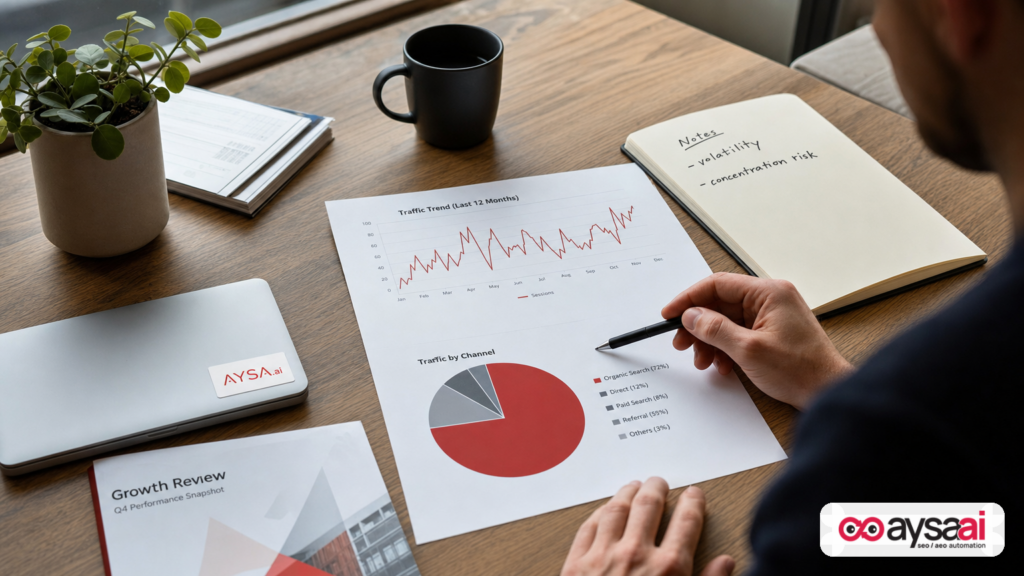
- AI referrals are accelerating, but they can swing dramatically when AI platforms change product behavior.
- ChatGPT is the primary referrer in trackable LLM traffic right now—so “AI Optimization” that ignores ChatGPT is usually unfocused.
- Internal search results pages are a top AI landing page type across many industries—so internal search is no longer “nice-to-have navigation.” It’s acquisition infrastructure.
- Page-type fit matters more than content volume: ecommerce product pages, education course pages, health About pages, and SaaS search pages behave differently as AI entry points.
- Measurement must evolve: track AI referrals by platform, landing page type, and conversion outcomes—not just sessions.
- Execution speed with control is the new advantage. Monitoring + prioritized recommendations + Approved Execution is how you keep up without breaking your site.
Table of contents

- The new AI referral reality: growth, consolidation, and whiplash
- What AI referrals are (and aren’t): stop mixing channels
- Why ChatGPT’s dominance changes strategy (and increases risk)
- Claude’s rise, Gemini’s steadiness, and why some challengers faded
- Why internal search pages are suddenly SEO landing pages
- Landing page fit by vertical: what AI sends to ecommerce, SaaS, publishers, health, legal, education
- The modern AI entry-point checklist: what to fix on your website
- How to measure AI referrals in GA4 without lying to yourself
- A practical SME scenario: the local clinic that loses AI traffic without noticing
- What agencies and in-house teams must rethink
- Where AYSA.ai fits: monitoring, preparation, approval, and execution
- A 90-day action plan you can actually run
- What to do next
- Sources and further reading
The new AI referral reality: growth, consolidation, and whiplash

The Search Engine Land piece ChatGPT commands 92% of AI referral traffic. Here’s what 6.77 million sessions reveal. lays out a pattern many of us have felt anecdotally: AI referrals are rising quickly, but they don’t behave like Google search traffic.
Traditional SEO has volatility, sure. But it’s mostly shaped by algorithm updates, competitor actions, and your own changes. AI referral volatility adds a new dependency: product decisions inside a single LLM interface—how it cites, when it links, whether it encourages clicking, and what sources it privileges.
The research reports a sharp drop in AI sessions in one period that was largely explained by changes in ChatGPT referrals, while other platforms remained steadier. That’s the “whiplash” factor: your business can do everything right and still see a sudden decline because the discovery layer changed its preferences.
This is the first strategic shift:
- In AI discovery, the referrer is a product, not just an algorithm.
- Your acquisition channel now has UI/UX decisions that can reduce outbound Clicks.
- Concentration is a risk multiplier. If one platform is the source of most referrals, its changes can feel like a “core update” every month.
If you’re an SME, the practical takeaway is not “panic.” It’s: build a plan that expects volatility. Make AI referrals an additional stream that you monitor, optimize, and convert—without becoming dependent on it before it stabilizes.
What AI referrals are (and aren’t): stop mixing channels
A lot of confusion in the market comes from people collapsing everything “AI” into one bucket. But there are at least two distinct realities:
- Standalone LLM referrals: traffic that arrives when a user clicks a link inside ChatGPT, Claude, Perplexity, Gemini, Copilot, etc. This is what the Search Engine Land / Previsible dataset measures.
- AI inside search engines: especially Google experiences (e.g., AI-powered summaries and other SERP Features) that may influence clicks in ways that don’t look like “LLM referral traffic.” This can be larger in impact but is measured differently.
Why does this matter? Because if you treat them as the same, you’ll misread your own performance:
- You might celebrate “AI traffic growth” while your Google organic conversions drop due to SERP changes.
- You might optimize content to get cited in LLM answers but forget that your Google snippets still drive the majority of revenue.
- You might invest in tactics that increase impressions (or citations) but don’t increase sessions.
At AYSA, we treat this as a measurement and execution problem: you need separate tracking, separate hypotheses, and separate workflows—then a unified plan that ties it all to business outcomes.
If you’re building internal literacy, it helps to use three terms consistently:
- SEO: ranking and earning clicks in traditional search.
- AEO (Answer Engine Optimization): being selected as a cited or referenced answer in AI systems.
- GEO (Generative Engine Optimization): shaping how your brand, products, and content are represented inside generative answers (including what gets summarized, compared, recommended).
These aren’t buzzwords if you treat them as distinct inputs and outputs. They become operational when you track and improve them with discipline.
Why ChatGPT’s dominance changes strategy (and increases risk)
The most headline-grabbing detail from the Search Engine Land analysis is market share: ChatGPT accounts for the overwhelming majority of trackable LLM referral traffic in the dataset.
I’m not going to repeat every number here—you can read them directly in the source article—but the strategic implication is clear:
- “Optimize for AI” is not a channel strategy. It’s a slogan.
- If ChatGPT drives most LLM referrals, your first optimization target is ChatGPT behavior.
However, the second implication is even more important for operators:
- Concentration creates platform risk. If a single vendor can alter your referrals drastically, you need a volatility buffer.
- Volatility buffers come from conversion improvements, retention, and diversified acquisition—not from chasing every new AI tool.
In plain SME terms: if you’re getting 10,000 visits a month from Google and 200 from AI referrals, you shouldn’t reorganize your company around the 200. But you also shouldn’t ignore it—because those 200 could become 2,000, and the early movers are learning how to convert those users better.
The right stance is: treat AI referrals as high-intent experimental traffic. Optimize the entry points. Improve the site experience. Measure conversions. Then scale.
Claude’s rise, Gemini’s steadiness, and why some challengers faded
The Search Engine Land analysis doesn’t just show consolidation; it highlights movement below the top—especially Claude’s growth and the relative steadiness of Gemini, alongside declines in some other platforms’ referral volumes.
Rather than framing this as a “horse race,” I think business owners should frame it as a distribution question:
- Which AI surfaces encourage outbound clicks?
- Which AI surfaces keep users inside their own experiences?
- Which audiences use which tools? (Developers and technical buyers may behave differently from consumer shoppers.)
That’s why it’s reasonable to prioritize ChatGPT first for volume, while also monitoring emerging sources that may matter disproportionately for your niche—especially if you sell into technical, professional, or enterprise contexts.
One more practical note: even if a platform sends fewer clicks, it may still shape purchasing decisions. A user can read an AI answer, remember your brand, and then Google you later (or navigate directly). Your analytics might never attribute that influence correctly. That’s not an excuse to invent attribution models—it’s a reminder to balance measurable referrals with brand discovery signals.
If you want to explore broader AI search shifts beyond this one dataset, Search Engine Land has related reporting you can use as context, including:
- 6 SEO priorities to rethink for AI search
- How to measure prompt-level visibility in AI search
- Build better site architecture for SEO, AI, and users
Why internal search pages are suddenly SEO landing pages
The most operational insight in the Search Engine Land write-up is this: a large share of AI-referred traffic lands on internal search results pages.
That single behavior changes how you should think about site architecture and UX. Here’s what’s happening in plain English:
- A user asks an AI system for help (e.g., “best running shoes for flat feet,” “HIPAA-compliant scheduling software,” “how to file an LLC in Texas”).
- The model decides it trusts a domain (your site).
- But it’s not confident enough to choose a single exact page (or it believes the user will want to narrow options).
- So it sends the user to your internal search page with a query-like URL or a generic search hub.
In old-school SEO, internal search pages were often treated as:
- navigation-only pages,
- often blocked from indexing,
- rarely designed as conversion-first landing pages.
In AI referral reality, internal search can become your “AI homepage.” That means:
- Internal search relevance and UX affects revenue.
- Filter design becomes acquisition strategy.
- Zero-results handling becomes a retention tool.
- Page speed, pagination, and canonical rules become AI conversion levers.
If you’re a busy business owner, here is the simplest framing: AI sends users deeper into the site, skipping your marketing narrative. You don’t get a second chance to “warm them up.”
The 7 common internal search failure modes that kill AI-referred conversions
When AI drops a user onto a search page, these issues become expensive:
- Unhelpful default sorting (e.g., “most recent” instead of “best match”)
- No synonym handling (user searches “sofa,” your catalog says “couch”)
- Thin result cards (no price, no availability, no key attributes)
- Missing filters (size, location, compatibility, insurance accepted, etc.)
- Poor mobile UX (filters unusable; results hard to scan)
- Zero-results dead ends (no suggestions, no categories, no support options)
- Tracking blind spots (no idea what users searched, clicked, or bought)
Fixing internal search is not glamorous. But it is exactly the kind of “boring” work that converts high-intent AI visitors into customers.
Landing page fit by vertical: what AI sends to ecommerce, SaaS, publishers, health, legal, education
The source analysis highlights that AI referrals don’t land uniformly. They cluster by page type, and the clustering differs by industry. That means your roadmap should be shaped by your business model, not generic AI advice.
Below is a practical interpretation of what this implies—without pretending we have universal benchmarks (we don’t). Use this to guide what you audit first.
Ecommerce: product and category pages become the pitch deck
When AI sends users to product pages, your product detail page (PDP) is no longer just for shoppers who already found you. It becomes the first impression for someone who discovered you through an answer.
What ecommerce teams should prioritize:
- Structured product information that is consistent and comparable (specs, sizing, compatibility, materials).
- Transparent pricing and availability. If your site hides pricing behind “contact us,” AI systems have less to summarize and users have less reason to trust.
- Evidence: reviews, return policy clarity, shipping timelines—especially above the fold.
Even if you’re not thinking about “schema,” your PDP data should be machine-readable and human-credible. It’s both AEO and conversion optimization.
SaaS: internal search, docs, and pricing clarity
If AI referrals land on internal search pages for SaaS, that suggests users are trying to self-serve: “Does this product do X? How does it integrate with Y?”
SaaS priorities:
- Use-case and integration pages that map to how users ask questions.
- Documentation discoverability that doesn’t require login to be useful.
- Pricing communication: not necessarily one price, but clear tiers, ranges, or packaging logic.
If you’re uncomfortable listing prices, at least make packaging explicit: who it’s for, what’s included, and what changes cost.
Publishers: producing the fuel, capturing little of the motion
One of the most important strategic tensions in AI search is the publisher equation: publishers produce a lot of the content that AI systems learn from and cite, but may receive relatively little traffic back in return.
The Search Engine Land analysis notes that publisher penetration of LLM referrals is tiny relative to their organic search footprint. That should not surprise anyone paying attention to how answer experiences reduce the need to click. But it should change publisher strategy:
- Monetize beyond pageviews (memberships, newsletters, events, direct sponsorships).
- Invest in brand and direct demand so users seek you out intentionally.
- Instrument content for “next action” (newsletter CTA, topic hub, tool, calculator)—because the click may be the only one you get.
Also worth tracking: publisher-side controls and policies are evolving. Search Engine Land has covered publisher tools and crawler controls in related reporting (e.g., Cloudflare and beehiiv controls), which can shape how content is accessed by AI systems—worth monitoring if publishing is your business model.
Health and local services: trust pages (About, credentials, location) become conversion pages
When AI sends health-related traffic to About pages, it signals something deep: users are checking legitimacy before they trust advice. For clinics, dentists, chiropractors, med spas, and therapy practices, AI discovery may accelerate the trust evaluation stage.
That means your About and credentials content isn’t “fluff.” It’s a decision layer. Make sure it includes:
- real clinicians and credentials,
- clear services and boundaries (what you treat, what you don’t),
- location and hours accuracy,
- insurance/payment clarity,
- how to book (frictionless).
Legal, insurance, finance: the full evaluation arc shows up as landing-page diversity
For high-consideration services, it’s common to see AI users land across educational content, About pages, contact pages, and location pages. That’s not a bug—it’s how people hire professionals.
Translation: your AI strategy can’t be “one great blog post.” It’s about building a decision system:
- service pages that explain outcomes,
- proof (cases, testimonials where allowed, credentials),
- clear next steps,
- fast response paths.
Education: course pages over marketing pages
If AI sends users directly to course pages, marketing content may be bypassed. Course pages must do the persuasion work: syllabus, outcomes, requirements, pricing, schedule, and credibility.
The modern AI entry-point checklist: what to fix on your website
Once you accept that AI referrals often enter mid-funnel or bottom-funnel, the website priorities shift. Here’s the checklist I’d use for SMEs and lean teams.
1) Make entry pages self-sufficient
Identify your top AI landing pages (you’ll do this in GA4). For each, ask:
- Can a new visitor understand what we do in 10 seconds?
- Is there a clear next step (buy, book, demo, call, quote)?
- Is trust built quickly (reviews, credentials, policies, guarantees)?
- Is the page fast and usable on mobile?
This is basic CRO—but the trigger is new: AI drops users onto pages you never designed as entry points.
2) Fix internal search like it’s a product
If internal search pages are a major landing destination, treat internal search like an owned product:
- Search analytics: log queries, clicks, conversions, and zero-result queries.
- Synonyms and spelling: build a lightweight synonym map; handle pluralization.
- Result quality: prioritize “best match” and business value.
- Filters: design filters around real decision criteria.
- Zero-results UX: add suggestions, categories, contact options.
This work is often under-owned. Marketing thinks it’s product. Product thinks it’s engineering. Engineering thinks it’s “nice-to-have.” AI referrals turn it into revenue infrastructure.
3) Structure product and service data for clarity
You don’t need to chase every new “LLM optimization trick.” Focus on clarity and machine-readability:
- consistent naming,
- clear attributes,
- pricing transparency where possible,
- FAQs that reflect real questions,
- contact and location information that’s consistent site-wide.
When the source study recommends making pricing machine-readable, the point isn’t just technical. It’s strategic: AI systems summarize what they can parse, and users trust what’s explicit.
4) Build topic and entity coherence
AI systems do not “think” like search engines, but they do rely on coherence: your site should clearly communicate entities (brand, products, locations, authors, clinicians) and how they relate.
Practically:
- Use consistent brand naming and descriptions.
- Ensure About pages, author pages, and team pages are complete.
- Create hub pages that map use cases to solutions.
5) Protect user experience at the moment of truth
AI-referred users are often in “decision mode.” Don’t blow it with:
- intrusive popups,
- slow scripts,
- hidden prices,
- broken forms,
- confusing calls-to-action.
This is where SMEs can beat bigger brands: you can be faster and clearer.
How to measure AI referrals in GA4 without lying to yourself
Measurement is the foundation of everything in this space. If you can’t see AI referrals clearly, you will:
- overreact to noise,
- miss real growth,
- invest in the wrong pages,
- fail to connect traffic to revenue.
The Previsible dataset described in the Search Engine Land article is based on GA4 properties. That’s good news: most businesses can replicate at least the basic tracking.
What to track (minimum viable)
- Sessions by source/medium (to isolate LLM referrers).
- Landing page (not just pageviews).
- Landing page type (product, category, blog, About, internal search, location, pricing, contact).
- Conversions tied to business value (purchase, lead form, call click, booking, demo request).
Why page type matters more than site-wide averages
Site-wide averages hide the truth. An ecommerce site might have low AI penetration overall, but product pages might be performing strongly. Or a SaaS site might see AI users land mostly on docs and search pages—so blog performance is irrelevant to that segment.
To do this well, you need a simple content classification system. It can be as basic as URL patterns:
/products/= product/category/= category/blog/= editorial/about= about/searchor?q== internal search/locations/= local
Not perfect, but enough to make decisions.
The metric everyone avoids: conversion rate by AI platform
The Search Engine Land article ends on the most important unanswered question: which platforms send visitors who convert?
Traffic volume is a vanity metric if it doesn’t produce outcomes. Some AI tools may send curious researchers; others may send buyers. Until you track conversion rate (and ideally downstream quality), you’ll make the wrong prioritization calls.
For SMEs, start simple:
- Track conversions for AI referral sessions.
- Compare conversion rate vs. Google organic and paid search.
- Segment by landing page type.
Even if the sample size is small today, the habit matters. When AI referrals scale, you’ll be ready.
A practical SME scenario: the local clinic that loses AI traffic without noticing
Let’s make this real with a scenario I see constantly.
The business
A local clinic (say: physical therapy + sports rehab) has:
- a website with service pages, provider bios, location pages, and a blog,
- online booking,
- most new patients coming from Google Maps, Google search, and referrals.
What changes
Over a few months, they start noticing “weird” leads: patients show up saying, “ChatGPT recommended you.” GA4 shows a small but growing set of referrals from AI sources.
But two things go wrong:
- AI visitors land on the About page and bounce because the page doesn’t answer key questions: insurance accepted, specialties, appointment availability, and whether they treat specific conditions.
- Platform volatility hits: a product change reduces outbound clicks, and the clinic assumes “AI doesn’t work” and stops paying attention.
The fix
A clinic doesn’t need to “do AI SEO.” It needs to do three unsexy things:
- Make the About/provider pages decision-ready (credentials, conditions treated, insurance/payment clarity, trust signals, booking CTA).
- Instrument GA4 to track AI referrals → landing pages → bookings/calls.
- Monitor for sudden changes and respond by improving conversion on the traffic they do get.
This is the core of my POV: AI discovery rewards operational excellence more than content volume.
What agencies and in-house teams must rethink
AI referrals changing doesn’t mean SEO is dead. It means the center of gravity is shifting from “rank this page” to “build a system that earns and converts discovery.”
1) Move from keyword lists to intent clusters and page roles
LLM prompts are not the same as keywords, but they map to intents. Agencies should evolve deliverables:
- From: keyword list + content calendar
- To: intent clusters + recommended landing page types + conversion paths
Search Engine Land’s piece on prompt-level visibility is a useful direction of travel here, even if the industry is still early: How to measure prompt-level visibility in AI search.
2) Treat architecture as growth infrastructure
When AI systems choose domains but struggle with page selection, architecture matters more. That includes:
- clean navigation,
- clear taxonomy,
- strong internal linking,
- indexation clarity,
- internal search quality.
Worth reading for this mindset: Build better site architecture for SEO, AI, and users.
3) The advantage shifts to execution velocity (without chaos)
AI referral volatility means strategy cycles must tighten. But tightening cycles usually increases risk:
- bad redirects,
- broken templates,
- schema errors,
- indexation mistakes,
- UX regressions.
This is why the operational model matters as much as the idea. You need an execution system that’s fast, but controlled—especially for SMEs without large QA teams.
Where AYSA.ai fits: monitoring, preparation, approval, and execution
At AYSA.ai, we built around a simple truth: most SEO/AEO/GEO programs fail not because the strategy is wrong, but because execution is slow, inconsistent, or blocked.
AI search accelerates that failure mode. The window between “insight” and “implementation” is where you lose.
AYSA is an execution system designed to:
- Monitor what’s happening (including discovery and performance signals) so you see volatility early: AYSA Monitoring
- Prepare prioritized recommendations tied to specific pages and outcomes (not generic advice)
- Ask for approval before changes go live (so you stay in control)
- Execute accepted changes on the website (so work doesn’t die in tickets and backlogs)
For AI search specifically, that means AYSA can support workflows like:
- Identify AI landing pages with poor engagement → propose improvements → implement after approval
- Detect internal search landing patterns → recommend UX and content improvements → ship changes
- Find high-intent product/service pages missing key information → enrich and structure content → publish
If you’re new to the topic, start here:
- AI search visibility (what it means in practice)
- AYSA AI SEO tools (how we turn monitoring into action)
- Pricing (to evaluate fit)
- AYSA blog (ongoing playbooks and updates)
My opinionated takeaway: AI search is creating a world where the winners are not the teams with the fanciest dashboards. They’re the teams that can consistently ship improvements that make entry pages clearer, faster, more trustworthy, and more convertible.
A 90-day action plan you can actually run
If you’re an SME or a lean marketing team, you don’t need a six-month “AI transformation project.” You need a 90-day execution plan with measurable outputs.
Days 1–14: Get visibility and isolate the channel
- In GA4, identify AI referral sources and baseline sessions.
- Pull top landing pages from AI referrals.
- Classify landing pages by type (product, blog, About, internal search, location, pricing).
- Define 1–3 conversions that matter (purchase, lead, booking, call).
Days 15–45: Fix the highest-leverage entry points
- Improve top 5–10 AI landing pages for clarity and next-step conversion.
- If internal search is a landing page, implement at least two improvements:
- better filters
- better default sorting
- zero-results suggestions
- synonyms
- Make pricing/packaging clearer where possible.
- Strengthen trust signals (policies, credentials, reviews) on entry pages.
Days 46–90: Build a repeatable system
- Create a monthly “AI entry points” review: traffic, landing pages, conversion rate, changes.
- Expand page improvements from 10 pages → 25 pages, based on performance.
- Document what worked (for your business) and operationalize it.
- Set up monitoring for sudden drops/spikes and create a response playbook.
This is where AYSA’s model is useful: monitoring + prepared changes + approval + execution. The goal is not to chase every platform shift; it’s to keep shipping improvements that compound.
What to do next
- Audit your AI referral landing pages this week. If internal search is on the list, treat it like a revenue page.
- Segment by page type. Don’t optimize “the site.” Optimize the pages AI actually sends traffic to.
- Track conversions from AI referrals. Start simple, then improve attribution later.
- Prioritize ChatGPT first for measurable referrals, but monitor emerging sources relevant to your audience.
- Build an execution cadence. If changes take 2–3 months to ship, you will always be behind.
- If you want an execution system, evaluate AYSA. Start with AI search visibility and Monitoring, then review Pricing.
Sources and further reading
- Search Engine Land: ChatGPT commands 92% of AI referral traffic. Here’s what 6.77 million sessions reveal.
- Search Engine Land: 6 SEO priorities to rethink for AI search
- Search Engine Land: How to measure prompt-level visibility in AI search
- Search Engine Land: Build better site architecture for SEO, AI, and users
- Search Engine Land: The new SEO stack: What replaces your old toolset
AYSA resources:
Continue the AI search topic inside AYSA.
Use these pages to connect the article with AI SEO tools, AI visibility monitoring, AI Overviews and approved website execution.
Turn this topic into a website action plan.
Use these AYSA hubs to move from reading to technical fixes, AI visibility monitoring, research, glossary context and approval-first SEO execution.