
Specificity Wins in AI Search: How to Write Content That Gets Cited (and What to Fix on Your Site)
AI search engines don’t “reward” broad content—they reuse specific, verifiable answers. Here’s how SMEs and agencies can build content that earns citations in AI Overviews and LLM answers, plus the execution checklist to make it work on real websites.

Search is changing in a way that’s easy to describe but hard for most businesses to operationalize: it’s no longer just about ranking pages. It’s about becoming the source that AI systems reuse.
That shift is why a simple idea—write content that’s specific—is suddenly one of the highest-leverage moves you can make. Not “long.” Not “Keyword-rich.” Not “thought leadership.” Specific. The kind of content that an AI assistant can quote without guessing, paraphrasing dangerously, or mixing your advice with someone else’s.
This editorial is inspired by the conversation covered by Search Engine Journal about how writing on “specific enough” topics can increase the odds of being cited by AI systems and AI Search engines. I agree with the core premise, but I’m going to take it further: specificity isn’t a writing style. It’s an operating system for modern SEO/AEO/GEO—across content, Site architecture, entity signals, and execution workflows.
Primary source (for context): Search Engine Journal – “AI SEO: Writing That’s Specific May Get Cited More”.
Concise summary
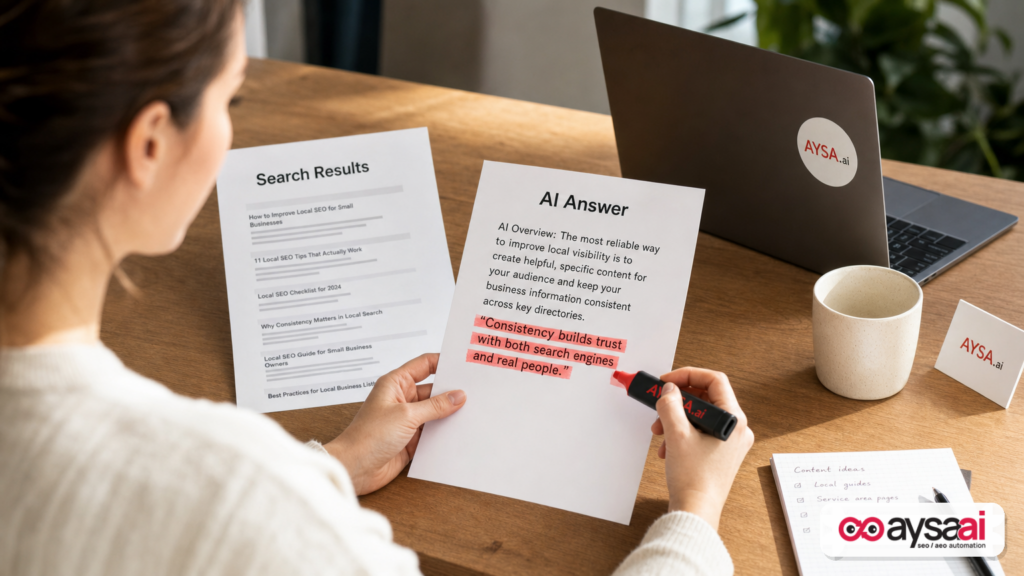
- AI citations reward clarity. The easiest thing for a model to reuse is a well-scoped answer with constraints, definitions, steps, and supporting references.
- Specific beats broad. Broad “ultimate guides” can work, but only if they’re built from specific, extractable sub-answers—otherwise they become bland and uncitable.
- Execution is the moat. Most teams can agree on strategy; most teams fail at implementing the site changes, internal links, page structure, and Monitoring needed to compound gains.
- AYSA fits at the execution layer. You monitor AI search visibility, prepare recommended improvements, request approval, and execute the accepted changes—without content chaos or endless ticket queues.
Key takeaways (what to do differently this quarter)

- Pick fewer topics, but narrow them until the “answer” can fit in 5–12 sentences without losing truth.
- Write pages that include constraints (who this applies to, when it doesn’t, and what assumptions are required).
- Build a “citation stack”: clear structure + corroboration + internal policy pages + consistent entity signals.
- Stop publishing vague content that forces AI to infer. If AI has to infer, it will either avoid citing you or cite someone else.
- Implement an execution workflow that actually ships improvements (monitor → propose → approve → deploy).
Table of contents

- The real shift: from “ranking pages” to “being used as a source”
- Why specificity wins in AI search (even when traffic is down)
- What “specific” actually means (and why it’s different from “long”)
- How AI systems decide what to cite (and what they avoid)
- The “citation stack”: what AI systems look for when deciding what to reuse
- Content types that earn citations: patterns you can deploy
- Where specificity goes wrong: the 7 most expensive mistakes
- A concrete SME scenario: a local clinic trying to win AI answers (without becoming a publisher)
- What agencies should rethink: deliverables, not decks
- Measurement: what to track when clicks aren’t the only win
- Where AYSA fits: approved execution for AI search readiness
- 90-day action plan: ship specificity at scale
- What to do next
- Sources and further reading
The real shift: from “ranking pages” to “being used as a source”
Classic SEO is built on a simple exchange: you publish a page, Google ranks it, the user clicks, and you get an opportunity to convert. That model still matters—but AI has added a new layer where the user may get an answer without visiting your site.
From the business side, that can feel like theft. From the search side, it’s a new interface. Either way, the practical implication is clear: your content now has two audiences:
- Humans scanning, comparing, and deciding.
- Machines extracting, summarizing, and attributing (sometimes via citations, sometimes not).
Search Engine Journal’s coverage highlights a point I want every operator to internalize: when your content is specific enough, it becomes easier for AI systems to reuse and cite. That’s not “SEO magic.” It’s a byproduct of how language models reduce uncertainty: they prefer tight passages that look complete on their own.
Practically, this re-frames “ranking” as only one outcome. The other outcome is being referenced—in AI answers, AI Overviews, and assistant-style experiences.
If you want an operational definition of the new game, it’s this:
- Old game: Build pages that win clicks.
- New game: Build pages that are safe to quote.
Why specificity wins in AI search (even when traffic is down)
Most SMEs and even many mid-market teams are reacting to AI search the wrong way. They see declining CTR in some queries and respond with more content volume. More blog posts. More “ultimate guides.” More “top 10” lists.
That’s a rational reaction—if your goal is to flood the index.
But in AI search, content volume isn’t the bottleneck. The bottleneck is reusability. AI systems summarize. They compress. They stitch together multiple sources. And when they cite, they cite sources that provide compact certainty—the kind you get from specificity.
Specific content helps in three ways:
- It reduces ambiguity. When you narrow scope, you reduce the number of possible interpretations.
- It improves extractability. A model can lift a tight paragraph, a short list of steps, a definition, or a constraint statement without rewriting everything.
- It increases accountability. Specific claims can be checked. Vague claims can’t, and AI systems often avoid citing what they can’t anchor.
One subtle point: “specific” isn’t just a content tactic. It’s a business tactic. The businesses that win in AI search will often be the ones with the most explicit policies, clearest documentation, and best owned explanations of how they operate.
What “specific” actually means (and why it’s different from “long”)
Let’s separate two ideas that get confused:
- Long content is about length.
- Specific content is about scope and constraints.
You can be long and still be vague. You can be short and still be specific.
Here’s a practical test I use:
- If you remove 30% of the words, does the content still say the same thing? If yes, it might be padded.
- If you ask “When would this not apply?” and the page can’t answer, it’s probably too broad.
- If you ask “What exact decision does this help someone make?” and the page can’t answer, it’s probably not specific enough.
Specific content typically includes:
- Definitions (what a term means in this context)
- Assumptions (what must be true for this guidance to apply)
- Constraints (what this doesn’t cover)
- Steps (what to do, in order)
- Examples (one realistic scenario)
- References (internal policy pages, official documentation, reputable sources)
That structure isn’t just good for readers. It’s friendly to machine extraction.
SEJ’s piece also mentions the writing discipline of cutting off-topic sections. That matters more now than ever. AI systems don’t “enjoy” your detours. Detours create conflicting signals and decrease the chance a model will quote you cleanly.
How AI systems decide what to cite (and what they avoid)
I’m not going to pretend we have full transparency into every AI search engine’s citation logic. We don’t. But we can infer patterns from how LLMs behave and from what Google and others have publicly said about usefulness and quality.
In the SEJ story, Google’s John Mueller re-shared the discussion and emphasized making “insightful & useful stuff.” That aligns with Google’s broader guidance that content should help users and demonstrate quality. (SEJ’s coverage is the reference point here.)
What does “useful” mean in AI citation terms?
- Answer completeness: the passage stands on its own without needing five other pages.
- Low hallucination risk: fewer gaps that force the model to guess.
- Stable meaning: if summarized, the meaning doesn’t change.
- Corroboration: ideally, the claims can be validated (either via reputable external sources or consistent internal documentation).
What do AI systems avoid citing?
- Generic advice that could have been written for any business
- Unclear authorship (no accountability cues)
- Overly promotional copy (reads like an ad, not a source)
- Contradictory pages across the same site (policies and facts don’t match)
Even if your site ranks, if your content can’t be extracted safely, you may be present but not cited. That’s a new form of invisibility.
The “citation stack”: what AI systems look for when deciding what to reuse
Think of AI citations as the output of stacked layers. You don’t need perfection at every layer, but weak layers compound.
Layer 1: A tight question and a tight answer
Start with the question you’re answering. Not a keyword, a question. Make the first 10–15% of the page deliver a direct answer that is:
- Specific
- Actionable
- Bounded (with constraints)
Layer 2: Structure that machines can parse
Use obvious headings, short paragraphs, and lists where appropriate. You don’t need to write for robots; you need to write in a way that reduces parsing ambiguity.
Layer 3: Internal corroboration (your policy pages)
Many SMEs underinvest in “boring pages”:
- Shipping / returns / warranties
- Pricing explanation
- Service area boundaries
- Appointment, cancellation, and eligibility policies
- What’s included vs not included
These pages are often the most cite-worthy because they are factual and specific. They also reduce the chance that an AI assistant will invent your policy.
Layer 4: External credibility (where possible)
When you can, point to primary or reputable sources—manufacturer documentation, standards bodies, government resources, or widely accepted references. If you can’t, be honest about what’s your internal policy vs what’s a general guideline.
Important constraint: In this editorial environment, I’m not going to fabricate a list of official documents that aren’t present in the provided research context. If your business operates in a regulated space (health, finance, safety), you should add primary sources that match your jurisdiction and services.
Layer 5: Off-site signals (links and mentions still matter)
The SEJ story includes a crucial ingredient: people linked to the content, and then AI started reflecting it. That doesn’t mean you need a “viral” campaign. It means citations are more likely when your content becomes referenced by others.
Links are still a proxy for being used and valued on the web. In AI search, that becomes a proxy for being safe to reuse.
Content types that earn citations: patterns you can deploy
Specificity isn’t only a topic choice—it’s a content design pattern. Here are the page types I’ve seen perform best in “AI answer” environments, regardless of industry.
1) Decision FAQs (not marketing FAQs)
Most FAQ pages are fluff. A decision FAQ answers the questions people ask right before converting, complaining, or cancelling:
- “Do you ship refrigerated items to Arizona in July?”
- “Can I change my appointment type after booking?”
- “What happens if my package is delayed?”
These are specific enough that AI can quote them directly, and they reduce customer support load.
2) Policy pages that are written like reference docs
Policies should be written like a contract someone can understand—not like a legal smokescreen. Use:
- Plain English
- Examples
- Edge cases
- Last updated date (where appropriate)
3) “X vs Y” pages that state constraints and tradeoffs
Comparison pages are citation magnets—if you do them honestly. Don’t just say your product is better. Explain:
- Who should choose option A
- Who should choose option B
- What assumptions drive the recommendation
This makes your content reusable even by an assistant trying to be neutral.
4) Troubleshooting and “why it happens” guides
AI systems love troubleshooting content because it’s structured. Example patterns:
- Symptoms → causes → fixes
- Error message → checklist
- “If/then” decision trees
5) Location and service-area pages with operational detail
Local businesses often publish thin “We serve {city}” pages. AI systems can’t cite those because they don’t say anything. A cite-worthy local page includes:
- Exact services offered at that location
- Hours (and exceptions)
- Parking/access info
- Service boundaries (what you do not cover)
- Booking/call routing instructions
If you operate multiple locations, consistency becomes a big deal. (This is one reason monitoring AI search visibility for locations is becoming essential.)
Where specificity goes wrong: the 7 most expensive mistakes
Specificity can backfire when teams misunderstand what “specific” means and rush into tactical publishing. Here are the failures I see most often.
1) Over-narrowing into irrelevance
You can pick a topic so niche that no one asks it. The fix: anchor specificity to real customer questions (support tickets, sales calls, onsite search, reviews).
2) Being specific but unverifiable
Specific claims that can’t be supported are a liability. If you can’t support a claim, reframe it as an internal policy, a tested procedure, or an opinion—and label it clearly.
3) Fragmenting content into hundreds of thin pages
Specific does not mean “one paragraph per URL.” You need enough substance per page that it stands alone, and you need internal structure so subtopics are easy to navigate.
4) Forgetting to update specific pages
Specific pages go stale faster because they contain facts, rules, and constraints. If your return window changes, your AI footprint might keep repeating old terms. Add an operational cadence for reviews and updates.
5) Conflicting policies across the site
If your product page says one thing and your policy page says another, an AI system may quote the wrong one—or avoid citing you entirely. Consistency is a technical and editorial requirement.
6) Over-optimizing headings for keywords
Old SEO habits die hard. If your headings read like search queries rather than meaning, the content becomes less usable for humans and less quotable for machines. Write headings like a manual, not like a spammer.
7) Publishing without an execution loop
Specificity isn’t a one-and-done content project. It’s an iterative loop: monitor what AI says, fix the inputs, publish clarifications, and measure impact.
A concrete SME scenario: a local clinic trying to win AI answers (without becoming a publisher)
Let’s make this real with a scenario that doesn’t require an SEO team of 20.
Business: A local clinic with two locations and a small admin team.
Problem: Patients ask the same questions repeatedly, and AI answers online sometimes misstate the clinic’s policies (insurance eligibility, appointment requirements, cancellation windows).
Old approach: Publish a generic “FAQ” page and some blog posts about wellness topics. Maybe it ranks, maybe it doesn’t. But it rarely gets cited because it’s broad and not operational.
Specificity-first approach: Build a small cluster of reference pages written for accuracy:
- Insurance & billing policy (what is accepted, what isn’t, how pre-authorization works, what patients need to bring)
- Appointment types (telehealth vs in-person constraints, who qualifies, what tech requirements exist)
- Cancellation and late policy (time windows, fees if any, exceptions)
- Location pages with parking, accessibility info, and hours exceptions
Each page starts with a direct answer paragraph, then constraints, then steps, then examples. The clinic also links these pages from booking flows and confirmation emails (so humans use them too).
Why this helps in AI search:
- The content is factual and bounded (low risk to quote).
- It matches real user questions (high relevance).
- It reduces ambiguity, so AI is less likely to invent policy details.
What could go wrong: If the clinic doesn’t keep the pages updated, the wrong policy could spread. That’s why monitoring and an execution workflow matter as much as writing.
What agencies should rethink: deliverables, not decks
Agencies are under pressure because “content” has been commoditized. But execution hasn’t. And specificity demands execution.
Here’s what I believe agencies must change in 2026-era AI search:
Shift 1: From keyword lists to question maps
Keyword research still has value, but question mapping is closer to how AI answers are generated. Agencies should deliver:
- Prioritized question sets (by funnel stage and risk)
- The constraints needed for correct answers
- The internal pages that must exist to support those answers
Shift 2: From blog calendars to “reference libraries”
Clients don’t need 4 posts a month that say nothing new. They need a reference library that covers:
- Policies
- Specs
- Comparisons
- Troubleshooting
- Definitions
Shift 3: From recommendations to implemented changes
This is the hard part. Most agencies can write a strategy doc. Fewer can get changes shipped—especially when clients have limited dev time or messy CMS governance.
That’s where “approved execution” becomes a competitive advantage: prepare changes, ask for approval, then deploy accepted updates quickly and safely.
Measurement: what to track when clicks aren’t the only win
In AI search, you still track rankings and traffic. But you also need to track signals that reflect being referenced and reused.
At a minimum, SMEs and agencies should track:
- AI visibility: whether your brand/pages appear in AI answer experiences for your core questions
- Citations/mentions: when your domain or brand is referenced (where measurable)
- Conversion quality: leads/sales from fewer but higher-intent visits
- Support deflection: reduction in repeat policy questions (a real business KPI)
Be careful: you can’t always measure AI citations perfectly, and platforms vary. Treat measurement as directional and focus on what you can verify. This is where monitoring matters more than any single metric.
If you want a starting point for building an AI visibility workflow, see AYSA AI Search Visibility and AYSA Monitoring.
Where AYSA fits: approved execution for AI search readiness
Most teams don’t fail because they lack ideas. They fail because execution is messy:
- Content lives in Google Docs, but the site is WordPress (or worse, a custom CMS).
- SEO recommendations sit in Jira for months.
- Policies are “owned” by ops, not marketing, so nothing gets published.
- Location pages are inconsistent, and nobody notices until reviews drop.
AYSA’s role is to turn AI search strategy into a dependable execution loop:
- Monitor how you show up in AI search experiences and where gaps exist (Monitoring).
- Prepare specific, page-level recommendations—content structure, internal links, clarifications, and technical fixes.
- Ask for approval so humans stay in control (especially for policy and compliance content).
- Execute accepted changes on the website so improvements ship and compound.
If you’re building an AI-ready content program, start with AYSA AI SEO Tools, then map it to your rollout and governance model. For teams that want a clear starting point on packaging and cost, see AYSA Pricing.
For ongoing education and playbooks, browse the AYSA blog.
90-day action plan: ship specificity at scale
Here’s a practical plan you can run without turning your company into a media organization.
Days 1–15: Build your “specificity backlog”
- Collect 50–100 real questions from: sales calls, support tickets, reviews, onsite search, email threads.
- Group them into 10–20 themes (shipping, returns, eligibility, setup, compatibility, pricing, timelines).
- Identify which questions are highest risk if AI answers them incorrectly (policy, safety, compliance, pricing).
Days 16–45: Publish the first reference cluster
- Create 5–10 pages that answer the highest-risk questions with constraints and examples.
- Link to them prominently from conversion flows (checkout, booking, product pages).
- Ensure internal consistency: update older pages that contradict the new ones.
Days 46–75: Turn one broad guide into 6–12 citeable sub-answers
- Pick one “ultimate guide” that currently ranks but doesn’t convert well.
- Extract the best sections into specific standalone pages or structured sub-sections.
- Add “when this doesn’t apply” blocks to reduce ambiguity.
Days 76–90: Monitor, refine, and expand
- Monitor AI visibility for the questions you targeted.
- Fix confusing passages that could be misquoted.
- Expand into comparisons and troubleshooting pages.
This is where an execution system matters. If you can’t ship changes weekly, you’ll fall back into “strategy-only” mode and lose momentum.
What to do next
- Pick 10 questions your customers ask that require precise, policy-level answers.
- Draft 10 pages using the structure: direct answer → constraints → steps → example → links.
- Audit consistency: remove contradictions across product pages, FAQs, and policies.
- Set an update cadence (monthly for fast-changing policies; quarterly otherwise).
- Implement monitoring so you can see how AI search represents your brand and locations: AI Search Visibility and Monitoring.
- Operationalize execution: prepare changes, request approval, and deploy accepted updates—consistently.
Sources and further reading
- Search Engine Journal – AI SEO: Writing That’s Specific May Get Cited More
- Search Engine Journal – SEO category (context and related coverage)
- AYSA – AI Search Visibility
- AYSA – AI SEO Tools
- AYSA – Monitoring
- AYSA – Pricing
- AYSA – Blog
Note on sourcing: The supplied research context includes Search Engine Journal’s article and site navigation links but does not provide additional primary documentation (e.g., Google’s official AI Overviews documentation, structured data guidelines, or detailed citation policies). Where your business needs higher assurance—especially in regulated industries—add primary sources appropriate to your market and jurisdiction.
Continue the AI search topic inside AYSA.
Use these pages to connect the article with AI SEO tools, AI visibility monitoring, AI Overviews and approved website execution.
Turn this topic into a website action plan.
Use these AYSA hubs to move from reading to technical fixes, AI visibility monitoring, research, glossary context and approval-first SEO execution.

