
Summer Break Is the New Search Lab: What Google’s AI Study & Productivity Tips Reveal About Where SEO Is Headed
Google is training a generation of students to research, plan, practice, and study inside AI-first interfaces like AI Mode, Gemini, and NotebookLM-style workflows. That behavior shift is a preview of how customers will discover and choose businesses next. Here’s what changed, why it matters, and what SMEs and agencies should do now—plus how AYSA executes the fixes with approval-based automation.

College students are getting a new kind of summer homework: not from professors, but from product design. Google’s latest student-focused tips highlight how tools like Gemini and AI Mode are helping people plan internships, learn new skills, and build study guides inside AI-first workflows.
That might sound like an “education” story. It isn’t.
It’s a behavior-change story—and for anyone who depends on search (SMEs, ecommerce brands, agencies, publishers), behavior change is the whole game. When users learn to do their thinking inside an AI workspace—summaries, dashboards, conversational follow-ups, and synthesized “best options”—they click fewer links, but they make decisions faster. Your brand either becomes one of the “sources” the AI relies on, or it becomes invisible in the moment that matters.
This editorial breaks down what’s changing, why it matters, what can go wrong, and what to do next. I’ll also show where AYSA fits: an execution system for SEO/AEO/GEO that monitors, prepares changes, requests approval, and then ships accepted updates to your website—because in AI Search, strategy without execution is just vibes.
Concise summary

- Google is normalizing AI-first research (AI Mode + Canvas, Gemini, Gemini Live, Notebook-style workflows). That’s a preview of how customers will discover businesses.
- AI search rewards clarity, structure, and credibility: explicit policies, explainable claims, robust “about” signals, and content that can be reliably summarized.
- Clicks may decline while intent quality rises. SMEs should measure outcomes (leads, bookings, revenue), not just traffic.
- Monitoring becomes non-negotiable: AI answers can drift, misunderstand, or pull outdated details.
- Execution is the bottleneck. AYSA helps by turning strategy into an approval-based pipeline: monitor → recommend → approve → implement.
Key takeaways for SMEs and agencies
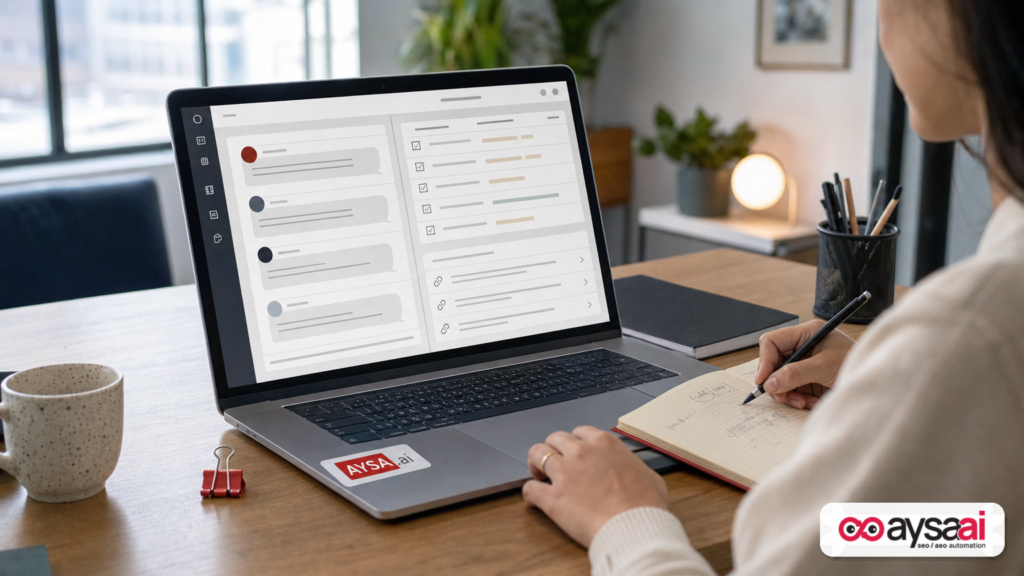
- AI Mode-style experiences train users to ask multi-step questions (“compare,” “summarize,” “build me a plan,” “what should I do next”). Your site must support follow-up depth.
- Entity trust beats clever copy. If your About, policies, and service definitions are weak, AI systems will be hesitant—or wrong.
- Content must be usable as evidence: clean structure, scannable sections, clear claims with context, and consistent details across pages.
- Agencies should productize AI visibility into monitoring + iterative execution, not one-off “AI Optimization” projects.
Table of contents
- What changed: Google is teaching users to “work inside search”
- Why it matters: new search behavior compresses the funnel
- The hidden lesson in Google’s student tips
- What businesses should build for AI-first discovery
- AEO/GEO in plain English (no hype)
- A concrete SME scenario: A local clinic and an ecommerce brand in the same AI funnel
- What can go wrong (and how to reduce risk)
- What to monitor weekly in AI-driven search
- What agencies should rethink
- The execution problem: AI visibility is rarely a single change
- Where AYSA fits: approval-based SEO/AEO/GEO execution
- 90-day action plan: from “content” to “customer-ready answers”
- What to do next
- Sources and further reading
What changed: Google is teaching users to “work inside search”
The Google Search Blog post is framed as a summer productivity guide for college students, but the underlying product direction is bigger: users are being guided toward AI-native workflows that keep the entire task inside a single experience—research, planning, drafting, and practice.
From the source, the most telling elements aren’t “productivity tips.” They’re the mental models being taught:
- AI Mode + Canvas as a workspace for dashboards and study guides—users ask for a structured output, then iterate with follow-ups.
- Gemini as a narrative and synthesis engine for resumes, cover letters, and study materials—users bring messy inputs and expect coherent outputs.
- Gemini Live as an interactive coach—users practice conversations, explain concepts out loud, and request feedback.
- YouTube Learning “Ask” as embedded Q&A—users expect summaries, quizzes, and deeper understanding without leaving the content environment.
- Lens and camera-first discovery—users shift from keyword queries to contextual, visual questions.
That is not a niche student workflow. It is a preview of mainstream search behavior: fewer open tabs, fewer “ten blue links,” and more task completion inside AI-powered experiences.
Source: Google Search Blog, “13 Google tips for a fun, productive summer off from college.”
Why it matters: new search behavior compresses the funnel
Traditional search funnels are wide and clicky:
- User searches → clicks a few results → reads pages → compares → returns → refines → converts.
AI-first search funnels are narrow and decisive:
- User asks a multi-step question → AI synthesizes → user asks follow-ups → AI refines → user chooses.
For businesses, that changes the optimization target. Historically, SEO could be “win the click.” In AI search, you also need to “win the synthesis.” That means your content must be:
- Extractable (clear sections and definitions)
- Consistent (details match across pages)
- Trustworthy (credible entity signals, policies, and proof)
- Decision-ready (pricing context, constraints, eligibility, next steps)
The student article’s “dashboard” and “study guide” examples are exactly how buyers will behave:
- “Build me a shortlist of the best options for X.”
- “Summarize the differences.”
- “What should I do next?”
If your site can’t be summarized accurately—or doesn’t contain the details required to answer those follow-ups—the AI will either avoid you or fill in blanks with other sources. Neither is good.
The hidden lesson in Google’s student tips
Let’s translate each “student productivity” concept into what it means for search and marketing.
1) Canvas/workspaces → customers expect structured outputs
When Google suggests using AI Mode with Canvas to build an internship dashboard or study guide, it’s teaching users that search results should become a project artifact: a plan, a checklist, a comparison table, a timeline.
Business implication: Your content should be ready to populate those artifacts. Not just “a blog post,” but structured information like:
- Requirements and exclusions (who it’s for, who it’s not for)
- Clear steps (“How it works”)
- Timeframes, service area, shipping/returns, warranties
- Comparison-ready differentiators
2) Notebooks/synthesis → customers bring messy context
Gemini Notebook-style guidance (upload resumes, feedback, notes, videos) normalizes a key pattern: users feed AI a pile of context and ask for “the answer.”
Business implication: Customers won’t always discover you via your perfect top-of-funnel query. They might ask AI:
- “Here are my symptoms—what kind of clinic should I book?”
- “Here’s my budget and my room size—what HVAC unit should I buy?”
- “Here’s my skin type and routine—what product fits?”
To be included, your site needs clean definitions, constraints, and “fit” language—so an AI can map user context to your offering without hallucinating.
3) Live coaching → users expect interactive clarification
Gemini Live for interview practice is essentially “conversational QA with feedback.” That’s what consumers want too: not a page, but a dialog.
Business implication: You should anticipate follow-up questions and embed them into your site architecture (FAQs, “People also ask” style sections, troubleshooting, decision trees). This is AEO in practice: answer the next question before the user asks it.
4) YouTube Learning “Ask” → content becomes queryable
YouTube’s “Ask” overlay turns video into a searchable knowledge object (summaries, quizzes, key points). The model is: every piece of content should be interrogable.
Business implication: If your product pages and service pages aren’t easy to interrogate—clear headings, plain language, unambiguous terms—AI systems and users both struggle. The winners are the sites that read like reliable documentation, not like brochures.
5) Lens and visual discovery → “keywords” are less central
Lens-style discovery means a customer can point a camera at a product, a plant, a landmark—or a problem—and ask what it is and what to do next.
Business implication: Image SEO and product metadata matter more, but not in the old “alt text stuffing” way. The priority is clear labeling, consistent product names, and contextual media that supports accurate identification.
What businesses should build for AI-first discovery
AI-first visibility is not a single tactic. It’s a “site readiness” posture.
Here’s the practical build list I recommend to SMEs and agencies in 2026, based on where Google’s own guidance is nudging user behavior.
Build #1: Customer-ready answers (not content calendars)
Most SMEs don’t have a “content problem.” They have an “answer quality” problem. Their site might have 200 blog posts, but still fail to clearly answer:
- What exactly do you do?
- Who is it for?
- What does it cost (even ranges or pricing logic)?
- What happens after I buy/book?
- What are the rules (returns, cancellations, insurance, service area)?
AI systems gravitate toward sites that reduce uncertainty. If you want to be included in AI synthesis, write like you’re reducing risk for the buyer.
Build #2: Entity credibility that can be summarized
AI answers often compress “trust” into a few lines. Your site should make those lines easy and defensible:
- Years in business (if true and stable)
- Team credentials (if relevant)
- Clear physical presence or service area
- Contact methods and escalation paths
- Policies that reduce buyer anxiety
I’m deliberately not listing stats like “X% improvement” because you shouldn’t either unless you can back them up. AI makes unverified claims more risky: if it amplifies a weak claim, you’re the one wearing it.
Build #3: Pages that map to “tasks,” not just keywords
Students are being trained to use AI to accomplish tasks: apply, learn, practice, organize. Buyers do the same: compare, choose, troubleshoot, return, renew.
Map your content to tasks such as:
- Choose: comparisons, “which is right for me,” alternatives
- Prepare: checklists, sizing/eligibility, timelines
- Use: setup guides, care instructions, best practices
- Fix: troubleshooting, error codes, “what to do if…”
- Decide: pricing logic, coverage, warranties, constraints
Build #4: Technical foundation that prevents AI misunderstandings
AI can only summarize what it can reliably parse. Technical SEO is still table stakes—maybe more than ever—because broken structure leads to broken summaries.
At a minimum:
- Clean indexation (no accidental noindex, canonicals correct)
- Fast, stable pages (avoid layout shifts that hide content)
- Clear information hierarchy (headings used properly)
- Consistent internal linking (help both crawlers and users)
AYSA’s angle here is pragmatic: monitor what matters, propose changes, and ship them with approval. More on that below.
AEO/GEO in plain English (no hype)
Two acronyms are getting thrown around:
- AEO (Answer Engine Optimization): making your content more likely to be used in direct answers and summaries.
- GEO (Generative Engine Optimization): broader optimization for generative systems that synthesize responses from multiple sources.
You don’t “do AEO” by sprinkling Q&A everywhere. You do it by:
- Writing in a way that supports faithful summarization
- Providing the constraints and definitions AI needs
- Reducing ambiguity in offers, pricing, availability, and policies
Google’s student tips are basically a playbook for future consumer expectations: AI can summarize, plan, quiz, coach, and organize. So your site needs to become a reliable source of answerable truth.
If you want the short version: clarity is the new ranking factor—not because Google says so, but because users demand it from AI experiences.
A concrete SME scenario: A local clinic and an ecommerce brand in the same AI funnel
Let’s make this real.
Scenario A: A local clinic (appointments, insurance, constraints)
A patient doesn’t search “dermatologist near me” the way they used to. Instead, they ask an AI-driven experience:
- “I have recurring eczema flare-ups. I work 9–5. I’m on X insurance. Find the best next step and what to ask during the visit.”
The AI will try to:
- Clarify urgency and contraindications
- Suggest visit types (telehealth vs in-person)
- Narrow to clinics with compatible insurance/hours
- Provide a prep checklist and questions
What makes the clinic “AI-includeable”?
- Service pages that explicitly list conditions treated and what they don’t treat
- Clear appointment types, hours, and service area
- Insurance/payment policy written in plain language
- Practitioner bios and credentials
- FAQ that answers real scheduling and prep questions
If any of these are missing, the AI will select other clinics that are easier to evaluate—or it will give generic advice that delays the booking.
Scenario B: An ecommerce brand (comparison and risk reduction)
A shopper asks:
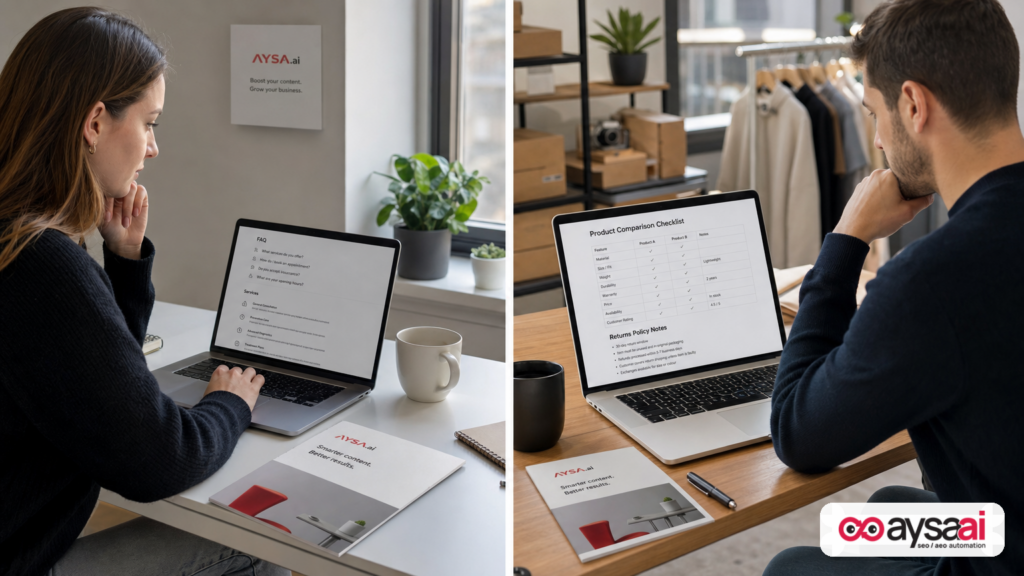
- “I need a carry-on that fits European budget airlines, durable, under $200, and I’m tall so I need a comfortable handle height. Compare top options and tell me which to buy.”
What makes the ecommerce brand “AI-includeable”?
- Product specs that are complete and consistent (dimensions, weight, materials)
- Clear compatibility constraints (“fits most overhead bins,” with specifics if possible)
- Return and warranty policies that reduce purchase anxiety
- Comparison content (or at least structured “features” sections) that helps the AI reason
- Media that supports accurate identification (images with clear angles, labeled variants)
Notice what’s not on the list: “publish 30 blog posts.” The most valuable content is the content that helps an AI (and a human) make a decision with fewer unknowns.
What can go wrong (and how to reduce risk)
AI-first discovery is powerful—but it is also fragile. When answers get synthesized, your business can be misrepresented even if your website is technically correct.
Risk #1: Outdated details get amplified
If your site has old PDFs, old pricing, or outdated hours on a forgotten page, AI summaries can surface the wrong detail because it “sounds authoritative.”
Mitigation:
- Audit for duplicate/conflicting policy statements
- Consolidate “source of truth” pages (returns, cancellations, pricing)
- Use clear “last updated” practices where appropriate
Risk #2: Ambiguity causes AI to fill in blanks
When a page says “affordable,” “fast shipping,” or “we treat most cases,” an AI may attempt to interpret what that means. That can backfire.
Mitigation:
- Replace vague adjectives with constraints and definitions
- Add ranges (“typical turnaround is…”) instead of absolutes
- State exclusions clearly
Risk #3: Regulated categories get messy
Healthcare, finance, legal, supplements—these categories require extra care. If AI summarizes incorrectly, you can create compliance risk or customer harm.
Mitigation: Don’t overpromise. Keep claims verifiable. Use prominent disclaimers where appropriate. If you can’t verify something, don’t publish it as fact.
Risk #4: Attribution and brand dilution
When answers are summarized, brand attribution can be weaker. Even if you “power” the answer, users might not remember you.
Mitigation:
- Make your brand and entity signals easy to extract (About page, consistent naming)
- Publish distinctive frameworks, checklists, and explanations that are clearly “yours”
- Create content that encourages a next step (calculator, guide, booking flow)
What to monitor weekly in AI-driven search
If AI search compresses the funnel, monitoring becomes how you protect revenue. Not “rank tracking” in the old sense—visibility and accuracy tracking across the queries that matter.
What I’d monitor weekly for an SME:
- Branded + high-intent queries: are you still discoverable when buyers are close to purchase?
- Policy questions: “returns,” “warranty,” “cancellation,” “shipping time,” “insurance accepted.” These often decide the sale.
- Comparison questions: “best X for Y,” “X vs Y,” “alternative to.”
- Local intent patterns (if relevant): “near me,” neighborhoods, service area constraints.
- Content drift: do AI summaries align with your actual offerings and constraints?
This is where AYSA Monitoring is designed to live: track visibility patterns, surface issues, and turn them into an execution queue—not a monthly PDF report nobody reads.
What agencies should rethink
Agencies are being forced into a hard pivot: away from “deliverables” (audits, keyword research decks) and toward “operating systems” (monitoring + iteration + shipping changes).
Google’s student guidance makes the direction obvious: user journeys are becoming multi-step conversations. That means clients need ongoing adjustments—new questions appear, new objections matter, new summaries surface.
Three agency resets I’d make:
Reset #1: Stop selling traffic. Sell decision coverage.
Instead of promising more sessions, promise stronger coverage of decision-driving questions:
- Eligibility
- Pricing logic
- Comparison
- Implementation / onboarding
- Risk reducers (returns, cancellations, guarantees)
Reset #2: Treat “boring pages” as premium assets.
About pages, policy pages, and FAQs are often the highest leverage for AI summaries because they contain explicit statements. Agencies should elevate them, not ignore them.
Reset #3: Package execution, not recommendations.
If your agency hands clients a list of 47 recommendations, you didn’t deliver value—you delivered homework. In AI search, speed of iteration is advantage.
This is also where an approval-based system helps: propose a change, get sign-off, ship it, log it, measure it.
The execution problem: AI visibility is rarely a single change
Most businesses want a single lever: “optimize for AI.” That lever doesn’t exist.
AI visibility is the outcome of dozens of small, compounding improvements:
- Rewrite a confusing service definition
- Add an exclusions section
- Fix an internal link so a policy page is easy to find
- Remove conflicting legacy language
- Add structured, scannable FAQs that match real conversations
- Improve category copy so products can be compared cleanly
- Align metadata and on-page copy so names and variants don’t drift
That’s why “AI SEO” can’t be a quarterly project. It needs an operating cadence.
And candidly: most SMEs fail here, not because they don’t understand the ideas, but because they don’t have time to implement consistently.
Where AYSA fits: approval-based SEO/AEO/GEO execution
AYSA is built around a simple reality: good SEO strategy dies in Google Docs.
In AI-first search, you need a system that:
- Monitors visibility and risk areas (where your business might be misrepresented or excluded)
- Prepares website changes as concrete edits (not vague advice)
- Asks for approval so stakeholders stay in control (brand, compliance, legal)
- Executes accepted changes so improvements compound week over week
That’s the “approved execution” model. It’s especially relevant for AI search because the work is iterative and cross-page: a new question emerges, you update the right sections, you monitor what happens next.
If you want to explore the approach, start here:
- AI Search Visibility (how we frame visibility beyond rankings)
- AI SEO Tools (what gets automated vs. what requires human judgment)
- Monitoring (what we track and why it matters)
- Pricing (how to evaluate ROI for ongoing execution)
- AYSA Blog (more editorials and playbooks)
90-day action plan: from “content” to “customer-ready answers”
If you’re an SME owner or a marketing lead, here’s a 90-day plan that aligns with the behavior shift Google is encouraging.
Days 1–15: Build your “AI decision coverage” map
- List your top 10 revenue-driving products/services.
- For each, write down the top 10 customer questions that decide purchase (not curiosity questions).
- Identify which questions are not clearly answered on your site.
- Identify where details conflict across pages (pricing, service area, policies).
Days 16–45: Fix the trust and clarity backbone
- Strengthen About/Contact pages so your entity is unambiguous.
- Make policies explicit: shipping, returns, cancellations, warranties, booking terms.
- Add “fit” language: who it’s for / not for, prerequisites, constraints.
- Improve internal linking so policy and FAQ pages are one click away from key landing pages.
Days 46–75: Create comparison and task content
- Add at least 3 comparison assets: “X vs Y,” “best for,” “alternatives.”
- Create at least 3 task assets: checklists, setup guides, troubleshooting.
- Ensure each asset has scannable headings and summary-friendly structure.
Days 76–90: Operationalize monitoring + iteration
- Set a weekly monitoring routine (visibility + accuracy checks).
- Turn findings into a prioritized execution queue.
- Ship small improvements weekly rather than big rewrites quarterly.
The difference between brands that win and brands that lose in AI search is not “who has the best prompt.” It’s who compounds site improvements consistently.
What to do next
- Pick one funnel stage you want AI to represent accurately (comparison, booking, returns, onboarding) and improve those pages first.
- Rewrite one “boring” page this week (returns/cancellations/FAQ/About) to reduce ambiguity and customer anxiety.
- Create one decision asset (a comparison or checklist) tied directly to revenue.
- Set up monitoring so you can detect when AI summaries drift or when your visibility changes.
- Adopt an execution cadence: weekly approved updates beat quarterly overhauls.
Sources and further reading
- Google Search Blog: 13 Google tips for a fun, productive summer off from college
- Google DeepMind blog
- Google Research blog
- Google Developers blog
- Google Cloud blog
- Google Ads & Commerce blog
- Waze blog
- Google Security blog
AYSA internal reading: AI Search Visibility, AI SEO Tools, Monitoring, Pricing, Blog.
Continue the AI search topic inside AYSA.
Use these pages to connect the article with AI SEO tools, AI visibility monitoring, AI Overviews and approved website execution.
Turn this topic into a website action plan.
Use these AYSA hubs to move from reading to technical fixes, AI visibility monitoring, research, glossary context and approval-first SEO execution.

