
The Clarity Era: SEO in 2026 Isn’t About Ranking Pages—It’s About Being Understandable to AI (and Humans)
In 2026, the SEO winners won’t be the sites with the most content or the best plugin scores. They’ll be the businesses that remove friction, structure information clearly, and build real brand signals—so AI systems can confidently retrieve, cite, and recommend them. Here’s the practical playbook, plus how AYSA turns clarity strategy into approved execution.

By Marius Dosinescu (AYSA.ai)
SEO in 2026 is less about “how do I rank a page?” and more about “how do I become the most understandable, citeable, recommendable source for a topic or task?” If that sounds like semantics, it isn’t. It’s the practical difference between a site that survives AI-driven search and a site that slowly disappears while the owner keeps “publishing more content” and wondering why nothing moves.
This editorial is inspired by Casey Markee’s argument that clarity—not plugins, word counts, or fake freshness—is the new center of gravity for bloggers and content-driven businesses. The original perspective was published at Search Engine Land. I agree with the core premise, but I want to extend it beyond bloggers into the world I spend most of my time in: SMEs, ecommerce teams, local services, and agencies trying to execute at scale without gambling their brand on unreviewed automation.
The bottom line: AI Search doesn’t eliminate SEO. It makes unclear SEO more expensive. And it rewards businesses that build clarity into content, structure, internal connections, and trust signals—then execute consistently.
Concise summary

- Search is shifting from ranking documents to assembling answers. Your content must be easy to extract, summarize, and trust.
- Clarity is the new competitive advantage. Not word count, not “SEO scores,” not gimmick schema—clarity across site structure, entities, and user journeys.
- Winning is less about publishing and more about improving. Mature SEO starts by upgrading high-signal pages using Search Console insights.
- Brands beat pages in AI-heavy SERPs. If AI systems can’t tell who you are, what you do, and why you’re credible, they’ll default to someone else.
- Execution is where strategies die. Monitoring, preparing changes, getting approval, deploying, and validating is the real work—AYSA is built to systematize that loop.
Table of contents

- What changed: from “ranking documents” to “assembling answers”
- Clarity is a ranking factor in practice (even if Google won’t call it that)
- The “new SEO rules” that actually matter in 2026
- A practical clarity framework: the 5 layers AI systems need to understand
- Rule #1: Upgrade high-value pages before you publish more
- Rule #2: Build internal connections that make your expertise obvious
- Rule #3: Fix entity clarity (what you are, who you serve, where you operate)
- Rule #4: Remove friction that blocks reading, crawling, and trust
- Rule #5: Turn “E-E-A-T” from a slogan into site behavior
- Rule #6: Build direct audience channels—because Google is rented land
- The SME scenario: a local clinic losing calls even though rankings “look fine”
- What agencies need to rethink: deliverables vs. outcomes
- What to measure now: visibility, citations, journeys, and conversions
- Where AYSA fits: clarity strategy → approved execution
- What to do next: a 30/60/90-day clarity plan
- Sources and further reading
What changed: from “ranking documents” to “assembling answers”
For most business owners, SEO historically felt like a straightforward exchange:
- A customer searches.
- Google lists pages.
- Your job is to have the best page and earn the click.
That model still exists, but it’s no longer the only model that matters. AI-enhanced search experiences increasingly behave like a task completion system:
- The query triggers follow-up questions and related intents.
- The system tries to assemble an answer from multiple sources.
- It may satisfy part of the need on the SERP.
- Then it nudges the user toward “what next” actions.
Search Engine Land described this shift in practical terms for bloggers: write not only for skimmers and distracted readers, but also for LLMs and AI systems that scan, summarize, and decide whether your content is clear enough to retrieve, cite, or ignore (source).
I’ll translate that into business language: your content now competes for inclusion in an assembled answer, not only for a top-10 blue link. If your page is confusing, bloated, or vague, it becomes hard for machines to extract reliably—and hard for humans to trust quickly.
And because these systems can “fan out” into sub-questions, you’re no longer optimizing for one Keyword; you’re competing to be the most reliable piece inside a broader decision journey.
A simple example: “best payroll software” vs. “best payroll decision”
In classic SEO, “best payroll software” meant: write a listicle, add comparisons, optimize headings, try to rank.
In AI-heavy search, the system may implicitly break that into:
- What’s the business size and country?
- Do they need contractor payments?
- Do they need accounting integrations?
- Do they need time tracking?
- What’s the next action: demo, pricing, migration checklist?
If your content is the clearest, most Structured answer for a slice of that journey, you can win even without being the “biggest brand.” If your content is generic, you lose even if you’re “optimized.”
Clarity is a ranking factor in practice (even if Google won’t call it that)
No, “clarity” isn’t a single checkbox in Search Console. It’s not a plugin. It’s not a schema type. And it’s rarely an explicit Google statement like “clarity boosts rankings.”
But clarity emerges as a compound advantage from multiple things Google does care about:
- Crawlability and renderability: If your core content is buried behind heavy scripts, intrusive overlays, or poor information architecture, systems struggle.
- Structured information: Headings, lists, tables, and consistent page templates help machines and humans extract meaning.
- Entity understanding: “Who is this business? What services/products? Where? For whom?”
- Trust and experience signals: Evidence of real experience, accurate claims, and consistent brand presence.
- UX and friction reduction: If users bounce, struggle, or can’t find the answer fast, you bleed performance.
That’s why “clarity” is not a nice-to-have. It’s the operating system for the new SEO reality.
Clarity vs. length: the uncomfortable truth
Many teams still equate “better” with “longer.” That instinct came from years where long-form pages often ranked because they tended to include the necessary subtopics.
In 2026, long can still work—but only if it’s structured. Long and messy is a liability. Long and clear is an asset.
AI systems don’t need your page to be 3,000 words. They need your page to be extractable and defensible—with clear sections, direct language, and minimal fluff.
The “new SEO rules” that actually matter in 2026
Whenever platforms shift, the market fills with gimmicks. For AI search, those gimmicks show up as:
- “AI optimization” plugins promising instant visibility
- Content scores that reward keyword repetition
- Fake freshness (“updated” dates with no substance)
- Schema spam (marking up things that aren’t on the page)
- Prompt templates sold as strategy
The Search Engine Land piece makes a strong case for ignoring the noise and focusing on better content, stronger connections, and less friction (source).
Here’s my editorial translation into “rules” that are practical for SMEs and agencies:
- Improve what already works before creating what might.
- Connect your content so expertise becomes obvious.
- Make your business legible: entities, offerings, proof, locations.
- Eliminate friction—technical and experiential.
- Build trust signals that survive summarization.
- Stop depending on one channel. Convert visitors into an owned audience.
Notice what’s missing: word count targets, “SEO score” chasing, and “one weird trick.” This is deliberate. Those tactics can decorate a strong foundation, but they can’t replace it.
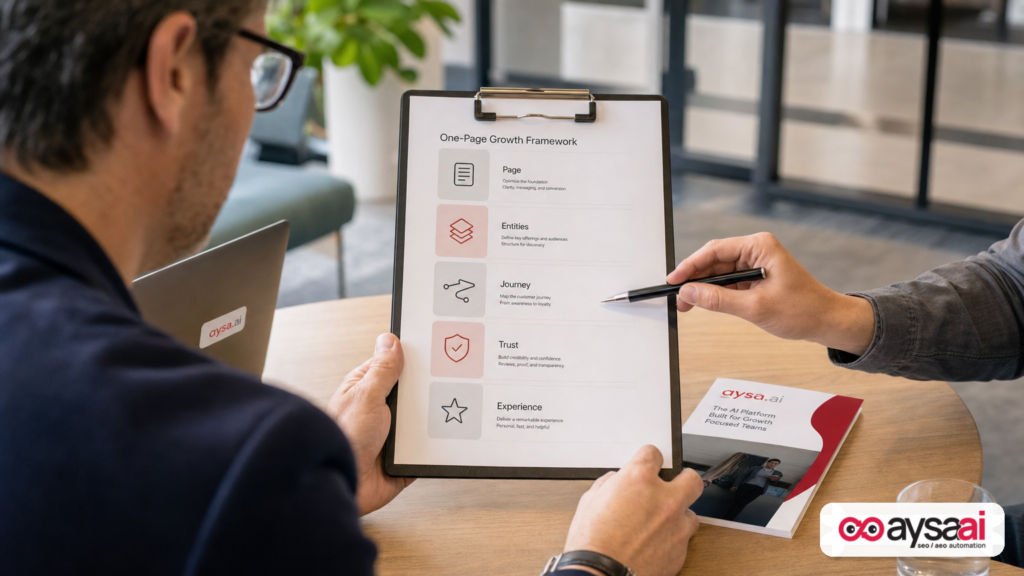
A practical clarity framework: the 5 layers AI systems need to understand
If you want a usable mental model, here it is. Your website needs clarity across five layers:
Layer 1: Page clarity (the answer is obvious)
When someone lands on a page—human or machine—can they quickly determine:
- What is this page about?
- What problem does it solve?
- Who is it for?
- What are the key steps, options, or takeaways?
If the real answer is buried under a long preamble, repeated intros, or unclear headings, you’re forcing the system to guess.
Layer 2: Entity clarity (who/what/where you are)
Entities are the “things” AI systems organize the world around: businesses, people, products, services, locations, brands, methods, ingredients, conditions, and so on.
For an SME, entity clarity means your site makes it unambiguous:
- Company name and brand consistency
- What you sell (products/services)
- Where you operate (locations, service areas)
- Who it’s for (industries, audiences)
- What makes you different (proof, positioning)
This is where many “pretty websites” fail. They look great, but they don’t say enough in straightforward language.
Layer 3: Journey clarity (how pages connect into a task)
AI-driven search experiences behave like task completion. Your website should behave the same way.
Ask: if a user starts on an informational page, can they naturally progress to:
- Comparison
- Proof
- Pricing or estimates
- How it works
- Book / buy / contact
This is internal linking and UX, but also editorial strategy.
Layer 4: Trust clarity (why you’re credible)
Trust is not a badge; it’s evidence. AI systems and users look for signals like:
- Clear authorship and expertise for advice content
- Policies (returns, shipping, warranties, editorial guidelines)
- Contact details and business legitimacy
- Accurate, consistent information across key pages
If a page makes claims but provides no evidence—no method, no testing notes, no sources, no customer outcomes—it becomes a weak candidate for recommendation.
Layer 5: Experience clarity (less friction, more completion)
Finally, the experience: speed, layout stability, intrusive elements, readability, and conversion paths.
Friction doesn’t just hurt conversion. In AI-shaped SERPs, friction can reduce the very signals that tell the ecosystem “this page helped.”
Rule #1: Upgrade high-value pages before you publish more
If your SEO plan is “publish two blogs a week,” you don’t have an SEO plan—you have a production schedule.
Mature SEO starts with triage. The Search Engine Land editorial recommends using Google Search Console to identify pages with traffic history, strong impressions, decay, seasonal upside, or rankings just outside meaningful visibility—and then improving those pages substantively (source).
That advice is even more important for SMEs because SMEs don’t have infinite topical authority or content budgets. You can’t afford to create 200 “meh” pages to find 10 winners. You need to turn your existing winners into category leaders.
How to pick upgrade targets (simple, non-SEO process)
Open Search Console. You’re looking for pages that meet at least one of these criteria:
- High impressions, low clicks: You’re visible but not chosen. That can be a clarity issue (title/description mismatch), intent mismatch, or SERP competition shift.
- Ranking 8–20: Close enough that upgrades can push into meaningful visibility.
- Revenue adjacency: Pages that influence buying decisions (pricing, comparisons, “best,” “how much,” “near me”).
- Decay signs: A formerly strong page losing clicks or impressions over time.
- High assist value: Pages that appear early in journeys but drive conversions later (top-of-funnel with strong internal paths).
What a “real update” looks like in 2026
A real update is not “change the date” or “add a paragraph.” A real update improves usefulness and clarity. Examples:
- Rewrite the introduction so the answer and audience are obvious within 5–10 seconds.
- Add a “quick answer” block (plain text) before deep detail.
- Replace generic advice with steps, ranges, decisions, and edge cases.
- Add FAQs that reflect real customer questions (from calls, tickets, sales chats).
- Add internal links that naturally progress the task (comparison → pricing → booking).
If you can’t answer “Is this page more useful today than yesterday?” you didn’t update; you just edited.
Rule #2: Build internal connections that make your expertise obvious
Internal linking used to be treated as a “nice technical thing.” In AI-driven search, it’s a meaning-making system.
Why? Because internal links (and your overall architecture) tell machines:
- What topics you cover deeply vs. superficially
- Which pages are authoritative hubs
- How concepts relate (and therefore whether you’re a credible source)
For SMEs, internal links also do something more important: they move people toward revenue without forcing them back to Google.
Internal linking patterns that work in 2026
- Hub → spoke: A core “Service” or “Category” page links to supporting guides and sub-services, and those link back.
- Decision paths: Informational guides link to “cost,” “timeline,” “requirements,” and “book” pages.
- Comparison clusters: A comparison page links to individual product/service pages and to migration/implementation guides.
- Location reinforcement (for local businesses): City pages link to relevant service pages and proof (case studies, testimonials), not just a generic contact form.
A quick note on anchor text (stop being generic)
“Click here” doesn’t help. “Learn more” doesn’t help. AI systems, crawlers, and users benefit from explicit anchors like:
- “See our roof replacement pricing guide”
- “Compare HIPAA-compliant telehealth options”
- “Read the return policy for custom bouquets”
This is clarity in micro-form: the link itself explains the relationship.
Rule #3: Fix entity clarity (what you are, who you serve, where you operate)
In the Search Engine Land ecosystem, a related piece emphasizes schema and entity gaps as a way to align content with AI search needs (Schema for AI search: identify and prioritize entity gaps). Even without going deep into markup, the strategic point is correct: AI systems reward sites that are unambiguous about entities and relationships.
SMEs routinely under-communicate their entities. Common examples:
- An agency that says “we do growth” but doesn’t explicitly list services (SEO, paid search, CRO) in consistent page structures.
- A clinic that lists treatments in a menu but has no dedicated pages explaining candidacy, risks, pricing ranges, and aftercare.
- An ecommerce store with thin category pages that don’t define the category, use cases, sizing, materials, or shipping constraints.
- A local service business that vaguely states “serving the area” without clear service areas, licensing, or response times.
Entity clarity checklist (plain-language)
On your site, make sure you can answer, in plain text:
- What is your company?
- What do you offer? (List it.)
- Who is it for? (List segments.)
- Where do you operate? (Cities/regions.)
- What proof supports quality? (Methods, credentials, reviews, case studies.)
Then make sure those answers appear consistently across the site—not buried in a footer or a single About page.
Schema note (no gimmicks)
Structured data can help reinforce clarity, but only if it matches what users can see. Marking up things you don’t actually show is not “optimization”—it’s risk.
If you need official implementation guidance, use Google’s structured data documentation (not included in the provided research context). If that documentation isn’t in your internal process today, be cautious: start with content and architecture, then add markup once your on-page content is accurate and stable.
Rule #4: Remove friction that blocks reading, crawling, and trust
Friction is anything that makes it harder for a user (or crawler) to access and understand the content.
The Search Engine Land editorial calls out clutter, filler, popups, and redundant visuals that make readers dig for the answer (source). For SMEs, friction shows up differently but the harm is the same.
Common SME friction patterns
- Homepage as a vibe: Beautiful hero, vague messaging, unclear offerings.
- Service pages without specifics: No process, no deliverables, no pricing guidance, no FAQs.
- Lead forms that ask too much: Users bounce before submitting.
- Intrusive interstitials: Popups that cover the content before the user gets value.
- Thin “location pages”: Same text with city swapped.
- Broken journeys: Great blog post → no next step.
Friction fixes that are “boring” but high-impact
- Put the primary answer and primary CTA above the fold (without being aggressive).
- Add a table of contents to long pages.
- Make pricing guidance clearer (even if it’s ranges and factors, not exact numbers).
- Use comparison tables for decisions.
- Reduce template bloat: fewer repeated blocks, fewer redundant sections.
In AI-heavy search, being “nice to read” is not an aesthetic preference; it’s retrieval strategy.
Rule #5: Turn “E-E-A-T” from a slogan into site behavior
Many teams talk about expertise and trust, but their websites don’t behave like trustworthy systems.
Trust clarity looks like:
- Specificity over slogans: “We’re the best” becomes “Here’s our process, what’s included, and what results look like.”
- Evidence over adjectives: Credentials, certifications, methodologies, case studies, before/after (where appropriate), and clear policies.
- Consistency: The same business name, address, phone, hours, and service descriptions across key pages.
- Editorial integrity: Clear authorship for advice content; reviewed/updated notes when facts change.
If your site is going to be summarized by AI, you need your trust signals to be summary-safe. That means they should be visible, explicit, and hard to misinterpret.
A caution for YMYL topics (health, finance, legal)
If your business touches health, finance, or legal outcomes, you should be more conservative. Don’t let automation add claims. Don’t let templates publish advice without review. Trust is slow to earn and fast to lose.
This is one reason I’m opinionated about approved execution: AI can prepare changes, but humans must approve anything that could be construed as a claim.
Rule #6: Build direct audience channels—because Google is rented land
The Search Engine Land editorial makes a point that every operator should internalize: you don’t own Google traffic. A ranking can vanish, a SERP layout can change, and AI experiences can satisfy more of the query on the SERP (source).
So the question becomes: once someone discovers you, how do they come back without needing Google?
Owned and semi-owned channels that actually work for SMEs
- Email: simplest, highest control, still undervalued.
- SMS (where appropriate): powerful but requires careful consent and frequency control.
- YouTube / short-form video: strong for demonstration and trust, especially local services and ecommerce.
- Community: groups, webinars, workshops, memberships for certain niches.
- Branded search: not a channel you “set up,” but a result of building a brand people remember.
SEO should be your discovery engine—not your only engine.
The SME scenario: a local clinic losing calls even though rankings “look fine”
Let’s make this concrete.
Scenario: A local clinic ranks top-3 for several non-branded queries: “sports injury doctor,” “knee pain treatment,” “physical therapy near me.” The owner feels “SEO is good.” But phone calls and bookings decline.
What happened?
- AI experiences in search start answering basic “what is it / what to do” questions on the SERP.
- Users now click fewer “basic explainer” pages.
- The clinic’s pages are generic (definitions, common symptoms) and don’t clearly show: candidacy, treatment pathways, appointment expectations, costs, and proof.
- Competitors provide clearer next steps (pricing ranges, doctor bios, treatment timelines, patient prep checklists).
The result: rankings “look fine” but the journey underperforms. Visibility does not convert into action.
A clarity-first fix (what I’d do)
- Upgrade top pages with a 30-second “What to do next” section: when to book, what to bring, what to expect.
- Create/upgrade doctor and clinician pages with clear expertise and scope.
- Build a treatment pathway cluster (symptom → diagnosis → treatment options → recovery → booking).
- Improve internal linking so informational pages lead to specific booking options.
- Remove friction: simplify forms, reduce popups, strengthen contact clarity.
That’s not “AI optimization.” That’s clarity, executed.
What agencies need to rethink: deliverables vs. outcomes
Agencies are under pressure because clients are asking, “Why did traffic drop?” and agencies are tempted to answer with activity: more posts, more keywords, more audits.
In 2026, the agency deliverable that matters is not “a content calendar.” It’s:
- What pages will we upgrade?
- What friction will we remove?
- What internal connections will we build?
- What entity gaps will we close?
- What proof will we add to make claims defensible?
- What monitoring will detect shifts early?
Execution becomes the differentiator. Not ideas—deployment.
The silent killer: the “recommendations graveyard”
Most SEO programs fail in the same place: the gap between analysis and implementation. Audits become PDFs. Backlogs grow. Dev teams get busy. Content writers churn new posts because it’s easier than editing old ones. And nothing changes on the site.
This is exactly the gap AYSA is designed to close: monitor what’s happening, prepare specific changes, ask for approval, then execute accepted updates and validate impact.
If you want to see the product surface area, start here: AYSA AI SEO tools and monitoring.
What to measure now: visibility, citations, journeys, and conversions
Clicks still matter. But if you only measure clicks, you can miss the real story: AI search can change where value is created.
Here are KPI categories that better reflect the 2026 landscape:
1) Search visibility beyond rank
- Impressions trends (by query class)
- Branded vs. non-branded demand
- Page-level visibility stability
2) Engagement quality and journey completion
- Scroll depth on key pages
- CTR from internal links (“next step” clicks)
- Conversion rate by landing page type (info vs. commercial)
3) AI search visibility (where possible)
Many businesses now care about whether they are recommended or cited in AI experiences. Search Engine Land has related coverage on AI search behavior and visibility measurement topics (for example, “AI-driven personalized search: A practical guide,” though the full content is not included in the provided extract: Read the source article on searchengineland.com).
At AYSA, this is an explicit focus: AI search visibility. The operational idea is simple: if AI systems are shaping discovery, you need to monitor where you show up, where you don’t, and what competitors have that you lack.
4) Operational SEO metrics (execution health)
- Time from insight → change deployed
- Number of critical pages reviewed per month
- Approved change rate (how often stakeholders say yes)
If your implementation cycle takes 90 days, you can’t adapt to an environment that shifts monthly.
Where AYSA fits: clarity strategy → approved execution
AYSA’s role in this new SEO era is not to “generate content” for the sake of volume. It’s to turn clarity into an operating system:
- Monitors visibility and site signals so you catch changes early (Monitoring).
- Prepares specific recommended improvements (content structure, internal links, clarity fixes, technical cleanup).
- Requests approval so nothing risky goes live without human sign-off.
- Executes accepted changes to the website—closing the gap between “knowing” and “doing.”
This matters because clarity is not a one-time project. It’s continuous maintenance: upgrading high-signal pages, refining internal connections, updating facts, and reducing friction as the business evolves.
If you want to understand how we think about the toolchain and workflows, start with:
Why “approved execution” is not a buzzword
In a world where AI can draft, summarize, and propose, the temptation is to auto-publish everything. That’s a mistake for most real businesses.
Approved execution is how you get speed and control:
- Marketing gets leverage and throughput.
- Founders keep messaging aligned.
- Compliance-sensitive industries reduce risk.
- Agencies can ship improvements without endless back-and-forth.
The businesses that win won’t be the ones with the most “AI.” They’ll be the ones with the best system for turning insight into safe, consistent execution.
What to do next: a 30/60/90-day clarity plan
If you’re an SME or agency, here’s a plan you can actually run without a huge team.
First 30 days: diagnose clarity and pick battles
- Export top pages by impressions and by conversions (Search Console + analytics).
- Pick 10 “money-adjacent” pages to upgrade (services, categories, pricing, comparisons, top guides).
- For each page, write (in one sentence): “This page helps who do what.” If you can’t, you have a clarity problem.
- Identify missing entity pages (services, products, locations, policies, proof).
Next 60 days: upgrade, connect, remove friction
- Rewrite introductions and headings for directness.
- Add quick-answer sections, decision tables, and FAQs based on real questions.
- Build internal linking paths from informational content to commercial actions.
- Reduce intrusive elements that block reading and crawling.
By 90 days: operationalize and monitor
- Create a recurring cadence: every month, upgrade 5–10 high-signal pages.
- Establish approval rules for sensitive content changes.
- Track outcomes: conversions, assisted conversions, branded demand, and page-level stability.
- Adopt a monitoring system so you detect shifts early (not after revenue drops).
If you want a system to support this loop end-to-end—monitoring, preparation, approval, and execution—evaluate AYSA here: AYSA pricing.
What to do next (action list)
- Pick 10 pages that matter. If you don’t know which, start with Search Console: high impressions, low clicks; rank 8–20; pages tied to revenue.
- Rewrite for instant understanding. Make the “who/what/next step” obvious above the fold.
- Add decision support. Tables, checklists, troubleshooting, pricing factors—whatever reduces uncertainty.
- Strengthen internal paths. Link informational pages to “cost,” “compare,” “book,” “buy,” and proof pages with explicit anchor text.
- Close entity gaps. Ensure services/products/locations/policies and proof are represented in dedicated, indexable pages.
- Reduce friction. Remove or delay intrusive popups; simplify forms; improve readability.
- Set up monitoring + execution cadence. Treat SEO like operations, not a campaign.
Sources and further reading
- Search Engine Land: The new SEO rules for bloggers in 2026: Why clarity matters in AI search
- Search Engine Land: Schema for AI search: How to identify and prioritize entity gaps
- Search Engine Land: AI-driven personalized search: A practical guide
- Search Engine Land: ChatGPT topic ownership is rare, and SEO alone doesn’t explain it
- Search Engine Land: 4 types of content decay and how to fix each one
- AYSA: AI search visibility
- AYSA: Monitoring
- AYSA: AI SEO tools
- AYSA: AYSA blog
Note: Where this editorial discusses broader Google documentation (e.g., structured data implementation specifics), it does so cautiously because those official sources are not included in the provided research context. If you’re implementing technical changes, validate against official documentation and your own legal/compliance requirements.
Continue the AI search topic inside AYSA.
Use these pages to connect the article with AI SEO tools, AI visibility monitoring, AI Overviews and approved website execution.
Turn this topic into a website action plan.
Use these AYSA hubs to move from reading to technical fixes, AI visibility monitoring, research, glossary context and approval-first SEO execution.

