
Standard Shopping Gets Maximize Conversion Value: What It Really Changes (and How to Use It Without Losing Control)
Google is rolling out Maximize Conversion Value bidding for Standard Shopping without requiring Target ROAS. That small-sounding switch changes how ecommerce teams can structure campaigns, test automation, and keep transparency—without forcing feed-only Performance Max as a workaround.

Google just removed a surprisingly annoying constraint for ecommerce advertisers: Standard Shopping campaigns can now use Maximize Conversion Value bidding without being forced to set a Target ROAS. That sounds like a small settings tweak, but in day-to-day paid search management it changes how you can structure campaigns, test automation, and keep the transparency many teams still prefer in Standard Shopping.
This editorial breaks down what changed, why it matters, how it affects Standard Shopping vs. Performance Max decisions, what can go wrong (especially with messy conversion value tracking), and a practical rollout plan you can use without gambling revenue. I’ll also explain where AYSA fits as an execution system: we monitor, prepare, ask for approval, and implement accepted website changes so your ads and your site evolve together.
Concise summary
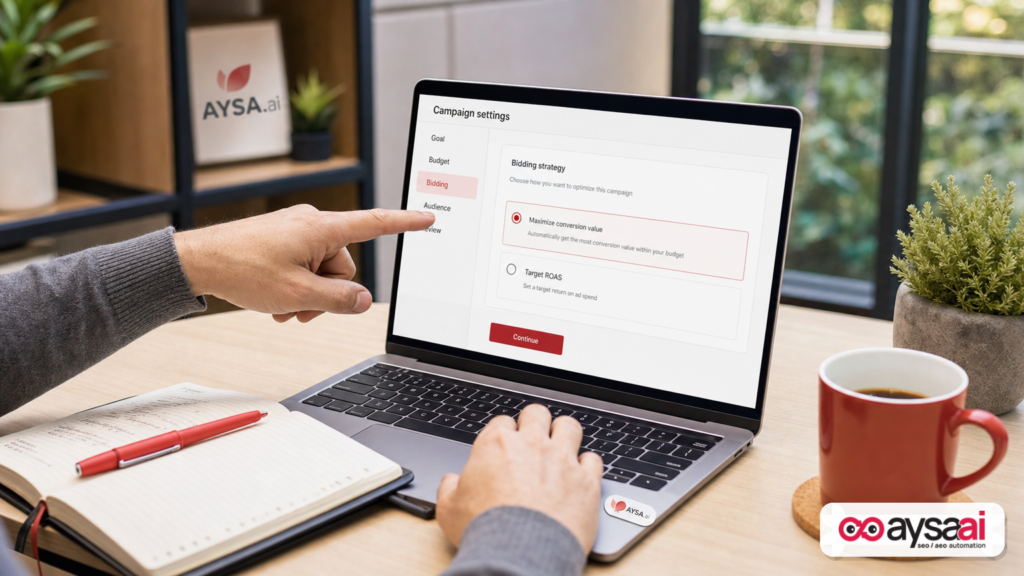
- What changed: Google is rolling out Maximize Conversion Value for Standard Shopping without requiring a Target ROAS.
- Why it matters: Many advertisers used feed-only Performance Max as a workaround to get value-based bidding without a ROAS constraint. That workaround may now be unnecessary for some accounts.
- The real opportunity: You can pair Standard Shopping’s control/transparency with a more flexible value-optimization strategy.
- The big risk: If your conversion value is wrong (refunds, shipping, duplicate purchases, lead values, etc.), “maximize value” will scale the wrong thing faster.
Key takeaways (for busy owners and operators)

- If you avoided Standard Shopping because value-based bidding felt “locked behind ROAS,” that gap is narrowing.
- If you ran feed-only PMax mainly to access Maximize Conversion Value without a ROAS constraint, you may be able to simplify.
- Don’t treat this like a set-and-forget upgrade. Treat it like a controlled experiment with guardrails.
- Before switching, validate conversion value tracking and business rules (discounts, returns, taxes, shipping, multiple conversions).
Table of contents

- The change in plain English (and why it’s not just a checkbox)
- Context: why Standard Shopping never fully went away
- Why this matters: Standard Shopping vs. Performance Max, for real businesses
- What Google is really doing (between the lines)
- The hidden risk: “Maximize value” can optimize the wrong thing if your measurement is messy
- Who should use Maximize Conversion Value in Standard Shopping (and who should wait)
- A practical rollout plan: how to test this without tanking revenue
- Campaign structure ideas that make this work
- Why your feed and your site matter more when bidding optimizes for value
- Concrete SME scenario: a home goods store cleaning up “value” and getting predictable growth
- What agencies should rethink (reporting, incentives, and control)
- Where AYSA fits: closing the execution gap between ads, content, and measurement
- What to do next
- Sources and further reading
The change in plain English (and why it’s not just a checkbox)
Historically, if you wanted Google to optimize a Shopping campaign for higher revenue (not just more orders), you often ended up in a bidding conversation that included Target ROAS. That’s a strong constraint: you’re telling the system, “Get me the most value you can, but you must hit this return.”
Now Google is rolling out a way to run Standard Shopping with Maximize Conversion Value without requiring that Target ROAS constraint. In practice, that means:
- You can tell the system “prioritize value,” while letting it flex more aggressively as it learns.
- You can keep Standard Shopping’s structure (and, for many advertisers, its perceived transparency and control) while still benefiting from value-based automation.
- You can potentially avoid building (or maintaining) a feed-only Performance Max campaign solely to access value-based bidding behavior without setting a ROAS target.
The original reporting of this change came from Search Engine Land, which framed it as Google narrowing a key feature gap between Standard Shopping and Performance Max.
Context: why Standard Shopping never fully went away
Standard Shopping has survived multiple waves of “new shiny object” campaign types for a simple reason: plenty of businesses want a bounded system. They don’t want to wonder where ads showed, why budget moved, or what combination of placements drove a result. And they especially don’t want a black box when margins are tight.
In parallel, Google’s product direction for years has been clear: automate more, broaden more, and let bidding and creative systems do more of the work. Performance Max (PMax) is a major expression of that direction. Google keeps adding experiments and management features across Ads—Search Engine Land has also recently covered topics like new Performance Max experiment types (Microsoft, not Google, but indicative of the market trend toward “automation with testing harnesses”) and other Google Ads interface and policy changes.
Even if you love automation, Standard Shopping’s persistent appeal is understandable:
- Business operators can reason about it. SKUs, product groups, priorities, negatives, and budget allocation are more explicit.
- Teams can build cleaner tests. It’s easier to isolate variables when fewer “surfaces” are bundled together.
- Organizations can keep governance. Many brands have internal rules about where ads can show and how data is used.
This update is important because it removes a historical “pressure point” that nudged value-focused advertisers away from Standard Shopping and into PMax—even when they didn’t want the rest of what PMax implied.
Why this matters: Standard Shopping vs. Performance Max, for real businesses
Let’s talk about how this shows up in the real world, not in a product announcement.
The “feed-only PMax” workaround
Many advertisers who wanted to optimize for revenue (conversion value) but didn’t want to be pinned to a specific ROAS target used a workaround: create a Performance Max campaign that is effectively feed-only (or close to it), sometimes limiting creative assets and treating it primarily as a Shopping engine rather than a true multi-surface campaign.
Why do that? Because it gave access to a specific automated bidding behavior for value, without the feeling of “handcuffing” the system to a target that might be too aggressive early on, too conservative during seasonality, or simply unrealistic during learning.
If Standard Shopping can now do Maximize Conversion Value without tROAS, that workaround can become optional—at least for accounts whose primary goal is Shopping performance with clearer knobs and dials.
The real decision isn’t “Standard vs. PMax”—it’s governance vs. velocity
Most SMEs and many mid-market brands aren’t debating campaign types as a hobby. They’re trying to answer:
- How do we grow without losing margin?
- How do we scale without surprises?
- How do we automate without outsourcing judgment?
This change helps because it allows a hybrid posture: automate the bidding goal (value) while keeping more explicit campaign structure.
What Google is really doing (between the lines)
If you zoom out, this update looks like part of a broader theme: reduce reasons advertisers resist automation by bringing key features to the places they still feel comfortable.
Standard Shopping has long been a “comfort zone” for many ecommerce teams. Adding Maximize Conversion Value without requiring Target ROAS does two things at once:
- It narrows the feature gap so fewer advertisers feel forced into PMax just to access value-based bidding behavior.
- It increases adoption of value signals across more accounts, which (from Google’s point of view) improves the ecosystem of conversion value modeling.
Search Engine Land’s write-up also notes that this was first spotted by a marketer sharing the option publicly (a reminder that Google Ads changes often appear gradually and unevenly across accounts). If you don’t see it in your account yet, it may simply not have rolled out to you.
The hidden risk: “Maximize value” can optimize the wrong thing if your measurement is messy
Here’s the blunt truth: value-based bidding is only as good as the value you feed it.
When you switch from “get me as many conversions as possible” to “get me as much conversion value as possible,” you’re telling the system that the number attached to each conversion is the truth. If that number is inflated, inconsistent, duplicated, or disconnected from profit, the algorithm will do exactly what you told it to do—just faster than you can manually notice.
Common conversion value tracking failures to check before you switch
- Refunds and returns: If you sell products with high return rates, gross revenue value can be misleading. If your platform reports purchase value but you never reconcile returns, bidding may scale categories that look valuable but are net-negative.
- Shipping and tax included inconsistently: If conversion value sometimes includes shipping/tax and sometimes doesn’t, your “value” signal becomes noisy and can skew optimization.
- Discounts and coupons: Are you reporting pre-discount or post-discount revenue? Either can be valid—just don’t mix them.
- Duplicate conversions: Double-firing purchase events or counting the same order multiple times can lead to “phantom revenue,” which value-based bidding will chase aggressively.
- Lead gen value approximations (if applicable): If you use Shopping for leads (less common but possible in some verticals), assigning arbitrary values to leads without calibration can distort bidding.
Revenue isn’t profit (and Google optimizes what you measure)
Google Ads bidding strategies optimize toward the goals you define in the platform. If your conversion value is simply “order total,” then the system is incentivized to find higher order totals—even if those orders come from products with:
- thin margins,
- high fulfillment costs,
- high return rates, or
- inventory constraints that create customer service problems.
This isn’t an argument against Maximize Conversion Value. It’s an argument for tightening measurement and being explicit about what “value” means for your business.
Who should use Maximize Conversion Value in Standard Shopping (and who should wait)
This is not a universal “turn it on today” recommendation. Here’s a grounded way to decide.
Good fit: when this is likely to help
- You sell products with meaningful variation in AOV (average order value) and want the system to prioritize higher-value purchases.
- Your Conversion tracking is stable and you trust reported revenue directionally.
- You prefer Standard Shopping’s structure and you’ve been reluctant to rely on PMax for governance reasons.
- You have enough data for learning (this is relative; the main point is consistency, not just volume).
Proceed carefully or wait: when this can backfire
- Your conversion value is not reconciled (returns, refunds, cancellations, duplicate events).
- Your catalog has extreme margin differences and you’re not able to reflect that in value signals or campaign segmentation.
- You’re highly seasonal and your value signals swing hard without clear guardrails.
- You’re still fixing fundamentals like product feed hygiene, price competitiveness, or landing page conversion issues.
If you’re in the “wait” group, the best move may be to use this update as motivation to clean up measurement and site experience first—then adopt the bidding change with confidence.
A practical rollout plan: how to test this without tanking revenue
Most advertisers fail with bidding experiments because they change too many variables at once, panic too early, or don’t set guardrails. Here’s a safer plan you can actually run.
Step 1: Confirm your value signal is consistent
Before you touch bidding:
- Verify purchase values align with what your ecommerce platform reports (directionally, not necessarily perfectly).
- Check for duplicate purchase events (common after theme/app changes).
- Decide a rule for discounts/shipping/tax and stick to it.
If you’re not sure how, start with a Monitoring routine. AYSA can help here by continuously watching key pages and conversion-critical elements and surfacing change recommendations, then executing approved fixes. See how we approach monitoring at AYSA Monitoring.
Step 2: Start with a controlled slice of the catalog
Don’t flip your entire account on day one. Choose a segment where:
- pricing and margin are relatively consistent,
- conversion volume is stable, and
- inventory is healthy.
This can be a product category, a set of brands, or a best-sellers group—whatever makes sense in your product taxonomy.
Step 3: Set guardrails that reflect business reality
Even without Target ROAS, you still control budgets, priorities, and (in many setups) query sculpting via negatives and structure. Guardrails can include:
- daily budget caps,
- inventory-based exclusions,
- category segmentation (so one group can’t cannibalize all spend),
- clear definitions of what counts as success (not just “more revenue”).
Step 4: Review on a cadence, not on emotion
Automated bidding systems learn. If you check performance every hour and keep intervening, you can sabotage the learning process. Instead:
- Pick a review cadence (e.g., 2–3 times per week for SMEs).
- Track a small set of metrics: revenue (value), spend, conversion count, and a business KPI like margin proxy or return rate if you can.
- Document changes (bids, budgets, feed updates, promo launches) so you don’t misattribute results.
Step 5: Keep a rollback plan
Plan how you would revert if performance degrades. A rollback plan is not pessimism; it’s operational maturity.
Campaign structure ideas that make this work
Maximize Conversion Value without tROAS changes how you might think about segmentation. The goal is to avoid letting the algorithm optimize toward “big numbers” that aren’t good business.
Structure by margin bands (if you can’t pass profit as value)
If you can’t send profit-based values (often hard for SMEs), a practical proxy is to segment by margin tiers:
- High-margin products
- Mid-margin products
- Low-margin products
Then apply Maximize Conversion Value within each tier. This doesn’t make the system profit-aware, but it reduces the chance that low-margin high-price SKUs consume the entire budget.
Structure by inventory and operational constraints
Value-based bidding can scale demand quickly. If your operations can’t fulfill spikes in certain categories, segment them out so you can set budgets and pacing that match capacity.
Structure by AOV variance (where the “value” signal is actually meaningful)
If a category has nearly identical price points across all SKUs, Maximize Conversion Value may behave similarly to Maximize Conversions. Put your effort where value variance is real.
Why your feed and your site matter more when bidding optimizes for value
Automated bidding is often discussed like it’s separate from creative and UX. In ecommerce Shopping, that’s a mistake. When the system optimizes for value, it will seek out users, queries, and contexts that it believes lead to higher-value purchases. Whether those purchases happen depends heavily on:
- Feed quality: titles, attributes, product types, GTINs, images, and price accuracy.
- Landing page clarity: shipping, returns, financing, availability, and trust signals.
- Merchandising: bundling, upsells, and cross-sells can change conversion value materially.
This is where “ads people” and “website people” need to stop operating as separate departments. If you ask the bidding system to maximize value but your site fails to support higher-AOV purchases (e.g., poor product comparison, weak bundle presentation, unclear delivery dates), you will pay for traffic that doesn’t convert at the expected value.
AYSA is built to close that gap: it continuously monitors your site and search visibility, prepares prioritized changes, asks for approval, and then implements accepted updates—without relying on a constant backlog of developer tickets. Explore the broader toolkit at AI SEO Tools and how we think about visibility beyond Clicks at AI Search Visibility.
Concrete SME scenario: a home goods store cleaning up “value” and getting predictable growth
Imagine a 12-person ecommerce business selling home organization products: shelves, storage bins, and small furniture. Their catalog has three realities:
- Some products have high price but low margin (bulky items with expensive shipping and frequent damage returns).
- Some products have moderate price and great margin (small accessories, reliable fulfillment).
- Bundles and multi-item carts are common, but only if the site encourages them.
Before this Google update, the team wanted value-based bidding but didn’t want to commit to a Target ROAS number because:
- they were in the middle of adjusting prices,
- seasonality made ROAS targets swing, and
- they didn’t trust their value tracking due to occasional duplicate purchase events after app updates.
So they ran a feed-only Performance Max campaign as a “value bidding engine” and kept Standard Shopping for control. The structure was complicated, reporting felt messy, and internal stakeholders argued about what was driving growth.
With Maximize Conversion Value now available in Standard Shopping (without requiring tROAS), a more disciplined approach could be:
- Fix value tracking first: eliminate duplicate purchase events and standardize whether shipping/tax is included.
- Segment campaigns by operational reality: bulky items vs. small accessories vs. bundles.
- Turn on Maximize Conversion Value only in the “cleanest” segment (small accessories and bundles) where higher value correlates with healthier margin.
- Improve the site for higher-value carts: clearer bundle offers, shipping thresholds, and comparison modules.
Notice what’s happening: the bidding strategy is only one piece. The win comes from aligning measurement, catalog economics, and on-site experience.
What agencies should rethink (reporting, incentives, and control)
This update is also a quiet challenge to agencies and in-house teams that have built workflows around “campaign type as a capability.” If a client previously needed PMax to access certain value-bidding behavior, an agency might have packaged that as a strategic migration. Now the conversation shifts from “we need PMax because features” to “we need the right mix because governance and business constraints.”
Reporting has to move up a level
When advertisers run both Standard Shopping and PMax (especially feed-only PMax), Attribution debates can become a time sink. If you can simplify and run value bidding inside Standard Shopping, reporting can become more interpretable—if you also:
- define success metrics beyond ROAS (e.g., revenue mix, repeat purchase, margin proxies),
- separate tests from always-on campaigns, and
- maintain change logs so you know what caused what.
Incentives must match business outcomes
Value-based bidding can increase reported revenue while harming profitability if not governed. Agencies should proactively ask for product margin context, return rates, and promo calendars. Otherwise, you’re optimizing a number that can drift away from “good business.”
Control is not the opposite of automation
Many teams treat control as “manual bidding.” That’s outdated. Control can mean:
- better segmentation,
- cleaner measurement,
- clearer landing pages, and
- a disciplined experiment framework.
This update supports that more modern definition: you can automate the bidding objective while retaining strategic control over structure and inputs.
Where AYSA fits: closing the execution gap between ads, content, and measurement
Paid search performance isn’t just a bidding problem. In 2026, most growth constraints come from execution gaps:
- tracking is “mostly” correct but breaks during site updates,
- category pages don’t match intent,
- product pages lack trust elements that increase AOV,
- teams know what to fix but can’t ship changes quickly.
AYSA is designed for operators who want progress without chaos. The model is straightforward:
- Monitor: We track site and search/AI visibility signals continuously. (Monitoring)
- Prepare: We generate prioritized recommendations tied to outcomes (visibility, conversions, clarity).
- Approve: You choose what changes are allowed—nothing ships silently.
- Execute: Accepted website changes get implemented so improvements actually go live.
That matters here because Maximize Conversion Value will amplify whatever your site and measurement system signals. If the signal is wrong, you scale mistakes. If the site under-converts high-intent traffic, you pay more for less. Tight execution reduces both risks.
If you want to understand how we think about visibility beyond classic SEO—especially in AI-shaped discovery—start with AI search visibility. If you’re exploring adopting AYSA operationally, pricing and packaging are here: AYSA Pricing. More editorials and playbooks live on the AYSA blog.
What to do next
Use this checklist to turn the update into a controlled advantage.
In the next 7 days
- Check whether the option is available in your Standard Shopping campaign bidding settings (rollouts can be uneven).
- Audit conversion value integrity: spot-check orders vs. reported conversion value; look for duplicates and inconsistent value rules.
- Identify a test segment (category/brand/best sellers) that is stable and margin-consistent.
In the next 30 days
- Run a staged experiment with budgets and guardrails, documenting changes and outcomes.
- Improve the on-site path for higher-value carts: shipping clarity, bundling, trust signals, comparison content, and speed.
- Simplify campaign structure if you were only using feed-only PMax as a value-bidding workaround—but only after you confirm the Standard Shopping alternative performs.
Ongoing
- Maintain measurement hygiene as the website changes (themes/apps/checkout updates can silently break value tracking).
- Review value mix, not just ROAS: which products are being pushed by the algorithm, and do they match business goals?
- Invest in execution capacity: the fastest teams win because they can improve site + feed + measurement while bidding optimizes.
Sources and further reading
- Search Engine Land: Google brings Maximize Conversion Value bidding to Standard Shopping
- Search Engine Land: Microsoft expands Performance Max testing with new experiment types
- Search Engine Land: Google Ads redesigns All Campaigns selector
- Search Engine Land: Google adds new YouTube brand campaign measurement tools
- Search Engine Land: The paid brand mention problem in GEO (useful context on measurement and brand influence across emerging discovery systems)
Note on official documentation: The supplied research context for this editorial does not include a primary Google Ads Help Center URL specifically for this rollout. If you need official confirmation inside your organization, look for an in-product notification in Google Ads or consult your Google rep, and treat the rollout as account-dependent until you see the setting live.
Continue the AI search topic inside AYSA.
Use these pages to connect the article with AI SEO tools, AI visibility monitoring, AI Overviews and approved website execution.
Turn this topic into a website action plan.
Use these AYSA hubs to move from reading to technical fixes, AI visibility monitoring, research, glossary context and approval-first SEO execution.

