
Tracking AI Citations Across Engines: The New SEO Measurement Layer (And Why Execution Now Matters More Than Rankings)
AI answers are citing sources across multiple engines, and most teams can’t reliably measure what got indexed, what got cited, and what stayed cited. This editorial lays out a practical cross-engine measurement framework, the new metrics that matter, and an execution-first operating model—where AYSA monitors, prepares, gets approval, and ships changes that improve AI search visibility.

AI didn’t “kill SEO.” It changed what you need to measure and what you need to ship. Rankings are still real, but they’re no longer the full story. Your content can rank, get crawled, even get traffic—and still fail the moment a customer asks an AI engine a question and your brand isn’t cited.
This is the new gap that’s quietly widening: teams can tell you whether a page ranks, but not whether it was indexed and then cited across multiple AI engines, whether it stayed cited after week three, and what change actually caused the improvement. Search Engine Journal framed this challenge clearly in its discussion of cross-engine AI citation tracking and the measurement breakdown that comes with it (Search Engine Journal source).
I’m writing this from the perspective of building AYSA.ai as an execution system—not a “dashboard that tells you you have a problem.” The market doesn’t need another place to look at numbers. It needs an operating model where Monitoring leads to planned changes, approvals happen quickly, and fixes actually get deployed, verified, and retained.
Concise Summary

- AI citations are now a distribution problem. You’re being cited (or not) across multiple engines with different indexing and citation behaviors.
- Rankings ≠ AI visibility. A page can rank and still not be retrieved or cited in AI answers.
- The hard part isn’t the dashboard. It’s cross-engine consolidation, prioritization, and execution—especially in teams with approvals and QA gates.
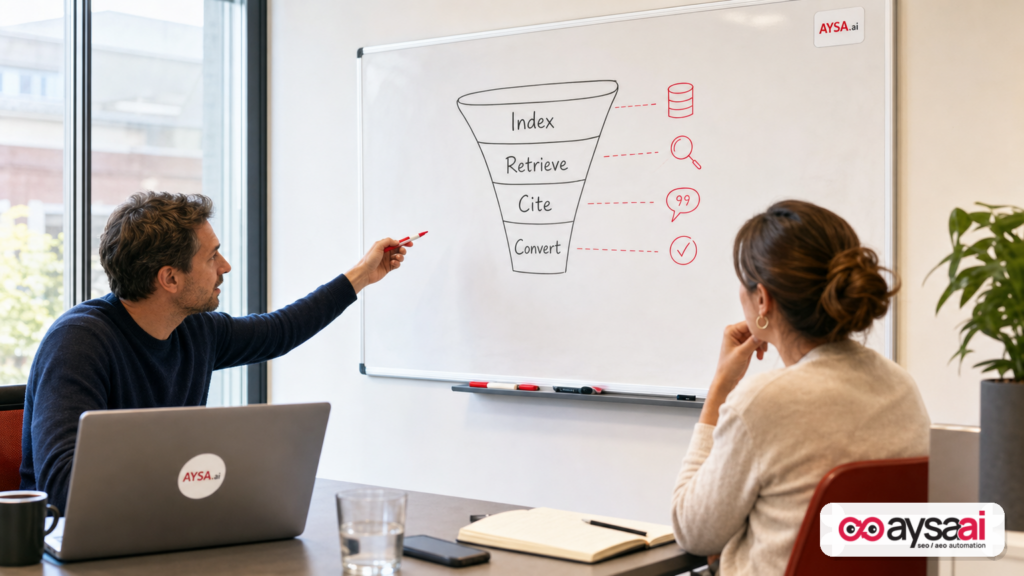
- Winning now requires a new funnel: Index → Retrieve → Cite → Convert, plus retention over time.
- AYSA’s role: monitor AI Search visibility, prepare change plans, request approval, then execute accepted website updates and verify outcomes. See AI search visibility and monitoring.
Table of Contents

- What Changed: From “Where Do We Rank?” To “Where Are We Cited?”
- Why This Matters Now (Even If Your Traffic Looks Fine)
- The Cross-Engine Measurement Problem (And Why Dashboards Alone Don’t Fix It)
- Define The Terms: Indexing, Retrieval, Citations, Mentions, And Links
- A Practical Framework: The AI Citation Funnel (Index → Retrieve → Cite → Convert)
- What To Measure: The Minimum Viable AI Visibility Scorecard
- Prompt Testing Without Fooling Yourself: Control Groups, Drift, And False Wins
- What Gets Cited: Content Architecture That AI Systems Can Use
- Citations Are Earned: Authority Signals That Still Matter
- An SME Scenario: The Clinic That “Disappeared” From AI Answers (Without Losing Rankings)
- What Agencies Must Rethink: From Reporting To Operating
- Why Execution Is The Bottleneck (And The Only Durable Advantage)
- Where AYSA Fits: Monitor → Prepare → Approve → Execute → Verify
- What To Do Next: A 30-Day Action Plan
- Sources And Further Reading
What Changed: From “Where Do We Rank?” To “Where Are We Cited?”
Classic SEO was built around a clean feedback loop:
- Google crawls and indexes pages.
- Your pages rank for queries.
- Users click results.
- You measure Clicks, sessions, and conversions.
That loop still exists. But generative AI engines introduce a second loop that is less visible and more fragmented:
- An AI system retrieves information from a mix of sources (web, licensed data, internal indexes, partners, public forums).
- It synthesizes an answer.
- Sometimes it cites sources. Sometimes it only mentions brands. Sometimes it provides no Attribution at all.
- Users may never click—meaning your old measurement model doesn’t see the interaction.
The SEO job expands from “improve rankings” to “improve retrievability and citability across multiple systems.” This is exactly the measurement gap highlighted in Search Engine Journal’s discussion: teams can track rankings, but far fewer can track indexing and citations across multiple AI engines (SEJ).
Why This Matters Now (Even If Your Traffic Looks Fine)
Most businesses react to changes only when analytics show pain. AI answer engines create a delayed pain pattern:
- Your organic sessions can remain stable while your assist rate drops—meaning fewer people hear about you during research.
- Your branded search volume can soften later because fewer people learned your name.
- Your lead quality can decline because the AI answer pre-qualifies users with competitors’ framing, pricing, and positioning.
In practical terms: you can “win” traditional SEO and still lose the conversation layer where many buying journeys begin.
This is also why “we’ll just wait and see” is risky. Waiting doesn’t just delay optimization—it delays learning. And learning speed is the only compounding advantage left in search.
The Cross-Engine Measurement Problem (And Why Dashboards Alone Don’t Fix It)
The moment you accept that citations are distributed, you inherit three problems:
1) Different engines, different rules
Even within the limited research context we have, the point is clear: AI engines index and cite differently, and the supporting data sits across many tools without clean integration (SEJ). So any “one metric” view is usually a lie—because it hides variance by engine, query type, and content format.
2) Data exists, but the workflow breaks
Most teams can assemble a Frankenstein report. The failure is what comes next:
- Who decides what to fix first?
- Who writes or edits the changes?
- Who implements them on the site?
- Who verifies the outcome and watches retention?
Dashboards surface problems. They don’t create a repeatable execution loop.
3) Manual consolidation doesn’t scale
When measurement requires weekly exports, spreadsheets, and human judgment calls, the system collapses under growth:
- More locations
- More products
- More content
- More AI engines
- More stakeholders
The cross-engine world demands an operating system, not a reporting habit.
Define The Terms: Indexing, Retrieval, Citations, Mentions, And Links
Before you measure anything, you need semantic clarity. Otherwise teams argue about words while the business loses ground.
Indexing
Your content is discoverable and stored by a system. In classic SEO, we associate this heavily with Google Search Console coverage. In AI search, indexing can mean different things (web crawl, partnered index, or proprietary retrieval store). If you can’t verify indexing, you’re guessing about everything else.
Retrieval
Your content is being pulled as an input for an answer. Retrieval is upstream of citations: a system can retrieve you and still not cite you.
Citation
Your URL (or domain) is referenced as a source. Citations can be stable, intermittent, or query-dependent. Citations can also shift if the engine changes the way it summarizes.
Brand mention (without citation)
Your brand is named, but no link is provided. Mentions can still be valuable (they influence perception), but they are harder to track and often provide no referral traffic.
Click / conversion
The classic outcome. Still matters. But it’s no longer the only meaningful outcome—because influence happens even when no click occurs.
AYSA’s stance: treat citations and mentions as visibility events, and treat clicks and conversions as economic events. You need both views to avoid optimizing for the wrong thing.
A Practical Framework: The AI Citation Funnel (Index → Retrieve → Cite → Convert)
When teams get stuck, it’s usually because they can’t locate where the system is failing. The AI citation funnel gives you a diagnostic map:
1) Index
Is your content actually available to be found? If not, stop. Fix technical and discoverability issues first.
2) Retrieve
Does the engine pull your content as an input for relevant prompts? If retrieval is low, you likely have a topical authority, content alignment, or structural clarity problem.
3) Cite
If retrieval is happening but citations are low, you have a “trust packaging” problem: unclear authorship, missing definitions, weak structure, lack of corroboration, or content that’s too salesy to be used as a neutral source.
4) Convert
If citations happen but conversions don’t, you might have mismatch between the cited page and the user’s next step: wrong landing page, no clear offer, poor UX, or the content is informative but not commercially connected.
5) Retain (the hidden step)
The most under-measured: do you stay cited after updates, competitors’ changes, or engine shifts? Citation retention is where operational maturity shows up.
This funnel is why I believe “AI SEO” is less about clever prompt hacks and more about disciplined content and site operations.
What To Measure: The Minimum Viable AI Visibility Scorecard
You don’t need a 40-metric dashboard. You need a small set of metrics that can drive weekly decisions. Here’s the minimum viable scorecard I recommend for SMEs and agencies.
1) Coverage: pages intended vs. pages indexed
For your “money pages” (service pages, category pages, core guides):
- How many were published/updated?
- How many show evidence of indexing?
- How many remain indexed after 2–3 weeks?
2) Prompt set: tracked prompts by intent
Build a stable prompt set (20–100 prompts depending on business size) across these intent buckets:
- “Best” / comparison prompts
- Problem/solution prompts
- Cost/pricing prompts
- Location prompts (for local businesses)
- Use-case prompts (industry-specific)
3) Citation share (by engine, by prompt bucket)
How often are you cited when you should be cited?
- By engine
- By intent bucket
- By page type (guide vs. product vs. FAQ)
4) Citation quality
- Is the cited page the one you want (not a random PDF or outdated blog post)?
- Is the citation context positive, accurate, and aligned with your positioning?
5) Retention / volatility
Track whether citations hold over time. A one-week spike can be noise.
6) Downstream signals you already trust
- Branded search trends (directional)
- Assisted conversions in GA4 (where applicable)
- Lead quality notes from sales/customer service
Important: I’m intentionally not inventing “industry benchmark” percentages. The right target depends on category competitiveness, content maturity, and how often engines cite sources for your prompt types.
For measurement fundamentals and analytics naming conventions, Google’s own documentation can help teams stay grounded in what GA4 can and can’t tell you (Google Analytics 4 documentation). For SEO measurement basics and how Google frames search behavior, the official Google Search Central documentation remains the safest primary reference (Google Search Central).
Prompt Testing Without Fooling Yourself: Control Groups, Drift, And False Wins
If you start tracking AI citations tomorrow, you’ll immediately face a credibility problem inside your organization:
- “Did our update cause that?”
- “Or did the engine change?”
- “Or did the prompt wording change the output?”
To avoid false wins, treat prompt testing like experimentation:
Use stable prompts and document variants
Small wording changes can produce different sources. Maintain a canonical prompt list and track variants separately.
Create control groups
Not every page should be updated at once. Keep a set of pages untouched for a period so you can detect engine-level shifts versus your work.
Expect drift and measure ranges, not single outcomes
AI outputs can vary. A better approach is to test multiple runs over time and look for consistent citation presence.
Separate “citation gained” from “citation retained”
Gaining a citation once is different from being a stable reference. Retention is the durable win.
Search Engine Journal’s framing emphasizes that the gap is not just identifying the problem but consolidating, prioritizing, and verifying changes after publication (SEJ). That “verify and hold” step is where most teams currently break.
What Gets Cited: Content Architecture That AI Systems Can Use
In the classic SERP world, you could sometimes rank with content that was messy but keyword-aligned. In AI citation land, messy content is expensive—because it’s harder to retrieve, harder to summarize, and easier to replace with a clearer source.
Here’s what I see consistently in content that earns citations (framed as durable principles, not engine-specific hacks):
1) Clear question-to-answer mapping
AI systems thrive on content that answers discrete questions cleanly. Build pages with explicit sub-questions and direct, scannable answers.
2) Strong definitions and constraints
Define terms and boundary conditions (“This applies when…”, “This does not apply if…”). This reduces hallucination risk and makes you safer to cite.
3) Evidence and references where appropriate
When you make claims, support them. For general SEO guidance, the most reputable baseline source is often Google Search Central (Google Search Central).
4) Ownership and accountability signals
Make it obvious who wrote the content, how it’s maintained, and why you’re qualified. This is not about “gaming E-E-A-T.” It’s about being a safer source.
5) Structured data where it genuinely fits
Schema doesn’t magically create citations. But it can reduce ambiguity and improve machine interpretability. Use it when it accurately represents the page.
If your content strategy is still “publish 10 posts and hope,” you’re optimizing for output, not outcomes. In AI search, outcomes are tied to usefulness, clarity, and trust packaging.
If you want a practical overview of how AYSA approaches AI-oriented SEO tooling and workflows, start here: AYSA AI SEO tools.
Citations Are Earned: Authority Signals That Still Matter
It’s tempting to believe AI engines are “new” and therefore the old web signals don’t matter. In practice, authority still shows up—just with a twist.
Three durable authority pillars remain relevant:
1) Brand legitimacy
Real businesses with real footprints tend to be safer to cite than anonymous sites. That legitimacy can show up through consistent business information, clear about pages, leadership profiles, and a history of publishing.
2) Topic depth (not just breadth)
AI engines often prefer sources that cover a topic comprehensively and consistently. One “hero article” rarely beats a coherent cluster of useful pages.
3) Independent corroboration
When other reputable sites reference you, it signals that your claims aren’t isolated. (This is one reason why classic PR and link earning still matter.)
None of that requires spammy link building. It requires publishing content worth referencing and building relationships in your category.
An SME Scenario: The Clinic That “Disappeared” From AI Answers (Without Losing Rankings)
Let’s make this real with a scenario I expect to become common.
Business: a regional dermatology clinic with three locations.
Symptoms:
- Google rankings for “dermatologist near me” and “acne treatment [city]” remain stable.
- Website traffic is slightly down, but nothing alarming.
- New patient calls start slipping. Front desk reports more callers saying, “I saw another clinic recommended when I asked AI.”
What happened? The clinic lost visibility in AI answers for high-intent questions like “best acne treatment clinic near [city]” and “does insurance cover mole removal.” The AI engine cites a competitor’s detailed insurance FAQ and a Reddit thread rather than the clinic’s thin service page.
What a modern fix looks like:
- Create a plain-language insurance & billing hub page with location-specific details and clear disclaimers.
- Add an FAQ section per service page answering the questions AI users ask (cost ranges, eligibility, recovery time, when to see a doctor).
- Strengthen internal linking between “conditions” pages and “treatments” pages.
- Ensure author review/medical review information is present where appropriate (without pretending it’s something it’s not).
- Monitor citation presence weekly across a stable prompt set and track retention.
Notice what’s missing: gimmicks. No “AI prompt injection.” No keyword stuffing. This is just clearer, more trustworthy content that AI engines can safely retrieve and cite.
In a system like AYSA, the workflow is exactly what most SMEs struggle to operationalize: monitor the citation drop, propose the specific content updates, route them for approval (especially important for medical/legal sensitivity), execute the accepted changes on the site, then verify citation recovery over time. That’s the point of approved execution.
What Agencies Must Rethink: From Reporting To Operating
If you run an agency, the AI search shift is both a threat and an opportunity.
The threat: clients will ask questions your current reporting can’t answer
- “Are we showing up in AI answers?”
- “Which pages are being cited?”
- “What changed when citations dropped?”
If your agency only reports rankings and traffic, you’ll look blind—even if your work is good.
The opportunity: agencies that build execution systems will compound
The real moat isn’t knowing that citations matter. Everyone will know that. The moat is:
- A repeatable measurement protocol
- A prioritization model tied to business outcomes
- A production pipeline that ships improvements weekly
- A QA layer that avoids brand and compliance mistakes
- A retention monitoring loop
Search Engine Journal’s webinar framing points to the need for systems that can identify gaps, prioritize fixes, draft updates, and verify outcomes across engines (SEJ). Whether you use AI agents, internal tooling, or a platform like AYSA, the organizational capability is the product.
Why Execution Is The Bottleneck (And The Only Durable Advantage)
Most companies don’t lose because they didn’t know what to do. They lose because they couldn’t do it fast enough, consistently enough, with high enough quality.
AI search makes that more brutal for three reasons:
1) More engines means more surface area
Each engine adds variance. Variance increases the amount of testing and iteration required to learn what works.
2) The “half-life” of content strategy shrinks
If you only update your content quarterly, you’ll be reacting to last quarter’s world. Faster cycles win.
3) The cost of mistakes rises
AI engines can amplify incorrect or outdated information. That increases the need for QA, approvals, and factual discipline—especially in regulated categories.
Execution isn’t glamorous. It’s also the only thing that compounds.
Where AYSA Fits: Monitor → Prepare → Approve → Execute → Verify
AYSA is built around a simple belief: insight without execution is theater. The platform’s job is not to generate more ideas. It’s to turn measurable visibility gaps into approved, shipped website improvements—then prove whether those improvements held.
Here’s the operating loop we advocate:
1) Monitor
Track your AI search visibility and the prompts/topics that matter to your business. Start with AYSA monitoring.
2) Prepare
Translate gaps into concrete changes: content structure updates, new FAQ sections, internal links, clarity improvements, schema where appropriate. Explore how we think about AI-oriented tooling here: AI SEO tools.
3) Ask for approval
Businesses need governance. AYSA is designed to request approval before making changes, so brands keep control.
4) Execute accepted changes
Approved execution is the difference between “recommendations” and “results.”
5) Verify and retain
After publishing, you track whether changes improved citation presence and whether it persists. This connects to the broader visibility goal: AI search visibility.
If you want to evaluate fit quickly (SME vs. agency, single site vs. multi-location), pricing and packaging details are here: AYSA pricing.
And if you want ongoing thinking on this shift, our editorial hub is here: AYSA blog.
What To Do Next: A 30-Day Action Plan
If you’re an SME or agency trying to respond without chaos, here’s a practical plan you can run in one month.
Days 1–5: Build your “AI visibility baseline”
- List your top 20–50 customer questions (sales calls, support emails, live chat logs).
- Group them into intent buckets: comparison, cost, how-to, local, troubleshooting.
- Identify the pages that should be cited for each bucket (not just “a blog post”—the right page).
Days 6–12: Diagnose using the funnel
- Check indexing health for the target pages (use your existing SEO tools and Search Console processes where applicable).
- Identify where you fail: index vs. retrieve vs. cite vs. convert.
Days 13–20: Ship 3–5 high-leverage improvements
- Rewrite or restructure one core page for clarity (tight Q&A mapping).
- Add an FAQ block that answers the “AI prompt questions” directly.
- Improve internal linking so the best answer page is easy to reach.
- Add author/editor review and update timestamps where truthful and appropriate.
Days 21–30: Verify and institutionalize
- Re-test your prompt set and record changes (don’t trust one run).
- Create a weekly cadence: measure → prioritize → approve → ship → verify.
- Assign ownership: who approves, who edits, who deploys, who audits outcomes.
If you don’t have an execution pipeline, this is where platforms like AYSA can help: monitoring and visibility intelligence are only useful if they reliably become approved site changes.
Sources And Further Reading
- Search Engine Journal (source context on cross-engine AI citation tracking): How Are SEO Teams Actually Tracking AI Citations Across Six Engines?
- Google Search Central documentation (primary reference for how Google frames search crawling/indexing and SEO basics): Google Search Central
- Google Analytics 4 help center (primary reference for GA4 measurement concepts and configuration): Google Analytics 4
- Search Engine Journal SEO category (broader related coverage and research lead): SEJ: SEO
- Search Engine Journal Webinars (context on the cited webinar format and related sessions): SEJ: Webinars
Continue the AI search topic inside AYSA.
Use these pages to connect the article with AI SEO tools, AI visibility monitoring, AI Overviews and approved website execution.
Turn this topic into a website action plan.
Use these AYSA hubs to move from reading to technical fixes, AI visibility monitoring, research, glossary context and approval-first SEO execution.

