
The Web Is Now Written for Machines: What SMEs Must Do to Win in AI Search (Without Losing Trust)
Bots now “read” more of the web than humans do, and AI assistants increasingly answer without sending clicks back. That flips old SEO assumptions about policing, access, and what counts as cheating. Here’s a practical playbook for SMEs and agencies to stay findable, cited, and trusted—while using AYSA’s approved-execution model to turn strategy into safe, measurable changes.

Most businesses still think of “the web” as a place where humans read pages, click links, and buy things. That mental model is now outdated. Increasingly, the first real reader of your content is a machine: an AI crawler, an Answer engine, a browser agent, or a platform summary layer that reads your page, extracts a few facts, and gives the user an answer without sending a visit back.
This isn’t a minor distribution shift. It changes the incentives that shaped SEO for 20+ years: who polices quality, why access mattered, and what “cheating” even means when the audience is no longer a human pair of eyes.
I’m writing this as Marius Dosinescu from AYSA.ai, where we spend our time turning AI-search strategy into safe, approved, measurable execution: we monitor, prepare changes, ask for approval, and then implement what you accept. That workflow matters more now than ever—because in AI Search, small factual inconsistencies and weak structure don’t just hurt rankings. They can erase you from the answer.
Primary research inspiration: Search Engine Journal’s editorial “Written For Readers Who Don’t Read” by Pedro Dias (June 2026) is a strong catalyst for this conversation, and worth reading directly for context: Search Engine Journal source.
Concise summary

The web is being “read” more than ever, but a growing share of that reading is done by bots and AI agents that don’t click. That breaks the old SEO bargain (crawl in exchange for traffic), weakens the old “webspam warden” model, and changes how we should think about content formatting vs. deception. SMEs and agencies need to shift from traffic-only SEO to AI visibility: making facts consistent, pages extractable, entities clear, and content genuinely useful—while Monitoring what AI systems say and fixing inputs fast.
Key takeaways (for busy operators)

- Your real audience now includes machines. If an assistant can’t extract your facts cleanly, you often don’t exist in the answer layer.
- “Ranking” is being replaced by “being used.” You may get cited or summarized without getting the click.
- Access is becoming economic. Publishers and platforms are experimenting with blocking, licensing, or charging for AI Crawling.
- The definition of “cheating” shifts from formatting differences to deception. Machine-readable structure is fine if the substance matches what users see.
- Execution speed and safety matter. Monitoring + approved changes beats quarterly SEO projects when AI systems amplify errors instantly.
Table of contents
- The New Reality: The Web Is Being Read—Just Not by People
- How AI Assistants “Read” the Web (and Why You Don’t Get the Click)
- Rule #1 That Changed: The “Traffic Deal” Is Breaking
- Rule #2 That Changed: “Cheating” Isn’t What It Used to Be
- Rule #3 That Changed: “Quality” Is Now a Business Model Decision
- What “Good” Looks Like in AI Search (AEO/GEO Reality)
- What Can Go Wrong: Failure Modes SMEs Don’t Expect
- A Practical SME Scenario: The Local Clinic That Lost Clicks but Gained Patients
- Agency Reset: Selling SEO When Traffic Isn’t the KPI
- The 2026 Action Plan: Make Your Site Machine-Readable Without Becoming Machine-Written
- Where AYSA Fits: Monitoring + Approved Execution for AI Search
- What to do next
- Sources and further reading
The New Reality: The Web Is Being Read—Just Not by People
For most of the commercial internet era, publishing was built around a simple funnel:
- Google crawls your page.
- You rank for a query.
- A human clicks, reads, and takes an action.
AI assistants invert that. A user asks a question, the system reads many sources in the background, and the user receives a synthesized answer. The underlying pages become input material—not destinations.
Pedro Dias describes this shift bluntly: the web is being read “more than ever,” but a lot of that reading is performed by bots and agents rather than humans. That’s not just an SEO concern. It’s a business concern—because it changes what your site is for.
If you operate an SME—local service, ecommerce brand, clinic, hotel, SaaS—the web used to be your storefront. Now it’s also your product catalog for machines.
How AI Assistants “Read” the Web (and Why You Don’t Get the Click)
Think about the behavior of a modern answer engine in plain terms:
- It fetches multiple pages. It’s not “searching” like a human. It’s collecting candidate sources.
- It extracts what’s usable. Not what’s beautifully designed. What’s structurally clear: definitions, steps, prices, hours, specs, policies, attributes, evidence.
- It produces a compressed output. A paragraph, bullet list, comparison table, or recommendation.
- It may cite sources… softly. Citations can be de-emphasized or non-clicked. The user gets satisfaction without a visit.
This is the root reason “SEO content” stopped working for many sites: the format was designed to win a click from a human skimming a results page. In AI search, the system doesn’t skim. It extracts. If your page is 1,800 words of vibes with a single actionable sentence buried under popups, it’s not “high quality” to a machine. It’s low-yield input.
So what do machines favor?
- Consistency: the same facts across pages and data sources
- Clear entities: who you are, what you sell, where you operate
- Extractable structure: headings that match intent, lists, tables, definitions, FAQs where appropriate
- Proof and specificity: policies, constraints, dates, warranty terms, ingredients, citations, authorship
None of this is “AI trickery.” It’s basic communication—just optimized for a reader that doesn’t admire your design.
Rule #1 That Changed: The “Traffic Deal” Is Breaking
The old bargain was simple: let search engines crawl your site and they’ll send you visitors. That bargain shaped everything:
- publishers monetized via ads and subscriptions
- SMEs monetized via leads and purchases
- SEOs tuned pages for rankings that drove clicks
Now, AI systems can extract value without returning the visit. So content owners are starting to ask a question we didn’t have to ask before: what is a crawl worth?
The Search Engine Journal piece points to Cloudflare’s public discussion of bots and the emergence of “pay per crawl” approaches and default blocking behavior for some AI crawlers. Even if you disagree with the economics, the direction is rational: if the visitor doesn’t come back, the publisher looks for another compensation mechanism.
What this means for SMEs:
- If you rely on informational traffic to monetize (ads, affiliate), your model is under pressure.
- If you rely on informational traffic to retarget and nurture, your funnel will thin.
- If you rely on local/commercial intent, you may still win—because users still convert on “best provider near me,” “price,” “availability,” and “book now.” But the assistant might pre-filter who gets suggested.
Operational shift: you need to treat visibility in AI answers as a first-class channel, not a side effect of “ranking.” That means tracking whether you are cited, summarized, or recommended—something we build toward with monitoring in AYSA: AYSA Monitoring.
Rule #2 That Changed: “Cheating” Isn’t What It Used to Be
Classic SEO folklore taught a hard rule: never show search engines something different than what you show users. “Cloaking” was the sin.
But even historically, the underlying principle wasn’t “never vary presentation.” The principle was “don’t deceive to manipulate rankings.” If you serve one set of facts to a crawler and another to a person, you’re misleading someone—either the system or the user.
Here’s the key shift in the AI era: the reader has changed. Machines don’t “see” cookie banners, hero images, sliders, and storytelling arcs the way humans do. They look for structured meaning. So giving them structured meaning is not cheating. It’s translation.
Practical examples of acceptable machine-first formatting (when truthful):
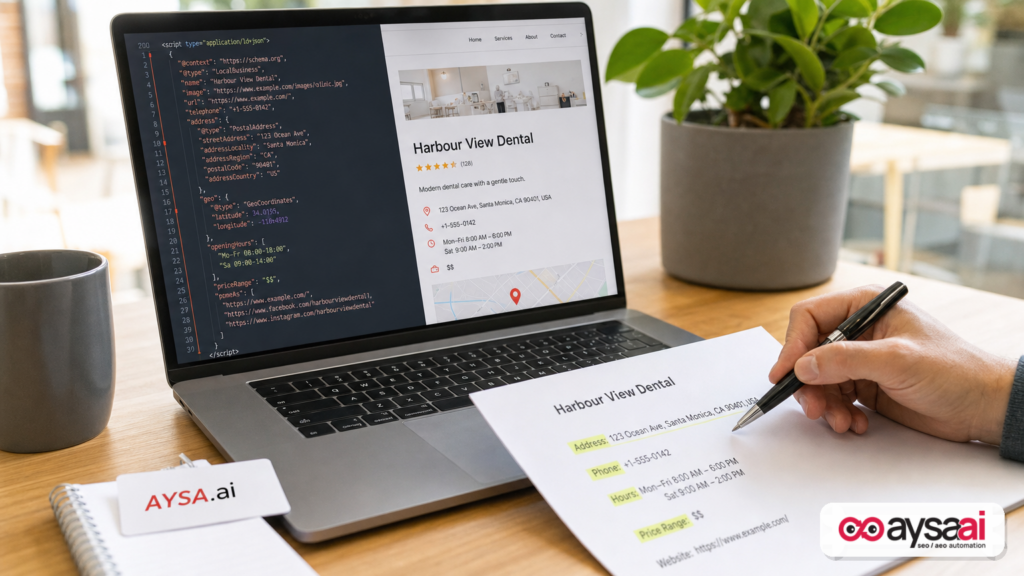
- Adding structured data (schema) that matches visible page content
- Creating clearly labeled FAQ sections that reflect real policies
- Publishing product feeds and location feeds that match your site
- Providing short “key facts” summaries at the top of long pages
Examples that cross into deception:
- Marking up fake reviews, fake prices, or fake availability in schema
- Publishing “summary” content to crawlers that contradicts the page
- Claiming credentials, licenses, or affiliations you can’t substantiate
Google’s spam policies and structured data guidance historically emphasize that markup should reflect the content users can see and that manipulative behavior is the core problem. If you’re uncertain, anchor your decisions to primary policy documentation rather than SEO hearsay. (I’m not linking specific policy URLs here because they were not included in the provided research context; if you want, we can add them during WordPress editing using official Google documentation.)
AYSA angle: “approved execution” becomes a governance system. Your team sees proposed changes, approves what’s accurate, and rejects what’s risky—before anything goes live. This is exactly why we built AYSA to prepare changes, ask, then execute: AI SEO Tools.
Rule #3 That Changed: “Quality” Is Now a Business Model Decision
For two decades, Google acted like a warden for web quality—not altruistically, but because quality protected the advertising value of search. Dias’s point is worth sitting with: the policing existed because the business model needed it.
Now the “front door” is contested:
- Some experiences will be ad-supported.
- Some will be subscription-supported.
- Some will claim neutrality as a competitive advantage.
Why does that matter to your business?
- Because whichever model wins gets to define what “good” looks like.
- Because “good” increasingly means “useful to an answer engine,” not “engaging to a reader.”
- Because incentives shape extraction: what’s cited, what’s recommended, what’s suppressed.
SMEs don’t control these platforms, but you can control your inputs: your site, your data consistency, your credibility signals, and your ability to update fast when reality changes (hours, stock, service areas, pricing, policies).
What “Good” Looks Like in AI Search (AEO/GEO Reality)
Let’s define the new goal in a way that an owner can operationalize.
In classic SEO, the goal was: rank and get clicks.
In AI Search (what many call AEO: Answer Engine Optimization, and GEO: Generative Engine Optimization), the goal becomes:
- Be eligible to be used as a source.
- Be extractable so your facts survive summarization.
- Be citable so your brand stays attached to the answer.
- Be trustworthy so the system prefers you when stakes are high.
- Be current so the answer isn’t outdated (and you don’t lose the sale).
That translates into a practical checklist.
1) Eligibility: can machines access and parse you?
- Indexable pages (don’t accidentally noindex core content)
- Fast, stable rendering (avoid content hidden behind heavy scripts)
- Consistent canonicalization (avoid duplicate confusion)
- Clean internal linking so machines find key pages
2) Extractability: can machines pull the right facts?
- Clear headings that match real questions users ask
- Short “key facts” sections near the top
- Tables for specs and comparisons
- Bulleted steps for processes
3) Entity clarity: do you look like a real business?
- About page with real ownership, expertise, and location context
- Contact details consistent everywhere
- Policies that match your industry (shipping, returns, cancellations)
- Team/member pages where appropriate (especially for clinics and professional services)
4) Evidence: can you be trusted?
- Original reporting, primary data, or documented experience
- Sources cited where claims need support
- Clear dates on updated pages
- Author/editor ownership where it matters
If you want the operational framing we use at AYSA, start here: AI Search Visibility.
What Can Go Wrong: Failure Modes SMEs Don’t Expect
When businesses lose organic traffic, they often assume “Google update” or “competition.” In AI search, failure modes look different—and can feel unfair because the system doesn’t always tell you what happened.
1) Wrong facts get amplified
If your site says one thing, a directory says another, and an older PDF says a third, an assistant may choose the wrong version and state it confidently. That’s a conversion killer. For a clinic, it’s “wrong hours.” For ecommerce, it’s “wrong return policy.” For a hotel, it’s “wrong amenities.”
2) You’re “high quality” but not extractable
You wrote a great page—beautifully designed—but the core answer is buried in carousels, tabs, or scripts. The assistant doesn’t reward artistry. It rewards yield.
3) You become interchangeable
If your content is generic and similar to everything else, it becomes easy for AI systems to replace you with another source—or with the model’s own synthesis. Originality becomes defensibility.
4) You get used but not credited
Even when systems cite, the citation may not drive a click. You need brand reinforcement in what’s extracted: named methods, proprietary frameworks, distinct product naming, precise policies. If the extracted content is generic, the brand benefit disappears.
5) Risky changes get shipped too fast
The temptation is to “optimize for AI” with rushed schema, AI-written pages, or overconfident claims. That can lead to policy issues, legal exposure, or reputation damage—especially in YMYL categories.
This is where a controlled execution system matters. Fast does not have to mean reckless.
A Practical SME Scenario: The Local Clinic That Lost Clicks but Gained Patients
Let’s make this real with a scenario I see constantly in SME land.
Business: a multi-provider local clinic (physical therapy, dental, dermatology—pick your vertical).
Old model:
- Rank for “best [service] near me.”
- Get clicks to a service page.
- Convert from web form or phone call.
New behavior: users ask an assistant:
- “Do I need a referral for PT in [state]?”
- “Which clinic offers dry needling and takes [insurance]?”
- “What’s the average cost for [procedure]?”
The assistant may answer without a click, then suggest 1–3 providers. If you’re not in that suggestion set, you can have a perfect website and still lose.
What the clinic changes (the non-sexy work that wins):
- Create provider and service pages that clearly define offerings, credentials, and constraints (“we do X, we don’t do Y”).
- Add concise “key facts” blocks: insurance accepted (if applicable), appointment lead time, service areas, parking, accessibility, cancellation policy.
- Use structured data where appropriate, ensuring it matches visible content.
- Publish a small set of genuinely helpful answers that reflect real clinical judgment (reviewed by professionals), not generic AI fluff.
- Monitor AI-facing visibility: are we cited, are our facts correct, do answers mention the right location?
Outcome: website sessions may not skyrocket—but qualified inquiries improve because the assistant pre-qualifies the patient and the clinic appears as a trusted option.
This is the mindset shift I want SMEs to adopt: stop treating “traffic” as the only proof of SEO value. In AI search, influence often happens upstream of the click.
Agency Reset: Selling SEO When Traffic Isn’t the KPI
If you run an agency, the AI transition is uncomfortable for one reason: it breaks the cleanest reporting story in marketing—sessions up and to the right.
Here’s how I think agencies need to reposition.
1) From “rankings” to “business outcomes + presence”
Rank trackers don’t capture what assistants summarize. Your client will ask, “Why did my leads drop?” and “Why did my brand disappear from AI answers?”
You need a new reporting stack:
- presence in AI summaries (brand mention / citation where measurable)
- lead quality and close rate
- entity consistency across locations and products
- content freshness and accuracy
2) From quarterly projects to continuous execution
AI systems change fast. Your business changes fast. If your SEO process is “audit → roadmap → wait 90 days,” you will always be late.
Agencies that win will operationalize execution: create a backlog, ship safe changes weekly, and monitor outcomes. That’s why an execution engine matters.
3) From “more content” to “more credibility”
When the web fills with AI-generated sameness, original experience becomes the differentiator. Agencies should help clients:
- capture unique processes
- publish real case notes (redacted, compliant)
- document policies and constraints clearly
- create durable “source-worthy” pages
If you want a starting point to align services with AI search reality, you can explore the frameworks we publish on the AYSA blog: AYSA Blog.
The 2026 Action Plan: Make Your Site Machine-Readable Without Becoming Machine-Written
Here’s the playbook I recommend for SMEs and pragmatic marketing teams. It’s not about chasing every AI trend. It’s about building a durable source.
Step 1: Decide what you want to be the source of
Most SMEs publish random blog posts because someone said “content marketing.” In AI search, focus matters. Pick 5–10 topics where you can be genuinely authoritative:
- your products and how they compare
- your service constraints (what you do and don’t do)
- your pricing model (how it’s calculated)
- your process (what happens next)
- your location-specific facts (hours, coverage, policies)
Step 2: Fix your factual spine (the stuff AI extracts)
Before you write anything new, audit what already exists and where it conflicts:
- Hours, addresses, phone numbers
- Service areas and location pages
- Shipping, returns, warranty, cancellations
- Pricing ranges and what’s included
- Availability (appointments, inventory, lead times)
AI assistants are ruthless about inconsistency. If you’re fuzzy, you’ll be replaced by someone crisp.
Step 3: Make key pages extractable
Pick your highest-intent pages (services, categories, product lines, locations) and upgrade structure:
- Add “Key facts” near the top (not hidden in accordions)
- Use H2/H3 headings that match real questions
- Add short lists and tables where appropriate
- Remove or reduce distractions that hide content
Step 4: Use structured data responsibly
Structured data is not a magic trick. It’s a clarity tool. Use it where it honestly reflects visible content and helps machines understand:
- Organization and local business details
- Products (where applicable)
- FAQs (only if the questions and answers are real)
- Authors and articles (when editorial integrity matters)
If you’re not sure what to implement, don’t guess. Prepare, review, approve, then ship. That’s the philosophy behind AYSA’s workflow.
Step 5: Publish fewer pages, but make them source-worthy
AI systems don’t need 200 near-duplicate posts. They need:
- original detail
- clear definitions
- scoped claims
- evidence or experience
Examples that work for SMEs:
- An HVAC company publishing a clear guide to “SEER rating explained” with real install constraints and local climate considerations.
- An ecommerce brand publishing a “material and care” hub with exact washing instructions, durability tradeoffs, and warranty coverage.
- A boutique hotel publishing a “what’s included” page with explicit policies (parking, pets, late checkout, resort fees).
Step 6: Monitor what AI says about you—and fix inputs fast
This is the new discipline that most teams don’t have yet. You need an ongoing loop:
- Monitor AI-facing visibility and brand facts
- Detect wrong answers, missing citations, or outdated info
- Prepare site changes that improve clarity and consistency
- Get approval (brand/legal/compliance)
- Execute and re-check
That loop is exactly what we built AYSA to do: monitoring + execution tools + governance through approvals.
Step 7: Reframe success metrics
In AI search, traditional KPIs can mislead you. Don’t throw them out—but contextualize them.
- Keep: conversions, revenue, calls, bookings, qualified leads, assisted conversions
- Watch differently: sessions, CTR, impressions (they may fall even as business improves)
- Add: AI citation/mention monitoring where measurable, brand query lift, lead quality, close rate
Where AYSA Fits: Monitoring + Approved Execution for AI Search
Most SEO tools tell you what’s wrong. Very few reliably help you fix it—especially when fixes require cross-team approval and careful implementation.
AYSA is built around a simple operating principle: execution is the advantage.
Here’s how it fits into the AI-search shift:
1) Monitor what matters in AI search
We start by monitoring visibility signals and the underlying website factors that typically affect extractability and trust. Learn more about the monitoring approach here: AYSA Monitoring.
2) Prepare changes that improve clarity (not gimmicks)
Rather than spitting out “recommendations” that sit in a PDF, AYSA prepares concrete, reviewable changes: content structure, metadata, internal linking, technical cleanup, and other fixes aligned with AI search visibility.
3) Ask for approval (governance)
In the AI era, a sloppy change can become a widely repeated wrong answer. Approval workflows are not bureaucracy—they’re brand protection.
4) Execute accepted changes on the website
Once approved, AYSA executes changes so you don’t lose months to backlog and vendor handoffs. This is especially important for SMEs that don’t have in-house SEO engineering.
If you’re evaluating whether this model fits your team, start with: AI search visibility and then review plans here: AYSA Pricing.
What to do next
- Pick 10 pages that drive money (services, products, locations) and make them extractable: key facts, clear headings, visible policies.
- Run a “facts consistency” sweep: hours, addresses, phone, pricing language, service areas, shipping/returns/cancellation terms.
- Decide your source strategy: what topics you want AI systems to cite you for—and what proof you can bring.
- Stop publishing generic filler. Publish fewer, better pages with unique detail and clear constraints.
- Set up monitoring + a weekly execution cadence so you can correct errors before they become the answer.
- If you need a system, not a spreadsheet, explore AYSA’s tooling and workflow: AI SEO Tools.
Sources and further reading
- Search Engine Journal — “Written For Readers Who Don’t Read” (Pedro Dias)
- Search Engine Journal — SEO section (ongoing coverage)
- Search Engine Journal — News section
- Search Engine Journal — Google Algorithm Updates hub
- Search Engine Journal — Local SEO coverage
- Search Engine Journal — Enterprise SEO coverage
Note on sourcing: The supplied research context references multiple external entities (e.g., Cloudflare statements, legal actions, and platform monetization positions). To avoid inventing or misquoting specifics, I’ve framed those parts as directional analysis grounded in the Search Engine Journal source rather than adding precise claims or numbers not independently linked in the provided context. During final WordPress editing, we can strengthen the “further reading” list with official primary links (Cloudflare, court documents, platform policy pages) if you provide them or approve their inclusion.
Continue the AI search topic inside AYSA.
Use these pages to connect the article with AI SEO tools, AI visibility monitoring, AI Overviews and approved website execution.
Turn this topic into a website action plan.
Use these AYSA hubs to move from reading to technical fixes, AI visibility monitoring, research, glossary context and approval-first SEO execution.

