
Advanced SEO Tools vs SEO Execution Platforms: What Businesses Really Need
Advanced SEO tools are useful, but visibility grows when recommendations become approved changes. Here is the difference between tooling and execution.
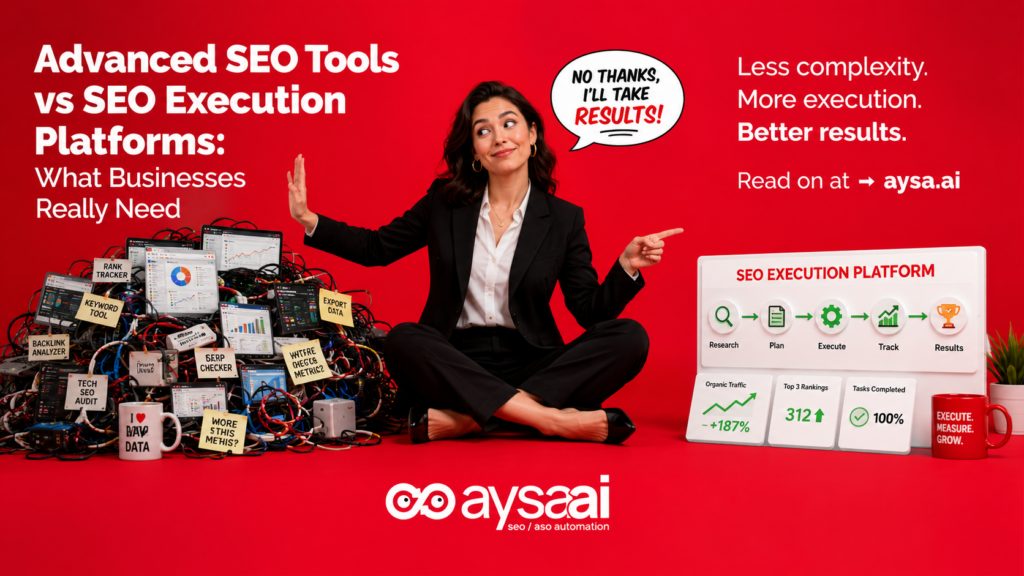
Advanced SEO tools are powerful. They are also incomplete if the business cannot turn the insight into approved website action. The next competitive layer is not more dashboards. It is execution: Monitoring, prioritization, approval, implementation and learning.
The phrase advanced SEO tools has changed meaning several times. In the early days, an advanced tool might have meant a rank checker, a Backlink explorer or a crawler that could find broken pages. Later it meant a full suite: Keyword research, competitive intelligence, site audit, Backlink Monitoring, Content optimization and reporting. In 2026, that definition is no longer enough. Search now includes classic organic results, local packs, shopping surfaces, video, images, AI Overviews, answer engines and Generative discovery. The real challenge is not only finding data. The real challenge is turning the right data into safe, approved, repeatable execution.
This is where the distinction between an SEO tool and an SEO execution platform becomes important. A tool helps you inspect, measure or analyze. An execution platform helps you move the work forward. Both can be useful. But they solve different problems.
The evolution of SEO tools
SEO tools evolved because search became too complex to manage manually. A small website owner can look at a few pages by hand. A serious business cannot manually monitor hundreds of URLs, thousands of queries, competitors, technical issues, internal links, redirects, content decay, schema, authority signals and AI visibility every week.
The first category was measurement. Rank trackers showed where a page appeared for selected keywords. Analytics tools showed visits and conversions. Search Console showed queries, clicks, impressions and index coverage. These tools answered a basic question: what is happening?
The second category was discovery. Keyword tools, backlink databases and competitor research platforms made SEO more strategic. They helped teams discover what people search for, what competitors rank for, which links support authority and which topics are missing. These tools answered: what opportunities exist?
The third category was diagnosis. Crawlers and audit tools checked status codes, titles, duplicate pages, canonical tags, noindex directives, schema problems, internal linking, sitemap coverage, page speed, mobile issues and crawl depth. These tools answered: what is broken or weak?
The fourth category was recommendation. Content optimization tools, AI writing assistants and scoring systems started suggesting briefs, outlines, headings, entities, questions, title ideas and page improvements. These tools answered: what could we change?
The fifth category is now emerging: execution. This layer asks a more operational question: what work should be prepared, approved and applied? That is a different product philosophy.
What Google’s documentation actually implies
Google does not publish a shopping list of SEO tools. It publishes principles and requirements. Those principles help explain why execution matters.
The Google SEO Starter Guide is still a useful foundation because it focuses on discoverability, helpful content, clear page titles, useful snippets, links, images, crawling and site organization. None of those items create value by appearing in a report. They create value when they are implemented correctly on the website.
Google’s documentation on how Search works explains the broad process of crawling, indexing and serving search results. That matters because many SEO problems are operational: important pages are not discovered, the wrong pages are indexed, canonical signals are confused, internal links are weak, or the content does not satisfy the query. Again, the report is not the fix.
Google’s helpful content guidance pushes the same point from the content side. The goal is not to produce text that looks optimized. The goal is to create content that genuinely helps users. That requires business context, expertise, editorial judgment and continuous improvement. A generic AI draft is not automatically useful SEO content.
Google’s page experience documentation reinforces the relationship between technical quality and user experience. Speed, mobile usability, intrusive elements and safe browsing are not abstract metrics. They shape whether users can actually consume the page.
And Google’s guidance on AI features and your website makes the modern context clear: the same fundamentals that help Search understand and serve pages also matter when content may appear in AI-powered search experiences. No serious platform can guarantee inclusion in AI Overviews, but a website can improve clarity, crawlability, structure, content quality and authority.
The implication is simple: SEO success is not a reporting event. It is an execution system.
What advanced SEO tools usually do well
Modern SEO suites are strong at data. Platforms such as Ahrefs, Semrush, Screaming Frog, Similarweb, Sitebulb and others have shaped the way SEO teams work. Their value is real.
Ahrefs is widely known for backlink data, keyword research, competitor analysis, site auditing and rank tracking. Semrush covers SEO, PPC, content, competitive research, local and reporting workflows. Crawlers such as Screaming Frog and Sitebulb help technical SEO teams inspect websites at scale. Google Search Console and GA4 provide first-party visibility into search and user behavior.
These tools are valuable because they make invisible problems visible. They can show that a page has impressions but no clicks. They can reveal that competitors own a topic cluster. They can detect redirect chains, duplicate titles, thin pages, broken links, slow templates, missing schema or lost backlinks. They can help agencies explain performance to clients. They can help specialists avoid guessing.
For SEO professionals, advanced tools are not optional. They are instrumentation. A serious technical SEO cannot inspect a large website only through a browser. A serious content strategist cannot build a topic map without search and competitor data. A serious agency cannot manage multiple clients without reporting and monitoring.
But instrumentation is not execution. A hospital can own advanced diagnostic machines and still need doctors, protocols, treatment plans and patient follow-through. SEO has the same pattern. Better diagnostics do not automatically create better implementation.
The execution gap: where SEO projects actually fail
Most SEO projects do not fail because nobody found issues. They fail because the work does not move through the organization.
An audit finds 74 technical issues. A content tool suggests 120 page improvements. Search Console reveals 400 queries with impressions and poor CTR. A backlink tool identifies missing authority. A competitor report finds 35 pages the business should have. Then the recommendations sit in a spreadsheet, a slide deck, a project management board or an email thread.
The bottleneck is rarely the idea. The bottleneck is usually one of these:
- Prioritization: the team does not know which issue matters first.
- Translation: the recommendation is written for specialists, not business users or developers.
- Approval: nobody is sure who can approve title changes, content rewrites, redirects or link spending.
- Implementation: the CMS, developer backlog or agency workflow slows everything down.
- Risk: technical changes may affect indexing, conversion, brand voice or legal wording.
- Monitoring: after changes go live, nobody connects the result back to the original recommendation.
This is the execution gap. Advanced SEO tools can make the gap more visible, but they do not necessarily close it.
Why AI made the gap bigger, not smaller
AI tools made it easier to generate drafts, titles, outlines, schema ideas, keyword clusters and recommendations. That is useful. But it also created more output than teams can review.
A generic AI assistant can write a title tag. It can summarize a page. It can create a content brief. It can suggest FAQs. But unless it is connected to the website, business context, Google data, approval history, technical constraints and publishing workflow, the user still has to verify and execute everything manually.
This is why the question “why not just use ChatGPT or Claude?” matters. General AI models are excellent thinking partners, but they are not automatically SEO execution systems. They do not know which pages are already indexed, which queries have impressions, which technical issues are live, which actions were approved last month, which links were inserted, which content matches the brand, which changes are safe to publish, and which ones need human review.
AI without workflow can increase cognitive load. AI with website context, approval and execution can reduce it.
What an SEO execution platform adds
An SEO execution platform does not replace every SEO tool. It adds an operational layer above the tool stack.
1. Business context before recommendations
Good SEO work depends on the business. A local clinic, ecommerce shop, SaaS company and publisher need different priorities. The system should understand services, audience, geography, tone, competitors, objectives and risk tolerance before preparing work.
2. Connected data
Execution should be informed by website structure, Search Console, Analytics, Business Profile context, rankings, content inventory, technical audits and authority signals. Disconnected tools create disconnected decisions.
3. Work preparation
The platform should not merely say “improve title tags.” It should prepare proposed titles, explain why they matter, show affected pages and make the approval decision easy.
4. Approval-first controls
SEO automation must respect control. Redirects, content rewrites, metadata changes, schema output, internal links and authority purchases can affect revenue and trust. The user should approve meaningful actions before they are applied.
5. Safe website execution
Once approved, the platform should apply what it can through the website integration. For AYSA, WordPress execution is available now, with a product direction toward broader website execution across platforms.
6. Action history
Teams need to know what was prepared, what was approved, what was rejected, what was applied and what changed later. Without history, SEO becomes a series of disconnected opinions.
7. Monitoring after implementation
The loop does not end when a change goes live. Search Console, rankings, AI visibility, crawl status and engagement should be monitored after execution. This is how the system learns what worked and what needs another pass.
A practical comparison
| Capability | Advanced SEO tools | SEO execution platform |
|---|---|---|
| Primary value | Data, analysis, diagnosis and reporting | Prepared work, approval workflow and implementation |
| User expectation | User interprets the data and decides what to do | System explains the action and asks for approval |
| Technical SEO | Finds issues and exports reports | Classifies issues, prepares safe fixes and separates manual review |
| Content | Suggests keywords, topics, scores or briefs | Builds approval-ready content updates and publishing actions |
| AI search | May track visibility or suggest optimization | Connects AI visibility opportunities to page, schema, content and authority work |
| Control | Usually outside the tool, handled by process | Built into the workflow through approvals and action history |
| Best fit | SEO specialists and teams that can execute internally | Businesses that need SEO work to move without specialist overhead |
The agency angle
Agencies do not disappear in this model. Their role changes. A strong agency can use advanced tools for research and strategy, then use an execution platform to scale implementation, maintain quality and reduce repetitive work.
For agencies, the advantage is not only speed. It is consistency. Every client needs monitoring, audits, content planning, approvals, technical review and reporting. A platform that works like a 24-hour SEO operations employee can help agencies serve more clients without turning every strategist into a project coordinator.
White-label and enterprise workflows can go further: custom agents, custom reporting, integration into existing systems, approval layers for different teams and business-specific knowledge. This is where execution platforms become infrastructure rather than just software.
The business owner angle
For business owners, the problem is different. They often do not want to become SEO experts. They want organic growth without hiring an agency, managing ten tools or learning technical jargon.
A business owner does not want to know that a crawl found “canonicalized URL conflicts with weak internal-link equity distribution.” They need plain language: this page may be confusing search engines; here is the proposed fix; here is the risk; approve or reject.
This is why AYSA’s positioning is not “another SEO dashboard.” AYSA is built for approved SEO execution. The user talks to the agent, the system prepares work, and important actions wait for approval before execution. That is a different experience from opening a tool and being handed another list.
The AI search angle
AI Overviews, answer engines and generative search make execution even more important. Visibility is no longer only a ranked link. A business may need clearer answer sections, stronger topical coverage, better entity signals, structured data, source-worthy content, authority mentions and ongoing monitoring of brand presence in AI-assisted search.
Google’s AI features guidance does not create a separate magic checklist. It reinforces the fundamentals: make content useful, accessible, crawlable, indexable and understandable. That is exactly why execution matters. AI visibility work often requires many small improvements across content, structure, technical health, authority and brand clarity.
My view: the companies that win in AI search will not be the ones that chase one trick for AI Overviews. They will be the ones with a disciplined system for improving pages, documenting expertise, building authority and adapting quickly when search behavior changes.
When advanced SEO tools are enough
Advanced SEO tools may be enough when a company already has a capable SEO team, developers who can implement quickly, writers who understand search intent, a clear approval process and leadership that trusts the workflow. In that case, the tool stack feeds an existing machine.
For enterprise SEO teams, advanced tools remain essential. They need raw data, exports, custom analysis, logs, crawls, competitive intelligence and deep diagnostics. Execution platforms should not remove access to data. They should help operationalize it.
When an execution platform becomes necessary
An execution platform becomes necessary when SEO recommendations repeatedly stall. If audits are completed but fixes wait for months, if content plans are approved but never published, if title improvements sit in spreadsheets, if internal links are known but not inserted, if authority opportunities are discussed but not tracked, the business does not have a tooling problem. It has an execution problem.
This is especially common for small and medium businesses. They cannot justify a full SEO department, but they also cannot afford to ignore organic growth. They need a system that turns professional SEO thinking into simple decisions and controlled execution.
How to evaluate a platform honestly
Use this checklist before buying any advanced SEO tool or execution platform.
Does it connect to real data?
Recommendations should be grounded in the website, Search Console, Analytics, rankings, technical checks and business context.
Does it explain the “why”?
A recommendation without reasoning is hard to trust. Users should understand the expected impact and risk.
Does it prepare the actual work?
Look for proposed titles, content updates, redirects, schema actions, internal links, briefs and approval-ready changes, not just generic advice.
Does it protect approval?
Automation without approval is risky. Approval without execution is slow. The ideal workflow has both.
Does it track what happened?
Action history matters for reporting, accountability and learning.
Does it support SEO, AEO, GEO and AI visibility?
Classic SEO is still the foundation, but search visibility now includes answer-ready content, generative search, AI Overviews and entity clarity.
Does it fit the team?
A specialist tool may be perfect for an SEO team and wrong for a business owner. A simple execution agent may be perfect for a founder and too abstract for a technical SEO who wants raw crawl data. Fit matters.
Where AYSA fits naturally
AYSA sits in the execution platform category. It does not claim that data tools are useless. That would be wrong. Data tools are part of the ecosystem. AYSA’s argument is that most businesses do not grow from data alone.
AYSA learns the business through a Setup SEO Profile, connects website and Google context, performs research, identifies technical and content opportunities, prepares SEO/AEO/GEO actions, surfaces authority opportunities and asks the user to approve important work. After approval, AYSA can execute accepted changes inside the website workflow.
The product is especially relevant for companies that do not want classic agency overhead and do not want to become SEO specialists. It is also relevant for agencies that want a scalable execution layer. The common need is the same: fewer stalled recommendations, more approved action.
A strong opinion: dashboards are overvalued
Dashboards feel professional. They also create the illusion of progress. A dashboard can show hundreds of metrics while nothing meaningful changes on the website.
My opinion is that the SEO industry has overvalued visibility into problems and undervalued the operational ability to fix them. A report is useful only if it improves decisions. A decision is useful only if it becomes action. An action is useful only if it is monitored after implementation.
This is why the next category will not be “more advanced SEO tools” in the old sense. It will be systems that combine intelligence, workflow, approval and execution. Some will serve specialists. Some will serve agencies. Some will serve business owners. But the winning products will respect one fact: SEO is work, not just analysis.
Final takeaway
Advanced SEO tools are not going away. They remain important for research, auditing, monitoring and competitive analysis. But the center of gravity is moving. Businesses no longer need only more data about what is wrong. They need a reliable way to turn search opportunities into approved website improvements.
If your team already executes quickly, advanced tools may be enough. If your SEO backlog keeps growing while implementation stays slow, you need an execution layer. That is the category AYSA is building for: SEO, AEO, GEO and AI visibility work prepared by an agent, approved by the user and executed inside the website workflow.
FAQ
Are advanced SEO tools still useful?
Yes. Advanced SEO tools are useful for research, audits, backlink analysis, rank tracking and reporting. The problem is not the tools. The problem is stopping at analysis without implementation.
What is an SEO execution platform?
An SEO execution platform prepares specific SEO actions, explains them, collects approval and helps apply accepted changes. It connects data, workflow and implementation.
Can AYSA replace Ahrefs or Semrush?
AYSA is not positioned as a database clone of Ahrefs or Semrush. Those tools are strong for research and competitive data. AYSA is focused on approved SEO execution: turning website and search signals into actions.
Why not just use ChatGPT or Claude?
General AI can help with ideas and drafts. AYSA is different because it is designed around website context, Google data, approval workflow, action history and execution. The distinction is workflow, not only language generation.
Can execution be fully automatic?
Some tasks can be automated safely, but important SEO actions should be approval-first. AYSA prepares work and executes accepted changes after approval, not blind autopilot.
Sources and further reading
- Google Search Central: SEO Starter Guide
- Google Search Central: How Search works
- Google Search Central: Creating helpful, reliable, people-first content
- Google Search Central: Page experience
- Google Search Central: AI features and your website
- Google Search Central: Spam policies for Google web search
- Ahrefs: SEO tools and data platform
- Semrush: Online visibility management platform
Continue the AI search topic inside AYSA.
Use these pages to connect the article with AI SEO tools, AI visibility monitoring, AI Overviews and approved website execution.
Turn this topic into a website action plan.
Use these AYSA hubs to move from reading to technical fixes, AI visibility monitoring, research, glossary context and approval-first SEO execution.

