
The AEO Execution Gap: Why AI Search Strategy Fails Without Workflow
A new AEO maturity report shows a sharp gap between leaders who say they have an AEO strategy and practitioners who are actually executing it. Here is what SMEs should learn about AI visibility, ownership, measurement and approved execution.
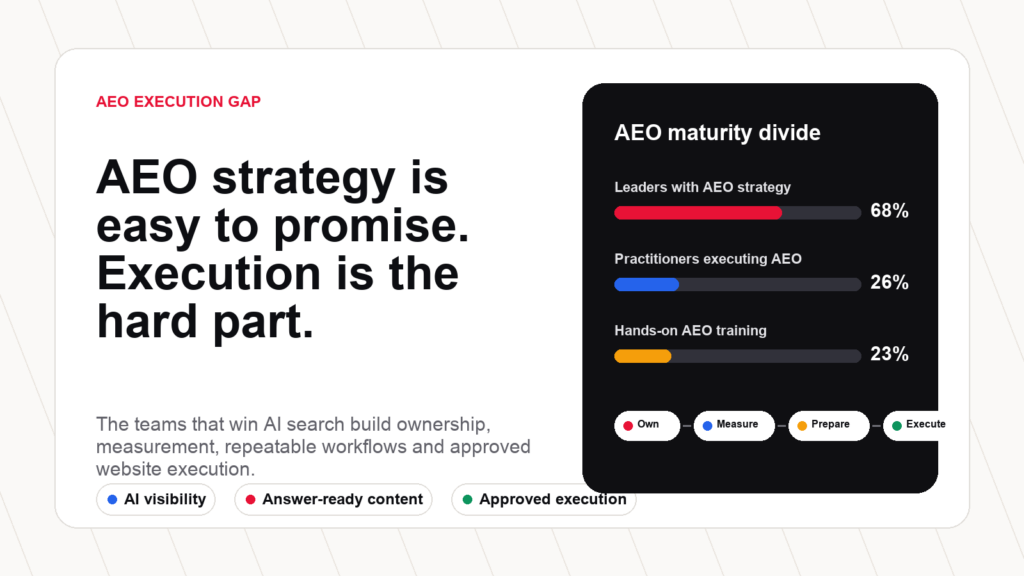
Short version: AEO is not failing because marketers have never heard of AI Search. It is failing because most companies do not yet have a repeatable operating system for turning AI visibility goals into content, technical fixes, structured information, approvals and published website changes.
Webflow’s The AEO Divide report is useful because it puts numbers behind a problem many teams already feel: leadership interest is ahead of day-to-day execution. For SMEs, this matters even more. You do not have infinite SEO, content, development, analytics and legal capacity. If AEO becomes another dashboard nobody has time to act on, it will not change business outcomes.
The real AEO gap is execution, not awareness
Answer Engine Optimization, usually shortened to AEO, is the work of making a website easier for AI-powered answer experiences to understand, trust, retrieve, cite and summarize. It overlaps heavily with SEO, technical SEO, content optimization, structured data, entity SEO and brand authority. The phrase is new-ish. The discipline is not magic.
The strategic conversation has moved quickly. Executives now ask whether their brand appears in ChatGPT, Perplexity, Google AI Overviews, AI Mode and other answer surfaces. Marketing teams are told to become visible in AI. Agencies are pitching AEO packages. Software vendors are shipping AI visibility dashboards. The problem is that visibility is not produced by a dashboard alone. It is produced by better content, cleaner website structure, stronger Entity Clarity, useful media, technical accessibility, authority signals and constant maintenance.
That is why the AEO divide is so important. It is not the gap between people who believe in AI search and people who do not. It is the gap between people who talk about AEO as a strategy and teams that can actually execute the work every week.
What the AEO Divide report found
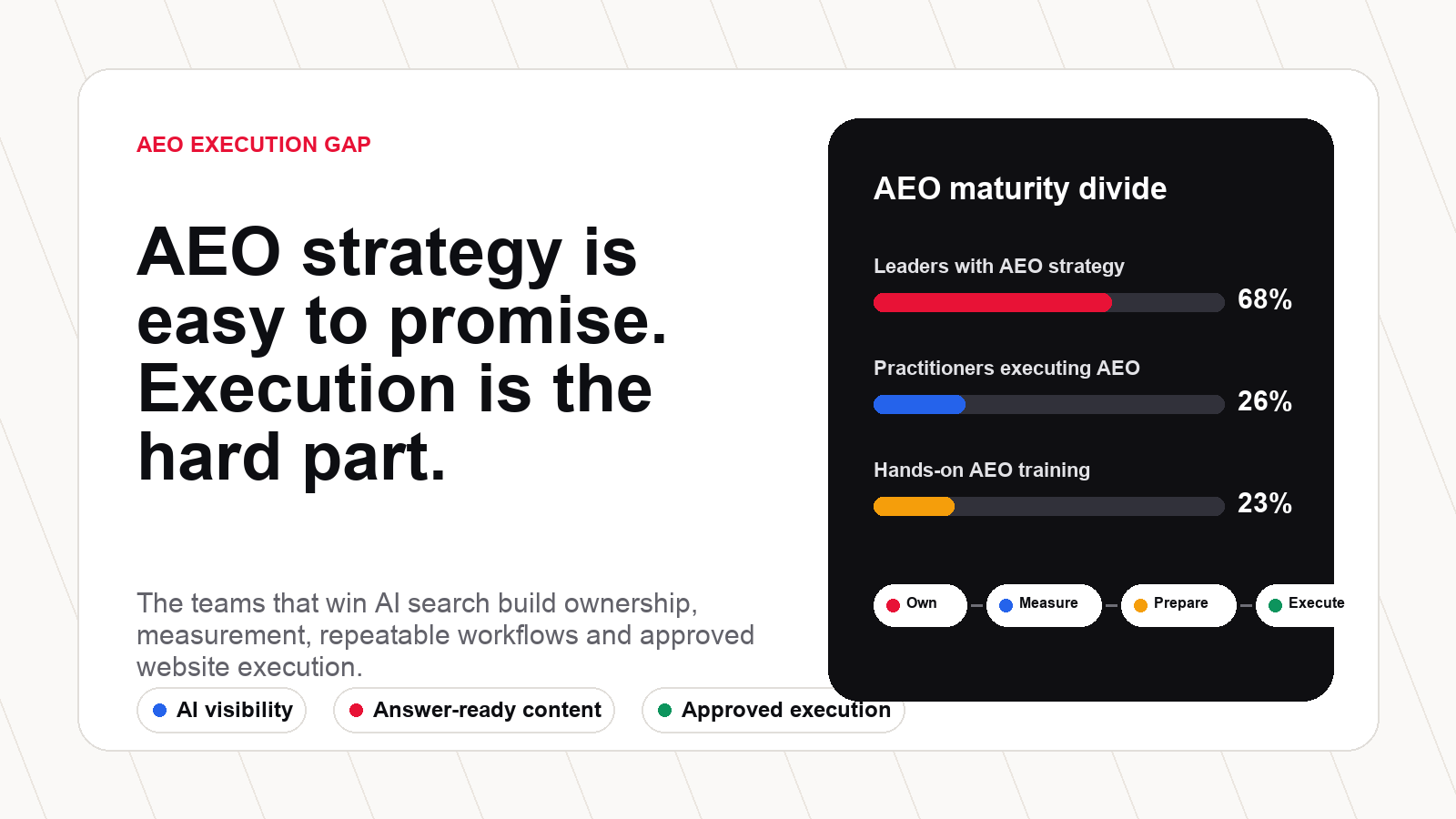
Webflow’s report is based on a survey of 400 U.S.-based marketing professionals, split between leaders and practitioners. Its headline finding is blunt: 68% of marketing leaders report some level of AEO maturity, while only 26% of practitioners say they are actively implementing AEO or feel like experts. That is a big spread.
In my opinion, this is exactly what happens when a topic becomes strategically fashionable before the operational model is ready. A board or leadership team can declare that AI visibility is now important. A marketing director can add AEO to the quarterly plan. But someone still has to identify the queries, map the entities, improve weak pages, check Crawlability, update content, add missing proof, align internal links, clean duplicated content, monitor answer surfaces and get changes approved.
The report also shows that mature teams are more likely to have clear ownership, more systematic content workflows and earlier adoption of AI visibility or answer-level measurement. Low-maturity teams are more likely to treat AEO as a vague responsibility scattered across SEO, content, brand and web teams.
AEO stays as a slide
- Leadership says AI search matters.
- Teams watch dashboards but lack ownership.
- Content updates wait for approvals, developers or agency cycles.
- Website changes happen slowly and inconsistently.
AEO becomes a workflow
- Important pages are monitored continuously.
- Opportunities become approval-ready tasks.
- Technical, content and authority actions are prioritized.
- Approved changes are executed inside the website workflow.
Ownership is the first maturity signal
The report’s maturity pattern makes sense: companies that know who owns AEO move faster. Companies that treat AEO as a shared but undefined responsibility usually stall. AEO touches too many areas to survive without ownership. It involves search data, content quality, brand consistency, technical SEO, analytics, website operations, local or ecommerce data and sometimes legal or compliance review.
For an enterprise, this may become a cross-functional program. For an SME, that is unrealistic. Most small and mid-sized companies do not have a dedicated SEO engineer, content strategist, analyst, webmaster, PR specialist and brand governance person sitting around a weekly AEO meeting. The owner, founder, marketing manager or ecommerce operator needs a simpler model: one system that identifies what matters, explains why, asks for approval and moves the work forward.
This is why ownership and automation must work together. Automation without ownership becomes risky. Ownership without automation becomes slow. A good AEO workflow should keep the human in control while removing the manual drag from research, task preparation and implementation.
High-maturity teams build workflows, not one-off content projects
AEO is not solved by rewriting five blog posts with the phrase “AI search” in the title. It is not solved by adding an FAQ block everywhere. It is not solved by chasing every new acronym. AEO needs a repeatable workflow because AI answer surfaces reward clarity, consistency, usefulness, authority and accessibility over time.
Google’s official guidance for generative AI features reinforces this. Google says the same foundational search work still matters: unique and helpful content, crawlable pages, clear technical structure, good page experience, images and video where useful, and avoiding manipulative attempts to mass-produce pages for every query variation. Google also says you do not need special AI-only markup, llms.txt files, artificial chunking or content rewritten only for AI systems.
That is an important correction. The best practical AEO work looks like disciplined SEO work upgraded for the answer-engine era. It asks better questions: Can the page answer the actual decision? Is the business entity clear? Are services, locations, prices, proof and processes visible? Is the content crawlable? Does the site have internal links between related topics? Are structured data and media aligned with visible content? Are outdated pages refreshed? Are weak pages consolidated or improved?
The workflow matters because all these improvements are small until they compound. One title improvement is not a strategy. One FAQ is not an AEO program. One AI visibility report is not execution. The companies that win are likely to be the ones that make useful improvements continuously.
AI visibility measurement is imperfect, but waiting is worse
Measurement is one of the hardest parts of AEO. Traditional SEO has imperfect but familiar metrics: rankings, clicks, impressions, CTR, conversions and indexed pages. AI search adds messier questions. Was the brand mentioned? Was it cited? Was the answer accurate? Which source influenced the response? Did the user click anything? Did the answer reduce the need for a visit? Did the answer influence later demand?
The Webflow report points to early adoption of AI visibility and answer-level tracking as a maturity signal. That does not mean every metric is perfect today. It means mature teams are not waiting for a final industry standard before building monitoring habits. They create baselines, track brand representation, watch important prompts and queries, and connect answer visibility back to the website work they can control.
For SMEs, the practical approach is simple: monitor the queries and topics that matter commercially, not every possible AI answer on the internet. If you are a private clinic, monitor how AI systems explain your services, trust signals, location and booking options. If you are an ecommerce store, monitor product-category advice, comparison queries, product feed clarity and review signals. If you are a B2B service provider, monitor problem-aware and vendor-comparison prompts.
The hidden bottleneck: approvals and implementation
The report notes that practitioners struggle not only with measurement but also with the work of changing content and keeping it updated. That is the boring part of AEO, but it is the part that decides results. Someone has to approve claims, pricing, service details, medical or legal language, product specifications, brand positioning and authority actions. Someone has to publish the accepted changes.
This is where many organizations lose momentum. AEO strategy creates ideas faster than teams can safely implement them. If the workflow depends on long email threads, spreadsheets, one-off agency tickets, developer queues and manual copy-paste, execution slows down. When execution slows down, the strategy becomes decorative.
Approval-first automation is the middle path. The system should not publish sensitive changes blindly. But it should prepare the work in a way a business owner or marketing manager can understand, show what will change, explain why it matters, ask for approval and execute accepted changes without forcing the user to become an SEO specialist.
What SMEs should do differently now
For SMEs, the lesson is not “build a large AEO department.” The lesson is to avoid treating AEO as another pile of reports. Smaller teams need focus, rhythm and execution leverage.
Start with the pages that already matter: homepage, service pages, product categories, comparison pages, location pages, pricing pages and help content. Make sure those pages clearly explain what you do, who it is for, where you operate, what proof you have, what the next step is and why someone should trust you. Then connect them semantically through internal links and supporting content.
Next, build a monitoring habit. Watch search performance, AI visibility, brand mentions, important answer prompts, crawl problems, page freshness and authority gaps. Do not turn monitoring into a full-time job. The point is to detect meaningful change and convert it into action.
Finally, protect quality. Google’s guidance is clear that mass-producing pages for every possible query variation is not the answer. Helpful, unique, experience-led content still matters. If you use AI, use it to accelerate useful work, not to flood the web with generic pages that nobody would trust.
Where AYSA fits: from AEO intention to approved execution
AYSA was built around the exact operational gap described in this report. The product idea is simple: SEO and AEO should not stop at analysis. The system should monitor your website, understand your business, find opportunities, prepare approval-ready actions and execute accepted changes inside the website workflow.
That means AYSA can help with the practical layer behind AI visibility: weak pages, missing topics, title and description improvements, technical SEO issues, internal linking opportunities, FAQ and answer-ready content, structured data opportunities, local or ecommerce details, authority-building actions and content plans. The user does not need to manually interpret 20 dashboards or copy-paste SEO recommendations into WordPress. The important work is prepared, explained and placed into an approval flow.
In my opinion, this is the direction AEO has to move for SMEs. AI search visibility will not be won by companies that only read reports. It will be won by companies that can improve their websites continuously, safely and quickly. Strategy matters. But without a workflow, strategy is just a promise.
Sources and further reading
Turn AEO strategy into approved website execution.
AYSA monitors your website, prepares SEO and AI visibility actions, asks for approval and executes accepted changes inside your website workflow.
Continue the AI search topic inside AYSA.
Use these pages to connect the article with AI SEO tools, AI visibility monitoring, AI Overviews and approved website execution.
Turn this topic into a website action plan.
Use these AYSA hubs to move from reading to technical fixes, AI visibility monitoring, research, glossary context and approval-first SEO execution.

