AI Agents Are Becoming Website Visitors: How To Prepare For Auto-Browsing, Transactional AI, And The Next SEO Surface
Two phone agents launched on the biggest mobile platforms—one primarily reads your site to answer questions, the other can visit your site to complete tasks. That difference changes what “SEO” means in 2026: not just being cited, but being executable.

AI is no longer only a “search box” problem. It’s becoming a website visitor problem.
In the last wave of Generative search, the main fear (and opportunity) was: “Will an AI model cite my content?” In the next wave, the question gets more operational: “Will an AI agent complete tasks on my website—and will my site let it?”
A recent analysis in Search Engine Journal highlighted a shift that too many businesses are treating like a feature comparison. Two default phone agents shipped close together. One primarily reads the web to assemble answers. The other can visit websites and act on them, like a user.
From an operator’s perspective (founders, marketers, ecommerce teams, clinics, agencies), that “reads vs. acts” distinction is the real scoreboard. Because the moment an agent starts doing things on your site—filling forms, booking appointments, initiating checkouts—your SEO, UX, technical stack, analytics, and risk controls collide into one new discipline.
I’m Marius Dosinescu, and at AYSA we care about one thing: turning visibility into outcomes, reliably. In this editorial, I’m going to outline what changed, why it matters, what can break, and exactly how SMEs and agencies should prepare for agentic browsing—without panic, without buzzwords, and without pretending we know more than we can verify.
Concise summary
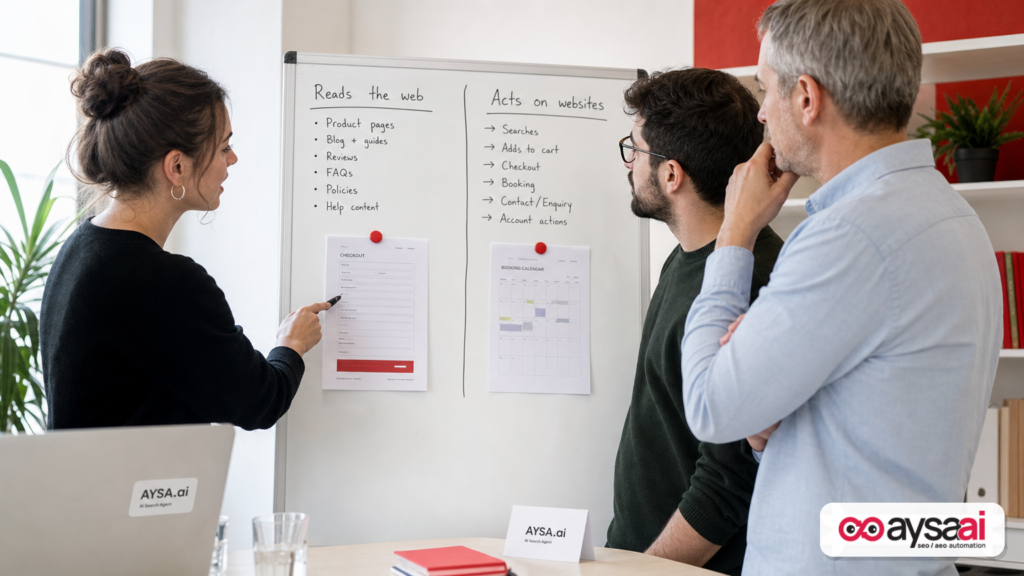
- AI “readers” summarize the web and may cite you. Your job: be a clean, structured, accessible source.
- AI “actors” operate websites to complete tasks. Your job: make key flows machine-executable (not just pretty), measurable, and resilient.
- The winners will treat this as SEO Automation + UX + analytics + governance—not just content marketing.
- AYSA’s role: monitor what’s changing, propose fixes, request approval, and execute accepted changes—so “preparing” doesn’t die in a backlog.
Key takeaways (for busy operators)

- Stop optimizing only for citations. Optimize for completions: booking confirmed, lead submitted, checkout completed.
- Audit your money flows first. Homepage rankings won’t matter if your checkout/booking flow can’t be completed by an agent (or a human).
- Make your site understandable without visual hints. Agents don’t “feel” design; they follow structure, labels, and predictable states.
- Instrument like a product team. Event tracking and server-side signals become as important as page titles.
- Govern automation. The right model is: monitor → recommend → approve → deploy, with clear risk boundaries.
Table of contents

- The New Split: “Reading Agents” vs. “Acting Agents”
- What Actually Changed In 2026 (And Why It’s Not Just Hype)
- Why This Changes SEO: From Ranking Pages To Executing Tasks
- The “Acting Surface” Is Your Website: What Agents Need From You
- What Breaks First When An Agent Tries To Buy, Book, Or Apply
- A Concrete SME Scenario: Local Clinic Booking vs. Agentic Browsing
- Staying Citable: Content Structure Still Matters (AEO/GEO)
- Technical SEO Becomes “Operational SEO”: A Readiness Checklist
- The Measurement Problem: When “Traffic” Stops Explaining Revenue
- What Agencies Must Rethink: From Deliverables To Outcomes
- Risk, Compliance, And Brand Safety: Don’t Let Agents Become a Security Incident
- Where AYSA Fits: Monitor, Recommend, Get Approval, Execute
- What To Do Next (Action List)
- Sources And Further Reading
The New Split: “Reading Agents” vs. “Acting Agents”
Here’s the framing that matters for business outcomes:
- Reading agents pull information from the web and generate an answer. They may quote or cite sources. They influence discovery and consideration.
- Acting agents open a browser and attempt to complete a task on a website: compare options, fill forms, book, buy, submit, reserve. They influence conversion—directly.
The SEJ piece makes this distinction central: one agent’s relationship to your website is “content ingestion,” the other’s relationship is “task execution.” That’s not a semantic difference. It determines your priorities:
- If an agent only reads, you invest heavily in content clarity, structured pages, accessibility, and crawlable rendering.
- If an agent acts, you invest in flow reliability, predictable UI states, resilient forms, fewer blockers, and instrumentation.
In reality, you need both. But most SMEs have limited bandwidth. So the first step is recognizing there are two surfaces to win: the answer surface and the transaction surface.
What Actually Changed In 2026 (And Why It’s Not Just Hype)
We’ve had “assistants” for years. We’ve even had experiments where bots could browse pages. The change is not the concept; it’s the operationalization:
- Default distribution: an agent that can operate websites becomes available at phone scale without user setup (per the SEJ analysis).
- System-level integration: rather than a niche extension, it’s embedded into a mainstream browser/OS workflow.
- User intent Compression: users increasingly want “done” rather than “shown.” The assistant isn’t just finding a page; it’s attempting to finish the job.
That combination changes the economic incentive. If a meaningful share of users delegate tasks to agents, the web becomes less about persuasion-by-page and more about successful execution under automation.
And that pressure lands on the least glamorous parts of your stack: form labels, session timeouts, modal dialogs, JavaScript dependencies, CAPTCHA, and error handling.
Why This Changes SEO: From Ranking Pages To Executing Tasks
Traditional SEO (oversimplified) was: get discovered → earn Clicks → convert.
AI answer engines already disrupted the “earn clicks” stage by answering directly. Now acting agents can disrupt the “convert” stage by becoming the clicker. That has three consequences:
1) Visibility isn’t enough—your site must be operable
You can rank #1 and still lose if your booking widget fails when driven programmatically or your checkout requires fragile UI interactions. Agentic browsing rewards robust interaction models.
2) UX and technical SEO converge
In many organizations, UX is “design,” and Technical SEO is “crawl/render.” Acting agents force a merge: the same structural decisions that help bots understand content also help agents complete tasks.
3) Conversion optimization becomes “agent optimization”
Some conversion patterns depend on confusion, friction, or dark-pattern nudges. An agent won’t be persuaded by scarcity banners the way a human might. It will attempt to complete the task with the fewest steps—and it will fail fast if you force it into ambiguous UI.
The “Acting Surface” Is Your Website: What Agents Need From You
Let’s translate “agent-friendly” into plain business requirements.
Predictable structure and labels
Agents (and accessibility tools) rely on clear semantics:
- Properly labeled inputs (
labelassociations, descriptive names) - Unique, stable button text and roles (“Book appointment,” “Continue,” “Pay now”)
- Consistent form validation (don’t move fields around mid-entry)
This is less about “AI” and more about building sites that behave like well-designed software.
Reliable page states and navigation
Agents need to know when a step is complete. If your UI relies on subtle animations, hidden elements, or ambiguous success states, the agent can’t confidently proceed.
Fewer blockers (or smarter blockers)
Most sites were built assuming “the user is a human with eyes.” Acting agents challenge that assumption. Common blockers:
- Over-aggressive bot protection that blocks legitimate assisted sessions
- Popups and interstitials that hijack focus
- Consent banners that break flows when not handled cleanly
This doesn’t mean “remove security.” It means design security with risk tiers (low-risk browsing vs. high-risk transactions) and with graceful fallbacks.
What Breaks First When An Agent Tries To Buy, Book, Or Apply
If you only have time to audit one thing: audit your highest-value flow. For ecommerce, that’s checkout. For a clinic, it’s appointment booking. For B2B, it’s lead capture and qualification.
Here’s what tends to break first when a machine tries to complete tasks—also the same things that frustrate humans.
1) Form ambiguity
- Missing labels
- Placeholders used as labels (they disappear)
- Multiple “Continue” buttons with different meanings
2) Modals, overlays, and focus traps
Popups that steal focus can cause agents to loop or click the wrong element. If your conversion strategy depends on layered overlays, expect volatility.
3) Authentication friction and session resets
“Verify email,” “create account,” “log in to continue,” short session timeouts—these steps are already conversion killers. Agents will surface just how often you reset state or require repeated input.
4) CAPTCHA and bot protection misfires
Some level of fraud protection is necessary. But many configurations are blunt instruments. If your analytics shows unexplained checkout drop-offs, bot protection is often involved.
Important note: the SEJ source mentions the agentic browsing behavior at a high level. It does not provide a formal standard for how bot protection should adapt. Where you can’t verify, treat this as operational analysis: you will need to test and calibrate.
5) Fragile JavaScript dependencies
If a critical button only exists after several chained scripts run, you’ve increased failure points for everyone—especially nonstandard clients. Server-rendering and progressive enhancement aren’t old-school; they’re resilience.
A Concrete SME Scenario: Local Clinic Booking vs. Agentic Browsing
Imagine a local clinic with two locations. The website looks modern. Rankings are decent. The clinic gets leads.
Now picture a user saying to their phone: “Book me the earliest appointment for a flu shot next week at the clinic closest to me.”
A reading agent might summarize hours, policies, and location info. But an acting agent will attempt to:
- Open the clinic site
- Choose the nearest location
- Select “Flu shot”
- Select a date/time
- Complete the form
- Confirm the booking
What commonly goes wrong:
- The booking widget is third-party and loads late; the agent times out.
- The location switcher is a modal with no clear state; the agent selects the wrong clinic.
- The service type is in a dropdown with inconsistent naming (“Influenza Vaccine” vs “Flu shot”).
- Confirmation is only displayed as a temporary toast notification; the agent can’t detect success.
Now here’s the business impact: the user doesn’t “bounce.” They simply delegate the task to another provider whose workflow completes reliably. No drama, no complaint, just lost revenue.
This is why I believe 2026 SEO is less about “ranking tricks” and more about operational readiness for machine-led journeys.
Staying Citable: Content Structure Still Matters (AEO/GEO)
Even as acting agents grow, reading agents remain crucial. Being a trusted source still drives:
- Top-of-funnel discovery
- Brand preference
- Category education
- Local and multi-location accuracy (hours, services, policies)
So you still need AEO/GEO fundamentals:
Publish content in a crawlable, extractable way
Where possible, ensure important content is server-rendered and accessible. If your key policies or service descriptions only appear after heavy client-side rendering, you’re betting against extraction.
Use clear structure and intent-driven headings
Write like you want to be quoted correctly. Define terms. Provide concise answers. Then expand. A practical pattern for SMEs:
- One-sentence answer at the top of a section
- Eligibility/constraints (pricing ranges, location limitations, timing)
- Process (how it works step-by-step)
- FAQs that match real customer questions
Consistency across locations and pages
If you’re multi-location, inconsistent NAP details, hours, or service lists will get amplified by AI summaries. This is where monitoring matters.
AYSA’s AI visibility workflow is designed for this: AI search visibility monitoring, structured recommendations, and controlled execution.
Technical SEO Becomes “Operational SEO”: A Readiness Checklist
If agents will attempt to complete tasks, treat your website like a product that must handle automated journeys. Here’s a practical checklist you can actually run.
Step 1: Inventory your “money flows”
- Ecommerce: add-to-cart → checkout → payment → confirmation
- Local services: quote request → scheduling → deposit → confirmation
- Healthcare: service selection → location → insurance/self-pay path → booking
- SaaS: pricing → demo request → trial signup → onboarding
Write them down. If you can’t name them, you can’t defend them.
Step 2: Test flows in “no-guessing mode”
The SEJ source suggests running your own key task flows against an agent to find breakpoints. Even without specialized tools, you can simulate the mindset:
- Turn off “I know where it is” bias.
- Try keyboard-only navigation.
- Use screen reader checks (even basic ones).
- Look for steps that require visual interpretation rather than explicit labels.
Step 3: Reduce non-essential friction
- Minimize forced account creation
- Eliminate duplicate data entry
- Make error messages explicit and tied to the field
- Ensure success states persist (confirmation pages, emails, receipts)
Step 4: Build for resilience (progressive enhancement)
Where practical, ensure core actions work even if some scripts fail. If the “Book now” action requires three separate client-side frameworks to initialize, you’ve created a brittle funnel.
Step 5: Use structured data where it legitimately applies
Structured data doesn’t guarantee citations or agent behavior, but it improves clarity and reduces ambiguity. Don’t spam it. Use it where accurate (products, organizations, local business details, FAQs when appropriate and truthful).
Note: This editorial is not claiming specific ranking lifts. It’s advocating clarity and consistency to support both extraction and execution.
The Measurement Problem: When “Traffic” Stops Explaining Revenue
As AI changes discovery and conversion paths, sessions and pageviews become less explanatory. You may see:
- Fewer clicks from informational queries (answers happen elsewhere)
- Different navigation patterns (agents skipping pages)
- Higher variance in form completion rates based on UI changes
So measurement must shift from “what pages did they view?” to “what job did they complete?”
Adopt event-first analytics
Whether you use GA4 or another system, the principle is the same:
- Track start and success of each key flow
- Track major drop-off points (validation errors, payment failure, booking unavailable)
- Track key UI blockers (popup shown, consent accepted, captcha triggered)
If you’re not instrumented at this level, you can’t tell whether you have a “ranking problem” or a “flow operability problem.”
Prepare for new “visitor classes”
Historically, you segmented by device, channel, and location. Now you may need to segment by behavior patterns that look like automation. The goal isn’t to block; it’s to understand:
- Are these sessions converting?
- Where do they fail?
- Do your protections misclassify legitimate assisted journeys?
This is where a monitoring system matters. AYSA is built around monitoring signals, detecting changes, and turning them into an execution plan—not just reporting.
What Agencies Must Rethink: From Deliverables To Outcomes
Agencies have been trained by the market to sell deliverables: audits, content calendars, backlink plans, technical checklists.
Agentic browsing punishes deliverables that don’t ship. Because the competitive edge becomes:
- How fast can you identify breakage?
- How fast can you fix it safely?
- How well can you prove the fix improved completions?
That requires an operating model closer to product iteration than legacy SEO retainers.
The new statement of work (SOW) will include execution
The uncomfortable truth: most SEO programs die in implementation. Recommendations get stuck with dev teams, or they’re deprioritized behind “real work.”
In an agent-operated web, that lag becomes existential. If your checkout breaks for automated flows, you don’t have two quarters to negotiate a sprint.
This is why we built AYSA as an execution system—an engine that can recommend changes, request approval, and then deploy accepted improvements. See: AYSA AI SEO tools and the broader approach on the AYSA blog.
Pricing pressure will reward accountability
If clients start asking “Did the agent complete the booking?” instead of “Did we publish 8 blog posts?”, agencies will need to tie work to measurable conversions. That’s a healthy change.
Risk, Compliance, And Brand Safety: Don’t Let Agents Become a Security Incident
When you hear “agents filling forms,” you might worry about fraud, scraping, or unintended actions. That concern is legitimate.
But blocking everything that looks automated is not a strategy. It can also:
- Block accessibility tools
- Block legitimate assisted browsing
- Increase friction for real customers
The practical approach is tiered trust and tiered controls:
- Low risk: reading product/service info, checking availability → keep accessible
- Medium risk: submitting lead forms → validate inputs, rate-limit, spam protection
- High risk: payments, account changes → strong authentication, step-up verification
And remember governance: if automation can change your site quickly, you must define what requires human signoff.
Where AYSA Fits: Monitor, Recommend, Get Approval, Execute
Most businesses don’t fail because they don’t know what to do. They fail because execution is slow, fragmented, or risky.
AYSA is designed to close that gap:
- Monitor: detect visibility shifts and operational issues that affect AI and human journeys (Monitoring)
- Prepare: generate prioritized recommendations tied to outcomes (not vanity metrics)
- Ask for approval: keep humans in control for risky changes (pricing, compliance, messaging)
- Execute accepted changes: ship improvements so the backlog doesn’t swallow your strategy
This model matters more as the web becomes agent-operated. Because you’re not only competing for rankings—you’re competing on whether your digital business can be “run” reliably by automated clients.
If you want to evaluate fit quickly, start with AYSA pricing, then map it to your top flows.
What To Do Next (Action List)
- Pick one flow that pays your bills. Checkout, booking, lead form—choose one.
- Document the steps. If you can’t describe it in 8–15 steps, it’s too complex.
- Run an “agent-style” test. Keyboard-only, no guessing, no visual assumptions. Record every failure point.
- Fix the top 3 blockers. Usually labels, modals, and fragile success states.
- Add event tracking. Start-flow, submit-attempt, error, success. Without this, you’re blind.
- Improve citable content. Clear service pages, policies, location details—server-rendered where possible.
- Set governance. Define what can be auto-deployed and what needs approval.
- Adopt an execution loop. Whether with AYSA or internal process: monitor → recommend → approve → ship.
Sources And Further Reading
- Search Engine Journal — Chrome Auto-Browse Acts On Your Website, Apple’s Siri AI Only Reads It (primary research input)
- Search Engine Journal — Latest News (context stream)
- Search Engine Journal — SEO (broader coverage context)
- Search Engine Journal — Webinars (industry education context)
- Search Engine Journal — On-Page SEO (implementation context)
Note on sourcing: The provided research context did not include official Apple or Google documentation links for these specific features. Where details cannot be verified directly from primary documentation in the supplied context, this article treats implications as analysis and focuses on practical readiness patterns that are beneficial regardless of vendor implementation specifics.
About this editorial
This is an AYSA.ai editorial resource designed for SMEs, ecommerce teams, local operators, and agencies who need practical steps—not hype. For more on how we approach AI-era visibility and execution, explore:
If you want a single operational objective for 2026: build a website that is citable, executable, and measurable. The businesses that do that won’t just survive AI—they’ll compound.
Continue the AI search topic inside AYSA.
Use these pages to connect the article with AI SEO tools, AI visibility monitoring, AI Overviews and approved website execution.
Turn this topic into a website action plan.
Use these AYSA hubs to move from reading to technical fixes, AI visibility monitoring, research, glossary context and approval-first SEO execution.