
AI Search Ads, Qualified Future Conversions, And Creator Rights: The New Playbook For Measuring And Winning In Google’s AI Era
Google is keeping AI Search ad eligibility tightly tied to automation (Broad Match, AI Max/PMax, Smart Bidding), rolling out predictive measurement with Qualified Future Conversions, and reminding advertisers that creator content still requires explicit rights. Here’s what changed, why it matters, and the practical steps SMEs and agencies should take—plus how AYSA turns AI-search readiness into approved, executed website improvements.

Google’s AI-era messaging has a theme: if you want visibility in the newest search experiences, you’ll need to participate in systems that are increasingly automated, context-driven, and measured over longer time horizons. That’s not a hype statement—it’s a strategic constraint Google is making explicit.
In a recent Q&A, Google Ads Liaison Ginny Marvin clarified three areas that matter to every advertiser and business owner right now: (1) what makes ads eligible for AI Search experiences like AI Overviews and AI Mode, (2) what “Qualified Future Conversions” (QFC) is actually trying to measure, and (3) what’s required to use creator content in Google Ads without creating a rights mess. The full context is covered by Search Engine Journal, which summarized Marvin’s clarifications here: Google’s Marvin Clarifies AI Search and Qualified Future Conversions.
This AYSA.ai editorial goes beyond that recap. We’re going to translate what it means for real businesses, where it can go wrong, what to monitor, and what to change—on your site, in your campaigns, and in your measurement stack—so you’re not “AI-washed” into decisions you can’t explain to a CFO or business partner.
Concise summary

- Ad eligibility for AI Search isn’t a new checklist—it’s an escalation of Google’s push toward automation. Broad Match, Smart Bidding, and AI-powered campaign types (including Performance Max and newer AI Max concepts) are the path Google highlights for participation.
- “Relevance” now includes the AI answer itself. Google has indicated ad matching can consider the user’s query and the content of the AI-generated response, raising the bar for message/landing-page alignment.
- Qualified Future Conversions is a predictive measurement layer. It’s meant to estimate conversions that occur well after standard Attribution windows. Useful? Potentially. Risky? Also potentially—especially if teams treat prediction as proof.
- Creator partnerships require permission. Google can help you discover and request partnerships, but rights and approvals remain your responsibility.
- Execution matters more than strategy decks. AI Search and AI Ads reward tight alignment between intent, content, feeds, landing pages, and tracking. AYSA fits here as an “Approved Execution” system that monitors, prepares, asks for approval, and then executes site changes you accept.
Key takeaways (for busy operators)
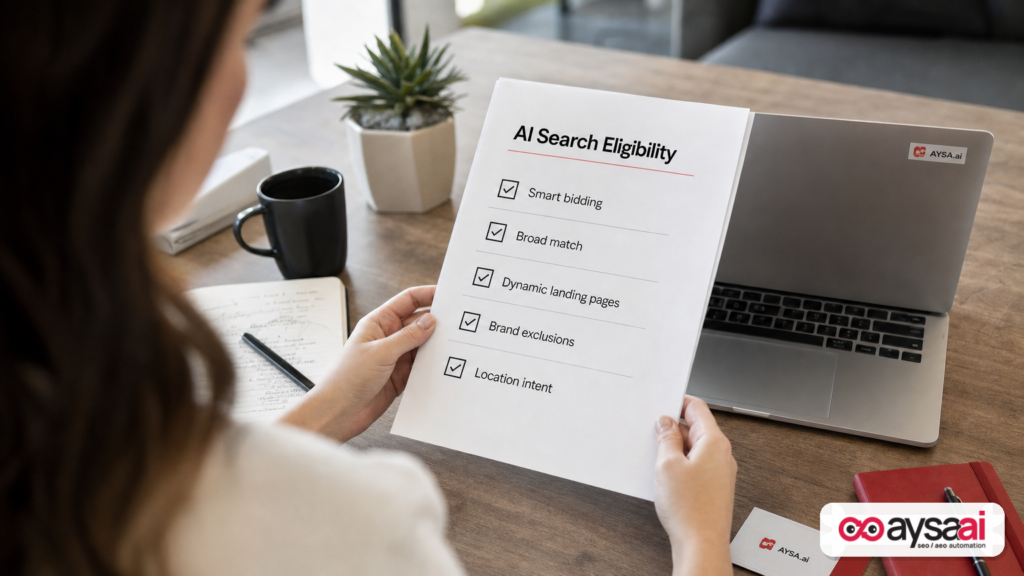
- If you’re avoiding automation, you may be avoiding eligibility. Not because Google is punishing you—because Google is designing AI Search ad experiences around automated matching, bidding, and creative customization.
- Your landing pages are now part of ad relevance in a bigger way. Dynamic routing (like Final URL Expansion concepts) can help—until it sends high-intent users to a page that doesn’t close them.
- Predictive metrics should be audited, not worshipped. Treat QFC as a directional signal that must be validated against your own sales and retention data.
- Rights are operational, not optional. If creator content is part of your strategy, build a lightweight but real rights process (permission, scope, duration, usage, whitelisting rules).
- Make your website “AI-ready” for both paid and organic. AI Search blends context; the best ad account in the world can’t rescue a confusing offer, thin product/service pages, or inconsistent location/service data.
Table of contents

- What This Moment Really Signals: Google Is Collapsing “Search + Ads + Measurement” Into One AI System
- AI Search Ad Eligibility: What Google (Still) Requires—and What That Means In Practice
- The New Relevance Bar: Query + AI Response + Your Ads + Your Site
- Automation With Guardrails: Brand, Location Intent, URL Inclusions/Exclusions
- Creative In The AI Era: Customization, Consistency, And “Message-Page Match”
- Measurement Is The Battleground: Why Google Keeps Expanding The Window
- Qualified Future Conversions (QFC): Why Google Needs A Predictive Metric (And Why You Should Be Skeptical)
- How To Validate QFC Without Fooling Yourself
- Creator Partnerships: Rights, Risk, And A Better Way To Use Creator Content
- A Concrete SME Scenario: Local Clinic + AI Search + Long Sales Cycles
- What Agencies Should Rethink: Reporting, Testing, And Client Expectations
- Where AYSA Fits: AI Search Visibility + Approved Execution (Not “Advice PDFs”)
- What To Do Next (90-Day Action Plan)
- Sources And Further Reading
What This Moment Really Signals: Google Is Collapsing “Search + Ads + Measurement” Into One AI System
For years, businesses have treated three things as separate lanes:
AI Search is forcing those lanes to merge. Google is increasingly evaluating:
- the user’s intent (often longer, conversational, multimodal),
- the AI-generated response content,
- the ad’s relevance to that context, and
- the landing experience that proves you actually satisfy the intent.
So when Marvin reiterates that eligibility leans on AI-powered targeting and Smart Bidding, that’s not just “Google pushing automation.” It’s Google designing a system where manual control is less scalable than machine interpretation. You can dislike that reality and still have to operate inside it.
As a business owner, the correct question isn’t “How do I hack my way into AI Overviews ads?” The correct question is:
“How do I become the most contextually relevant, measurable option—without losing control of brand, budget, and lead quality?”
AI Search Ad Eligibility: What Google (Still) Requires—and What That Means In Practice
According to the SEJ recap of Marvin’s Q&A, the key clarification was that eligibility hasn’t changed: to have ads eligible for AI Search placements (such as AI Overviews and AI Mode), advertisers generally need to use Google’s AI-powered targeting solutions and Smart Bidding. The campaign mechanics called out include approaches like Broad Match and newer/expanded AI-driven campaign types (including Performance Max and AI Max concepts), plus Dynamic Search approaches as they evolve. Source: Search Engine Journal.
Practically, that means:
- If you’re still running a rigid Keyword list, manual bids, and tightly controlled ad copy, you may remain functional in classic SERPs—but you may be structurally less aligned with where Google is steering AI Search ad delivery.
- If you’re already using automation, the next challenge isn’t “turn it on.” It’s constraining it so it serves your business model rather than burning budget on ambiguous intent.
Why Google is pushing this (the business logic)
AI Search experiences are built to interpret more context: longer queries, follow-up questions, voice inputs, images, and comparisons. Google needs ad systems that can respond to meaning, not just exact-match keywords. Automated matching and automated bidding are a better fit for that environment.
But this creates a trade:
- Pro: Better matching to “hidden” intent you didn’t anticipate in your keyword list.
- Con: More ways to pay for traffic you didn’t actually want.
The New Relevance Bar: Query + AI Response + Your Ads + Your Site
The most important strategic nuance in Marvin’s comments (as summarized by SEJ) is the idea that relevance in AI Search is higher—and that ad matching may consider both the user’s query and the AI-generated response content.
Even if you’re not a PPC expert, here’s the implication in plain English:
Your ad isn’t competing only against other ads. It’s competing against the AI answer itself.
If the AI answer frames the problem a certain way (e.g., “For emergency plumbers, prioritize same-day service and transparent pricing”), and your ad/landing page doesn’t reflect that framing, you can lose—even if your bid is high.
The hidden KPI: message-page match under AI context
Historically, “message match” meant: keyword → ad copy → landing page headline.
Now it’s: conversation context → AI answer framing → your ad message → the landing page that proves it.
That’s why the website is back in the center of paid search success. And it’s why “just run PMax” is not a strategy—it’s a starting configuration.
Automation With Guardrails: Brand, Location Intent, URL Inclusions/Exclusions
Automation isn’t binary. The winners will be the teams who combine automation with clear constraints. In the SEJ summary, Marvin referenced controls like brand controls, location-of-interest settings, and URL inclusion/exclusion options (contextual controls that shape how automation behaves).
Here’s the operator’s framework I recommend:
1) Brand guardrails (where you must be strict)
- Protect your brand terms from being “interpreted” into competitor conquesting unless you explicitly want that.
- Separate brand vs. non-brand reporting so you can see where growth is actually coming from.
2) Location intent (especially for multi-location or service-area businesses)
- “People in” vs. “people interested in” a location can materially change lead quality.
- AI Search makes location more conversational (“near my office,” “close to LAX,” “in downtown”). You need a coherent location strategy across ads and site pages.
3) URL routing (inclusion/exclusion)
If Google can choose landing pages dynamically, you must ensure only your best “closing pages” are eligible. Otherwise, you’ll pay for high-intent clicks and land users on:
- a generic homepage,
- an outdated blog post, or
- a page missing pricing, availability, or next-step CTAs.
This is one place AYSA’s approach is especially relevant: if your site has gaps (missing schema, thin service pages, inconsistent location details), automation will amplify those gaps. Fixing them requires execution, not just diagnosis. More on that below.
Creative In The AI Era: Customization, Consistency, And “Message-Page Match”
Marvin’s Q&A emphasized text customization and automated routing to the “most relevant” page. Conceptually, Google wants ads that feel native to the conversation and reduce friction for the user.
That puts pressure on businesses in three places:
1) Your value proposition must be unambiguous
AI matching can bring you new intent—but if your offer is fuzzy, you’ll get fuzzy traffic.
SME test: Can a stranger answer these in 10 seconds on your landing page?
- What do you sell?
- Who is it for?
- Why should they trust you?
- What should they do next?
2) You need “coverage” content for long, conversational queries
AI Search users don’t only type “best CRM.” They ask:
- “What CRM is easiest for a 3-person real estate team?”
- “Which payroll service integrates with my accounting tool and supports contractors?”
- “What’s the difference between ceramic coating and PPF for a leased car?”
That’s AEO/GEO territory: content that answers comparisons, constraints, and buyer anxieties. It supports organic AI answers and improves paid performance because it gives Google better landing-page relevance options.
Related: AYSA’s AI Search visibility work is designed around this reality: AI Search Visibility.
3) You need a real creative testing cadence
Automation does not remove the need for testing; it increases it. Your “inputs” are now the product: creatives, feeds, landing pages, conversion definitions, and audience signals.
Measurement Is The Battleground: Why Google Keeps Expanding The Window
If you feel like measurement keeps getting more complicated, it’s because it is.
Three forces are colliding:
- Longer buying cycles (especially in SaaS, B2B, home services with financing, healthcare, high-AOV ecommerce)
- More touchpoints (video, creators, AI answers, email, retargeting, branded search later)
- Less deterministic tracking (privacy constraints, consent modes, device fragmentation—note: we’re not citing specifics here because they aren’t in the supplied context)
Google’s response has been to add more “modeled” or “predictive” views of value. In the SEJ recap, Marvin positioned QFC alongside other measurement initiatives that aim to capture value beyond standard reporting windows (SEJ referenced items like Attributed Branded Searches and other Google measurement efforts in that same vein).
The business reason is straightforward: if the platform only gets “credit” for short-window conversions, it under-attributes upper-funnel and consideration campaigns. Google wants a measurement framework that justifies investment across the full funnel.
Qualified Future Conversions (QFC): Why Google Needs A Predictive Metric (And Why You Should Be Skeptical)
Qualified Future Conversions (QFC), as described in the SEJ summary, is a predictive metric intended to estimate conversions that occur up to 180 days after an ad interaction, using early signals (like branded searches) plus historical patterns to forecast future sales. Source: Search Engine Journal.
Let’s be clear about what that means:
- It is not a logged conversion. It’s a forecast.
- It is not a replacement for your core conversions. It’s intended as an additional signal.
- It is highly dependent on your tracking hygiene. Garbage in, confident garbage out.
Why QFC exists (and why many advertisers will want it)
If you run Demand Gen or video-heavy campaigns, it’s common to see a delay between initial exposure and purchase. Businesses complain that performance looks weak inside short attribution windows even when overall revenue improves. A metric that estimates long-lag impact is appealing, especially for teams trying to defend budget.
The risk: prediction becomes “proof” in board meetings
Here’s the caution: predictive metrics can be useful as directional guidance, but they can also mask problems:
- weak landing pages
- overbroad targeting
- mis-tagged conversions
- lead-quality issues that show up later in the CRM
If QFC says you “will” get future conversions, teams may stop asking whether the leads are qualified, whether margins are acceptable, or whether other channels deserve credit.
How To Validate QFC Without Fooling Yourself
Assume QFC becomes available to you. What should you do?
Step 1: Separate “prediction” from “observed truth”
- Keep your existing conversion reporting intact.
- Create a separate view for QFC as an experimental signal.
Step 2: Compare QFC trends to downstream business data
Even without perfect attribution, most SMEs can validate directionally by comparing:
- sales-qualified lead rate (SQL%)
- close rate by source
- time-to-close shifts
- repeat purchase / renewal trends
If QFC rises but your SQL% falls, you may be buying attention—not demand.
Step 3: Run holdouts or budget “pulses” where feasible
Not every business can do perfect incrementality tests, but many can do practical alternatives:
- geo-based budget reductions for a limited period
- brand-search monitoring during and after changes
- creative swaps with stable targeting
Goal: identify whether changes in predictive metrics correlate with real pipeline and revenue movement.
Step 4: Strengthen first-party measurement basics
QFC won’t rescue weak fundamentals. If you haven’t implemented robust conversion measurement, start there. Google’s own documentation on Enhanced Conversions is a primary reference point for improving conversion measurement quality in Google Ads (included here as reputable, official context): Enhanced conversions for web (Google Ads Help).
Also ensure you have a solid analytics foundation. For most SMEs, GA4 is the baseline: Google Analytics 4 (GA4) overview (Google Analytics Help).
Creator Partnerships: Rights, Risk, And A Better Way To Use Creator Content
Marvin’s creator partnership clarification is the most “boring” part of the Q&A—and that’s exactly why it matters. The SEJ summary stated that advertisers do need permission to use a creator’s video in Google Ads, and that securing rights is the advertiser’s responsibility. Source: Search Engine Journal.
This is not a “nice-to-have.” It’s operational risk management. If you use creator content without a clear agreement, you invite:
- takedown requests mid-campaign
- brand disputes and public complaints
- wasted production and editing costs
- potential platform policy complications
SME-friendly creator strategy (not “celebrity influencer” thinking)
One useful point from Marvin (per SEJ) is that creator partnerships aren’t only for giant consumer brands. Smaller, niche creators can be more valuable because:
- their audience trust is often higher,
- their content is more specific (tutorials, reviews, walkthroughs),
- their costs are typically more aligned with SME budgets.
A lightweight rights process you can actually follow
For most SMEs, keep it simple:
- Permission in writing (email minimum; ideally a short agreement)
- Scope: which assets, which edits allowed, which platforms
- Duration: start/end date
- Usage: paid amplification allowed? whitelisting allowed?
- Approvals: who signs off on final cut
A Concrete SME Scenario: Local Clinic + AI Search + Long Sales Cycles
Let’s make this real.
Business: A mid-sized dental implant clinic with two locations.
Average decision cycle: Weeks to months (patients compare options, financing, second opinions).
Current setup:
- Google Ads search campaigns with mostly phrase/exact match keywords
- Manual landing page selection (everyone goes to the homepage or one generic implants page)
- Conversions tracked as “form submit” only
What changes in AI Search
A prospective patient asks an AI-driven query like:
“What’s the difference between All-on-4 and traditional implants, and how do I choose a clinic near me that offers sedation and financing?”
In AI Search, Google’s systems may interpret intent across multiple dimensions: treatment type, safety/anxiety needs (sedation), affordability (financing), and location proximity.
If the clinic adopts automation to be eligible and competitive, Google might start matching them to broader variations. That’s good—if the clinic’s pages actually address sedation, financing, and location-specific trust elements.
What the clinic should do (practical)
- Create/strengthen service pages that clearly explain All-on-4 vs. alternatives, sedation options, financing, and candidacy.
- Create location pages that match “near me” intent with real proof (hours, accessibility, parking, credentials, reviews policy, and a clear CTA to schedule).
- Tighten conversion definitions beyond form submits: calls, booked consults, qualified leads, and ideally offline conversion imports (if available to them).
- Use URL exclusions/inclusions so AI routing doesn’t send high-intent traffic to a generic blog post.
This is exactly where AI Search and ads become a website execution problem. And it’s where AYSA is designed to help: monitor what AI systems surface about your business, prepare recommended changes, ask you for approval, and then execute accepted fixes.
What Agencies Should Rethink: Reporting, Testing, And Client Expectations
Agencies and in-house teams are about to have uncomfortable conversations with clients and stakeholders.
Stop selling placement myths; sell controllable outcomes
In the AI era, anyone promising “We’ll get you into AI Overviews” is walking clients into disappointment. The right promise is:
- improve coverage of high-intent questions,
- improve landing page relevance and conversion ability,
- improve measurement quality,
- run disciplined tests,
- report with integrity on what’s known vs. modeled.
Build a “measurement ladder” clients can understand
Most SMEs can’t manage a complex model. They can manage a ladder:
- Level 1: observed conversions (forms, calls, purchases)
- Level 2: qualified conversions (SQLs, booked appointments, revenue)
- Level 3: modeled/predictive signals (like QFC, branded search lift)
QFC belongs on Level 3. If an agency reports Level 3 like it’s Level 1, you’re setting up a trust failure.
Make the website part of the paid media scope (or partner with someone who can execute)
AI-driven campaigns reward “good inputs.” One of the biggest agency mistakes is running sophisticated campaigns into weak landing pages because “web changes aren’t in scope.” That used to be survivable. It’s becoming fatal.
AYSA’s model is a practical alternative: rather than producing a never-ending ticket backlog, we focus on monitoring and approved execution. Learn more about how AYSA approaches automation responsibly: AI SEO Tools and AYSA Monitoring.
Where AYSA Fits: AI Search Visibility + Approved Execution (Not “Advice PDFs”)
AI Search is changing two things simultaneously:
- What users ask (more conversational, more nuanced, more comparison-driven)
- How platforms match and measure (more automation, more modeling, more context)
That means businesses need a system that does more than generate recommendations. They need a system that reliably improves the website and content layer that both organic AI answers and AI ad experiences depend on.
AYSA is built as an execution engine:
- Monitors your search visibility and site signals over time
- Prepares changes (content, technical, structured data, internal linking, on-page improvements—depending on what’s needed)
- Requests approval so humans stay in control
- Executes accepted changes so progress isn’t trapped in a backlog
If you want the strategic view of how AI-driven search surfaces your brand, start here: AI Search Visibility.
If you want to understand how AYSA handles ongoing changes and monitoring, start here: AYSA Monitoring.
If you’re trying to budget (as every serious business must), see pricing here: AYSA Pricing.
And if you want more editorials like this, the AYSA blog hub is here: AYSA Blog.
What To Do Next (90-Day Action Plan)
This is the practical plan I’d recommend for most SMEs and growth-minded teams.
Days 1–15: Stabilize measurement and definitions
- Audit your conversion events: what counts as success today?
- Separate “leads” from “qualified leads” in reporting (even if qualification is manual at first).
- Implement/verify Enhanced Conversions if applicable: Google Ads Help.
- Confirm GA4 is correctly configured for your critical journeys: Google Analytics Help.
Days 16–45: Fix landing pages so automation doesn’t amplify weakness
- Identify the top 10 intents you want to win (not just keywords—questions and constraints).
- Map each intent to a “closing page” that is allowed to receive paid traffic.
- Rewrite above-the-fold for clarity (offer, trust, proof, CTA).
- Add comparison and FAQ sections that match conversational AI queries.
Days 46–75: Add guardrails to automation
- Set brand controls and exclusions where needed.
- Review location intent settings.
- Use URL inclusion/exclusion logic so dynamic routing can’t select low-converting pages.
Days 76–90: Build a test-and-validate loop (especially if you get QFC)
- Create a reporting view that cleanly separates observed conversions vs. predictive signals.
- Run one controlled test (creative, landing page, or targeting constraint) with pre-defined success metrics.
- Validate against business outcomes (SQL%, close rate, revenue per lead).
What can go wrong (and how to prevent it)
- Lead quality drops: tighten intent coverage, add exclusions, improve qualifying content on landing pages.
- Brand voice gets weird: constrain copy assets and ensure landing pages reflect the same promises.
- Teams hide behind predictive metrics: mandate a quarterly reconciliation of predictive vs. observed outcomes.
- Creator content becomes a legal mess: implement a minimal permission process before spend goes live.
Sources And Further Reading
- Search Engine Journal: Google’s Marvin Clarifies AI Search and Qualified Future Conversions (primary research input for this editorial)
- Google Ads Help: Enhanced conversions for web (official documentation)
- Google Analytics Help: Google Analytics 4 overview (official documentation)
- Search Engine Journal: Latest News (ongoing industry updates; use for context)
- Search Engine Journal: SEO coverage (context on AI Search evolution)
AYSA internal references:
Final word
Google’s clarifications aren’t a product launch—they’re a map of the road. AI Search is raising the relevance bar, automation is becoming the admission price, and measurement is drifting from “counting what happened” toward “predicting what will happen.”
Businesses that win won’t be the ones who argue with the direction. They’ll be the ones who build the best inputs—clear offers, strong pages, structured information, credible proof, and clean measurement—then use automation with guardrails. That’s the posture AYSA is built for: monitor, prepare, approve, execute—repeatedly—so you compound gains instead of accumulating recommendations no one implements.
Continue the AI search topic inside AYSA.
Use these pages to connect the article with AI SEO tools, AI visibility monitoring, AI Overviews and approved website execution.
Turn this topic into a website action plan.
Use these AYSA hubs to move from reading to technical fixes, AI visibility monitoring, research, glossary context and approval-first SEO execution.

