
Revenue Beats Attribution: How to Fund GEO and AI Search Visibility When Tracking Is Messy
Attribution is breaking as AI answers absorb discovery. You can still justify GEO by tying AI visibility to revenue opportunity, revenue at risk, and pipeline influence—then operationalizing execution with an approval-based system like AYSA.ai.

By Marius Dosinescu (AYSA.ai)
Search used to be measurable in a way finance teams could love: a query produced a click, the click produced a session, the session produced a conversion, and Attribution stitched the story together. That world is fading fast.
As AI-generated answers become a primary discovery layer (ChatGPT, Gemini, Perplexity, and Google’s AI Overviews), the buyer journey is moving upstream—into places that either don’t send Clicks or don’t send reliable referral data. Meanwhile, your CFO still has the same question they’ve always had: is this helping the business grow?
This editorial is a practical blueprint for funding Generative Engine Optimization (GEO) and AI Search visibility without pretending you have perfect attribution. We’ll focus on the metrics that survive the new reality, how to translate them into dollars, and how to operationalize execution with an approval-based system like AYSA.ai.
Primary research lead: Search Engine Land: How to justify GEO investment without perfect attribution.
Concise summary

AI search is reducing the number of measurable clicks while increasing “invisible influence.” If you wait for perfect attribution, you’ll underinvest while competitors shape customer decisions inside AI answers. The fix is not a new dashboard; it’s a better business case:
- Stop leading with channel metrics (Impressions, rankings, citation counts).
- Start leading with business metrics (revenue opportunity, revenue at risk, pipeline influence, CAC payback).
- Use a stack of directional signals—quant + qual—to build confidence, not certainty.
- Then execute quickly and safely: monitor, propose changes, get approval, deploy, re-measure.
Key takeaways
- Attribution is not the goal; growth is. If your measurement framework optimizes for “traceable clicks,” it will systematically undervalue AI influence.
- Leadership funds financial outcomes. You’ll win budget discussions by translating AI visibility into revenue impact, not by perfecting models.
- Directionally correct beats precisely irrelevant. A credible estimate tied to pipeline often beats a perfect count of impressions.
- Execution speed is a moat. In AI search, the winners update positioning, entities, comparisons, and proof points continuously.
- AYSA fits where most teams struggle: turning monitoring into approved execution—without waiting on a quarterly dev roadmap.
Table of contents

- What changed: AI answers moved discovery upstream (and your analytics downstream)
- Why attribution breaks in AI search (and why it’s not coming back the same way)
- The Dollar Rule for AI Search: separate channel metrics from business metrics
- How to win budget conversations when the CFO doesn’t trust your dashboards
- A practical measurement stack for GEO (even when attribution is broken)
- Fuzzy math that doesn’t insult finance: turning influence into revenue ranges
- Concrete SME scenario: a local clinic losing patients to AI summaries
- What SMEs should monitor weekly (and what to ignore)
- What agencies must rethink: deliver outcomes, not artifacts
- Execution is the bottleneck: why reporting without shipping is losing
- Where AYSA.ai fits: turning signals into approved execution (without waiting on a quarterly roadmap)
- What to do next: a 30–60–90 day action plan
- Sources and further reading
What changed: AI answers moved discovery upstream (and your analytics downstream)
The most important shift isn’t “AI is writing answers.” It’s that AI is collapsing the journey.
Historically, your website was the arena where buyers learned, compared, and converted. Search results were a set of doorways to your site. In that world, measurement was straightforward: Google Search Console showed the query demand, analytics showed the sessions, your CRM showed the revenue.
AI answer experiences compress those steps:
- People ask broad questions (best options, comparisons, “what should I choose?”).
- AI returns a summary with a few citations (sometimes none that the user clicks).
- The buyer forms an opinion before visiting any vendor.
- When they finally do take action, it may be a direct visit, a branded search, a call, or a store visit—often separated from the original prompt by hours or days.
That is why traffic can look flat while sales conversations change. You feel the influence in the market—yet you can’t “see” it in last-click analytics.
This is the core argument in Search Engine Land’s GEO attribution piece: you don’t need perfect attribution to justify GEO; you need to connect what you can measure to business outcomes. See: How to justify GEO investment without perfect attribution.
Why attribution breaks in AI search (and why it’s not coming back the same way)
Most attribution models—especially for SEO—were built on a fragile assumption: the click is the event that creates evidence.
In AI search, the “evidence-generating event” may never happen:
- Zero-click outcomes grow. The user gets an answer and moves on—or remembers your brand later.
- Referrers fragment. Discovery may happen in one interface, while the purchase happens after a direct visit or a branded search.
- Multiple touchpoints get compressed. AI summaries combine reviews, forums, publishers, and vendor pages into one response. Even if you earn a citation, the user may not click it.
In other words: a model that requires clean click trails will systematically undercount AI-driven demand.
It’s also why the conversation should shift from “attribution perfection” to “decision confidence.” If your team can create a reliable, repeatable read on whether AI visibility is moving revenue outcomes, you can invest rationally—even without a neat spreadsheet of “AI traffic → conversions.”
One more point that matters for leadership: this isn’t only an SEO issue. If AI answers are shaping decisions, then brand, PR, content, reviews, product positioning, and even customer support content become part of “search.” GEO is not a trick; it’s market communications under a new interface.
The Dollar Rule for AI Search: separate channel metrics from business metrics
I’m going to be blunt: most GEO reporting today is upside down. Teams lead with metrics that are easy to produce instead of metrics that are useful to finance.
The Search Engine Land article uses a framing I strongly agree with: if you can’t put a dollar sign in front of it, it’s a channel metric—not a business metric. (The piece calls this the “Dollar Rule.”) Source: Search Engine Land.
Let’s make it concrete.
Channel metrics (useful, but not funding-level on their own)
- AI “rankings” / visibility scores
- Citation share
- Impressions
- Non-branded keyword positions
- Click-through rate
These help operators diagnose what’s happening. They rarely answer the CFO’s question.
Business metrics (what gets budget approved)
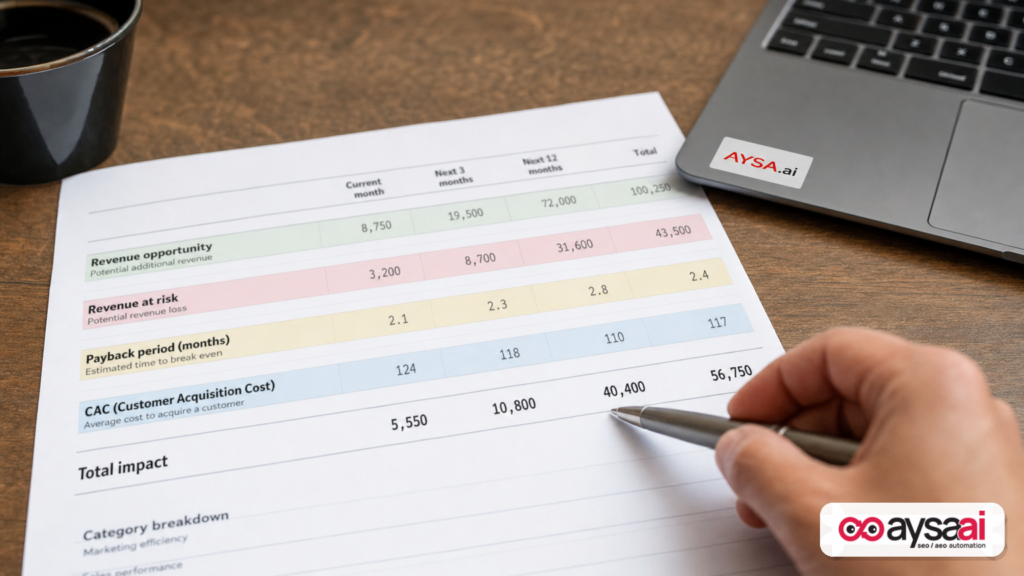
- Revenue opportunity (incremental pipeline you can credibly influence)
- Revenue at risk (pipeline you lose if competitors own the narrative)
- Customer acquisition cost (CAC) and payback period
- Pipeline influence (deal velocity, close rate, inbound-to-qualified rate)
- Retention/expansion (if AI answers change support load or product adoption)
Your GEO program should still track channel metrics. But the story should start with business metrics and use channel metrics as supporting evidence.
How to win budget conversations when the CFO doesn’t trust your dashboards
The CFO’s skepticism is not personal. It’s rational.
Finance leaders know three things:
- Digital attribution has always been an approximation.
- AI experiences add more untracked influence.
- Marketing teams sometimes confuse “measurable” with “valuable.”
So your job isn’t to defend GA4. Your job is to propose an investment thesis that survives uncertainty.
A CFO-friendly GEO budget narrative
Here’s a structure that works across most SMEs and mid-market businesses:
- Define the revenue surface area. What products/services are most profitable? What geos? What deal sizes? What seasonality?
- Define the AI question set. What questions would a buyer ask AI before buying? (Comparison, “best,” “alternatives,” “is it worth it,” “near me,” “for my situation.”)
- Show current narrative control. Are you cited? Is a competitor cited? Are reviews and third-party sources shaping the answer?
- Connect to business risk/opportunity. What happens if a competitor’s framing becomes the default AI answer for 12 months?
- Propose a measured spend with milestones. Not “trust us,” but “fund this for 90 days; we’ll report these leading indicators tied to pipeline.”
Notice what’s missing: a promise of perfect attribution. CFOs don’t need that. They need a disciplined way to make a bet, measure direction, and adjust.
If you want related context for how to speak finance in SEO conversations, Search Engine Land also surfaced a CFO-oriented piece in its navigation: How to win SEO budget conversations with your CFO (used here as a research lead).
A practical measurement stack for GEO (even when attribution is broken)
If you can’t count clean clicks, you need a measurement stack—a set of signals that, together, provide confidence.
I recommend organizing GEO measurement into four layers:
- Layer 1: AI visibility (the channel)
- Layer 2: Demand capture (search + direct)
- Layer 3: Sales reality (pipeline)
- Layer 4: Market narrative (qualitative proof)
Layer 1: AI visibility (the channel layer)
You still need to know whether AI systems are mentioning you. Track:
- Whether your brand is cited/mentioned for priority prompts
- Whether AI answers use your preferred positioning (not competitor framing)
- Whether citations point to your site or to third-party sources (reviews, publishers)
This is where tools and workflows matter. AYSA supports AI search monitoring and visibility workflows as part of a broader execution system. Start here: AI Search Visibility.
Layer 2: Demand capture (what happens when people act)
You’re looking for second-order effects that show up when AI creates brand familiarity:
- Branded search growth (people look for you by name after seeing AI mentions)
- Direct traffic trend (directional, not definitive)
- Returning visitor rate (people come back when ready to buy)
- Assisted conversions (if you have any multi-touch modeling in place)
Use GA4 and Search Console carefully. They are still useful; they just aren’t the whole truth. If your organization has measurement gaps, your goal is consistency and trendlines, not perfection.
AYSA’s monitoring workflows are built to keep these signals in a steady cadence: AYSA Monitoring.
Layer 3: Sales reality (pipeline and conversion quality)
If you run a business with sales calls, demos, or consultations, the best AI impact data is often in human conversations:
- Inbound lead-to-qualified rate
- Demo/consultation show rate
- Close rate changes (especially on inbound)
- Sales cycle length
- Common objections (did AI introduce them?)
If you’re ecommerce, the analog is:
- Conversion rate on branded landing pages
- Repeat purchase rate
- Customer support questions (do they reference AI summaries?)
Layer 4: Market narrative (qualitative proof)
This is the evidence many teams ignore because it doesn’t fit neatly in a dashboard:
- Prospects saying, “I heard you’re the best for X” (where did that belief come from?)
- Prospects citing competitor claims you never made
- Customer support tickets referencing AI answers
- Industry communities (forums, publisher content) shaping AI citations
When a competitor controls the narrative upstream, you can lose deals without ever seeing a “click” to their comparison page. That’s why you must measure influence, not just traffic.
Fuzzy math that doesn’t insult finance: turning influence into revenue ranges
Directional estimates are not the enemy. Sloppy thinking is.
Finance teams are fine with ranges when you:
- Make assumptions explicit
- Use conservative bounds
- Show sensitivity (best case / base / worst case)
- Update the model as evidence improves
The Search Engine Land piece provides a good pattern: take a qualitative signal from sales (e.g., mentions of a competitor narrative on calls), multiply it by call volume and deal economics, and quantify “pipeline influenced.” Source: Search Engine Land.
Here’s a CFO-safe way to structure that without inventing precision.
A simple influence-to-dollars template
Step 1: Pick the business event you can count reliably.
- B2B: qualified discovery calls per month
- Local service: booked consultations per month
- Ecommerce: branded sessions or returning sessions per month
Step 2: Identify an AI-related influence indicator.
- % of calls where prospects mention AI, a comparison, or a specific claim
- % of leads arriving with a pre-formed preference (good or bad)
- Change in the distribution of “how did you hear about us?” responses
Step 3: Convert to dollars using economics you already trust.
- Average order value / contract value
- Close rate or conversion rate
- Gross margin (optional but persuasive)
Step 4: Report a range and update monthly.
Instead of one number, present a conservative range: “$X–$Y revenue at risk” or “$X–$Y incremental opportunity,” depending on whether you’re defending narrative or expanding visibility.
Why this works
It avoids the trap of claiming you “attributed revenue to ChatGPT.” You’re not. You’re quantifying exposure and influence using your own operational reality, then making a controlled investment decision.
Concrete SME scenario: a local clinic losing patients to AI summaries
Let’s use a realistic scenario that mirrors what many SMEs experience—without pretending we can see every referral.
Business: a regional dermatology clinic with two locations.
Services: acne treatment, mole checks, cosmetic procedures (high margin).
The problem in 2026
Prospective patients increasingly ask AI questions like:
- “Best dermatologist near me for adult acne?”
- “Is laser treatment safe for darker skin?”
- “Dermatology clinic that takes [insurance]”
AI Overviews (and other AI platforms) summarize options. They may cite review sites, local directories, or publishers. If the clinic isn’t clearly understood—services, credentials, insurance, location, proof—AI answers may not mention it, even if it ranks in classic search.
What attribution looks like
The clinic’s GA4 shows:
- Organic traffic is flat
- Direct traffic is up slightly
- Phone calls are up, but source is unclear
Leadership asks: “Why should we invest in GEO if we can’t track it?”
The business case (without pretending perfect tracking)
You don’t need to know every AI touchpoint. You need a credible case that AI visibility changes outcomes:
- Revenue opportunity: if the clinic appears in AI answers for a set of high-intent prompts, bookings should rise.
- Revenue at risk: if competitors are described as the default “best option,” the clinic loses share even if its website is strong.
- Operational metric: appointment requests, consultation show rate, and the number of “I found you from…” answers mentioning AI summaries.
The execution plan
Operationally, this isn’t magic. It’s disciplined content and entity clarity:
- Create or improve service pages that match AI question patterns
- Add clear insurance/coverage details
- Publish clinician credentials, experience, and policies (trust signals)
- Ensure consistent local signals (addresses, hours) across the web
Then you monitor AI mentions and correlate with directional business signals. Not to “prove” a click path—but to justify ongoing investment.
What SMEs should monitor weekly (and what to ignore)
Most SMEs don’t need a 40-metric dashboard. They need a shortlist that creates clarity and momentum.
Weekly: the 8 metrics that matter most
- AI mention/citation presence for your top prompts (yes/no and trend)
- Share of voice for your category prompts (who else is being recommended?)
- Branded search trend (directional)
- Direct + returning traffic trend (directional; don’t over-attribute)
- Lead volume / booking volume
- Lead quality signals (qualified rate, inbound conversion)
- Sales/support qualitative notes (“prospect referenced AI”)
- One operational KPI tied to capacity (so growth doesn’t break service)
Monthly: upgrade the model
- Update your influence-to-dollars range
- Review what content or changes preceded improvements
- Decide where to invest next (defend, expand, or convert)
What to ignore (or at least demote)
- Obsessing over a single AI platform’s “ranking” without connecting to revenue
- Reporting impression gains as if they’re outcomes
- Assuming every AI citation is equal (some prompts are informational, not commercial)
- Chasing breadth before you own the high-margin prompt set
This is where SMEs can win. Big companies are slow. If you can create a weekly loop that monitors, decides, and ships improvements, you outmaneuver them.
What agencies must rethink: deliver outcomes, not artifacts
If you run an agency, GEO and AI search will expose a painful truth: clients don’t buy “SEO tasks.” They buy outcomes.
In the old model, it was enough to deliver:
- Rank tracking
- Monthly reports
- A content calendar
- Audit PDFs
In an AI-first discovery environment, those artifacts are not worthless—but they’re not sufficient. The competitive advantage shifts to:
- Narrative control (how AI describes your client)
- Entity clarity (what the business is, does, and is trusted for)
- Speed of iteration (how quickly you can update the site and supporting assets)
- Measurement discipline (tying direction to pipeline)
If you’re stuck in “deliver a report, wait for the client’s dev team,” you’ll struggle. AI search rewards teams that can execute continuously.
This is also why an approved execution model matters: recommendations don’t change outcomes; deployed changes do.
Execution is the bottleneck: why reporting without shipping is losing
Here’s a pattern I see repeatedly:
- Marketing identifies AI visibility gaps.
- They create a plan and a report.
- They wait on engineering, CMS access, approvals, legal, brand, and “next sprint.”
- Three months later, the market has moved, competitors have published, and the original plan is stale.
In classic SEO, you could sometimes survive this because rankings moved slowly. In AI search, the narrative shifts faster, because AI answers synthesize whatever the web currently signals as “true.”
So the competitive question becomes:
How fast can you safely ship improvements that make AI systems understand and recommend you correctly?
That’s not only a tooling question. It’s a workflow question.
At AYSA, we think the future belongs to “monitoring + approved execution.” The system should continuously detect opportunities, prepare changes, request approval, and then execute what you accept—so the website becomes a living sales asset, not a static brochure.
Where AYSA.ai fits: turning signals into approved execution (without waiting on a quarterly roadmap)
Most businesses don’t fail at GEO because they lack ideas. They fail because they can’t consistently execute.
AYSA is built as an execution system for modern search (SEO/AEO/GEO):
- Monitors visibility and site signals so you don’t rely on gut feel (Monitoring).
- Prepares recommended improvements (content, structure, internal linking, on-page clarity) and frames them for business impact.
- Asks for approval so you control what changes go live.
- Executes accepted website changes so momentum isn’t blocked by endless handoffs.
If you’re trying to improve AI search visibility, two AYSA areas are especially relevant:
And if you’re evaluating investment level, you can see how AYSA pricing maps to execution needs here: AYSA Pricing.
For readers who want additional tactical guidance, we’ll continue publishing implementation patterns on the AYSA blog: AYSA Blog.
How AYSA supports the “confidence over certainty” model
AYSA doesn’t need you to solve attribution first. It supports the operational loop that creates compounding results:
- Pick a revenue-critical prompt set (the questions that lead to purchases).
- Measure AI presence and narrative accuracy.
- Ship site changes that improve entity clarity, comparisons, and proof.
- Track downstream demand capture + pipeline signals.
- Update the business case range monthly.
That’s how you justify investment in a world where influence is real but tracking is imperfect.
What to do next: a 30–60–90 day action plan
If you want a practical plan that doesn’t require a data science team, use this.
Days 1–30: establish the baseline and the money model
- Choose 10–30 revenue-driving prompts (not vanity prompts). Include “best,” “alternatives,” “near me,” “pricing,” and “for [use case].”
- Record AI answer baselines: are you mentioned, cited, and framed correctly?
- Pick 3 business KPIs: one demand KPI (branded search or bookings), one pipeline KPI (qualified rate or close rate), one qualitative KPI (sales/support mentions).
- Create a conservative revenue range model (opportunity and/or risk). Make assumptions explicit.
Days 31–60: ship the “AI clarity” improvements
- Fix the core pages: services/products, comparisons, FAQs, proof, policies, and trust signals.
- Align positioning: ensure pages answer the questions buyers ask AI, using clear language a model can summarize accurately.
- Strengthen internal linking so your site communicates hierarchy and authority cleanly.
- Implement monitoring and a weekly review cadence.
Days 61–90: tie it to outcomes and scale what works
- Compare AI visibility changes for your prompt set against your business KPI trends.
- Collect qualitative evidence (call notes, objections, “how did you hear about us?” responses).
- Update your revenue range model using real observed data.
- Decide: defend vs. expand. Defend prompts where competitors control narrative; expand into adjacent high-intent prompts where you can win.
What can go wrong (and how to avoid it)
GEO is not a license to overclaim. In fact, the fastest way to get your budget cut is to promise certainty you can’t deliver.
Common failure modes
- Reporting-only programs: dashboards grow while the website stays the same.
- Vanity prompt chasing: you optimize for informational questions that don’t lead to revenue.
- Misaligned positioning: AI summarizes you incorrectly because your site is unclear or contradictory.
- Ignoring third-party sources: AI citations often pull from publishers, directories, reviews. If those are wrong, your narrative is wrong.
- Weak governance: too many stakeholders, no approval system, changes never ship.
Risk controls that help
- Use explicit assumptions in models and update them often.
- Prefer ranges over point estimates.
- Keep a changelog: what shipped, when, and why.
- Build an approval process so execution stays safe and compliant.
AYSA perspective: the new KPI is “speed to approved change”
My view is simple: AI search makes narrative control a continuous operation, not a quarterly project.
When buyers can ask AI “who’s best” and get an instant shortlist, you are either:
- in the shortlist (and your positioning is accurate), or
- you are explaining yourself after the decision is already made.
That’s why I believe the most underrated metric in modern SEO/GEO is operational: speed to approved change. The teams that can monitor, decide, and ship improvements weekly will win compounding visibility—regardless of whether every touchpoint is perfectly attributed.
And that’s where AYSA’s model fits: it’s built to make execution consistent while keeping humans in control.
Sources and further reading
- Search Engine Land — How to justify GEO investment without perfect attribution
- Search Engine Land — How to win SEO budget conversations with your CFO (contextual lead referenced in the source page navigation)
- Search Engine Land — Google AI Overviews will let you create image (AI Overviews context from source page navigation)
- Search Engine Land — ChatGPT citations change when hidden search pipelines switch (measurement volatility context from source page navigation)
- AYSA.ai — AI Search Visibility
- AYSA.ai — AI SEO Tools
- AYSA.ai — Monitoring
- AYSA.ai — Pricing
- AYSA.ai — Blog
What to do next
- Pick your revenue-critical prompt set (10–30 prompts) and capture an AI answer baseline.
- Write down one money model: revenue opportunity or revenue at risk, with conservative assumptions.
- Set a weekly GEO cadence: AI visibility check + branded demand + pipeline notes.
- Ship one improvement per week to the pages that matter most (services, comparisons, FAQs, proof).
- Adopt approved execution so changes don’t stall—start with AYSA monitoring and AI visibility workflows: AI Search Visibility.
Continue the AI search topic inside AYSA.
Use these pages to connect the article with AI SEO tools, AI visibility monitoring, AI Overviews and approved website execution.
Turn this topic into a website action plan.
Use these AYSA hubs to move from reading to technical fixes, AI visibility monitoring, research, glossary context and approval-first SEO execution.

