
ChatGPT Is Reducing Traditional Search: What A 9% Drop Means For Your SEO, Traffic, And Revenue
New clickstream research suggests wider ChatGPT access is tied to fewer traditional searches—and far fewer outbound clicks than Google. Here’s what changed, why it matters to SMEs, and how to adapt your content, measurement, and execution for AI search without guessing.

Traditional search isn’t “dying,” but it is being displaced in very specific, measurable ways—and that changes what good SEO looks like in 2026. New clickstream research summarized by Search Engine Journal points to two uncomfortable realities for anyone who depends on Organic traffic:
- ChatGPT sessions generate far fewer outbound Clicks than Google searches (5.2% vs 31.1% in the U.S. desktop data referenced).
- As access to “ChatGPT Search” widened, traditional search usage fell—9.4% weekly on average, with a bigger decline over time in the study’s window.
If you’re a founder, a local business operator, an ecommerce manager, a SaaS marketer, or an agency leader, you don’t need a philosophy debate. You need to know what changed, why it matters to your revenue, what to measure now, and what to do next—without guessing.
This editorial is my practical take as Marius Dosinescu at AYSA.ai: the web is moving from “search then click” to “ask then decide.” That’s a different funnel. It rewards different kinds of content. And it requires a different operating system for execution—Monitoring, preparing, approving, and shipping changes quickly and safely.
Concise summary
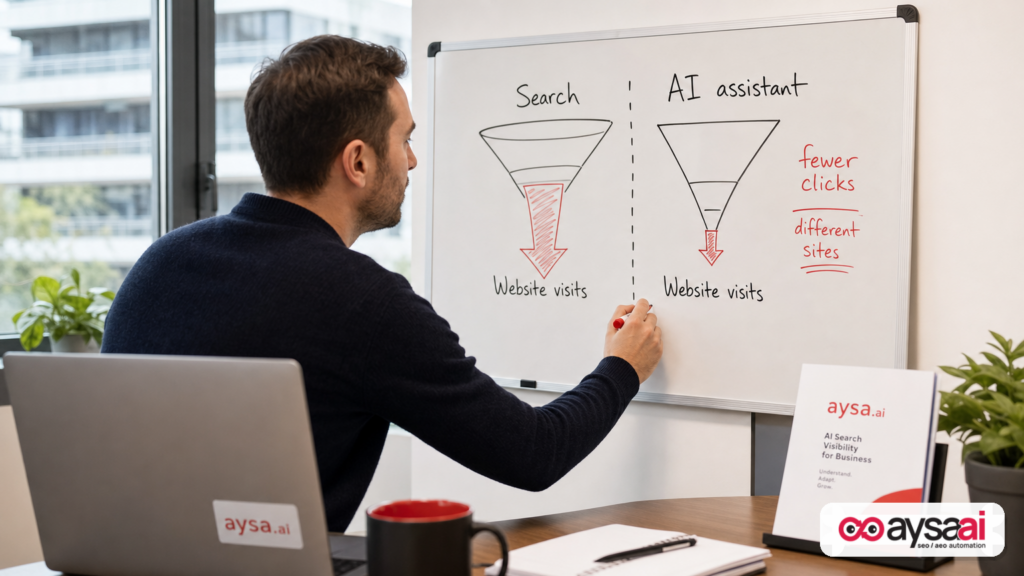
- AI assistants reduce clickouts: more questions get answered without a visit, which means fewer sessions to monetize or convert.
- Traffic allocation is shifting: when AI does send clicks, the destinations skew toward reference/knowledge resources, tools, developer docs, academic sources, and specialized sites—not necessarily ad-supported publishers.
- The biggest risk is informational content: that’s where the decline in traditional search appears most pronounced in the referenced research (academic and reference categories saw the largest drops).
- SEO becomes “visibility + validation + conversion”: you must win mentions/citations inside AI answers, then make the click (when it happens) convert immediately.
- Execution speed becomes a moat: teams that can monitor AI outputs and ship approved improvements weekly will outpace teams that still operate in quarterly SEO cycles.
Table of contents

- What changed: from search engine to answer engine behavior
- The numbers that should change how you plan SEO in 2026
- Why ChatGPT sends fewer clicks (and why that isn’t “good” or “bad”)
- The “different web” effect: who gets the clicks that remain?
- Who gets hit first: informational businesses, publishers, and long-tail explainers
- Measurement reality check: what you can and can’t attribute
- What “SEO” becomes: AEO/GEO, entity clarity, and decision support
- Content playbook for AI search: build the page that AI can trust and users can act on
- Technical playbook: structure, schema, speed, and index hygiene (still matters)
- Authority in an AI era: citations, references, and why links still matter
- A practical SME scenario: the local clinic that loses “informational” traffic first
- What agencies should rethink: reporting, retainers, and deliverables
- Where AYSA fits: visibility + monitoring + approved execution
- What to do next (action list)
- Sources and further reading
What changed: from search engine to answer engine behavior

For most of the last 20 years, the search economy followed a predictable rhythm:
- A user types a query.
- A search engine returns a list of options.
- The user clicks a website, compares, and decides.
Even when Google introduced features that reduced clicks (knowledge panels, featured snippets, local packs), the mental model remained “search → browse → click.”
AI assistants break that model. A growing share of queries now follow:
- A user asks a question conversationally.
- The assistant synthesizes an answer in the interface.
- The user either stops (no click), asks a follow-up (still no click), or clicks a citation/reference (fewer clicks, different destinations).
That is why the clickstream comparison matters. It’s not just that “traffic might fall.” It’s that the distribution mechanism is changing. And any business that relies on discovery via content has to adapt.
The numbers that should change how you plan SEO in 2026
The research summarized by SEJ (based on a Bocconi University paper using Comscore clickstream data) highlights three data points worth building strategy around:
- Outbound click behavior: ChatGPT led to an external website in 5.2% of sessions, compared to 31.1% for Google searches (U.S. desktop browsing).
- Referral mix: ChatGPT’s clickouts skewed toward reference/knowledge, tools, SaaS, academic, and developer sites; ad-supported sites received substantially less of that Referral traffic.
- Traditional search displacement: broader access to ChatGPT Search correlated with a 9.4% average reduction in weekly traditional searches, increasing over time in the study window (and smaller, but still meaningful, declines when comparing groups already using ChatGPT).
Let’s translate those into operational implications.
Implication #1: “Rankings” aren’t a complete KPI anymore
If fewer journeys begin on a traditional SERP, then a #1 ranking on Google can still be valuable—but it will increasingly represent a slice of discovery, not the whole pie. Your KPIs have to include:
- AI answer presence (are you cited/mentioned?)
- Brand recall and direct traffic trends
- Conversion efficiency of the visits you do receive
- Lead quality and sales cycle impact
Implication #2: “Traffic” becomes a noisier proxy for business impact
When AI absorbs informational queries, you can lose sessions while maintaining (or even improving) outcomes—for a while. But you can also lose the top-of-funnel education that later becomes demand. That’s why we need measurement discipline (we’ll cover this in the analytics section).
Implication #3: The web’s incentive structure is under pressure
If clickouts decline, ad-supported publishing models take the first hit. But SMEs also feel it when their “how-to” or “best of” content stops being the introduction to their brand. The fact that the research notes fewer referrals to ad-supported sites is a warning sign: if the economics of content weaken, the supply of quality content could change over time.
The researchers themselves were careful about interpretation (they measured observable traffic allocation, not consumer surplus or publisher revenue). That caution is appropriate—and it doesn’t change the practical takeaway: the funnel is shifting.
Why ChatGPT sends fewer clicks (and why that isn’t “good” or “bad”)
The instinct reaction in marketing is to label fewer clicks as “bad.” But the honest answer is: it depends who you are.
For users, fewer clicks can be genuinely better
If the question is simple (“What are the symptoms of X?” “What’s the difference between A and B?” “How do I reset a router?”), an in-interface answer saves time. That’s a better experience.
For businesses, fewer clicks can be either neutral or catastrophic
- Neutral if the question isn’t tied to revenue (pure curiosity) or if the user would never have converted anyway.
- Catastrophic if the question was a key step in the buying journey (education that previously introduced your product/service), or if you depend on ad Impressions.
There’s also a third outcome: fewer clicks can be a forcing function that improves strategy. If you can’t rely on casual browsing visits, you have to become more intentional about:
- being the source AI chooses to cite
- being the brand people search for directly
- making every landing page do more work (conversion)
This isn’t a moral argument. It’s a systems change.
The “different web” effect: who gets the clicks that remain?
One of the most under-discussed points in the SEJ summary is that ChatGPT and Google send users to different parts of the web.
In the summarized findings:
- Google referrals tend to cluster around massive destinations people already know (examples referenced include YouTube, Reddit, Wikipedia).
- ChatGPT clickouts skew more toward smaller, specialized sites: reference/knowledge, academic, developer, tools, SaaS, nonprofit/subscription/freemium platforms.
Two strategic lessons fall out of that:
Lesson #1: “Being useful” beats “being viral” in AI referral dynamics
AI assistants appear to favor sources that are directly usable for answering: documentation, definitions, standards, primary references, and purpose-built tools. That doesn’t mean you should turn your ecommerce store into a wiki. It means you should ensure you have some assets that AI can confidently use to support an answer:
- glossaries
- spec sheets
- compatibility tables
- clear “how it works” pages
- pricing/plan comparisons
- policies and factual reference pages
Lesson #2: If your model is “content → ads,” you’re exposed
The summary noted materially less referral traffic going to ad-supported sites from ChatGPT compared to Google. If your business depends on pageviews, you have to treat AI visibility as a new distribution channel—but also invest in diversification: subscriptions, email, community, direct brand demand, and product revenue.
Who gets hit first: informational businesses, publishers, and long-tail explainers
The SEJ summary highlights that the biggest declines in traditional search were concentrated in informational categories—particularly academic research and reference queries—while transactional and recreational searches changed less.
That pattern matches what many operators feel intuitively: AI is best at compressing informational exploration. The earlier in the funnel, the more likely a “browse journey” gets replaced by a synthesized answer.
Business models most exposed
- Publishers with high volumes of explainer content monetized by ads
- Affiliate sites that rely on comparison queries (“best X for Y”)
- Education and informational resources that don’t have a strong brand pull
- Local businesses that rely on blog traffic to drive awareness (clinics, legal, home services)
Business models less exposed (but not immune)
- Ecommerce with strong product demand (still many transactional searches)
- Branded demand businesses (people search the name)
- Marketplaces and tools that are inherently interactive
But here’s the part people miss: even if transactional searches “barely changed” in the studied period, the consideration stage that precedes a transaction may shift heavily to AI. If a buyer learns inside ChatGPT, you may only see them when they’re ready to purchase—meaning fewer total visits, but potentially more qualified. Or you may never see them if the AI recommends a competitor.
Measurement reality check: what you can and can’t attribute
When marketing teams feel uncertainty, they often overcorrect by inventing new KPIs that sound precise but aren’t measurable.
Let’s stay grounded:
What you can measure reliably today
- Organic search traffic (Google Search Console + analytics) trends over time
- Landing page conversion rates and funnel completion
- Brand demand proxies (branded queries in Search Console, direct traffic trends, CRM “heard about us” fields)
- Referral traffic from known sources that actually pass referrers (not always the case)
What is hard (and you should be cautious about)
- Attributing “AI mentions” directly to revenue
- Comparing AI assistant sessions to search queries one-to-one (the research itself treats conversations as a single exchange; in reality, multi-turn flows complicate equivalence)
- Getting complete visibility into when you were used as a training/source input (separate from being cited)
This is why I push for a measurement posture that blends:
- Visibility metrics (are you present in AI answers for priority topics?)
- Outcome metrics (leads, pipeline, revenue, bookings)
- Efficiency metrics (cost per lead, conversion rate, time to value)
If your reporting still lives and dies by “sessions,” you’ll make the wrong decisions.
What “SEO” becomes: AEO/GEO, entity clarity, and decision support
Call it AI Search, AEO (answer engine optimization), or GEO (generative engine optimization). The label matters less than the shift in work:
- From: optimizing pages to rank in a list
- To: optimizing the business to be selected as a trustworthy answer, and ensuring the website converts when the click happens
1) Entity clarity: make it easy for machines to know what you are
AI systems don’t “feel” your brand. They infer it. If your site is vague about:
- what you sell
- who you serve
- where you operate
- what makes you different
…then you’ll be summarized incorrectly or not at all.
2) Decision support: content that helps someone choose
AI assistants are compressing discovery. So your job is to build pages that make a user’s next step obvious:
- comparison pages
- use-case pages
- pricing clarity
- proof (reviews, policies, guarantees, certifications)
3) Distribution beyond the SERP
“From Search to Discovery” isn’t a slogan; it’s an operating requirement. Your content needs to work when consumed as:
- a quoted snippet in an AI answer
- a citation among others
- a single landing page visit without prior browsing
Content playbook for AI search: build the page that AI can trust and users can act on
When outbound clicks are rarer, each click has to do more work. At the same time, the content must be “extractable” for AI answers.
Here’s a practical playbook for SMEs.
1) Create “reference-grade” sections inside commercial pages
Most SMEs separate “blog” and “money pages.” In AI search, that separation can hurt you because AI wants factual, crisp, reusable blocks—while users want a clear path to action.
Recommendation: add a short reference section to key pages:
- definitions
- requirements
- process steps
- compatibility
- pricing factors (not necessarily exact pricing)
Example (non-SEO): a local roofing company can add a “Materials glossary” and “Insurance claim steps” section to a service page. That’s both AI-citable and conversion supportive.
2) Use Q&A blocks that match how people ask AI
AI prompts are often full sentences. Build a Q&A module that answers:
- “Should I choose X or Y?”
- “How long does it take?”
- “What does it cost and why?”
- “What are the risks?”
- “What’s included?”
Make answers direct, specific, and grounded. Avoid marketing fluff. If you can’t verify a claim, don’t state it as a fact—frame it as a consideration.
3) Build comparison pages you’re not afraid of
One of the fastest ways to lose in AI answers is to avoid naming alternatives. If the assistant is going to compare you to competitors anyway, you want to supply the comparison context.
Create “X vs Y” pages or “Alternatives to [category]” pages that:
- state your positioning clearly
- acknowledge trade-offs
- recommend when you’re not the best choice
That last point builds trust. Trust is the currency of AI summaries.
4) Make policies and proof easy to cite
AI systems and users both look for “is this legit?” signals. Don’t hide them:
- return/refund policy
- shipping and delivery timelines
- service area
- certifications and licenses
- editorial policy (for publishers)
5) Don’t outsource your expertise to generic AI text
This is the trap: when distribution becomes uncertain, teams try to publish more faster. But AI-generated sameness is exactly what AI assistants can already produce. Your differentiator is first-hand expertise, process, and specifics.
If your content doesn’t contain anything a model can’t predict, you’re training the market to not need you.
Technical playbook: structure, schema, speed, and index hygiene (still matters)
AI search discussions often get mystical. Let’s keep it practical. Technical fundamentals still matter because AI systems pull from the same underlying web ecosystem: crawlable pages, clear structure, and consistent data.
1) Clean information architecture
- Ensure important pages are linked from navigation or hub pages.
- Remove or noindex low-value thin content that muddies topical focus.
- Consolidate overlapping articles that compete with each other.
2) Structured data where it truthfully applies
Use schema to clarify entities and page intent (Organization, LocalBusiness, Product, FAQPage where appropriate). Don’t spam it. Don’t mark up content that isn’t visible or true.
Even without citing additional sources here, this is a safe principle: structured data is a machine-readable layer that reduces ambiguity.
3) Speed and usability still convert the scarce click
If AI reduces your clicks, your site can’t waste the ones you get. Treat performance, clarity, and mobile experience as revenue levers, not technical chores.
4) Index hygiene and canonical correctness
AI systems can surface outdated or duplicate versions of content if your site is messy. Make sure:
- canonical tags are correct
- old URLs redirect cleanly
- duplicate parameter pages are controlled
- your “source of truth” pages are consistent
Authority in an AI era: citations, references, and why links still matter
The SEJ summary notes that ChatGPT clickouts favor reference, academic, and developer-style sources—categories that often have strong reputational signals and are built around being cited.
That’s not an accident. AI answers depend on sources that look stable, well-structured, and credible.
Links still matter—but the why is evolving
Classic SEO treated links as ranking votes. In an AI discovery world, links and mentions also function as:
- credibility scaffolding (is this brand real?)
- topic association (what is this site “about”?)
- citation pathways (which pages are referenced by others?)
If your site has no credible third-party validation, you’re easier to ignore—and easier to misrepresent.
Digital PR becomes performance marketing
For SMEs: you don’t need “thousands of links.” You need a small number of relevant, high-trust mentions:
- industry associations
- local chambers
- supplier directories (real ones)
- expert interviews and podcasts
- case studies with partners
These aren’t just SEO tactics. They’re inputs into how the internet describes you—exactly what AI systems synthesize.
A practical SME scenario: the local clinic that loses “informational” traffic first
Let’s make this real with a scenario I see constantly.
The business
A multi-location clinic relies on:
- service pages (“sports physicals,” “urgent care,” “women’s health”)
- informational blog posts (“difference between X and Y,” “symptoms,” “when to see a doctor”)
- local SEO listings
What happens in an AI-first discovery world
Patients ask ChatGPT:
- “Do I need urgent care for a sore throat?”
- “What are the symptoms of strep vs allergies?”
- “How much does a sports physical cost?”
The assistant provides guidance, maybe cites a couple of authoritative health references, and the user decides what to do next. They may never click the clinic’s blog post.
At first, your analytics looks worse (less blog traffic). Leadership panics and cuts content.
Then two months later, bookings start to soften—because the clinic lost its role as a trusted educator, and other entities (large hospital systems, aggregator directories, or national brands) became the default “source” in AI answers.
The right response
- Keep the educational content, but restructure it into decision-support pages that clearly route to appointments.
- Add service area clarity and “what to do next” steps in every relevant piece.
- Build FAQ + policy clarity around costs, insurance, timelines, and what to bring.
- Monitor AI answers for priority queries in each location, and fix inconsistencies quickly.
This is exactly the kind of scenario where “AI volume” isn’t the goal. Accuracy + conversion is.
What agencies should rethink: reporting, retainers, and deliverables
Agencies will feel this shift before many clients do, because clients will come with one simple question:
“Why is my traffic down even though rankings look fine?”
1) Replace traffic reporting with decision reporting
Clients need to see:
- which topics drive qualified leads
- which pages convert (and which waste clicks)
- how brand demand is trending
- whether AI answers are recommending the client or competitors
That’s a different report. It’s closer to revenue ops than classic SEO.
2) Retainers must include ongoing iteration
Quarterly “SEO audits” are too slow. AI answers can shift quickly. Agencies that win will run a cadence like:
- weekly monitoring
- biweekly content and on-site improvements
- monthly measurement and re-prioritization
Not more busywork—more focused cycles.
3) Content teams need SMEs (subject-matter experts), not just writers
Because AI can generate generic text, generic content has a shrinking half-life. Agencies should embed SME interviews, capture real process detail, and build assets that are difficult to fake.
Where AYSA fits: visibility + monitoring + approved execution
At AYSA.ai, we treat AI search as an execution problem, not a theory problem.
Most businesses don’t lose because they “don’t know.” They lose because they can’t ship consistently:
- They don’t monitor where they show up in AI answers.
- They don’t know which pages need updates to be cited accurately.
- They don’t have time to implement technical and content improvements.
- They’re afraid automation will break the site, so nothing moves.
AYSA is built as an approved SEO/AEO/GEO execution system:
- Monitors your AI search visibility and the inputs that shape it (Monitoring).
- Prepares recommended website changes to improve clarity, structure, and relevance.
- Asks for approval before changes go live (governance matters).
- Executes accepted changes so you don’t stall out in backlog.
If you want the conceptual layer, start here: AI Search Visibility. If you want to see the tooling angle, explore: AI SEO Tools. For pricing and fit: Pricing. And for more editorials like this: Blog.
What AYSA helps you do specifically in this new environment
- Find the pages AI should cite (and ensure they’re structured to be cited correctly).
- Fix entity confusion (services, locations, offerings, policies).
- Improve conversion efficiency (scarce clicks must convert).
- Run a repeatable cadence of improvements with approvals—so you move fast without breaking trust.
In a world where traditional search volume can decline meaningfully when AI access expands, the advantage goes to operators who can adapt weekly.
What to do next (action list)
- Segment your search traffic: split informational vs transactional landing pages and compare trends over time.
- Identify your “AI answers” topics: list 20–50 questions customers ask before they buy or book.
- Audit your decision pages: do you have pricing factors, comparisons, FAQs, proof, and next-step CTAs?
- Consolidate thin content: merge overlapping articles into fewer, stronger reference-grade resources.
- Strengthen proof signals: policies, credentials, associations, and real-world validation.
- Upgrade measurement: prioritize conversions, qualified leads, and brand demand—not just sessions.
- Implement an execution cadence: weekly monitoring, biweekly updates, monthly strategy review.
- Use a system that ships: if your backlog is the bottleneck, consider AYSA to monitor, prepare, request approvals, and execute changes (monitoring, pricing).
Sources and further reading
- Search Engine Journal: ChatGPT Access Tied To 9% Drop In Traditional Search
- Search Engine Journal: Latest news (context for ongoing AI search changes)
- Search Engine Journal: SEO coverage
- Search Engine Journal: Google algorithm updates history (useful background for how SERPs evolved before AI)
- AYSA.ai: AI Search Visibility
- AYSA.ai: AI SEO Tools
- AYSA.ai: Monitoring
- AYSA.ai: Pricing
- AYSA.ai: Blog
Editorial note on evidence: This article uses the SEJ summary of a Bocconi University research paper that analyzed Comscore clickstream data. Where the underlying paper or additional primary sources are not included in the provided research context, I’ve kept claims descriptive and avoided adding new statistics or definitive causal statements beyond what was summarized.
Continue the AI search topic inside AYSA.
Use these pages to connect the article with AI SEO tools, AI visibility monitoring, AI Overviews and approved website execution.
Turn this topic into a website action plan.
Use these AYSA hubs to move from reading to technical fixes, AI visibility monitoring, research, glossary context and approval-first SEO execution.

