
The Shortlist Economy: How Agentic Commerce Shrinks Google Ads (And What To Fix Before Your Brand Disappears)
AI agents are turning shopping into a three-to-five option shortlist—squeezing impressions and raising the bar from “good ads” to “verifiable commerce.” Here’s the practical playbook to stay transactable, measurable, and recommended.

Google Ads is entering a phase that will feel familiar to anyone who lived through the shift from “ten blue links” to AI-assisted answers: fewer opportunities to be seen, and far less tolerance for ambiguity.
But the real change isn’t just fewer Impressions. It’s that buyers increasingly outsource discovery and purchasing to AI agents—and agents don’t browse like humans. They don’t scroll, they don’t get distracted by clever copy, and they don’t “consider” twenty options. They return a shortlist—often just a handful of choices—and execute when they can verify the outcome.
That reality creates a new competitive frontier for paid search and ecommerce: transactability. If an agent can’t confidently confirm your price, availability, shipping, and policies, it will recommend a competitor that it can verify—even if your product is a better fit.
This editorial is my POV as Marius Dosinescu at AYSA.ai: the winners in 2026 won’t be the brands with the most persuasive promotions. They’ll be the brands with the cleanest, most machine-verifiable commerce layer—paired with consistent brand trust signals for humans who still double-check recommendations.
Concise Summary

AI agents are compressing the funnel into a shortlist and a purchase. That squeezes ad inventory and raises the bar from “good marketing” to “verifiable truth.” To stay competitive, ecommerce teams and PPC managers should (1) allow legitimate shopping agents and crawlers, (2) eliminate feed/site mismatches for price and availability, (3) expand product attributes for constraint-based queries, and (4) prepare for emerging commerce protocols so agents can complete transactions cleanly.
Key Takeaways

- The impression squeeze is structural: AI surfaces and agent behavior reduce the number of chances you get to be noticed.
- The bigger risk is shortlist exclusion: if you’re not recommended, you’re not considered.
- Confidence is becoming a deciding factor: agents prioritize verified price, availability, shipping, and policy clarity.
- Promo psychology weakens: agents compare real numbers, not “% off” storytelling.
- Execution beats strategy decks: your advantage comes from operational hygiene—feeds, schema, crawl access, and monitored consistency.
Table of Contents
- What Changed: From “Search, Click, Buy” To “Ask, Decide, Do”
- The Impression Squeeze Is Real—But The Bigger Threat Is The Shortlist
- Confidence Is The New Auction Factor (Alongside Bid And Quality)
- Promos, Offers, And Pricing: What Breaks When The Buyer Is Software
- Measurement In A Shortlist World: What To Watch (Without Making Up Metrics)
- What Can Go Wrong: The Silent Failures That Remove You From Consideration
- A Concrete SME Scenario: The “Invisible Best Seller” Problem
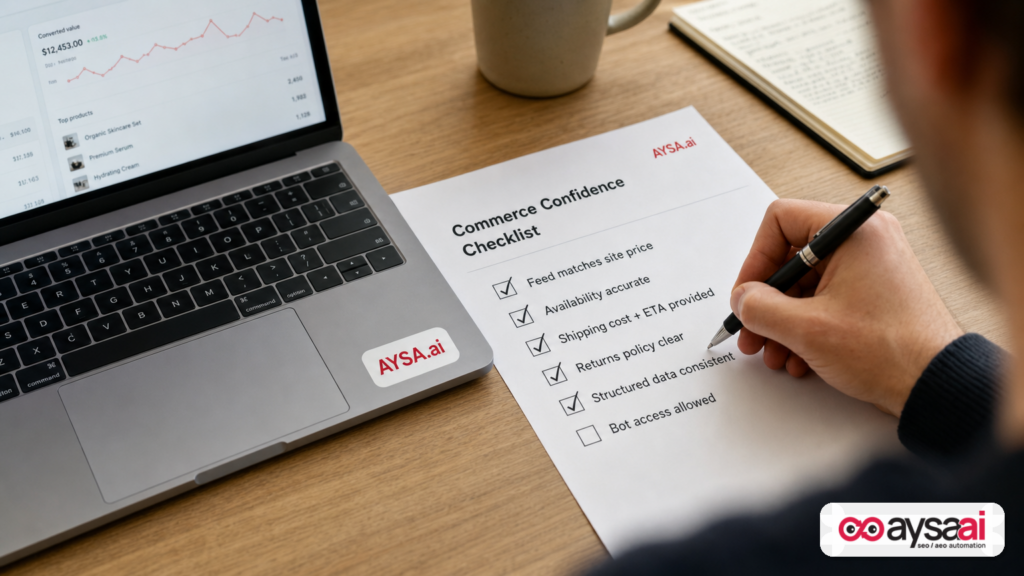
- The Practical Fix List: An Agentic Readiness Checklist For PPC + Ecommerce Teams
- Protocols And “Plumbing”: What To Prepare For (ACP, UCP) Without Overbuilding
- What Agencies Should Rethink: Deliverables That Don’t Survive Agentic Commerce
- Where AYSA.ai Fits: Monitoring + Approved Execution For The New Baseline
- What To Do Next (Action List)
- Sources And Further Reading
What Changed: From “Search, Click, Buy” To “Ask, Decide, Do”
For years, the ecommerce journey was friction-heavy by design:
- A shopper searches.
- They open several tabs.
- They compare prices, policies, delivery times, and reviews.
- They add to cart, fight pop-ups, maybe create an account, and finally buy.
Agentic commerce compresses this. A shopper tells an AI assistant what they want, including constraints (budget, size, compatibility, delivery deadline), and the agent returns a handful of validated options—sometimes even completing the checkout when permitted.
This is not just a UI change; it’s a behavior change. And it mirrors what happened in search: moving from “find me information” to “give me the answer.” The underlying consequence is the same: the surface area for visibility shrinks.
Search Engine Journal’s analysis of agentic commerce and Google Ads highlights the emerging “shortlist economy,” where agents provide three to five options rather than a full page of results and ads. That framing matters because it changes what we optimize for: not just Clicks, but inclusion and transactability.
The Impression Squeeze Is Real—But The Bigger Threat Is The Shortlist
When people talk about “the impression squeeze,” the mental model is usually: fewer ad slots, higher competition, higher CPCs. That’s part of it. AI Overviews, AI Mode, and other AI-first layouts can reduce traditional real estate where ads used to appear.
But the bigger threat is more existential:
- Humans tolerated exploration. They’d scroll, refine, and click around.
- Agents seek completion. They want the highest-probability path to a successful purchase.
In a traditional SERP, a “pretty good” listing could still get traffic. A product that was almost right could earn a click and then persuade a shopper on-site. In a shortlist world, that cushion disappears. The agent isn’t looking for a brand story; it’s looking for certainty.
That’s why you should think less about “how do I win position one?” and more about “how do I become a safe, verifiable recommendation?” Your enemy isn’t only a higher bidder. Your enemy is uncertainty.
Confidence Is The New Auction Factor (Alongside Bid And Quality)
Paid search teams grew up on a simple framework: bid and quality (or bid and relevance). In the agentic commerce frame described by Search Engine Journal’s source, there’s a third force: confidence.
Confidence is not a feeling. It’s the agent’s ability to verify key details with minimal risk:
- Availability: Is it actually in stock right now?
- Price: Is the price accurate, and will it match at checkout?
- Total cost: What are shipping and taxes likely to be?
- Delivery time: Will it arrive within the buyer’s constraint window?
- Policy clarity: Can the buyer return it? What are the terms?
- Product match: Does it truly satisfy the constraint (compatibility, sizing, material, etc.)?
If your listing is a better “marketing fit” but a worse “verification fit,” you can lose without ever being considered.
This should change how PPC managers collaborate with ecommerce operations. The bottleneck is no longer only creative and bidding strategy. It’s catalog truthfulness and consistency across your feed, your website, and whatever systems the agent uses to validate.
Confidence Is Built In Ops, Not In Copy
Traditional conversion optimization often leaned on persuasion layers: pop-ups, urgency, gated discounts, forced account creation, and so on. Some of those tactics can still lift conversion for humans. But they also introduce friction and inconsistency—two things an agent will treat as risk.
Search Engine Journal’s source references cart abandonment due to forced account creation, citing Baymard Institute research. That’s worth treating as a signal: if humans abandon due to friction, agents will simply route around it.
Baymard is a recognized UX research source for ecommerce. If you want the primary research library, start here: Baymard Institute. (Note: this link is provided as a primary research lead; confirm the exact percentages and study context directly on Baymard before using them in internal reporting.)
Promos, Offers, And Pricing: What Breaks When The Buyer Is Software
Let’s say you run a mid-sized ecommerce store. Your promotional calendar probably includes:
- “Was $X, now $Y” anchor pricing
- Tiered bundles designed to nudge the middle option
- Limited-time urgency banners
- Email capture pop-ups in exchange for a code
Some of this is behavioral psychology aimed at humans. Agents don’t experience it the same way. They compare the actual numbers against constraints the user provided: budget ceiling, delivery deadline, acceptable substitutes, etc.
Offers Start To Look Like “Limit Orders”
The Search Engine Journal source describes an emerging pattern: a user instructs an assistant to watch for a price and purchase when it falls below a threshold. That’s not “discount persuasion”; it’s trigger-based execution.
Practically, it means:
- If your discount doesn’t cross the threshold, it won’t matter to the agent.
- If your displayed price is inconsistent (feed vs on-site vs checkout), you’re risky.
- If shipping costs or delivery dates are unclear, you’re risky.
Discounting doesn’t die. But “promo creativity” becomes less important than “promo clarity.” The offer must be machine-readable, verifiable, and actually applicable.
Brand Still Matters (Because Humans Still Verify)
Even in an agent-driven world, people often double-check. The Search Engine Journal source references survey findings (Semrush) that shoppers validate AI recommendations through search engines and brand websites.
Two implications for marketers:
- Clean data gets you shortlisted.
- Brand trust closes the deal. The human verification step tends to confirm rather than restart the search.
If your brand site looks untrustworthy, if your return policy is buried, or if your pricing is inconsistent, verification can fail—even if the agent shortlisted you.
Measurement In A Shortlist World: What To Watch (Without Making Up Metrics)
One of the hardest parts of any platform transition is measurement. The metrics you’re used to—impressions, CTR, Average position—were built for pages filled with clickable results.
In AI-first surfaces and agentic workflows, you should still watch classic PPC and ecommerce metrics, but you’ll also need additional visibility indicators that answer a more basic question:
Are we being surfaced at all?
Merchant Center And AI Surface Insights (Where Available)
Search Engine Journal’s source notes that Google’s Merchant Center includes AI performance insights showing Share of Voice on AI surfaces against similar brands—positioned as a “rank report” proxy for the shortlist economy.
I’m not going to pretend every account has the same UI or reports (and Google changes these frequently). But the strategic takeaway is clear: shift your reporting from “how many impressions did we buy?” to “how often were we eligible and chosen?”
To operationalize that, create an internal Monitoring view that includes:
- Feed diagnostics health (disapprovals, item update lag)
- Price/availability mismatch frequency
- Shipping attribute completeness
- Structured data validity and changes over time
- Robots/WAF blocking incidents for legitimate bots
AYSA’s positioning here is straightforward: you want a system that can monitor these risk factors continuously, prepare fixes, ask for approval, and then execute changes safely. That’s exactly the workflow we built around continuous monitoring and approved execution.
Avoid Fake Certainty: Don’t Over-Interpret Early AI Metrics
When channels shift, marketers tend to grab whatever metrics are available and overfit decisions. Resist that.
Instead:
- Treat AI surface metrics as directional at first.
- Use controlled experiments where possible.
- Correlate changes in feed and site truthfulness to downstream outcomes (conversion rate, refund rate, customer satisfaction) rather than vanity visibility alone.
If you want a broader framework for measuring AI-driven visibility, see AYSA’s approach here: AI search visibility.
What Can Go Wrong: The Silent Failures That Remove You From Consideration
In classic PPC, failure was loud: CPC spikes, broken tracking, campaigns paused, disapprovals.
In agentic commerce, a lot of failure is silent. You don’t see “you were excluded from the shortlist.” You just see performance decay and assume it’s competition or seasonality.
Here are the most common silent failure modes implied by the Search Engine Journal source—and what they look like in practice.
1) You Block The Wrong Bots (Robots.txt, WAF, CDN Rules)
Historically, blocking bots was a defensive reflex. But the source points out a critical shift: some bots now represent real shoppers attempting to fetch product details or complete a purchase workflow.
What this looks like operationally:
- Your robots.txt disallows AI user agents broadly.
- Your WAF or CDN rate limiting flags agents as suspicious traffic.
- You don’t realize anything is wrong because human shoppers can still browse.
The result: humans can still find you the old way, but the agent can’t verify you, so you’re dropped from recommendations.
2) Feed ≠ Site ≠ Checkout
Agentic commerce punishes inconsistency. If your Merchant Center feed price differs from the on-page price, or if shipping costs only appear late in checkout, the agent can’t confidently compute total cost.
In 2026, “close enough” pricing isn’t just a conversion issue. It’s a visibility issue.
3) Thin Product Attributes In A Constraint-Based World
Agents excel when users specify constraints. If your product listings don’t include structured, comparable attributes—materials, sizing rules, compatibility, power requirements, ingredients, warranty terms—your product is harder to match to the request.
That’s why “title optimization” alone stops being a competitive advantage. The advantage moves to attribute completeness and accuracy.
4) Friction That Humans Tolerate, Agents Route Around
Forced account creation, pop-ups obscuring content, repeated consent prompts—humans might push through. Agents may not. Or they may simply prefer merchants whose path to purchase is smoother and more deterministic.
Even if you believe friction improves your email list growth, ask: “Is it costing me inclusion?” If yes, the tradeoff changes.
A Concrete SME Scenario: The “Invisible Best Seller” Problem
Let’s make this real with a scenario that I see constantly with small-to-mid ecommerce brands.
Scenario
You run a 12-person ecommerce business selling specialty running shoes and insoles. You’re not Nike, but you have a loyal audience and a few standout products that outperform bigger brands on comfort and durability.
Your PPC manager is competent. Your Performance Max campaigns run. You have decent product images and solid reviews. Yet performance starts drifting down year over year. You don’t see a catastrophic issue—just a slow squeeze.
What Changed Underneath
More shoppers begin asking AI assistants for “best stability running shoe under $140 for flat feet, wide toe box, delivery by Friday.” The agent returns five options. You’re not in the five.
Not because your product is wrong—but because:
- Your feed doesn’t explicitly list “wide toe box” as an attribute.
- Your size guidance exists only in an image (not machine-readable text).
- Your shipping ETA is ambiguous until checkout.
- Your availability is occasionally wrong due to inventory sync lag.
So the agent picks a competitor that may be slightly worse on comfort but is easier to verify. The shopper never visits your site. Your “best seller” becomes invisible in the new discovery layer.
What Fixes It
The fix isn’t “write better ad copy.” It’s:
- Expand product attributes and structured data so the agent can match constraints.
- Make shipping cost and delivery windows clearer and more consistent.
- Reduce price/availability mismatches between feed and site.
- Ensure bots that fetch for live user requests can access product pages.
This is a technical and operational problem dressed up as a marketing problem—which is exactly why many brands struggle to solve it quickly.
The Practical Fix List: An Agentic Readiness Checklist For PPC + Ecommerce Teams
The Search Engine Journal source provides a pragmatic four-part checklist. I agree with its spirit, and I’m going to expand it into a more operational plan you can actually run weekly—especially if you’re an SME without a huge engineering team.
1) Unblock Legitimate Agents And Crawlers (Without Opening The Floodgates)
Start with a 10-minute audit:
- Check
/robots.txtfor broad disallow rules that might block AI user agents used for live fetching. - Check your WAF/CDN (Cloudflare or similar) for bot rules, rate limiting, and security challenges that prevent content access.
- Be careful to distinguish between training crawlers and live, user-triggered fetchers when possible (the source highlights this nuance).
Important: This is not advice to “allow all bots.” It’s advice to treat legitimate shopping agents as a new acquisition channel—like treating Googlebot seriously in the early SEO era.
If you’re not sure which agents to allow or how to do this safely, don’t guess. Document current rules, test in a staging environment if you can, and ship changes with rollback capability.
AYSA can help here by monitoring crawl accessibility issues and preparing change recommendations you can approve before anything is deployed: AYSA AI SEO tools and monitoring.
2) Obsess Over Data Cleanliness: Price, Availability, Shipping
Agents reward consistency. Your data needs to be the same in three places:
- Your product feed (e.g., Merchant Center feed)
- Your on-page content
- Your checkout reality
Operational tasks to run:
- Audit mismatches weekly: sample top SKUs and compare feed values to page values and checkout totals.
- Enable automated item updates where applicable so platforms can reconcile changes quickly (noting the source’s recommendation).
- Standardize shipping logic: if shipping varies by region, ensure the logic is expressed in a way machines can evaluate as early as possible.
Even if you don’t have deep engineering resources, you can improve the truth layer by tightening the process between inventory systems, ecommerce platform, and feed generation.
3) Expand Product Attributes For Constraint-Based Queries
Most product pages are written for humans who browse. Agent queries are often constraint-first: budget, requirements, compatibility, timeframe.
So your catalog must answer constraints explicitly:
- Materials and composition
- Dimensions and sizing rules (including edge cases)
- Compatibility and supported models (for electronics/accessories)
- Use cases and exclusions (“not suitable for…”) where relevant
- Warranty and return policy clarity
The Search Engine Journal source notes that Google has been adding more conversational attributes in Merchant Center to support how people and agents ask questions. Even if you’re not using those fields today, the direction is obvious: richer, verifiable attributes will outperform thin listings.
This is also where ecommerce SEO and paid search converge. Better attributes don’t just help organic; they improve product matching in paid campaigns and eligibility in AI surfaces.
4) Embrace Emerging Commerce Protocols (But Don’t Overbuild Too Early)
The source introduces two protocol concepts:
- Agentic Commerce Protocol (ACP): positioned around conversational, agent-driven checkout experiences (noted as co-developed by OpenAI and Stripe in the source).
- Universal Commerce Protocol (UCP): described as a broader interoperability effort supported by an ecosystem including Google, Shopify, Visa, Mastercard, and Stripe (per the source).
Because our research context here is the SEJ article and not primary protocol documentation, treat these as directional signals, not final specs. The practical guidance remains:
- Be transactable in at least one major ecosystem. If you rely on a single platform pathway, you risk being excluded as standards evolve.
- Make your catalog “protocol-ready” by default. Clean attributes and consistent policies are prerequisites no matter which protocol wins.
- Prefer configuration over custom engineering unless you’re an enterprise brand with clear ROI. Most SMEs should avoid speculative builds and focus on data readiness.
Protocols And “Plumbing”: What To Prepare For (ACP, UCP) Without Overbuilding
Many teams hear “protocol” and panic. They imagine a six-month integration project. That may be true for enterprise retailers with custom stacks, but most SMEs don’t need to build the plumbing from scratch.
What you should do instead is prepare the prerequisites that make any protocol integration feasible:
- Stable product identifiers (SKUs, GTINs where applicable)
- Accurate, normalized attributes
- Clear return and shipping policies
- Consistent pricing logic across surfaces
- Bot-accessible product pages (where appropriate)
If you sell on platforms (marketplaces, retail partners, or a major ecommerce platform), the platform will likely handle much of the standardization over time. But you still control the data you feed into it. Garbage in, garbage out—only now the penalty is exclusion from consideration, not just a lower conversion rate.
What Agencies Should Rethink: Deliverables That Don’t Survive Agentic Commerce
Agency deliverables have traditionally skewed toward:
- Campaign builds
- Creative testing
- Bid strategy and budget allocation
- Landing page CRO recommendations
Those still matter, but they’re insufficient in a shortlist economy. If the client’s catalog truth layer is broken, no amount of creative iteration will get them shortlisted reliably.
The New Scope: “Commerce Integrity” As A Managed Service
Agencies that win will add a new core competency: maintaining commerce integrity across feeds, structured data, policies, and crawl access.
That means agencies need to operationalize:
- Monitoring (so you catch drift fast)
- Change management (so fixes ship, not just get recommended)
- Cross-team coordination (PPC, SEO, dev, merchandising, ops)
This is exactly where execution breaks in the real world. Everyone agrees “we should fix the feed,” but no one owns it end-to-end. Weeks pass. Performance keeps slipping. Then the channel gets blamed.
My opinion: in 2026, agencies that only “advise” will be commoditized. Agencies (and internal teams) that execute safely will be premium.
Where AYSA.ai Fits: Monitoring + Approved Execution For The New Baseline
AYSA is built for the part of the work that most teams struggle with: moving from “we know what to do” to “it’s live, it’s correct, and it stays correct.”
Here’s how I’d map AYSA to agentic commerce readiness:
1) Continuous Monitoring For Drift
Agentic commerce punishes drift—when pricing changes, inventory changes, templates change, or a security rule starts blocking legitimate crawlers. AYSA’s monitoring approach is designed to surface issues early: AYSA Monitoring.
2) Prepare Fixes As Concrete, Reviewable Changes
It’s not enough to say “add more attributes.” Someone needs to translate that into actual tasks: schema updates, template edits, product content improvements, technical configuration changes.
AYSA’s positioning is to prepare those changes and route them for approval—especially important when the change touches revenue-critical systems.
3) Approved Execution (Safety As A Feature)
Most SMEs don’t deploy SEO/commerce changes daily because the risk feels too high. AYSA’s model is built around approval gates: you decide what ships. That’s a key differentiator in a world where many “AI tools” want to auto-change your site without governance.
Learn more about how AYSA frames AI-driven execution here: AI SEO Tools.
4) AI Search Visibility As A Business KPI
Whether you call it AEO, GEO, or simply “being recommended,” businesses need to understand how often they appear in AI-driven discovery. AYSA’s framework focuses on visibility monitoring and operational fixes: AI Search Visibility.
5) Cost Reality For SMEs
Most SMEs can’t staff a full-time technical SEO, feed specialist, and PPC engineer. Tooling and process have to carry more weight. If you’re evaluating whether this is realistic for your team size, see: AYSA Pricing.
What To Do Next (Action List)
If you want a practical next-week plan—not a strategy deck—use this list.
In The Next 7 Days
- Run a bot access audit: review robots.txt and WAF/CDN rules for overblocking; document changes needed.
- Pick 25 revenue-driving SKUs: compare feed vs product page vs checkout price/availability/shipping. Track mismatch rate.
- Inventory your product attributes: list missing constraint fields customers ask about (compatibility, sizing, materials, warranty, etc.).
- Clarify shipping and returns: ensure policies are visible, consistent, and easy to parse (not buried in PDFs or images).
In The Next 30 Days
- Expand attributes systematically: start with categories where constraints are strongest (apparel sizing, electronics compatibility, health/beauty ingredients).
- Reduce mismatch drift: align inventory sync cadence, enable automated item updates where possible, and standardize price logic.
- Define an “agentic readiness” owner: one person accountable for feed truth + structured data + access, even if tasks are distributed.
- Set monitoring thresholds: agree on what constitutes an incident (e.g., mismatch rate above X%, disapproval spikes, sudden crawl blocking) and define response time.
In The Next 90 Days
- Operationalize commerce integrity as a monthly business review: not just a marketing report.
- Evaluate protocol readiness through your platform partners: focus on configuration and data compliance rather than speculative builds.
- Refit your PPC strategy: prioritize inventory-valid, attribute-rich products; reduce spend on items with chronic mismatch risk.
If you want an execution system that monitors, prepares fixes, routes approval, and executes accepted changes, start with AYSA resources: AYSA Blog.
Sources And Further Reading
- Search Engine Journal (source): Surviving The Impression Squeeze: How Agentic Commerce Is Changing Google Ads In 2026
- Baymard Institute: ecommerce UX research (primary research lead referenced in the source context)
- AYSA.ai: AI search visibility
- AYSA.ai: Monitoring
- AYSA.ai: AI SEO tools
- AYSA.ai: Pricing
- AYSA.ai: Blog
Editorial note on sourcing: This article is based on the supplied research context from Search Engine Journal. Where the source references third-party surveys or protocols (e.g., Semrush survey findings, ACP/UCP ecosystem claims), treat those as directional and confirm via primary documentation before using the details as internal KPIs or compliance requirements.
Continue the AI search topic inside AYSA.
Use these pages to connect the article with AI SEO tools, AI visibility monitoring, AI Overviews and approved website execution.
Turn this topic into a website action plan.
Use these AYSA hubs to move from reading to technical fixes, AI visibility monitoring, research, glossary context and approval-first SEO execution.

