AI Search Can’t Verify Your Business: Fix the “Identity Leak” Before It Kills Your Visibility
AI search systems don’t “browse” your website like humans do—they verify facts. If your ownership, location, services, and trust signals aren’t machine-retrievable, you can be invisible even with a great business. Here’s a practical playbook to close the identity leak, prioritize fixes, and keep it maintained with approved execution.

AI Search is changing the rules of visibility, and most businesses aren’t losing because they’re “bad at marketing.” They’re losing because AI systems can’t verify who they are.
Search Engine Land recently published a sharp warning: an audit of 71 real businesses found major gaps in AI retrievability—unreadable websites, dead domains, missing trust signals, and fragmented identities across the web. The author called this an “identity leak”: the gap between what’s true about a business in the real world and what AI systems can confirm online. (Source: Search Engine Land.)
I agree with the core diagnosis—and I’ll push it further: in a world of AI answers, verification becomes the new gate to discovery. You can have great reviews, great products, and a beautiful site, but if the machine can’t extract and reconcile your core facts, you won’t be recommended.
Concise summary

AI-powered search systems increasingly behave like verification engines. They retrieve facts, resolve entities, and decide what businesses to surface. If your business identity is scattered, hidden behind JavaScript, missing key trust pages, or inconsistent across listings, AI systems may omit you entirely. This editorial explains what changed, how to find your “identity leak,” how to fix it quickly, and how to keep it fixed with ongoing Monitoring and Approved Execution using AYSA.
Key takeaways

- AI search doesn’t browse like humans; it extracts facts and cross-checks them across sources.
- Entity verification beats “ranking” in many AI answer experiences: if you can’t be confirmed, you won’t be cited or recommended.
- The most common identity leaks are fixable: missing named owner/team, JS-only content, split domains, dead or redirected domains, and missing policies.
- Consistency wins: one canonical domain, consistent NAP (name/address/phone), and clearly linked pages for About/Contact/Policies.
- Maintenance matters: AI visibility isn’t a one-time project. Small drifts (an expired domain, a changed phone number, a redesigned homepage) can create a new leak.
- AYSA’s execution loop (monitor → prepare fixes → ask for approval → execute) is built for this era: lots of small, high-impact changes that must stay governed and auditable.
Table of contents
- What “AI can’t verify your business” actually means (in plain English)
- What changed: from keyword search to entity + evidence
- The new visibility bottleneck: entity verification beats “ranking”
- The 8 identity leaks that make businesses invisible to AI
- A concrete SME scenario: the clinic that vanished from AI answers
- A practical identity-leak audit you can run in under an hour
- Fixes that move the needle fast (without a rebuild)
- Schema and entity data: when structured data helps (and when it doesn’t)
- Local businesses: NAP, Google Business Profile, and the reseller problem
- What agencies must rethink: deliverables vs. durability
- What to monitor monthly so the leak doesn’t return
- How AYSA helps: monitor, prepare fixes, ask for approval, then execute
- What to do next
- Sources and further reading
What “AI can’t verify your business” actually means (in plain English)
Most business owners think visibility works like this:
- You publish a website.
- Google indexes it.
- You rank for keywords.
- People click and buy.
AI search introduces a different, quieter gate:
- AI systems attempt to extract facts from your website and other sources.
- They attempt to resolve those facts into a single “entity” (your business).
- They attempt to verify identity and trust using corroborating signals.
- Then, they decide whether to recommend you, cite you, or route a customer to you.
If a human visits your site, they’ll infer a lot:
- “This looks professional.”
- “The photos seem real.”
- “They probably operate in my city.”
AI systems can’t rely on that kind of intuition. They need machine-retrievable facts:
- Legal/business name and brand name
- Address/service area
- Phone number and email
- Named leadership (owner, partners, directors) when appropriate
- What you do (services/products) described plainly
- Policies (privacy/terms/refunds, depending on business type)
- A stable canonical domain (one “home” on the web)
If those facts are absent, inconsistent, hidden behind scripts, or scattered across multiple domains, the system may not “punish” you. It may simply exclude you.
What changed: from keyword search to entity + evidence
SEO has always had two parallel jobs:
- Relevance: Does this page answer the query?
- Trust: Should we show this page to users?
AI search raises the bar on trust because it’s summarizing and recommending—not just listing links. If an AI system gives a user an answer like “Here are three HVAC contractors in your area,” it is implicitly taking responsibility for:
- accuracy (these businesses exist)
- fit (they do the service)
- location (they serve the area)
- legitimacy (they aren’t scams)
The Search Engine Land piece frames this as an “identity leak,” which is an extremely useful business metaphor. You can think of it like revenue leakage from a sales funnel: your business may be real, but your verifiable digital identity is incomplete. AI can’t confirm you, so it routes attention elsewhere.
This is why the conversation is shifting from “SEO” to AEO (Answer Engine Optimization) and GEO (generative engine optimization). These aren’t just new acronyms. They represent a new requirement: be extractable and verifiable, not just indexable.
The new visibility bottleneck: entity verification beats “ranking”
Traditional ranking is a competition among pages. AI answer experiences often behave like a competition among entities (businesses, brands, people, products). The question becomes:
“Which business can we confidently recommend?”
That confidence is built from signals that are easy to underestimate because they feel “basic.” But in aggregate, they form a verification graph:
- Your website says you exist.
- Your About page shows who is accountable.
- Your Contact page matches your listings.
- Your policies show operational legitimacy.
- Third-party sources corroborate key details.
- Your domain history and redirects show continuity.
When that chain breaks, AI systems don’t always try harder. They move on—especially when there are many alternatives.
This is also why “we have a website” is no longer sufficient. You need a website that functions as a canonical source of truth that machines can parse.
The 8 identity leaks that make businesses invisible to AI
Based on the identity-leak patterns described in the Search Engine Land audit (unreadable websites, dead domains, missing trust signals, fragmented identity), here are the most common failure modes I see businesses run into—plus what to do about each.
1) Your site is beautiful, but unreadable (JS-only rendering)
Modern sites can be built so content appears only after JavaScript runs. Humans see the content. Some retrieval systems and bots may not.
Symptom: A direct fetch of your homepage returns little or no meaningful text.
Business impact: AI systems can’t extract your services, location, or leadership—so they can’t recommend you.
Fix: Ensure critical business facts are server-rendered or have a static HTML fallback. This does not require removing interactivity—just ensuring the facts are visible in the initial HTML.
2) Your identity is buried on a page no machine checks
The source audit found cases where leadership and trust details existed on secondary pages (Team, History) but were missed by systems doing shallow retrieval.
Symptom: The homepage has minimal text, and critical facts live only several clicks deep.
Fix: Link key trust pages prominently from the homepage and footer, and make sure the homepage includes a plain-language summary: who you are, what you do, where you operate.
3) You have no named human accountability
Many legitimate SMBs never name an owner or leadership team online. For AI verification, that’s a red flag—not morally, but operationally. Machines can’t easily separate a real business from a disposable lead-gen site without accountability cues.
Fix: Add an About page with a real name and role where appropriate (owner, founder, practice lead, general manager). Link it from the homepage. Keep it current.
4) Your domain is dead, expired, or quietly for sale
The Search Engine Land audit describes businesses whose domains lapsed or returned nothing. This sounds obvious, but it happens more than people admit—especially after rebrands, agency changes, or owner turnover.
Fix: Set renewal to auto-pay, confirm DNS and SSL, and monitor uptime. If you changed brands, make sure old domains 301 redirect to the new canonical domain.
5) Your identity is split across multiple domains (or duplicates)
Multiple domains, inconsistent domain variants, or different websites for “the same business” confuse entity resolution. AI systems may treat them as separate entities or prefer third-party platforms that look more consistent.
Fix: Choose one canonical domain. Redirect alternates. Standardize how the brand name is written across the web.
6) Your NAP data is inconsistent across listings
Name/address/phone mismatches are an old local SEO problem, but in AI search they’re also a verification problem. If sources disagree, confidence drops.
Fix: Make your website the source of truth, then update key listings to match. Keep your Contact page explicit and scannable.
7) Missing policy pages (privacy/terms/refunds)
The source article notes policy pages as trust signals that are often missing even on good-looking sites. Policies are boring—and exactly why they work as legitimacy cues.
Fix: Add privacy policy and terms. If you sell online, add shipping/returns. If you collect health info, consult counsel on compliance requirements and publish appropriate notices.
8) A reseller or directory becomes the “most verifiable” version of you
The Search Engine Land audit mentions transactional businesses like hotels where third-party booking resellers can outrank or out-verify the property’s own booking page. That’s not just a visibility issue—it can be a margin issue.
Fix: Ensure your direct booking/buying path is technically accessible, clearly described, and consistent with your entity details. Make sure structured data, contact details, and policies are present on the pages where money changes hands.
A concrete SME scenario: the clinic that vanished from AI answers
Imagine a two-location physical therapy clinic.
- They have strong word-of-mouth referrals.
- They rank decently for “physical therapist near me” in classic results.
- They redesigned their site last year with a sleek, animation-heavy front-end.
Then something subtle happens: prospective patients start saying, “I asked an AI assistant for options and you didn’t come up.” Referrals slow. Calls dip. Nothing looks “broken” in Google Search Console because traffic didn’t collapse overnight—it gradually shifts as user behavior changes.
When you audit the site, you find:
- The homepage is largely rendered client-side, and a basic fetch shows almost no text.
- Each location’s address exists only in an image block.
- There’s no dedicated “Locations” page with plain text NAP details.
- The owner’s name appears only in a PDF brochure that isn’t linked from the site nav.
- There’s no privacy policy linked in the footer, despite collecting form submissions.
To a human, it’s a perfectly fine site. To a verification system, it’s a set of missing facts.
The fix is not “write 50 blog posts.” The fix is identity repair:
- Server-render location info in HTML.
- Make a clear About page with clinical leadership.
- Link policies and contact details sitewide.
- Standardize citations.
That’s what “closing the identity leak” looks like in the real world: small, unglamorous changes that restore AI confidence.
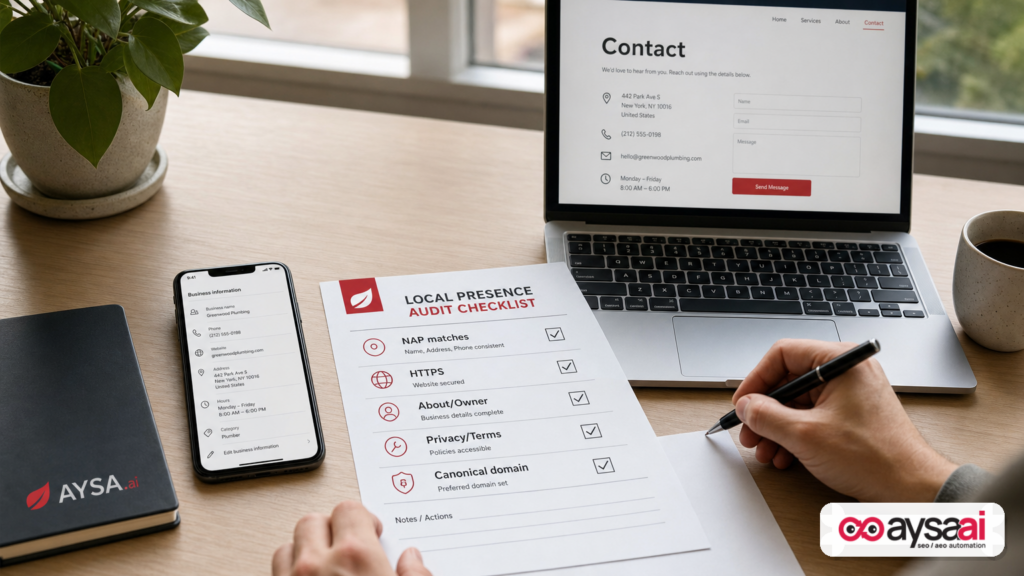
A practical identity-leak audit you can run in under an hour
The Search Engine Land audit emphasized something important: you don’t need a giant tech stack to catch the biggest issues. The most damaging leaks are discoverable with lightweight checks.
Here’s a pragmatic audit workflow for SMBs and lean marketing teams. You can run it across your own site in 30–60 minutes.
Step 1: Confirm your canonical domain and ownership
- What is your “one true” domain?
- Do you control it (registrar access, auto-renew on)?
- Does it redirect correctly from www/non-www and http→https?
Step 2: Direct readability check (no fancy tools)
Open your homepage and key pages (Services, Locations, About, Contact). Ask:
- Is the business name visible as text?
- Is the city/region visible as text?
- Are services described in plain language?
- Is leadership/ownership present as text?
If your content is mostly images, animations, sliders, or script-injected blocks, treat that as a risk. AI can’t extract what it can’t see.
Step 3: NAP consistency check
Check your website Contact page against your most important third-party references (major directories, social profiles, and your Google Business Profile if applicable). Look for:
- different phone numbers
- suite numbers missing in some places
- old business names or abbreviations
- old domains in listings
Step 4: Trust-page presence
From your homepage footer, can a user (and a crawler) find:
- Privacy policy
- Terms (or terms of use)
- Refund/returns (if ecommerce)
- Accessibility statement (if relevant/required in your market)
Step 5: “Who is accountable?” check
AI systems often need a clear answer to: “Who runs this?”
- Is there a named owner/founder/principal?
- If not, is there at least a named leadership role (general manager, director)?
- Is the name on your domain, not only on LinkedIn or a directory?
Step 6: Transaction path check (where money changes hands)
If you take bookings, leads, or orders, review the pages involved:
- Are your policies accessible there?
- Do those pages repeat NAP and brand identity?
- Are resellers outranking you for your own brand + “book” queries?
For deeper work on local entities and how systems interpret them, Search Engine Land also points to related reading on entity gaps and schema (useful background):
- Schema for AI search: How to identify and prioritize entity gaps
- The new SEO rules for bloggers in 2026: Why clarity matters in AI search
Fixes that move the needle fast (without a rebuild)
Most SMBs hear “AI search” and assume they need a total redesign or a large content program. That’s rarely the highest ROI starting point.
Start with the changes that increase verifiability immediately.
Fix 1: Put core identity facts on the homepage—plainly
Your homepage should state, in text:
- Your business name
- What you do
- Where you do it (city/region/service area)
- How to contact you
This isn’t about keyword stuffing. It’s about removing ambiguity.
Fix 2: Add a real About page with a named person (and link it sitewide)
If you’re a solo operator or founder-led business, name the owner. If you’re a larger org, name responsible leadership. Keep it honest and current.
Link the About page in the top navigation or footer, not buried behind a hamburger menu that changes per device.
Fix 3: Build a “Contact / Locations” page designed for machines and humans
Good Contact pages are boring in the best way. Include:
- NAP in plain text
- Hours
- Service area notes
- For multi-location: individual location blocks with consistent formatting
Fix 4: Server-render what matters (or provide static fallback)
If your site is built on a JS framework, that can be fine. The key is ensuring:
- Critical text exists in initial HTML
- Metadata is correct
- Important internal links are crawlable
This is where “technical SEO” becomes “AI readiness.” Not for performance theater—purely for extractability.
Fix 5: Consolidate domains and redirect duplicates
Pick one canonical domain and commit. Redirect everything else. Update directory listings that still point to old variants.
Fix 6: Add and link policy pages
At minimum:
- Privacy policy
- Terms of use / terms of service
If you sell online:
- Returns/refunds
- Shipping
Google has also publicly warned against manipulative review markup (a reminder that “trust signals” can be abused and then discounted). Don’t play games with structured data for reviews. If you use review snippet structured data, keep it honest and compliant. (Background: Search Engine Land coverage.)
Fix 7: Defend your booking / order path from resellers
If a third-party reseller is more verifiable than you are, AI systems may route traffic to them. Your job is to make your direct path:
- clear
- fast to verify
- consistent with your entity signals
Schema and entity data: when structured data helps (and when it doesn’t)
Schema is not a magic switch. But it’s still one of the cleanest ways to give machines unambiguous facts—when those facts are already present and consistent.
If your website is missing basic identity signals, adding schema on top can become “structured confusion.” First fix the fundamentals:
- one domain
- readable HTML content
- consistent NAP
- clear About/Contact/Policies
Then consider structured data to reinforce the entity:
- Organization / LocalBusiness schema
- PostalAddress
- SameAs links to authoritative profiles
- Person schema for leadership (where appropriate)
If you want a deeper framework for identifying “entity gaps” with schema, use this Search Engine Land guide as a research lead: Schema for AI search: How to identify and prioritize entity gaps.
Important: Don’t add structured data for things that aren’t true, aren’t visible on the page, or can’t be supported. Schema should clarify reality, not create it.
Local businesses: NAP, Google Business Profile, and the reseller problem
For local businesses, the identity leak is often a mismatch between:
- your website
- your Google Business Profile
- your directory citations
- your social profiles
AI systems are, in practice, doing a kind of cross-source reconciliation. Consistency isn’t a nice-to-have—it’s the foundation of being “real” to a machine.
NAP consistency isn’t a local SEO cliché anymore
In classic local SEO, NAP consistency helped rankings. In AI search, it helps verification.
Common gotchas:
- Your website has a tracking number, but your listings have your main number.
- Your address includes “Suite 200” in one place and not another.
- Your old name still appears in a high-authority directory page.
- You changed domains, but some listings still point to the old one.
If you sell bookings, directories become competitors
Hotels, tours, golf resorts, and many appointment-based services increasingly compete with resellers and aggregators for the customer relationship. The Search Engine Land audit highlighted this reality in accommodations, where third-party booking sites can show up alongside or above the business’s own pages.
The practical strategy is not “fight the directories” (some are unavoidable). It’s to ensure that your owned properties—especially your booking pages—are verifiable, consistent, and clearly authoritative.
What agencies must rethink: deliverables vs. durability
Agency work often defaults to deliverables that look good on a slide:
- content calendar
- keyword map
- link building campaign
- site redesign
In the AI verification era, the biggest wins can be “unsexy”:
- fixing a split domain problem
- ensuring server-rendered text
- adding named leadership
- building a policy footer
- cleaning citation inconsistencies
The challenge is that these wins are:
- harder to bill as “creative output”
- easy to miss in audits
- easy to undo during redesigns
Agencies that win will productize verification: recurring checks, recurring fixes, and change control.
One relevant mindset shift: stop treating technical SEO as a one-time “audit + backlog.” Treat it as identity operations: continuous, monitored, and governed.
What to monitor monthly so the leak doesn’t return
Identity leaks are often introduced by normal business events:
- new website theme
- domain renewal changes
- new location opening
- phone system change
- rebrand or legal entity update
That’s why one-time fixes are not enough. You need lightweight monitoring.
Monitor 1: Domain health and redirects
- Is the canonical domain live and secure (HTTPS)?
- Do old domains still redirect correctly?
- Any unexpected status codes or DNS changes?
Monitor 2: Homepage extractability
- Did a redesign hide key text in scripts?
- Did someone replace text with images?
- Did navigation change in a way that hides About/Contact?
Monitor 3: NAP drift across major citations
- Did a directory update your hours incorrectly?
- Did an old address reappear in a high-authority listing?
- Do you have duplicates?
Monitor 4: Policy page accessibility
- Are policies still linked in the footer?
- Did a new theme remove them?
- Are they still accurate after product/service changes?
Monitor 5: Transaction path integrity
- Are booking/order pages still accessible and consistent?
- Are resellers outranking you for branded “book” queries?
- Do your direct pages clearly represent your entity?
AYSA’s monitoring capabilities are designed for this kind of “drift detection”—not just rank tracking. Learn more at AYSA Monitoring.
How AYSA helps: monitor, prepare fixes, ask for approval, then execute
Most businesses don’t fail because they don’t know what to do. They fail because execution is fragmented:
- marketing sees the problem
- dev is busy
- the agency is waiting on approvals
- no one owns ongoing maintenance
AI search raises the value of many small, correct changes—and that requires an execution system.
AYSA is built around a governed workflow:
- Monitor identity and visibility signals continuously.
- Prepare specific website and content changes that improve extractability and trust.
- Ask for approval so humans stay in control (no risky auto-publishing).
- Execute accepted changes reliably and document what changed.
This matters because identity-leak fixes often include things you should not “wing”:
- redirect rules
- canonical consolidation
- schema updates
- footer-wide policy links
- contact information changes
If you want to understand how your brand is currently appearing (or not appearing) in AI answers, start here: AI Search Visibility.
If you want a broader set of AI SEO utilities to support audits and ongoing optimization, see: AI SEO Tools.
For teams evaluating whether this is a fit operationally, pricing and packaging are here: AYSA Pricing.
And for ongoing education and playbooks as AI search evolves: AYSA Blog.
What to do next
If you’re a founder, operator, or marketing lead, here’s the action list I’d run this week.
1) Decide your canonical identity
- Pick one canonical domain.
- Pick one official business name format.
- Pick one primary phone number.
2) Make your website a machine-readable source of truth
- Put core facts (who/what/where/how) on the homepage in text.
- Create or update an About page with named accountability.
- Create a clean Contact/Locations page with consistent NAP.
3) Fix the “boring trust layer”
- Add privacy and terms pages.
- Ensure they are linked sitewide (footer).
- If ecommerce, add returns/shipping.
4) Confirm your site isn’t invisible to retrieval systems
- Check that key content is not trapped behind JS-only rendering.
- Ensure important text isn’t embedded only in images.
5) Set up ongoing monitoring and an execution loop
- Monitor for domain lapses, redirect breaks, NAP drift, and missing pages.
- Implement an approval-based workflow for changes.
If you want AYSA to help operationalize this (monitor → propose → approve → execute), start with monitoring: AYSA Monitoring.
Sources and further reading
- Search Engine Land — AI search can’t verify your business — here’s how to fix it
- Search Engine Land — Schema for AI search: How to identify and prioritize entity gaps
- Search Engine Land — The new SEO rules for bloggers in 2026: Why clarity matters in AI search
- Search Engine Land — Google says don’t include fake or undisclosed incentivized reviews in review snippet structured data
- Search Engine Land — How category framing changes which brands AI recommends
Note: The Search Engine Land source references primary datasets and industry sources as part of the underlying audit methodology. Those primary citations were not included in the provided extract, so I’m not restating them here. Where you need industry-specific compliance guidance (healthcare, finance, regulated services), consult qualified counsel and relevant regulators in your jurisdiction before publishing policy language.
Continue the AI search topic inside AYSA.
Use these pages to connect the article with AI SEO tools, AI visibility monitoring, AI Overviews and approved website execution.
Turn this topic into a website action plan.
Use these AYSA hubs to move from reading to technical fixes, AI visibility monitoring, research, glossary context and approval-first SEO execution.