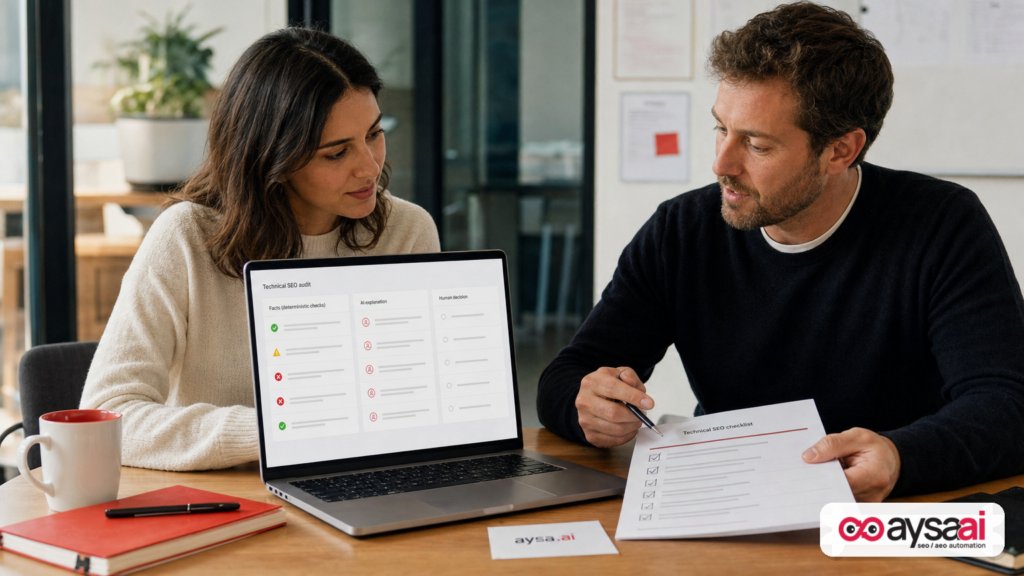
SEO-DAY Cologne 2026 and Germany’s AI SEO Market
AYSA.ai looks at SEO-DAY Cologne 2026, Germany’s SEO and GEO market, AI search, Mittelstand opportunities and why approved SEO execution matters now.

Executive summary: SEO-DAY Cologne 2026 is not interesting only because AYSA.ai is now listed as a partner. It is interesting because the event reflects a larger change in the search industry: classic Search Engine Optimization (SEO), Generative Engine Optimization (GEO), AI Search visibility and execution workflows are becoming one operational discipline.
Germany is a serious market for this transition. It has a large ecommerce base, a strong agency ecosystem, sophisticated SMEs, high expectations around quality and compliance, and a growing but still uneven adoption of AI. That combination makes Germany one of the most useful markets for understanding what practical AI SEO execution has to become: not more dashboards, not more generic AI content, but controlled, approved work that improves real websites.

Why SEO-DAY Cologne 2026 matters now
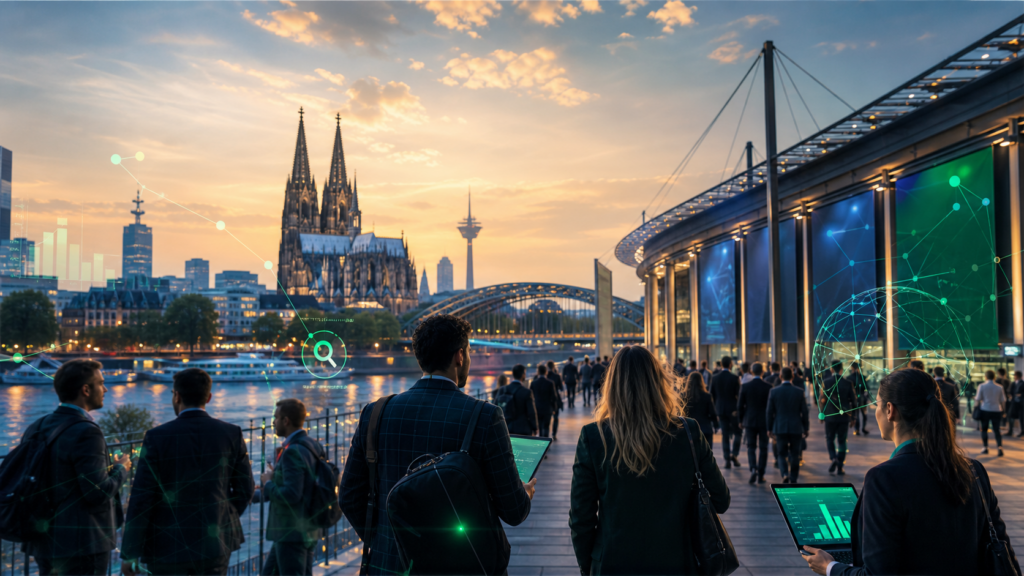
Every search conference has a public theme, but the useful signal is usually deeper than the tagline. SEO-DAY Cologne 2026 matters because it places classic SEO, GEO and AI in the same frame. That is exactly where the industry is moving. The work is no longer only about ranking pages in Google. It is about making a business understandable across search engines, AI answers, comparison journeys, local discovery, ecommerce surfaces and generative systems that summarize the web.
For AYSA.ai, this is not an abstract trend. It is the product problem we have been working on: SEO recommendations are easy to produce; execution is hard. Most businesses already have too many audits, dashboards, Keyword lists and content ideas. What they lack is a reliable operating layer that can understand the website, prepare practical SEO work, ask for approval and apply accepted changes without turning every improvement into a manual project.
That is why our partnership with SEO-DAY is more than a badge. It gives us a reason to join a serious European conversation about what happens after the industry agrees that AI search is changing the rules. The next question is not “should we talk about AI?” Everyone is already talking about AI. The useful question is: how do teams turn AI, SEO and GEO into repeatable website work that is trusted, reviewable and measurable?
My opinion is simple: Germany is one of the best places to test that question. The market is demanding. Buyers are careful. Agencies are mature. Ecommerce is competitive. SMEs have real operational constraints. Compliance and quality expectations are higher than in many markets. If AI SEO execution can become useful in Germany, it can become useful almost anywhere.
What SEO-DAY is really signaling
SEO-DAY takes place on 19 November 2026 at RheinEnergieSTADION in Cologne (Köln). The official positioning is clear: the event focuses on classic Search Engine Optimization, Generative Engine Optimization and AI. It is not presented as a generic marketing conference. It is a specialist conference for people who care about visibility in Google, Generative search systems and AI-powered marketing.
The organizers describe the event as one of the leading SEO conferences in the German-speaking region, with more than 30 speakers, more than 520 attendees and a history of more than 15 years. Those numbers matter less than the direction of the agenda. The fact that GEO and AI sit next to SEO on the event’s main positioning tells us something: the DACH search community is no longer treating Generative discovery as a side topic.
The ExpertDAY on 18 November 2026 is also important. It is positioned as an exclusive pre-event with an AI-coding focus, limited access and a confidential format. Whether someone attends that specific format or not, its existence says something about the state of online marketing. The gap between marketing and software is shrinking. Search professionals cannot remain only writers, auditors or reporting specialists. Increasingly, they need to understand how AI-assisted workflows, code, CMS operations, Structured data and automation affect outcomes.
That is the broader shift I see: the search industry is moving from advice to systems. Advice still matters. Expertise still matters. But the organizations that win will be the ones that can turn expertise into shipped improvements.
Old conference question
Which tactics improve rankings in Google?
New conference question
Germany as a serious SEO and AI search market

Germany is not a small test market. It is one of Europe’s most important digital economies, with strong ecommerce, advanced B2B sectors, a deep agency market, sophisticated publishers and a large base of small and medium-sized enterprises. It is also a market where trust, accuracy, legal clarity and operational quality carry real weight.
That matters for SEO because the next phase of search is not only about content production. It is about credibility. Generative search systems need reliable source material. Users need clear answers. Businesses need to avoid publishing weak, risky or inaccurate AI-generated content. German companies, especially in B2B, healthcare, finance, manufacturing, ecommerce and professional services, cannot simply flood the web with low-control AI pages and hope for the best.
The digital advertising market in Germany is still growing despite economic uncertainty. OVK/BVDW expects the German online display and video advertising market to grow from more than 7.5 billion euros in 2025 to 8.2 billion euros in 2026. That does not measure SEO directly, but it shows the structural strength of digital demand. When paid media grows, competition for efficient acquisition also grows. Organic visibility becomes more valuable because it compounds over time and reduces overdependence on paid channels.
At the same time, search is becoming more complex. Search ads, marketplaces, social search, AI Overviews, AI Mode, ChatGPT, Perplexity, Gemini and vertical discovery all compete for user attention. For German businesses, SEO can no longer mean “write a blog post and check rankings.” SEO has to become a visibility system: technical foundations, useful content, entity clarity, structured information, authority, monitoring and execution.
This is why I think the German market is particularly interesting for AYSA.ai. The buyer is not looking for magic. The buyer is looking for a controlled way to improve visibility without adding chaos. That is exactly where approval-first automation has a place.
The Mittelstand opportunity: high intent, limited execution capacity
The German Mittelstand is often discussed as the backbone of the economy, but from a search perspective it is also a very specific operational environment. Many SMEs know that digital visibility matters. Many have websites, local profiles, ecommerce channels, ERP systems, sales teams and industry expertise. But they do not always have a dedicated SEO team, a technical content process or fast implementation capacity.
Research from IfM Bonn shows that AI adoption among German SMEs has increased significantly. In 2025, around one in four German SMEs used AI applications, above the EU average. But large enterprises remain far ahead, with AI usage at 57 percent. That gap is important. It suggests that German SMEs are interested in AI, but many still lack the process, people and integration required to turn AI into measurable business value.
For SEO, that gap is visible every day. An SME may need title tag improvements, better service pages, internal links, updated schema, rewritten product categories, FAQ sections, local landing pages, image alt text, broken link fixes, redirects, canonical cleanup, Search Console interpretation and content refreshes. None of those tasks is impossible. The problem is coordination. Who finds the issue? Who decides whether it matters? Who writes the change? Who approves it? Who publishes it? Who checks the result?
This is where AI SEO execution becomes practical. The value is not in generating 100 generic articles. The value is in helping a real business move from search data to approved website changes. A German SME does not need an AI that acts irresponsibly on its website. It needs an AI system that respects control, explains the work, keeps a record and asks before making meaningful changes.
That is why I believe Germany will be a strong market for AI SEO products that are sober, controlled and execution-oriented. The winning message will not be “replace your marketer.” It will be “give your team the capacity to do the SEO work they already know they should be doing.”
Ecommerce pressure makes organic execution more valuable
Germany’s ecommerce market is recovering and transforming at the same time. The German ecommerce association bevh reported that online retail turnover rose 4.3 percent in the first half of 2026, with marketplaces growing 6.4 percent and direct-to-consumer manufacturers growing 6.3 percent. The same report notes that large Asian platforms continue to gain share, especially in fashion.
That creates a clear SEO problem for independent retailers. Marketplaces are strong. Paid acquisition is expensive. International platforms move quickly. Product margins are under pressure. A retailer that depends only on paid campaigns or marketplace visibility gives up too much control. Organic search, category quality, product content, internal linking, local visibility, brand demand and AI search readiness become defensive assets.
But ecommerce SEO is operationally heavy. Category pages go stale. Product pages are thin. Filters create crawl traps. Out-of-stock products create broken journeys. Internal links are weak. Images are not optimized. Structured data is incomplete. Search Console surfaces thousands of queries, but nobody has time to turn them into actions. This is exactly where execution systems are needed.
In classic agency workflows, the answer was often a long audit and a roadmap. That can still be useful, but ecommerce teams need continuous action. If a category page has impressions but poor CTR, update the title and description. If a product cluster lacks comparison content, create it. If internal links are missing from relevant editorial pages, add them. If schema is broken, fix it. If a page is important but orphaned, connect it. If AI search systems need clearer product context, improve the page structure.
AI can help with this, but only if it is connected to approval and execution. Otherwise it becomes another layer of suggestions. German ecommerce teams do not need more suggestions floating in spreadsheets. They need accepted changes shipped into the site.
GEO and AI search: useful label or new hype?
Generative Engine Optimization is a useful term when it helps teams think beyond blue links. It is not useful when it becomes a magic replacement for SEO. The websites that perform in generative discovery still need the fundamentals: crawlability, useful content, clear entities, authority, structured information and fresh, specific pages. GEO is not a shortcut around quality. It is a way to describe how content becomes retrievable and usable in AI-generated answers.
SEO-DAY’s decision to place GEO and AI at the center of the event is therefore important, but it should be interpreted carefully. The opportunity is not to invent a new checklist that promises citations in ChatGPT or Google AI Mode. The opportunity is to improve how websites communicate meaning.
A strong GEO-ready page usually does several things well. It defines the topic clearly. It explains the practical context. It uses descriptive headings. It answers related questions. It includes examples and trade-offs. It names products, services, locations and use cases accurately. It links to supporting pages. It avoids vague claims. It is technically accessible. It is part of a coherent website, not a lonely page.
This is close to good SEO, but the emphasis changes. Classic SEO often optimized for the keyword and the click. GEO and AI search force us to optimize for retrieval, synthesis and trust. The page has to help a machine understand the answer and help a human trust it.
For German companies, this can be an advantage. The market already values specificity and expertise. If businesses document their processes, products, locations, use cases and proof clearly, they have a better chance of becoming useful sources in AI-assisted discovery.
The real gap: execution, not knowledge
The SEO industry does not lack knowledge. It lacks implementation. That has been true for years, and AI makes it more visible. A website can have the best audit in the world and still lose if the recommendations sit untouched for six months.
The execution gap appears in many forms. Developers are busy. Content teams are overloaded. Founders do not know which tasks matter. Agencies prepare documents that clients do not implement. SEO tools show problems without prioritizing business impact. AI tools generate text without understanding the website. Everyone sees the issue; nobody owns the shipping process.
This is the problem AYSA.ai is designed to solve. The premise is not that human SEO expertise disappears. The premise is that expertise needs an execution layer. The system should understand the business, inspect the site, prepare concrete actions, explain the reason, ask for approval and execute accepted changes. That is different from an AI writer, a crawler, a rank tracker or a dashboard.
In a market like Germany, this distinction matters. Businesses want efficiency, but they also want control. They want automation, but they do not want chaos. They want AI, but they need accountability. The phrase “approved execution” is not just a product feature; it is a trust model.
AYSA.ai’s point of view for SEO-DAY Cologne

Our view going into SEO-DAY Cologne 2026 is that the next phase of SEO will be operational. The winners will not be the brands that publish the most generic AI content. They will be the brands that connect research, technical SEO, content, internal linking, authority, monitoring and approval into one repeatable system.
That means fewer isolated tools and more workflows. It means fewer disconnected recommendations and more approved actions. It means treating Search Engine Optimization (SEO), Answer Engine Optimization (AEO), Generative Engine Optimization (GEO) and AI visibility as connected parts of the same growth system.
For agencies, this creates both pressure and opportunity. The pressure is obvious: AI can produce audits, briefs, drafts and recommendations faster than before. The opportunity is more interesting: agencies can become better operators if they use AI to prepare work, enforce quality, keep approval trails and ship more client-approved improvements. The agency that only sells advice may struggle. The agency that combines expertise with execution capacity can become more valuable.
For SMEs, the opportunity is even clearer. A small business does not need to become an SEO expert. It needs to keep improving its website in ways that search engines, AI systems and customers can understand. If a tool can make that work safe, explainable and repeatable, SEO becomes less intimidating.
That is the conversation we want to have in Cologne (Köln). Not “AI will replace SEO.” That is a tired debate. The better conversation is: what should SEO execution look like when AI is finally capable enough to help, but trust, approval and business context still matter?
What we want to learn at SEO-DAY
As a partner of SEO-DAY, we are interested in more than visibility. We want to understand how German search professionals think about AI adoption, GEO, agency workflows, CMS execution, client approval and the practical constraints of the Mittelstand.
There are several questions I would like to explore with founders, agencies, ecommerce operators and SEO teams:
Where is AI already useful in SEO operations? Not in demos, but in real workflows.
Where do teams still refuse automation? This tells us where trust, risk or quality control needs to improve.
How do German companies evaluate AI-generated content? Is the concern quality, legal risk, brand voice, accuracy, or something else?
How do agencies want to use AI without weakening their expertise? The right system should increase expert leverage, not flatten expert judgment.
What does GEO mean in practice for German businesses? Is it a new service line, a layer on top of SEO, or simply a better vocabulary for search visibility beyond classic SERPs?
What do SMEs need most? Better recommendations, better education, easier implementation, lower cost, or stronger confidence that changes are safe?
These questions matter because product strategy should not be built only from hype. It should be built from market reality. SEO-DAY gives us a useful place to listen.
Why this is a good moment for European AI SEO
Europe has a chance to shape AI SEO differently from the loudest parts of the market. Instead of chasing volume, European businesses can build systems around quality, accountability, privacy, structured knowledge and controlled execution. That is not a weakness. It may become an advantage.
Search is fragmenting, but the core business need is stable: companies need to be found, understood and trusted. AI changes the interface, not the need. If anything, it raises the standard. A weak website with unclear information becomes easier to ignore. A strong website with useful, structured, specific content becomes more valuable.
SEO-DAY Cologne 2026 is therefore a good marker. It shows that the German-speaking search community is taking SEO, GEO and AI seriously as one conversation. AYSA.ai is happy to support that conversation, and we are especially interested in the practical side: how teams turn insight into approved execution.
My bet is that the next generation of SEO tools will not be judged only by the reports they produce. They will be judged by the quality of the work they help businesses ship. In that world, the useful AI SEO platform is not the one that talks the most. It is the one that helps the right changes happen.
AYSA.ai at SEO-DAY Cologne 2026
Let’s talk about approved AI SEO execution.
AYSA.ai helps teams move from SEO research to approved website changes: technical SEO, content, internal links, AI visibility and execution workflows for WordPress-first businesses and agencies.
Sources and further reading
- SEO-DAY official page: event date, Cologne location, SEO/GEO/AI positioning, speakers and attendee numbers.
- SEO-DAY sponsors and partners: AYSA.ai partner listing and description.
- ExpertDAY 2026: pre-event format, AI-coding focus, date and access model.
- bevh ecommerce update, H1 2026: German online retail growth, marketplace growth and category signals.
- IfM Bonn SME digitalization data: AI and cloud adoption among German SMEs and large enterprises.
- BVDW/OVK digital advertising forecast 2026: German online display and video advertising market growth.
Disclosure: AYSA.ai is listed as a SEO-DAY 2026 partner. This article is our independent market analysis and product point of view, written to explain why the event and the German market are strategically relevant for AI SEO execution.
Continue the AI search topic inside AYSA.
Use these pages to connect the article with AI SEO tools, AI visibility monitoring, AI Overviews and approved website execution.
Turn this topic into a website action plan.
Use these AYSA hubs to move from reading to technical fixes, AI visibility monitoring, research, glossary context and approval-first SEO execution.