AI Cuts Aren’t Coming “Someday”: The 2026 Marketing Survival Plan For Teams Who Want Bigger Budgets, Not Smaller Headcount
AI is exposing which marketing teams can prove growth—and which ones only prove efficiency. Here’s how to spot the signals of AI-driven contraction, rebuild your ROI story around outcomes, and use approved execution (not busywork) to protect budget before Q4 planning locks in.

AI isn’t just changing how marketing work gets done. In 2026, it’s changing how marketing work gets funded—and that’s the part too many teams are missing.
When a CFO hears “AI saved us 1,200 hours,” the next sentence is often unspoken but obvious: “So why do we need the same headcount?” That’s not a cynical take. It’s how finance is supposed to think.
A recent analysis in Search Engine Journal highlighted four leading signals that can show up 12–18 months before an AI-driven restructuring becomes public: complex tech stacks, flat/shrinking headcount, forecasted headcount declines, and senior departures. Whether you buy the exact predictive model or not, the operational lesson is real: if leadership believes AI is making routine work cheaper, marketing becomes a line item to compress unless you can prove expansion—growth, resilience, and competitive advantage.
This editorial is my playbook for doing exactly that, written for founders, marketers, and agency leads who need to walk into Q4 planning with a story that protects budget and protects momentum. Not with hype. With outcomes.
Concise summary

- The risk is not “AI replaces marketers.” The risk is your team proves only efficiency (time saved), which becomes an argument for headcount cuts.
- Early warning signals matter. Flat headcount + rising AI adoption + leadership churn is a budget danger zone—even before layoffs hit the news.
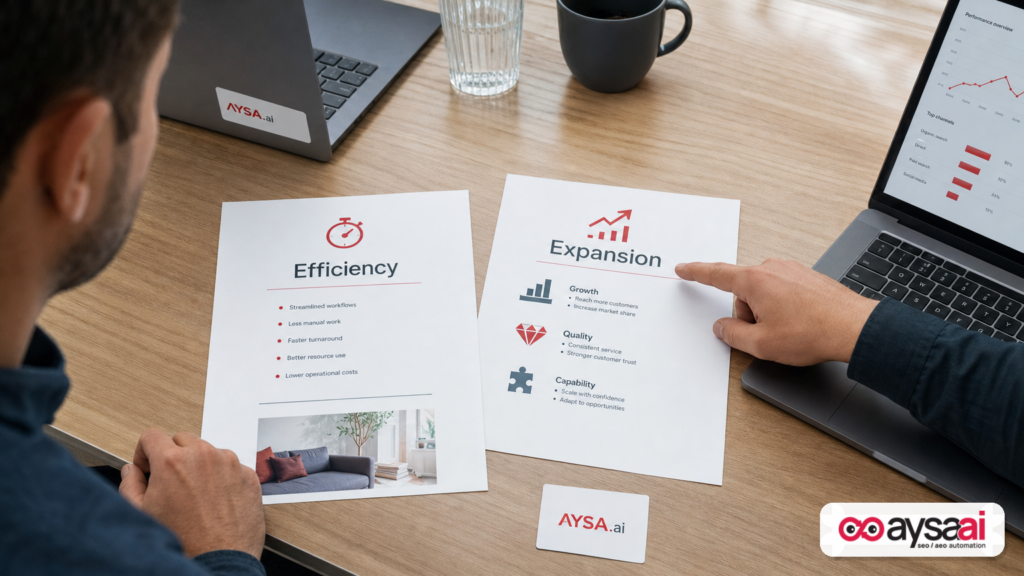
- Switch from efficiency metrics to expansion metrics. Measure quality lift, scope growth, and capability unlock (not prompts, tokens, or hours saved).
- AI Search is changing visibility rules. Being “ranked” is no longer the whole game; you need citations, mentions, and brand trust across AI answers (AEO/GEO).
- Execution is the moat. Teams that can safely ship changes—fast, with approvals—will outperform teams stuck in slide decks.
Key takeaways (bookmark this)

- Stop leading with productivity. Use productivity internally, but report outcomes externally.
- Assume budget scrutiny will intensify. Plan your “proof narrative” now—before Q4 plans are locked.
- Build an AI Search visibility baseline. Track where you show up in AI answers and how often you’re cited.
- Pick one workflow and run a 30-day expansion experiment. Document before/after with business metrics.
- Automate Monitoring and execution, not judgment. Use systems that propose changes and require approval before shipping.
Table of contents
- The new risk: “efficiency proof” becomes a headcount argument
- What changed in 2026: AI is now a restructuring tool, not just a productivity tool
- The four warning signals—how to interpret them without panic
- Which marketing work is most exposed (and what’s actually safe)
- The metrics shift that protects budget: expansion beats efficiency
- AI Search changed the rules: ranking is not the whole outcome anymore
- A concrete SME scenario: ecommerce brand under Q4 pressure
- What agencies must rethink: packaging, pricing, and proof
- The execution gap: strategy is cheap; approved change is rare
- The 45-day plan before Q4 planning ends
- Where AYSA fits: monitor, propose, approve, execute
- What to do next
- Sources and further reading
The new risk: “efficiency proof” becomes a headcount argument
Most marketing teams are telling an AI story like this:
- We generated more content in less time.
- We reduced reporting hours.
- We streamlined campaign setup.
- We shipped faster.
All of that can be true. But if you stop there, you’ve just created a perfect reduction thesis for finance: the same output with fewer people. That’s why “time saved” is a dangerous headline metric—even if it’s useful operationally.
What leadership funds is not effort. It’s outcomes: revenue, pipeline, retention, resilience, and competitive advantage. If AI makes the work cheaper, leadership expects either:
- the same budget with more growth, or
- a lower budget with the same results.
If your reporting can’t prove the first, you’re volunteering for the second.
And that’s why the most important shift in marketing in 2026 isn’t “use AI.” It’s: use AI to expand what the business can achieve, and prove it in business language.
What changed in 2026: AI is now a restructuring tool, not just a productivity tool
The Search Engine Journal piece references a predictive intelligence report describing “quiet restructuring”—AI-driven contraction that may not show up in obvious public signals until it’s already underway. Read the original article here: Search Engine Journal: 4 Warning Signs Your Marketing Team Is Next For AI Cuts.
I’m not going to restate or copy that analysis. Instead, I’m going to translate the implication for marketing leaders and SMEs:
- AI adoption is being interpreted as a structural cost lever. Not “nice-to-have software.”
- Headcount decisions are being made earlier than public announcements. If your budget is being shaped now, “we’ll fix reporting later” is not a safe plan.
- Marketing is vulnerable because it contains routine, scalable tasks. Reporting, trafficking, templated content, basic analysis—these are prime targets for automation.
So what changed? The evaluation framework. In prior years, adopting new marketing software was often a bet on efficiency. In 2026, adopting AI is increasingly seen as a bet on replacing or compressing labor unless the team proves expansion.
The four warning signals—how to interpret them without panic
The SEJ article highlights four signals that may appear well before AI-related workforce contraction becomes visible. You can’t always see all of these from inside marketing, but you can still use them as a risk lens for planning.
Signal 1: A complex tech stack (automation-ready environment)
When organizations use lots of technologies, they’re often capable of deploying automation at scale. This matters because:
- More tooling typically means more integration potential.
- More integration means fewer manual steps.
- Fewer manual steps means fewer “coordination roles” survive.
What you can do in marketing: map your workflows and find where humans are only acting as middleware between tools. Those roles need to be repositioned toward strategy, creative differentiation, customer insight, or partner growth—work that isn’t just moving data from A to B.
Signal 2: Flat or shrinking headcount (quiet freeze)
Flat headcount alone doesn’t mean layoffs. But flat headcount plus rising AI adoption is the danger pattern: leadership may already be “collecting the efficiency dividend.”
What you can do in marketing: build a simple internal chart:
- Headcount trend (12–18 months)
- AI/tooling adoption trend (12–18 months)
- Output trend (campaigns, pages, creative)
- Outcome trend (pipeline, leads, revenue influence)
If output rises but outcomes don’t, you’re scaling activity, not impact. That’s when budget gets cut.
Signal 3: Forecasted decline (finance expects compression)
Even without layoffs, forecasts can drive behavior: tighter approvals, slower hiring, reduced agency spend, “prove it” requirements. The practical effect for marketing is a shift from “build” to “justify.”
What you can do in marketing: treat measurement as a product. If you can’t defend performance with clean, understandable metrics, someone else will define your performance for you.
Signal 4: Senior departures (the reorg clock)
Leadership departures often precede budget reshuffles. If your CMO, VP Marketing, VP Growth, or even a VP Product Marketing exits, your next budget cycle might be evaluated by someone with different assumptions—or less patience for long payback periods like SEO.
What you can do in marketing: prepare a “continuity brief” that makes your program durable even if leadership changes:
- What you’re doing
- Why it matters now
- What metrics prove it
- What risks exist
- What happens if the budget is cut
Bonus signal: the “transformation hire”
The SEJ piece also references a pattern where companies hire AI transformation leadership ahead of workforce changes. If your company is adding AI transformation roles, expect:
- new reporting standards,
- new demands for automation, and
- less tolerance for “we think this helps the brand.”
That’s not bad. It’s just a new game.
Which marketing work is most exposed (and what’s actually safe)
Let’s be precise: AI doesn’t “replace marketing.” It replaces parts of marketing—especially the parts that are repetitive, template-driven, and easy to QA at scale.
Based on what we see across SEO and content operations, the most exposed buckets tend to be:
- Routine content production: templated landing pages, repetitive product copy, basic blog drafts.
- Reporting and dashboard wrangling: compiling weekly numbers, screenshots, manual exports.
- Campaign trafficking: moving creative into platforms, setting up basic structures, repetitive tagging.
- Surface-level analysis: “what happened” without “why it happened” or “what to do next.”
What’s safer—because it’s harder to commoditize and requires organizational context:
- Strategy tied to business constraints: pricing, margins, inventory, seasonality, sales cycles.
- Creative differentiation: distinctive brand voice, unique angles, category design, story.
- Customer research and insight: synthesizing qualitative feedback into positioning and content.
- Technical execution with accountability: shipping site improvements safely and consistently.
- Authority Building: earning real mentions, partnerships, and trust signals that AI systems rely on.
The goal isn’t to “prove humans matter.” The goal is to move humans into the work where they create defensible advantage.
The metrics shift that protects budget: expansion beats efficiency
The SEJ article references the idea that “time saved is a vanity metric” in the context of AI ROI. That phrase lands because it’s true in budget conversations: productivity metrics describe capacity, not impact.
Here’s the practical framework I recommend marketing leaders adopt immediately:
Efficiency metrics (use internally, don’t lead with them)
- Hours saved
- Assets produced per week
- Cost per asset
- Cycle time reduced
- Number of prompts / outputs
These metrics help you manage operations. They do not protect budget on their own.
Expansion metrics (lead with these)
Expansion metrics answer the CFO question: “Did this change a business outcome?”
- Quality lift: higher Conversion rate, improved engagement, fewer support tickets, better qualified leads.
- Scope growth: new markets, new product lines, new content clusters, new partner channels—things you couldn’t ship before.
- Capability unlock: durable new operating capability (e.g., your team can now monitor AI Search visibility weekly and ship fixes safely).
How to report AI ROI without inviting cuts
Instead of: “We saved 200 hours.”
Try: “We redirected 200 hours into a new program that produced 30% more qualified demos from Organic traffic.”
Instead of: “We created 100 more pages.”
Try: “We expanded coverage across our top 20 revenue categories and increased non-brand organic revenue contribution.”
Instead of: “We automated reporting.”
Try: “We moved from monthly lagging reports to weekly decision cycles, reducing time-to-fix for visibility losses.”
AI Search changed the rules: ranking is not the whole outcome anymore
Even if you ignore layoffs and budget pressures, search itself is changing. AI answer experiences (AEO/GEO) mean users increasingly get synthesized answers instead of ten blue links. That shifts what “SEO success” looks like:
- Visibility becomes: “Are we cited or mentioned in AI answers?”
- Authority becomes: “Is our brand a trusted source across the web?”
- Content strategy becomes: “Are we producing information that models can confidently reference?”
For many businesses, the new threat isn’t ranking #3 instead of #1. It’s being excluded from the answer entirely.
That’s why we talk about:
- AEO (Answer Engine Optimization): making your content easy to cite and hard to ignore in AI answers.
- GEO (Generative Engine Optimization): building the brand/entity footprint and authority signals that generative systems rely on.
If you want the modern framing, AYSA maintains a practical guide to AI-era visibility here: AI Search Visibility.
Why this matters to budget conversations
AI Search turns SEO from “traffic acquisition” into a broader competitive asset: brand presence inside answers. That’s an expansion story—if you measure it correctly.
But it can also become a budget vulnerability if you keep reporting only on page output and rankings while leadership is asking, “Are customers seeing us in AI answers?”
A concrete SME scenario: ecommerce brand under Q4 pressure
Let’s make this real with a scenario you can picture.
Business: a mid-sized ecommerce brand selling specialty home fitness equipment.
Team: 1 marketing manager, 1 content person, 1 part-time agency for SEO, plus a developer who is shared across the company.
Q4 problem: paid CAC is up, margins are tight, leadership wants organic to carry more weight. Meanwhile, the CEO is excited about AI and asks: “Can’t we just use AI to write all the content and cut agency spend?”
The wrong approach (how budgets die)
- Team reports: “We published 80 AI-assisted product guides.”
- Team reports: “We cut content costs by 40%.”
- Team cannot show: conversion impact, incremental organic revenue, or AI Search visibility improvements.
Result: leadership concludes content is commoditized. Budget gets cut.
The right approach (how budgets survive)
Same AI tools. Different plan.
- Baseline: measure current organic contribution to revenue and top landing pages driving sales (even if attribution is imperfect).
- Pick one workflow: “Category page + buyer’s guide + FAQ cluster” for the top margin product line.
- Ship improvements: refresh the category page, add structured FAQs, consolidate thin content, improve internal linking, and tighten E-E-A-T signals (about pages, author expertise, policies).
- Measure expansion: conversion rate on organic sessions, assisted revenue, reduction in support questions, and presence in AI answers where customers ask “best X for Y.”
- Report as outcomes: “Organic revenue contribution increased,” “support tickets decreased,” “AI answer citations improved,” “we expanded coverage of high-intent queries.”
Result: AI becomes a force multiplier for growth, not a justification for cuts.
What agencies must rethink: packaging, pricing, and proof
If you run an agency, the AI contraction conversation is not theoretical. Clients will ask why they’re paying for things they think AI can do.
The agencies that survive won’t be the ones with the best prompts. They’ll be the ones with the best execution and proof system.
What to productize in 2026
- AI Search visibility audits (AEO/GEO readiness): where clients show up, where they don’t, and why.
- Entity/authority building programs: consistent, credible mentions and citations, not spammy link schemes.
- Technical SEO that ships: site speed, indexation, canonicalization, schema, internal linking—delivered via approved execution.
- Content systems: refresh, consolidation, and quality improvement—not raw volume.
How pricing changes
Hourly pricing collapses when the client believes AI does the work faster. The better model is:
- retainers tied to outcomes and shipping cadence,
- clear deliverables that map to business impact,
- and a monitoring layer that proves progress.
If you want a practical example of building an AI-era SEO toolkit into service delivery, start here: AI SEO Tools.
The execution gap: strategy is cheap; approved change is rare
There’s a hard truth in modern SEO and AI Search visibility work:
Ideas are abundant. Execution is scarce.
Most businesses don’t lose because they didn’t know what to do. They lose because they couldn’t get the changes shipped:
- Developer bandwidth is limited.
- Approvals are slow.
- Risk tolerance is low (nobody wants to break the site).
- Teams ship half-fixes that don’t compound.
In an AI contraction environment, this becomes existential. If your team’s output is “recommendations,” you are easy to cut. If your team ships measurable improvements, you’re harder to replace.
Why approved execution matters
At AYSA, we’re opinionated about this: automation should accelerate change without removing accountability. That’s why an approved execution model matters:
- Monitor: detect visibility changes, technical issues, and content gaps early.
- Prepare: generate proposed fixes and improvements aligned to goals.
- Ask for approval: humans stay in control of what ships.
- Execute: implement accepted changes consistently and safely.
You can explore monitoring here: AYSA Monitoring. This is the layer that turns “we should” into “we did,” and it’s the difference between a team that reports and a team that performs.
The 45-day plan before Q4 planning ends
If you’re reading this while budgets are being drafted, you still have time. But you need a plan that produces proof quickly.
Days 1–7: Run a risk check and set baselines
- Headcount reality: has your team been flat/shrinking while AI tooling increases?
- Visibility baseline: where do you appear today in search and in AI answer experiences (at least qualitatively if you don’t have tooling)?
- Revenue baseline: what portion of pipeline/revenue is influenced by organic today (use best-available data; do not wait for perfect attribution)?
- Operational baseline: how long does it take to ship a website change?
Days 8–21: Pick one high-value workflow and redesign it for expansion
Choose a workflow that is both meaningful and shippable within your constraints:
- Top category page refresh + internal linking improvements
- Local service landing page upgrade + FAQs + schema
- Content consolidation (merge thin pages into one authoritative resource)
- Pricing/feature page improvements for SaaS
The key is to include execution, not just ideation.
Days 22–45: Ship, measure, and tell the story in leadership language
- Ship the changes (approved and documented).
- Measure impact weekly: conversion, qualified leads, assisted revenue, engagement, rank stability, crawl/indexation improvements, and early AI visibility signals.
- Write the narrative: “AI enabled X capability; we used it to achieve Y business outcome; next quarter we expand to Z.”
The one slide your budget deck must include
If you present only activity metrics, you lose. Include one slide with:
- Outcome achieved (expansion metric)
- Workflow improved
- What changed on the site / in ops
- Why it compounds
- What you will expand next
Where AYSA fits: monitor, propose, approve, execute
AYSA exists for the part most teams struggle with: consistent execution under real-world constraints. Not “more ideas.” More shipped improvements.
Here’s how we think about the fit in an AI contraction environment:
1) Monitoring that supports decision cycles
When budgets tighten, the teams that catch issues early and fix them quickly keep their performance stable. That stability is a budget defense. Start here: AYSA Monitoring.
2) AI Search visibility as a first-class KPI set
As AI answers become a primary interface, marketing needs to know: are we present, cited, and trusted? Learn the framework: AI Search Visibility.
3) AI SEO tools that are built for outcomes, not output volume
Tooling should drive better decisions and safer execution. Explore the toolset: AI SEO Tools.
4) Budget clarity when leadership asks “what are we paying for?”
In 2026, ambiguity gets cut. If you’re evaluating what it costs to run a monitoring + execution system, see: AYSA Pricing.
5) Ongoing strategy and implementation guidance
For more operational guidance, see the AYSA blog: AYSA Blog.
What to do next
- Rewrite your AI ROI report: move “time saved” to the appendix; lead with expansion outcomes.
- Pick one 30-day workflow experiment: something you can ship, measure, and defend in business language.
- Set an AI Search visibility baseline: define what “presence in answers” means for your category.
- Reduce the execution bottleneck: shorten approval cycles and standardize how website changes are proposed and shipped.
- Prepare a continuity brief: assume leadership changes and make your program durable.
Sources and further reading
- Search Engine Journal: 4 Warning Signs Your Marketing Team Is Next For AI Cuts (primary research input)
- Search Engine Journal: SEO section
- Search Engine Journal: SEO News
- Search Engine Journal: Webinars
- Search Engine Journal: Google Algorithm Updates history
Note: The SEJ source references external analyses and a predictive intelligence report, but those primary documents aren’t included in the provided research context. Where claims depend on those documents, I’ve treated them as directional context rather than verified fact.
Continue the AI search topic inside AYSA.
Use these pages to connect the article with AI SEO tools, AI visibility monitoring, AI Overviews and approved website execution.
Turn this topic into a website action plan.
Use these AYSA hubs to move from reading to technical fixes, AI visibility monitoring, research, glossary context and approval-first SEO execution.